
Scores
What Is a Good LSAT Score?
A good LSAT score is the one that clears your target schools' medians. Here is how the 120 to 180 scale maps to percentiles, what counts as a strong score, and how to set a realistic target.
“What is a good LSAT score” is the wrong question with the right instinct behind it. There is no universal cutoff that turns an application from weak to strong. A 162 can be excellent for one applicant and a reason to retake for another. The number that matters is not an abstract benchmark. It is the median of the schools you actually want to attend.
That said, you still need a frame of reference to set a target. So let’s start with how the scale works, then turn it into a number you can aim for.
How the LSAT scale works
The LSAT is scored on a scale from 120 to 180. You answer roughly 75 to 77 scored questions across the test, and your raw count of correct answers converts to that scaled score. There is no penalty for wrong answers, so you should never leave a question blank.
The scale is fixed, but what each score means is best understood through percentiles, which tell you how you did relative to everyone else who took the test.
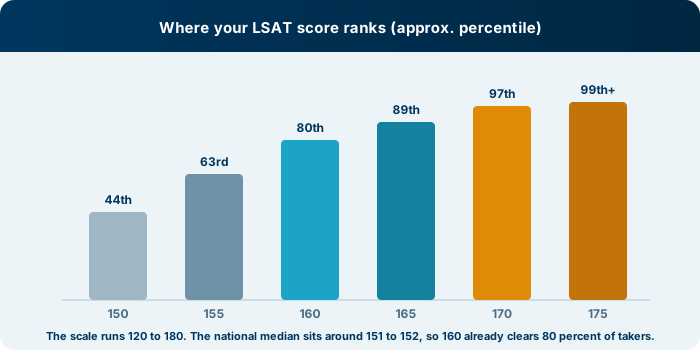
A few anchor points worth memorizing:
- 151 to 152 is the median. Score here and you are right around the 44th to 50th percentile, meaning roughly half of test-takers scored lower.
- 160 clears about 80 percent of test-takers. This is the first score that starts to feel like a real advantage.
- 165 reaches the high 80s in percentile.
- 170 sits near the 97th percentile. Only about 3 in 100 test-takers score this high or higher.
- 175 and above is the 99th percentile and beyond.
Notice how compressed the top is. The jump from 160 to 165 moves you from the 80th to the high 80s, but the jump from 170 to 175 moves you from the 97th to the 99th. Near the top of the scale, every additional point represents a much smaller slice of test-takers, which is exactly why those points are so hard to earn and so valuable in admissions.
A good score is relative to your school list
Here is the part most “good score” articles skip. Law school admissions is heavily numbers-driven, more so than most graduate admissions, and the single most useful piece of data you can gather is the median LSAT of each school on your list.
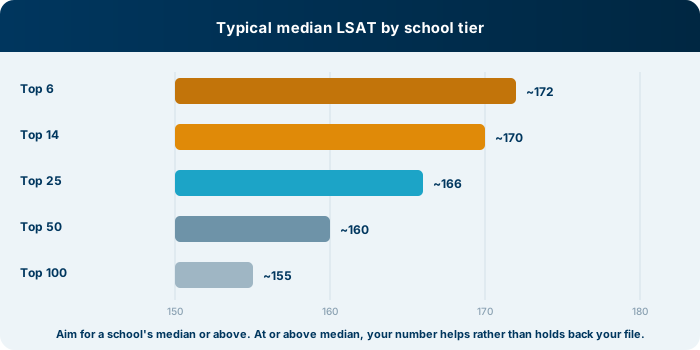
Every ABA-accredited law school publishes the 25th percentile, median, and 75th percentile LSAT of its entering class. Those three numbers tell you almost everything:
- At or above the median: your score helps your application. The school wants to keep its median up, so an applicant at or above it is attractive.
- Between the 25th percentile and the median: you are in range, but your score is doing nothing to lift the file. You will need other strengths, especially GPA, to carry it.
- Below the 25th percentile: possible, but you are asking the school to take a hit on its reported numbers, which usually requires something exceptional elsewhere.
So the honest definition of a good LSAT score is: a score at or above the median of the schools you want to attend. For a regional school that might be a 156. For a top-14 program it is likely a 170 or higher. Same applicant, same effort, completely different “good” depending on the goal.
LSAT and GPA work together
Schools evaluate the LSAT alongside your undergraduate GPA, and the two can partly compensate for each other. A score slightly below a school’s median can be offset by a GPA above the median, and vice versa. Many applicants use a school’s published medians for both numbers to estimate where they stand.
This matters for targeting. If your GPA is well above a school’s median, you have more room on the LSAT, and a score near the 25th percentile might still work. If your GPA is below median, you need the LSAT to do more of the lifting, which means aiming above median.
What this means for your target
Work backward from your school list:
- List the schools you genuinely want to attend.
- Look up each one’s median LSAT (it is public).
- Set your target at or just above the highest median on the realistic part of your list.
- Add a couple of points of cushion, because test day rarely matches your best practice exam exactly.
If you do not have a school list yet, default to building toward 160. It opens a wide range of solid programs, it is an achievable target for most people who prepare seriously, and you can always push higher once you are scoring there consistently.
Can you reach your target?
Almost certainly, with enough runway. The LSAT rewards preparation more predictably than most standardized tests because it tests a small, learnable set of reasoning skills rather than a huge body of content. The question types repeat. The logical structures repeat. The trap answers follow patterns. Once you learn to see them, your score climbs.
That is the whole premise behind our free book, The LSAT Reasoning Method. It treats Logical Reasoning and Reading Comprehension as one skill, finding an author’s conclusion and judging what does and does not follow, and teaches the patterns directly. If you are starting from a diagnostic in the low 150s and your target is 160-plus, a structured plan over a few months is a realistic path. We cover exactly how to build that plan in How to Study for the LSAT.
A good LSAT score, in the end, is not a trophy number. It is the score that gets you into a school you are excited to attend, ideally without debt you will regret. Define it against your list, then build toward it deliberately.
Want a target set against your specific GPA and school list? Join the early-access list and our LSAT instructors will help you map a realistic goal. When you’re ready to build toward it, 2,400+ practice questions are free during early access.
Frequently asked questions
What is a good LSAT score?
A good LSAT score is one at or above the median of the schools you want to attend. In absolute terms, anything above 160 clears roughly 80 percent of test-takers, 165 reaches the high 80s in percentile, and 170 sits near the 97th percentile.
What is the average LSAT score?
The national median is about 151 to 152, which corresponds to roughly the 44th to 50th percentile. The scale runs from 120 to 180.
Is a 160 LSAT score good?
A 160 is a solid score that beats about 80 percent of test-takers and is competitive for many regional and top-50 law schools. Whether it is good enough depends on your specific school list.
What LSAT score do I need for a top 14 law school?
Top 14 law schools generally have medians around 170 or higher, so you typically need a score in the high 160s to low 170s to be competitive, ideally paired with a strong GPA.
Do law schools take your highest LSAT score?
Most law schools report and consider your highest LSAT score rather than the average, because the ABA requires them to report the high score. Always confirm a specific school's policy.
Prepping for the LSAT?
Start with the LSAT prep options available today, or join the update list for new releases.