
Practice Resources
2,400+ Free LSAT Practice Questions: Inside the Premier LSAT QBank
The Premier LSAT QBank now holds 2,400+ original practice questions: 1,650 Logical Reasoning, 608 Reading Comprehension, two full-length tests, and writing practice, with every answer choice explained. Free during early access.
The Premier LSAT QBank has grown to 2,400+ original practice questions, and all of it is free while the platform is in early access. That total covers a drill bank of 1,650 Logical Reasoning and 608 Reading Comprehension questions, two full-length practice tests in a faithful replica of the 2026-27 testing interface, and two Argumentative Writing prompts. Every single question comes with a full explanation, plus a written explanation on each of its five answer choices.
This post is a tour of what’s inside: the exact question types covered, how the drills work, and what the explanations look like when you review.
What’s in the bank
| Section | Questions | Coverage |
|---|---|---|
| Logical Reasoning drills | 1,650 | All 20 question types, easy through hard |
| Reading Comprehension drills | 608 | Four subject families, including comparative reading |
| Full-length practice tests | 2 tests | Four timed sections each, with a 120-180 score estimate |
| Argumentative Writing | 2 prompts | The real two-phase format and timing |
That is roughly 2,460 practice questions in all, which makes this one of the largest free collections of original LSAT-style practice questions anywhere. Every item is original, written in the style of the current exam, and checked by an independent reviewer before it reaches the bank. Nothing is recycled from official tests, so your official PrepTests stay fresh for full-length rehearsal.
Practice in the interface you’ll actually test in
From August 2026, the LSAT runs on LSAC’s new testing platform. Our practice runner is a faithful replica of that interface: the two-pane layout with the stimulus on the left and the question on the right, lettered answer boxes, response masking to gray out eliminated choices, select-to-highlight annotation, a find-text bar, the review screen, and the same timer behavior, down to the five-minute warning.
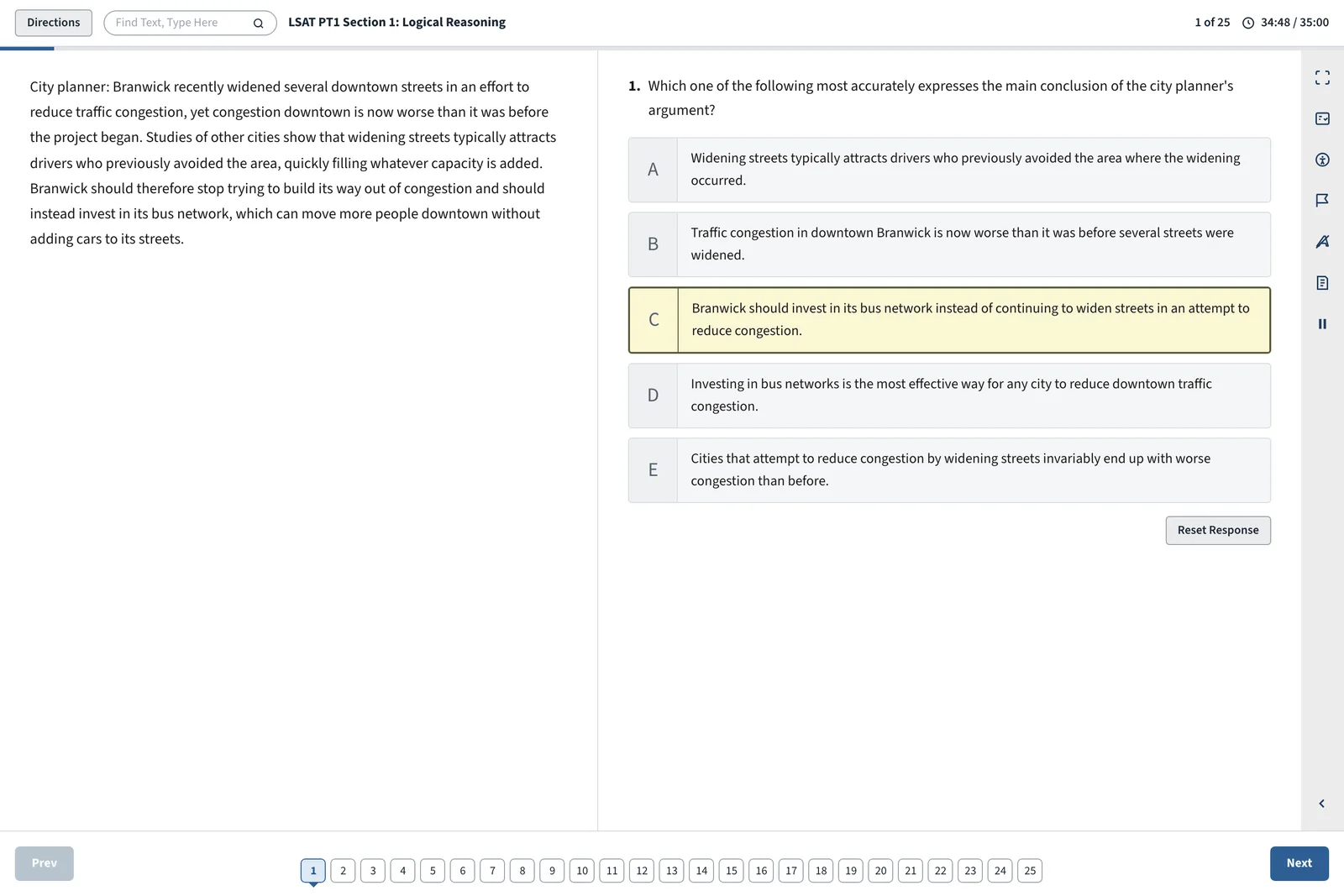
Practicing in the same layout you’ll see on test day sounds like a small thing. It isn’t. Pacing habits, masking habits, even where your eyes go when a question opens: all of it transfers when the practice environment matches the real one.
Every Logical Reasoning type, covered in depth
Logical Reasoning is two scored sections out of three on the current LSAT, so the drill bank leans into it: 1,650 original LR questions across all 20 question types, organized into the five families we teach in our Logical Reasoning method.
| Family | Question types |
|---|---|
| Argument Structure | Main Point, Role of a Statement, Method of Argument, Point at Issue |
| Assumptions & Flaws | Necessary Assumption, Sufficient Assumption, Flaw, Parallel Flaw |
| Strengthen & Weaken | Strengthen, Weaken, Weaken EXCEPT, Evaluate |
| Inference | Must Be True, Must Be False, Most Strongly Supported, Fill in the Blank, Paradox |
| Principle & Parallel | Principle (Identify), Principle (Apply), Parallel Reasoning |
The drill builder can target any single type on that list. Weak on Necessary Assumption? Build a timed set of nothing but Necessary Assumption questions at the difficulty you choose. Every drill draws only from questions you haven’t seen, so a fresh set stays fresh, and pacing and accuracy analytics accumulate by question type so you always know where your next points are.
Each type also comes with an easy, medium, and hard spread. That matters more than it sounds: the skill that answers an easy Flaw question (spotting a correlation-to-causation jump) is not the skill that answers a hard one (untangling a subtle scope shift buried in academic prose), and you need reps at both.
Reading Comprehension across all four subject families
The 608 Reading Comprehension questions come as full passage sets, the way RC should be practiced. Passages span the four subject families the LSAT draws from: law, humanities, natural sciences, and social sciences. Comparative reading sets, the two-passage format that appears once in every scored RC section, are in the rotation too.
Question stems cover the full range LSAC tests: main idea, primary purpose, stated information, inference, meaning in context, structure and organization, application, principle, analogy, author’s attitude, and strengthen/weaken. If a stem style shows up on the real exam, it shows up in the bank.
Explanations on every answer choice, not an answer key
This is the part we care about most. Most practice banks tell you the credited answer, give a paragraph about it, and move on. But if you picked B and the answer was C, “here’s why C is right” answers the wrong question. You need to know why B looked so good and where it falls apart.
So every question in the bank has two layers of explanation: a walkthrough of the reasoning, and a separate written explanation on each of the five answer choices.
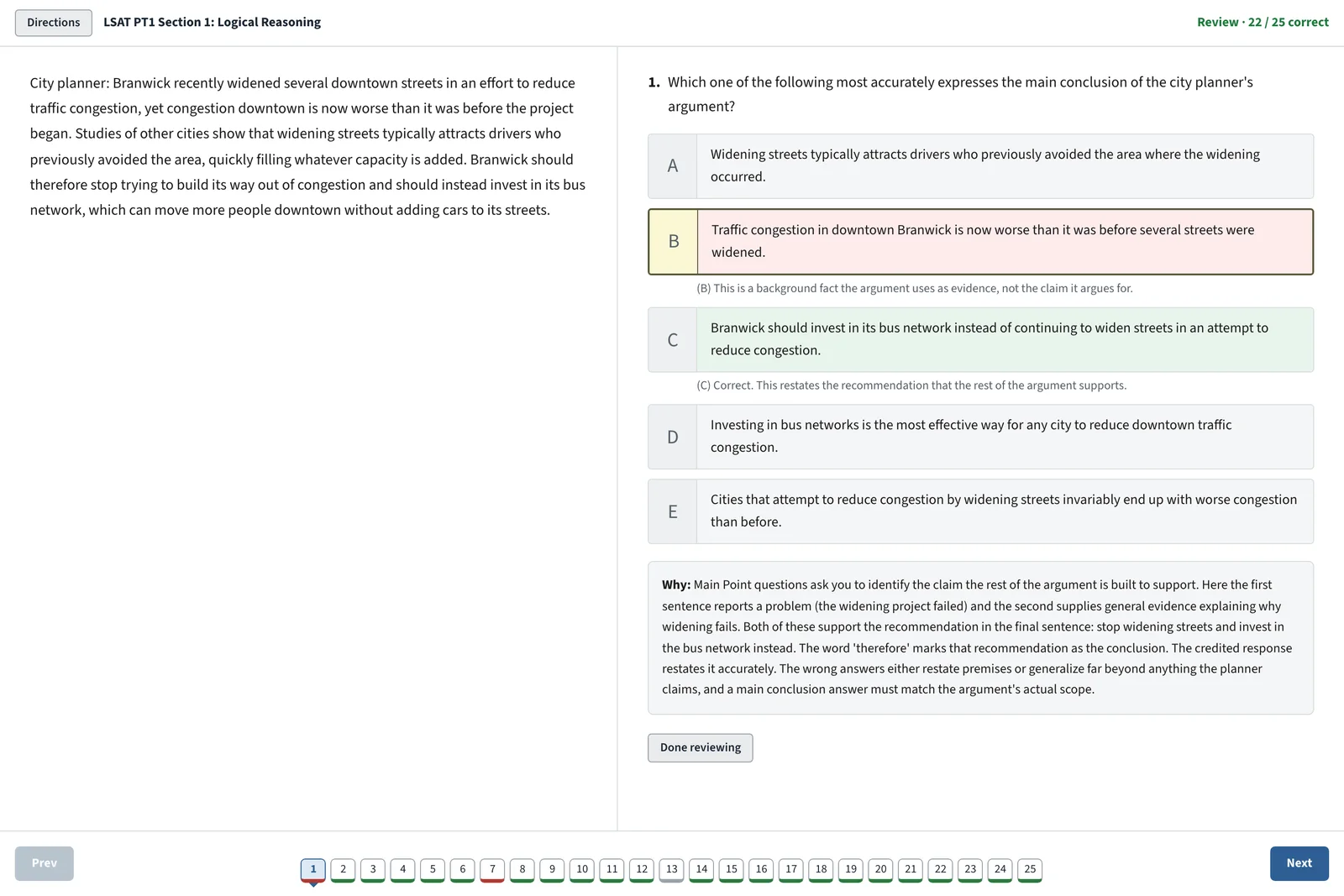
In the review above, the test-taker fell for the classic Main Point trap: picking a premise the argument states instead of the conclusion it argues for. The review says exactly that, in plain language, right under the choice. The credited answer gets its own line, and the “Why” panel walks through how the argument is built. A missed question stops being a lost point and becomes a named, fixable habit.
Before any question enters the bank, an independent reviewer re-solves it blind, without seeing the intended answer, and the two solutions have to agree. Questions that fail that check get cut. It is a slower way to build a question bank, and the right one.
Full-length tests and writing practice
When you’re ready to put sections together, the bank includes two full-length practice tests that mirror the real sitting: four timed sections including an unscored variable section, the 10-minute intermission, and a 120-180 score estimate with percentiles at the end. Argumentative Writing practice runs on the real two-phase timing, so the essay you write under practice conditions is the essay you’ll write on test day.
Free during early access
The practice platform is free while it’s in early access: all 2,400+ questions, both full-length tests, the drill builder, and the analytics. Joining the early-access group locks in your access and gets you set up on the practice platform.
If you want a guide inside the questions, Lex, the AI tutor that walks you through the reasoning instead of handing you answers, is available as an optional add-on at $29 a month.
Join the LSAT early-access group, see how the practice platform works, and if you want the method before the reps, the complete LSAT Reasoning Method book series is free to read on the site, no signup required. Prefer a person over a platform? 1-on-1 LSAT tutoring runs alongside both.
Frequently asked questions
How many questions are in the Premier LSAT QBank?
2,400+ original practice questions: a drill bank of 1,650 Logical Reasoning and 608 Reading Comprehension questions, plus two full-length practice tests and two Argumentative Writing prompts. Every question carries a full explanation and a written explanation on each of its five answer choices.
Is the Premier LSAT QBank really free?
Yes. The practice platform is free while it's in early access: the complete drill bank, both full-length tests, the drill builder, and the analytics. Joining the early-access group locks in your access from day one. The one optional extra is Lex, the AI tutor, available as a $29 a month add-on.
Are these official LSAT PrepTest questions?
No. Every question is an original item written in the style of the current LSAT and independently verified before entering the bank. We are not affiliated with LSAC. We actually recommend keeping official PrepTests in your plan; because our drills are original, you never have to burn an official test on targeted practice.
Can I drill one Logical Reasoning question type at a time?
Yes. The drill builder targets any of the 20 Logical Reasoning question types, from Necessary Assumption to Parallel Flaw, timed or self-paced, at easy, medium, or hard difficulty. Drills always draw from questions you haven't seen.
Do the Reading Comprehension drills include comparative reading?
Yes. The 608 Reading Comprehension questions span law, humanities, natural sciences, and social sciences passages and include comparative reading sets, the two-passage format that appears in every scored Reading Comprehension section.
What makes the explanations different from other question banks?
Most banks explain the credited answer and stop. Here every question has a walkthrough of the reasoning plus a separate written explanation on each of the five answer choices, so you see why the right answer earns the point and why each tempting wrong answer fails.
Prepping for the LSAT?
Start with the LSAT prep options available today, or join the update list for new releases.