
The exam interface, not a flashcard app
Passages on the left, questions on the right, highlighting, strikethrough, a flag for review, and a timer. Nothing about test day should be the first time you see it.
Your cart
Your cart is empty.
Free MCAT question bank
Every question carries a full explanation and a separate note on each answer choice. Four of them are on this page, answerable right now, with no account and no payment.
One from each section, copied exactly as they appear inside the question bank, explanations and all. Answer them here before you decide whether the rest is worth your time.
The second protein is net positive here and stays dissolved.
The first protein is at its isoelectric point and aggregates.
Correct. Its net charge is zero at pH 4.6, so repulsion between molecules is lost.
This reverses the two, since the buffer matches the isoelectric point of the first.
Not this time. The answer is C.
Full explanation
Correct Answer: Choice C
This question asks how one pH treats two proteins that differ in their point of zero net charge. We must use our knowledge of charge and solubility to answer this question.
The isoelectric point is the pH at which a protein carries no net charge, and it is also the pH of its minimum aqueous solubility. Away from that point every molecule in the solution carries the same sign of charge, so neighbours repel one another and stay dispersed.
Treat the two proteins separately. The first has an isoelectric point of 4.6, so in this buffer its net charge is zero, the repulsion between molecules disappears, and it aggregates and falls out of solution. The second has an isoelectric point of 8.2, so a buffer more than three units below that value leaves it strongly protonated and net positive. Those molecules repel one another and remain dissolved. Selective precipitation of this kind is why acidifying milk to about pH 4.6 curdles casein and leaves the whey proteins behind.
(Choice A) The second protein sits far from its isoelectric point, so it keeps the charge that holds it in solution.
(Choice B) The first protein has no net charge here, so nothing prevents its molecules from aggregating.
(Choice D) This reverses the two proteins, since the buffer matches the isoelectric point of the first.
From the free set "Titration, Isoelectric Point, and Electrophoretic Mobility" in the MCAT question bank.
That is 0 of 4 on four of the 1,617 questions waiting in the bank.
Continue to the full bank, freeNo payment required, no card asked for.
Pressure depends only on depth and density, both of which are the same for all three vessels.
This reverses the two, since it is the force and not the pressure that responds to base area.
The pressures are equal, but multiplying one pressure by three different areas gives three different forces.
Correct. Depth and density alone set the pressure, and force is that pressure multiplied by the differing base areas.
Not this time. The answer is D.
Full explanation
Correct Answer: Choice D
This question asks which hydrostatic quantity depends on the shape of a vessel. We must use our knowledge of pressure and force to answer this question.
Pressure at a depth is the product of fluid density, gravitational field strength, and depth alone. No area and no shape appear in it, so three vessels filled to the same depth with the same fluid have identical base pressures no matter how they flare or taper. A narrow vessel holding a litre and a wide one holding twenty litres press equally hard on every square centimetre of their bases.
The force is a different quantity and follows from the first. Force is pressure multiplied by the area over which it acts, so with the pressure fixed the force scales directly with the base area. The three forces are therefore unequal, and the widest base carries the largest one.
This pairing is the hydrostatic paradox: the force on the base can exceed the weight of the fluid in the vessel when the walls slope outward, because the walls push down on the fluid as well.
(Choice A) Unequal pressures would require the depths or the densities to differ, and the stem fixes both.
(Choice B) This reverses the pair, letting shape affect the pressure and not the force.
(Choice C) The pressures are right, but equal pressures on unequal areas cannot give equal forces.
From the free set "Hydrostatics, Buoyancy, and Body Composition" in the MCAT question bank.
That is 0 of 4 on four of the 1,617 questions waiting in the bank.
Continue to the full bank, freeNo payment required, no card asked for.
A statistic can be accepted while the impression of frequency survives it untouched.
Correct. Competing instances enter the retrieval set, which is the input the heuristic reads.
An argument about the two cases, not a change in what comes to mind.
Makes the two cases more retrievable still, so the estimate should rise instead.
Not this time. The answer is B.
Full explanation
Correct Answer: Choice B
The stem names the heuristic and asks what follows from it. The task is to work out which correction operates on the input the heuristic actually uses.
The availability heuristic estimates how common something is from how easily instances come to mind, so the currency of the judgement is retrieval rather than evidence. Two diagnoses from last week are highly retrievable, which is why the rate feels high.
A correction can therefore work only by changing what comes to mind. Bringing several patients to mind who had the same presentation and a different diagnosis loads the retrieval set with competing instances, and the felt frequency of the rare disease falls with it. The physician does not have to revise any belief for that to happen, which is what makes it the prediction the heuristic itself generates.
(Choice A) A printed prevalence figure is a statistic, not an instance. It can be read and accepted while the impression of frequency survives, which is why base rates so often fail to correct availability.
(Choice C) Being told the cases were unusual is an argument about them. It leaves them just as easy to recall as they were before.
(Choice D) Rereading the notes rehearses the two cases and makes them more retrievable, so availability predicts the estimate rises rather than falls.
From the free set "Framing, Deadlines, and Bounded Rationality" in the MCAT question bank.
That is 0 of 4 on four of the 1,617 questions waiting in the bank.
Continue to the full bank, freeNo payment required, no card asked for.
Passage I
The framing of the terms now concluded was an exercise in arithmetic: one determines what has been destroyed, adds an allowance for the trouble taken, and enters the sum against the defeated. That procedure requires an assumption which nobody has troubled to state, namely that the economic order interrupted by the war was a natural condition to which Europe will return of its own accord. I wish to argue that the assumption is mistaken, and that when it falls the arithmetic falls along with it. The consequence of the mistake is not a difference of degree but a difference of kind.
The prosperity of the last generation was not a natural condition but a delicate and temporary arrangement, and it depended upon two habits of mind rather than upon any law. The labouring population consented to a small share of what it produced, partly from custom and partly because it was persuaded that the whole would presently grow. The owning class was permitted its large share upon the tacit condition that it consumed very little and invested the remainder. Neither habit was written anywhere. Both have now been examined by everybody, and neither will survive the examination unchanged.
An economy is therefore not a mechanism which resumes when the interruption ends. It is a body of arrangements maintained by the confidence of the people inside it, and confidence, once withdrawn, is not restored by a signature. The coal must be cut, the wagons must run, the credit which moves grain across a frontier must be extended by somebody who expects repayment. Where these have been damaged, the productive power of a country is smaller than its accounts suggest, and it will remain smaller until the underlying arrangements have been rebuilt. Recovery is an act of construction and not a return.
The distinction upon which everything turns is between a transfer on paper and a transfer in fact. A treaty creates a claim by writing it down, and the claim is perfectly definite. Discharging it is another matter, for a country can meet an obligation abroad only by sending out more goods and services than it takes in, year after year, until the debt is extinguished. The surplus must first exist. A nation deprived of its mines, its shipping, and its markets has been deprived of the very instrument by which the demand upon it could be satisfied.
The two are not so easily kept apart, however, and here the matter becomes disagreeable. Productive power is itself partly a question of expectation. Men do not sink their savings into a works whose earnings they believe already pledged to a foreign creditor for a generation, nor do they labour with much energy for a reward they expect to be taken from them. The demand for payment therefore operates upon the capacity to pay, and it operates destructively. What began as a claim against a surplus concludes by preventing the surplus from appearing at all. The relation is plainly circular.
It will be urged that the claim is just, and that a lenient settlement would appear to reward the party which began the injury. I do not dispute the justice, and I have no wish to be understood as disputing it. Justice, however, does not by itself create a means of payment. A demand which cannot be met will not be met; it will be renewed, evaded, and enforced by fresh coercion, and the disorder which follows will not confine itself to the debtor. Those who framed these terms have made themselves dependent upon the recovery of the country they intended to hold down.
John Maynard Keynes, "The Economic Consequences of the Peace" (1919) [601 words]
This is the assumption of paragraph 1, which the author announces to be mistaken.
The tempting choice. Paragraph 2 supplies this description as support rather than as the argument.
Too extreme. Paragraph 6 says the author does not dispute the justice of the claim.
D (correct): Paragraph 1 says the arithmetic falls with the assumption, and paragraph 4 says the surplus must first exist.
Not this time. The answer is D.
Full explanation
This question wants us to find what the passage as a whole is doing. We can use the main idea of the passage to answer this question. The main idea is that paper claims cannot exceed the surplus a nation can produce. To answer this question, we will eliminate the answer choices that do not align with this idea.
A is incorrect. This answer choice is incorrect because it names the belief the author sets out to overturn. Paragraph 1 says the settlement rests on the assumption that the old order "was a natural condition to which Europe will return of its own accord," and then announces that "the assumption is mistaken." Restating a belief he immediately attacks cannot be his concern. We can eliminate A.
B is incorrect. This answer choice is incorrect because it takes one step for the destination. Paragraph 2 does describe the two habits, one belonging to the labouring population and one to the owning class. That description supports the larger claim about payment rather than standing as the point. This is the tempting choice, because paragraph 2 is the most vivid part of the passage. We can eliminate B.
C is incorrect. This answer choice is incorrect because it is stronger than anything the author says. Paragraph 6 states "I do not dispute the justice, and I have no wish to be understood as disputing it." He objects to a demand that cannot be met, not to reparations as such. We can eliminate C.
D is correct. This answer choice is correct because it is most in line with the author's main idea. Paragraph 1 says that when the assumption falls "the arithmetic falls along with it," and paragraph 4 explains why: a claim is definite on paper, but "The surplus must first exist." The sums were written for an economy that no longer stands.
From the free set "Paper and Payment" in the MCAT question bank.
That is 0 of 4 on four of the 1,617 questions waiting in the bank.
Continue to the full bank, freeNo payment required, no card asked for.
The other 1,613 questions, all 192 passages, the half-length diagnostic, and your analytics. Signing in with Google or an email link creates your account and opens all of it.
No payment required and no card asked for.
Every question is original, written and reviewed by tutors who scored 520 or above. Nothing is copied from official material, so your AAMC practice stays unspoiled for calibration.
| Section | Free questions | Sets | Passages | Topics covered |
|---|---|---|---|---|
| Biology and Biochemistry | 505 | 80 | 49 | Amino acids and proteins, enzyme kinetics, DNA replication, the immune system, cell cycle control |
| Chemistry and Physics | 439 | 72 | 45 | Acid-base equilibria, electrochemistry, fluids, circuits, thermodynamics, optics |
| Psychology and Sociology | 346 | 60 | 43 | Learning, memory, decision making, social stratification, health disparities |
| Critical Analysis and Reasoning Skills | 327 | 55 | 55 | Philosophy, literature, ethics, history, economics, anthropology |
| All four sections | 1,617 | 267 | 192 | Free, with an explanation on every question |
Counts were checked against the bank on July 29, 2026. New sets are added regularly, so these numbers only go up.
Knowing which letter was right teaches you very little. Knowing why the one you picked was wrong is the part that moves a score.
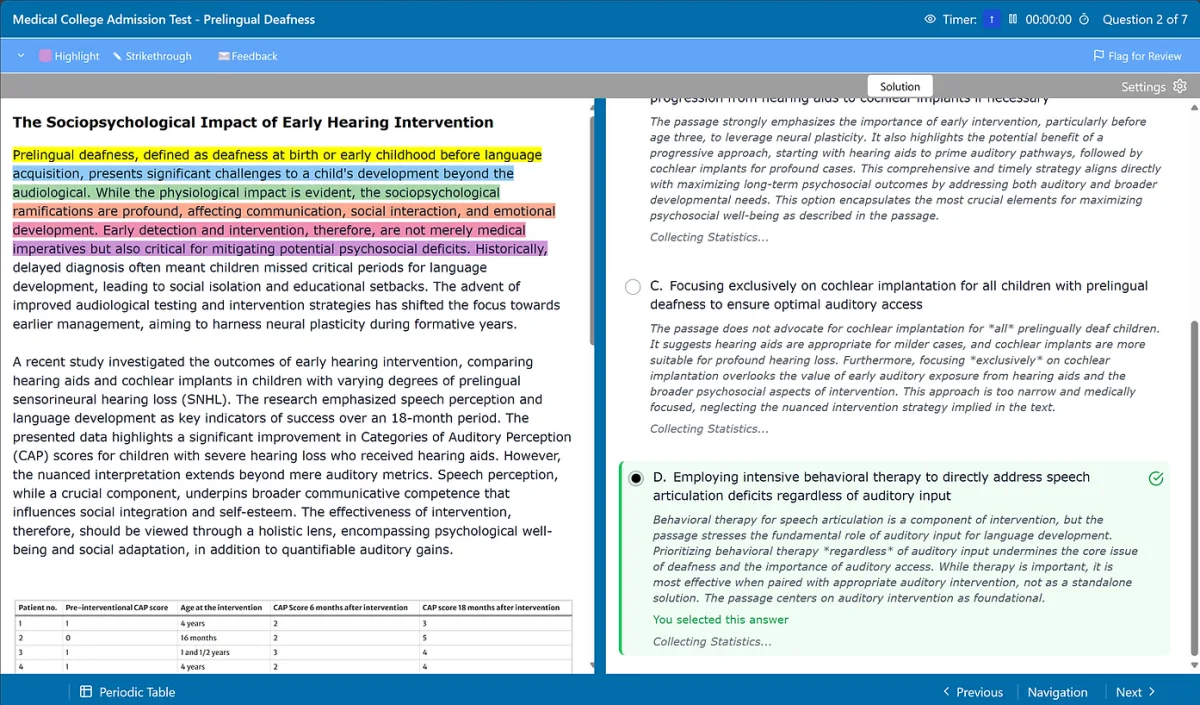
Built from the ground up to help you practice, review, and understand exactly where your score can improve.
Passages on the left, questions on the right, highlighting, strikethrough, a flag for review, and a timer. Nothing about test day should be the first time you see it.
Learn with instant feedback after every question in tutor mode, or hold your answers to the end under section pacing in exam mode. Switch whenever you want.
Six highlighter colors, strikethrough on eliminated choices, and a review queue that brings back what you flagged and what you missed.
Accuracy and pacing accumulate by section, subject, and reasoning skill, so the next study block picks itself instead of being a guess.
The bank tracks what you have done and builds new sets from what is left, so a fresh set is genuinely fresh and your accuracy stays honest.
An optional subscription that answers follow-up questions on the passage in front of you and points at the text that settles them.
Students routinely report that other companies' materials score noticeably easier or harder than the real thing. Ours are built to match it.
It is easy to sell a score increase by making the first test hard and the last one easy. Our exams are calibrated to predict your real MCAT score instead, which is less flattering and considerably more useful.
Questions are written and reviewed by our tutors, who scored in the top percentiles. The result is content that tests the same reasoning patterns you will face on the real exam rather than trivia that happens to be on the syllabus.
All 1,617 questions, every passage, every explanation, the analytics, and the half-length diagnostic cost nothing. Full-length exams are $20 each, a fraction of what other companies charge, because building an accurate one takes serious work.
Separate from the free bank, for when you want a scored rehearsal of the whole test day.
$0
See where you stand before committing a full test day to it. Scaled to track real AAMC scoring.
$20 per exam
A full 230-question, 7.5-hour simulation. The closest thing to the real MCAT you can sit from home.
Not open for purchase yet
An MCAT-trained assistant that answers follow-up questions, rewords a concept that has not landed, and points at the text that settles it. Entirely optional and separate from the free bank.
$29 / month
Free for one day, then $29 a month. Cancel anytime.
Yes. All 1,617 practice questions, the passages they sit in, the explanations, and the analytics are free once you sign in. No card is asked for at any point. The only paid items on this page are the optional AI tutor subscription and the full-length exams.
1,617 questions in 267 sets, including 192 passages: 505 in Biology and Biochemistry, 439 in Chemistry and Physics, 346 in Psychology and Sociology, and 327 in Critical Analysis and Reasoning Skills. Counts were checked against the bank on July 29, 2026 and go up as new sets are published.
No. Every question is original, written and reviewed by tutors who scored 520 or above, in the style of the current exam. Official AAMC material is still the best thing to calibrate your score against, so use it for that and use this bank for the volume of practice it takes to get there.
Not for the four samples on this page. An account is needed for the rest of the bank so your progress, your analytics, and the questions you have already seen can be saved. Signing in with Google or an email link creates it for you.
A walkthrough of the reasoning that gets you to the credited answer, plus a separate note on each of the other choices explaining what makes it wrong. You can see both in the four samples on this page.
Yes. 327 Critical Analysis and Reasoning Skills questions across 55 full passages, drawn from philosophy, literature, ethics, history, economics, and anthropology. One of those passages is the fourth sample on this page.
Yes. A half-length diagnostic is free and scaled to track a real MCAT score. Full-length 230-question exams are $20 each and are not open for purchase yet.
1,617 questions, 192 passages, and the half-length diagnostic, open as soon as you sign in.
Your account is created on first sign-in. No payment required.
Takes under a minute — tell us what you need and we'll take it from there.