
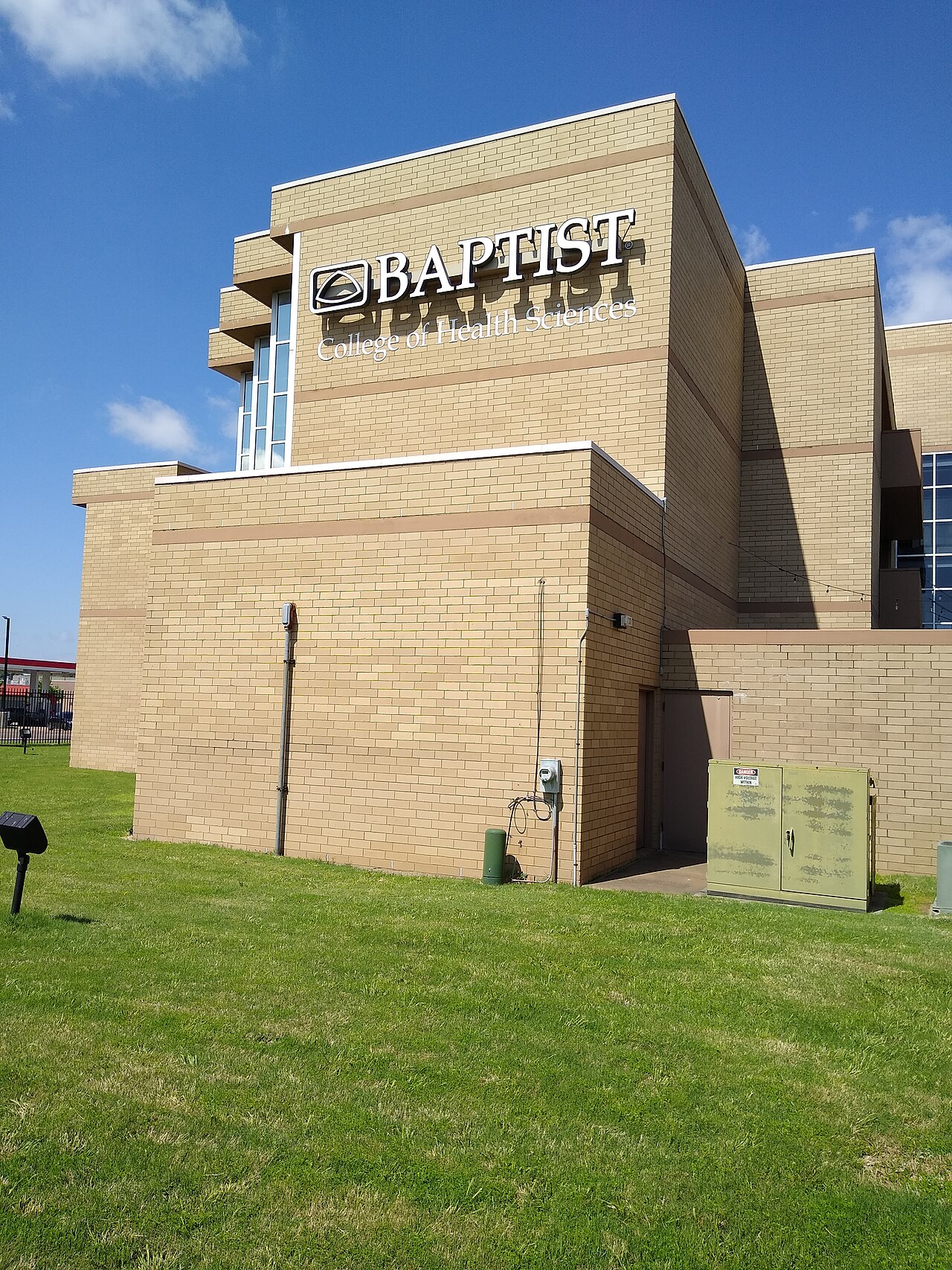

Baptist Health Sciences University College of Osteopathic Medicine
Tennessee · Less selective by the numbers · Founded 2024
Official websiteCan I get in?
Checking your session…
Admissions statistics
- Median MCAT
- 503
- MCAT range (25–75)
- 500–506
- Median GPA
- 3.52
- GPA range (25–75)
- 3.34–3.64
- Science GPA (est.)
- 3.34
- Acceptance rate
- ~10.9% (est.)
- Interview rate
- Not reported
Median MCAT by section (estimated)
- Chem / Phys
- 125
- CARS
- 125
- Bio / Biochem
- 126
- Psych / Soc
- 127
Section medians are projected from the total using the publicly published national section distribution (CARS runs lowest, Psych/Soc highest). Schools rarely publish their own per-section medians, so this is an estimate; real values are shown when we've sourced them.
vs US DO matriculants: MCAT -0.5 (nat. 503.5), GPA -0.08 (nat. 3.60).
MCAT range by residency Premier estimate
| Matriculants | 10th | 25th | 75th | 90th |
|---|---|---|---|---|
| Combined | 496.6 | 499.5 | 507.1 | 510.8 |
| In-state | 498.1 | 500.8 | 509.3 | 512.6 |
| Out-of-state | 498.5 | 501.4 | 508.9 | 512.7 |
The box spans the 25th–75th percentile; the whiskers reach the 10th and 90th. Premier's model estimates the full spread and the residency split from the published median, using its out-of-state share — calibrated across every US MD program and validated to within ~1.5 points of reported figures. Estimates are shown to one decimal. How this works.
Class profile
- Entering class size
- 114
- Public / Private
- Private
- Setting
- Not reported
- % Out-of-state
- 72.8%
- Orientation
- Service-oriented
Research vs. service orientation
Service-oriented (10/100) — New (2024) DO school with explicit primary-care/underserved/rural Mid-South workforce mission; no MSTP, no NIH/research ranking.
In-state vs. out-of-state class makeup
Course exams
Core clerkship exams are the NBOME's standardized COMAT subject exams — standardized nationally, so they're consistent across DO schools. Whether the preclinical years lean on in-house, NBME-based, or a mix of exams isn't something schools publish in one place — so we don't guess per school; confirm specifics with the school.
Cost & aid
- Cost of attendance
- $82,908
- Avg. graduate debt
- Not reported
- Secondary fee
- $50
- % receiving aid
- Not reported
Tuition & cost of attendance verified against the school's official site (official source, 2025-2026). Schools report "tuition" vs. "tuition & fees" differently and some (e.g. NYU Grossman, Kaiser early cohorts) award universal scholarships — always confirm on the official page.
Prerequisites & requirements
Typical for US DO programs — confirm this school's exact list.
- Biology
- 1 year with lab
- General Chemistry
- 1 year with lab
- Organic Chemistry
- 1 year with lab
- Biochemistry
- 1 semester (recommended/required)
- Physics
- 1 year with lab
- English / writing
- 1 year
- Math / statistics
- 1 semester–1 year (varies)
- Psychology & Sociology
- Recommended for the MCAT
Required tests
- MCAT — required
- CASPer: varies — verify with the school
- AAMC PREview: varies — verify
Letters of recommendation
- 3–5 letters or a committee letter
- At least one letter from a science faculty member
- A letter from a DO (osteopathic) physician is strongly preferred
Application timeline (AACOMAS)
Most US programs admit on a rolling basis — applying early materially helps.
What this school weighs
- GPA & MCAT (academic readiness)
- Clinical experience & shadowing (including osteopathic shadowing)
- Research experience
- Community service & volunteering
- Letters of recommendation
- Personal statement & secondary essays
- Interview performance & mission fit
- State residency (especially at public schools)
Secondary essay prompts (2024-2025)
⚠ Crowdsourced & anecdotal — secondary prompts change every cycle and may be incomplete. Always confirm on the school's own secondary application.
- Describe what it means to be a servant leader, and specifically how it connects to your decision to become an osteopathic physician. · 250 words
- Please describe your experience working or volunteering in the healthcare sector. Provide details of the work you did as well as any direct patient encounters that were particularly meaningful. · 250 words
- Describe the town or city where you spent the majority of your K-12 years, including the general population size and make-up, the closest major metropolitan city, and how far away it is. · 250 words
Interview
⚠ Anecdotal — based on applicant-reported experiences (e.g. SDN). Format and questions vary year to year; treat as a guide, not a script.
Format: MMI
In-person interviews held in small cohorts on Wednesdays or Thursdays; applicants report an MMI-style format (some under nondisclosure) including ethics and role-play scenarios, with strong focus on the school's servant-leadership mission and Memphis.
Questions applicants report
- Why BUCOM and why Memphis?
- What qualities should a successful DO have?
- Why is it important for an osteopathic physician to be empathetic?
- Medical school is hard - how do you deal with stress and maintain balance?
- Role-play: act out a patient nervous about test results.
- How do you plan to contribute to advancing BUCOM's mission?
Key facts
- Degree
- DO
- Type
- Private
- Location
- Tennessee
- Region
- South
- Interview format
- MMI
- Preclinical grading
- Not reported
- Licensing exam
- COMLEX-USA (many students also take USMLE)
- Oldest MCAT accepted
- within 3 years of application
- International applicants
- Not considered
- DACA applicants
- Not considered
Stats from the school's published class profile and publicly available national data. Prerequisite, timeline, and letter guidance is typical for US DO programs and may differ at this school. Some figures are being verified. Not affiliated with or endorsed by the AAMC.
Frequently Asked Questions
What MCAT score do I need for Baptist HSU?
Baptist Health Sciences University College of Osteopathic Medicine has a median MCAT of 503 (typical accepted range about 500–506). At or above the median is most competitive; below the 25th percentile (500) is a reach without other strengths.
What GPA does Baptist HSU require?
The median accepted GPA is about 3.52 (roughly 3.34–3.64). There's no hard cutoff, but below the median you'll want to be strong elsewhere.
What are the prerequisites for Baptist HSU?
Like most US DO programs, expect a year each of biology, general chemistry, organic chemistry, and physics (all with labs), biochemistry, and English, plus math/statistics. Psychology and sociology are recommended for the MCAT. Always confirm the school's exact list.
Is Baptist HSU hard to get into?
Its acceptance rate is approximately 10.9% — less selective by the numbers for US DO programs.
Aiming for Baptist HSU?
Our 520+ scoring tutors help you close the gap to a competitive MCAT. Start with a free consultation.
Explore Tutoring