
Section Strategy
Hardest Section of the MCAT: What the AAMC Data Actually Shows
A 527 scorer breaks down which MCAT section is the hardest by data, not opinion — section structure, retake gain, and why CARS wins on every difficulty axis that matters.
The hardest section of the MCAT is CARS — by every measurable definition of “hardest” that the data supports. Median retake gain is the smallest, the section is the only one where outside knowledge is forbidden, and student surveys consistently rank it #1 hardest. The science sections are hard for content reasons that practice can fix; CARS is hard for reasoning reasons that practice fixes much more slowly.
Why “hardest” needs a definition before we can answer it
When premeds ask “which section is the hardest,” they usually mean one of four different things:
- Which section has the lowest average score?
- Which section is the hardest to improve once you’ve started studying?
- Which section feels the worst on test day?
- Which section has the most content to learn?
These four questions have different answers. The AAMC scales every section to a mean near 125 on the 118–132 scale, so question (1) is essentially a tie by design — section means cluster within 0.5 points of each other. Question (4) goes to Bio/Biochem or Psych/Soc on raw content volume. But the question that actually matters for your score outcome is question (2): which section resists improvement.
That question has one answer: CARS.
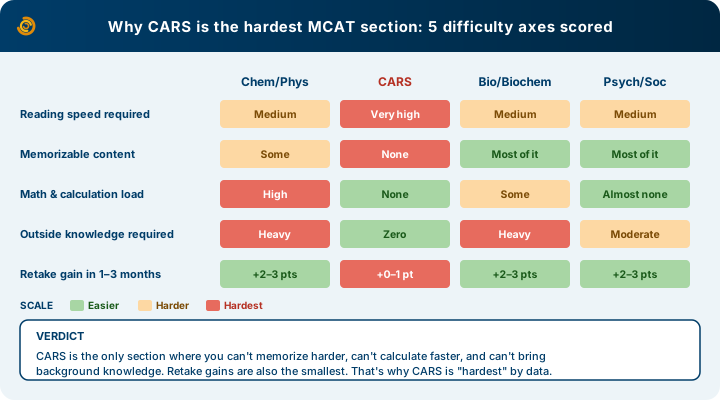
CARS is the only section where you can’t compensate for weakness
Look at the matrix above. Every other section has at least one lever you can pull to brute-force a score gain:
- Chem/Phys is heavy on math and outside knowledge. If your physics is weak, drilling formulas and unit-analysis problems works. The improvement curve is fast in the first 4–6 weeks of focused work because the test rewards content retrieval.
- Bio/Biochem is the most content-heavy section. Memorize amino acids, metabolic pathways, hormone signaling, and the cardiovascular system, and you can move 3–4 section points in two months. Content effort scales linearly into score.
- Psych/Soc is dominated by definitions and named theories. The 86-page Khan Academy P/S document plus a few weeks of Anki gets most students from a 125 to a 128 with high reliability.
CARS has none of these levers. There’s no content to memorize, no formulas to drill, no outside knowledge to bring. The 53 passages on the test will be on philosophy, history, art criticism, jurisprudence, ethics — disciplines you’ve probably never studied — and your job is to extract the author’s argument structure and answer questions about reasoning patterns under time pressure.
The data reflects this. Most prep companies that publish retake data show median CARS gains of 0–1 point on a 3-month retake, while Chem/Phys, Bio/Biochem, and Psych/Soc all hover around +2 to +3 points. CARS is the section where 25% of retakers actually score lower the second time.
The section structure: what you’re actually doing in each one
The AAMC has designed each section to feel structurally similar, but the cognitive demands differ.
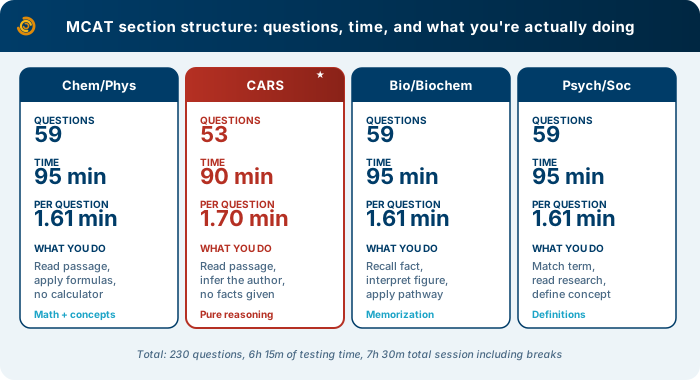
A few facts that surprise students:
- CARS gives you the most time per question. 1.70 minutes per question vs. 1.61 for the science sections. Students assume CARS feels rushed because the timing is tighter, but it’s actually the opposite — CARS feels rushed because each question takes longer to think through, not because you have less time.
- CARS has the fewest questions (53 vs. 59 for the science sections), but it’s the section students most often run out of time on.
- The science sections share a structure: about 10 passages with 4–7 associated questions, plus 15 discrete questions sprinkled in. CARS is 9 passages with no discretes — so every question is tied to a passage you’ve spent time reading. That makes time pressure compound when you fall behind.
What makes CARS uniquely hard
Three things, in order of importance:
1. The wrong answers are designed to match common misreads. On a science question, a wrong answer is usually wrong because it cites a wrong fact or applies a formula incorrectly. On a CARS question, a wrong answer is wrong because it’s almost right — it captures something the passage said but not what the question asked, or it generalizes the author’s specific claim into something they didn’t say. You need to be precise about scope and modal language (“most” vs. “all”, “suggests” vs. “proves”) to consistently distinguish trap answers from correct ones.
2. Background knowledge actively hurts you. The AAMC explicitly tells you not to use outside knowledge on CARS, and the test-makers exploit this. If a passage says “Aristotle argued that virtue is a habit,” the test will write a question where the correct answer is the one that matches the author’s claim — even if you happen to know Aristotle actually said something more nuanced. Students with strong humanities backgrounds often score poorly on CARS until they retrain themselves to read for the author’s argument, not for what they personally believe.
3. Improvement requires a metacognitive shift, not new content. Improving in C/P means learning more physics. Improving in CARS means changing how you read. That’s a slower, less measurable process. You can’t quiz yourself on “CARS knowledge” because there isn’t any. Practice has to be focused on diagnosing why you got an answer wrong — not what you didn’t know, but what reasoning move you missed. Our CARS strategy guide breaks down this diagnostic process in detail.
What makes each science section hard (in case CARS isn’t your weak one)
Not every student finds CARS the hardest. If you have a strong reading background, your weakest section may be one of the science sections. Here’s what makes each one hard:
Chem/Phys is hardest if you’ve been out of physics for a while and your math feels rusty. The section rewards comfort with unit analysis, ratio reasoning, and calculation under no-calculator conditions. The single most common pattern: students with strong gen chem backgrounds underestimate the physics weighting and end up with a 124–126 ceiling because their physics is shaky.
Bio/Biochem is hardest if your undergraduate biochem was weak. The section is content-dense — you need to know amino acid structures, all the major metabolic pathways (glycolysis, Krebs, oxidative phosphorylation, fatty acid synthesis, urea cycle), enzyme kinetics, and most of the standard biology curriculum. The good news: this is the most studyable section. The bad news: there’s a lot to study.
Psych/Soc is hardest if you skipped the social sciences in undergrad. P/S has its own vocabulary — sociological theories, psychological disorders, statistical concepts, research design — that you need to know cold. Most students underestimate this section in their first month of prep and pay for it later. It’s also the section most rewarded by Anki, which makes it the section students with strong study systems tend to score best in.
What it means for your study plan
If you’re more than three months out from your test date, allocate proportionally to your weakest section, but reserve at least 20% of your prep time for CARS regardless. The CARS curve is the slowest to move, so you need the longest runway. If you aren’t sure which section is actually weakest, a few full-length timed sets in a question bank will show you faster than guessing from content review alone.
If you’re inside two months and CARS is your weakness, the right move is daily passage practice with rigorous review of why you got each wrong answer wrong — not what the right answer was, but the reasoning move you missed. Jack Westin daily passages plus the AAMC CARS Question Pack are the most representative practice. Quality of review beats quantity of passages by a wide margin.
If you’ve taken the MCAT and your CARS score is dragging your total, a CARS-focused retake is one of the few situations where targeted prep beats generic study time. A 122 CARS retake done well moves to a 126; the same student doing generic prep often ends up at 123. The improvement is real but requires a specific approach. If you’re stuck below 126 in CARS after months of practice, that’s typically the signal that working with a tutor is worth the investment — the diagnostic problem is harder to solve in self-study.
The bottom line
The MCAT is hard, full stop. Every section will frustrate you somewhere in your prep. But if you’re picking the one section to take seriously from day one, CARS is the answer the data supports. It’s the section with the smallest retake gain, no compensating levers, and the longest improvement timeline. Build your prep so that CARS gets continuous attention from the start, and you’ll avoid the common pattern of students who finish their content review with strong science scores and a CARS plateau they can’t break before test day.
Frequently asked questions
What is the hardest section of the MCAT?
CARS is the hardest section by every data measure that matters: it has the highest required reading speed, zero memorizable content, no math you can practice, and the smallest median improvement on retake. Most test-takers also self-report CARS as hardest.
Is CARS the hardest section for everyone?
No. Students with strong reading backgrounds sometimes find a science section harder. But CARS is the section that resists improvement most across the board, which is why it's the most-cited 'hardest' section in surveys of test-takers.
Why is CARS so hard?
Three reasons: you can't bring outside knowledge into the section, you can't memorize content to compensate for weak reasoning, and the median retake gain is roughly 1 point versus 2 to 3 points for the science sections.
How long do you have per question on each MCAT section?
CARS gives you 1.70 minutes per question (53 questions in 90 minutes). Chem/Phys, Bio/Biochem, and Psych/Soc all give you 1.61 minutes per question (59 questions in 95 minutes). CARS gets the most time per question, which surprises students who expect tighter timing.
Which MCAT section has the lowest mean score?
Section means are deliberately calibrated by the AAMC to be very close, all clustered around 125 on the 118–132 section scale. The 'hardest' section is better measured by retake gain, not raw mean.