
Section Strategy
How to Improve Your MCAT CARS Score
A CARS improvement framework built around passage mapping, answer-choice elimination, and timed review discipline from a 527 scorer.
CARS is the section that makes science students nervous. You can’t memorize your way through it. There’s no content to review, no equations to drill. It’s just you, a dense passage you’ve never seen, and 10 minutes to answer a handful of questions about what the author meant.
I scored well on CARS, but it wasn’t because I’m some naturally gifted reader. It was because I stopped treating it like a section I could brute-force with volume and started treating it like a skill with specific, fixable failure modes.
Here’s what worked for me and what I’ve seen work with students I’ve tutored since.
Your review process matters more than your passage count
Most students who plateau on CARS are doing plenty of practice. They’re grinding through Jack Westin passages, AAMC question packs, third-party material. The volume isn’t the issue.
The issue is what happens after they check their answers. They see they got 2 out of 7 wrong, read the explanation, think “oh, I see,” and move to the next passage. That’s not review. That’s confirmation that you read the explanation.
Real review means answering these questions for every wrong answer:
- Why did the wrong answer I picked look right to me?
- What specific thing in the passage or question stem should have steered me away?
- Was this a passage comprehension error, a question interpretation error, or a trap answer I fell for?
The third question is the one that matters most, because the fix is completely different depending on the answer.
Name the failure mode
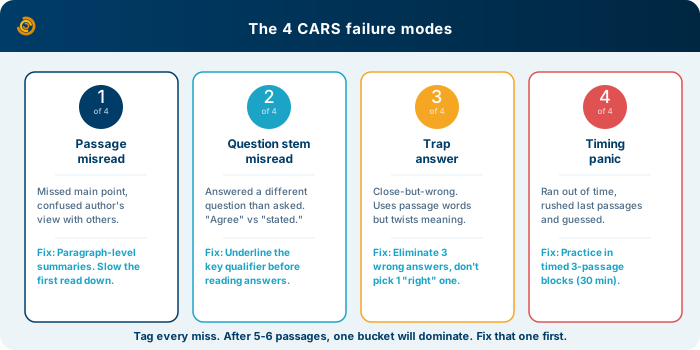
I tell students to sort their CARS mistakes into four buckets. Not because categorization is inherently useful, but because you can’t fix “I’m bad at CARS.” You can fix specific, named problems.
Passage misread. You missed the author’s main point, misidentified the tone, or confused the author’s view with a view they were describing. This usually means you’re reading too fast or getting lost in the details without tracking the argument structure.
Question stem misread. You answered a different question than the one asked. “Which of the following does the author most likely agree with?” is not the same as “Which of the following is stated in the passage?” This happens more than people admit, especially under time pressure.
Trap answer. You understood the passage and the question, but you picked an answer that was close-but-wrong. These are the answers that use language from the passage but twist the meaning slightly, or that are true statements but don’t answer the specific question. The AAMC is very good at writing these.
Timing panic. You ran out of time or rushed the last few passages and guessed. This isn’t really a comprehension problem. It’s a pacing problem.
Once you’ve done 5-6 passages and tagged each miss, the pattern becomes obvious. One of these buckets will have most of your errors. That’s where you focus.
How to fix each failure mode
For passage misreads: slow down your first read. I know that sounds counterproductive when you’re worried about timing, but hear me out. After reading each paragraph, pause for 2-3 seconds and mentally summarize it in one phrase. “Author argues X.” “Counterargument presented.” “Evidence for first claim.” This forces you to track the argument structure instead of just absorbing words. Some people call this passage mapping. I don’t care what you call it. The point is to read actively instead of passively.
For question stem misreads: start underlining or mentally flagging the key qualifier in every question before you look at the answers. Words like “most likely,” “least supported,” “the author would agree,” and “as described in the passage” completely change what counts as a correct answer. Train yourself to identify the qualifier first.
For trap answers: use elimination more aggressively. Instead of picking the answer that feels right, eliminate the three that are definitely wrong. For each answer choice, ask: “Can I point to something specific in the passage that supports this?” If you can’t, it’s probably wrong regardless of how reasonable it sounds.
For timing: the MCAT is a 7.5-hour endurance test, so practice in timed blocks of 3 passages (about 30 minutes). Don’t practice one passage at a time and then wonder why you can’t sustain focus across nine. The endurance component is real and you can only build it by simulating it.
The 10-minute passage rhythm
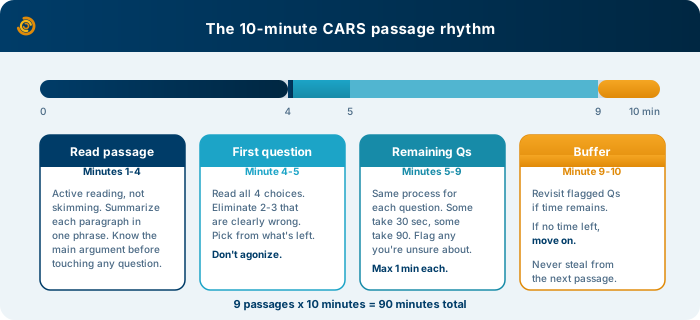
Here’s roughly how I allocated time per passage, and it’s what I recommend to students:
Minutes 1-4: Read the passage. Not skimming, actually reading. Do the paragraph-summary thing. By the end, you should be able to state the main argument in one sentence.
Minutes 4-5: Read the first question and all four answer choices. Eliminate what you can. Pick. Move on.
Minutes 5-9: Repeat for remaining questions. Some take 30 seconds, some take 90. Don’t agonize over any single question for more than a minute.
Minute 10: If you have time left, revisit any question you flagged. If you don’t, move on. The worst thing you can do in CARS is steal time from a later passage to agonize over an earlier one.
This rhythm gives you 90 minutes for 9 passages. It’s tight but doable once you practice it.
What most CARS advice gets wrong
A lot of CARS advice online focuses on reading comprehension tips borrowed from SAT/ACT prep. “Identify the thesis.” “Look for transition words.” That’s not wrong, exactly, but it misses the thing that makes MCAT CARS different from every other reading comprehension test.
MCAT CARS passages are written by academics, and the answer choices are written by test designers who know exactly where students will misread. The passages aren’t hard because the vocabulary is unusual. They’re hard because the arguments are layered, the author’s opinion is sometimes buried, and the wrong answers are designed to match your misunderstanding.
That means the real skill isn’t reading comprehension in the traditional sense. It’s learning to notice when the test is trying to mislead you. And you build that skill through careful review of wrong answers, not through reading more passages faster.
When to start worrying (and when not to)
If you’re scoring 125-126 on CARS and your exam is 3+ months away, that’s fixable. Most students I’ve worked with who went from 125 to 128-129 did it by changing their review process, not by doubling their passage volume.
If you’re scoring 123-124 and your exam is in 6 weeks, that’s a harder conversation. CARS improvement is slow. It takes weeks of deliberate practice to shift a score by 2-3 points because you’re changing reading habits, not filling content gaps.
Either way, the path is the same: tag your failure modes, fix the dominant one, then move to the next. It’s not glamorous, but it works. If you’re targeting 520+ overall, a 129 in CARS is a realistic floor — build your total from the other three sections by strengthening areas like the nervous system, solutions, and work and energy.
Our question bank includes CARS passages with detailed explanations if you need more practice material. And if you want someone to review your CARS error log and help you spot the pattern, that’s something our tutors do regularly. Sometimes an outside eye catches the habit you can’t see from inside it.
Frequently asked questions
How do I improve my CARS score?
Focus on reviewing wrong answers by categorizing errors into passage misreads, question misreads, trap answers, or timing issues, then fix the dominant failure mode.
What is a good CARS score?
A 129 in CARS is a strong, realistic target. For 520+ overall scorers, 129 is the recommended floor to build from.
How long should I spend per CARS passage?
About 10 minutes per passage: 4 minutes reading, then roughly 1 minute per question, with any remaining time for flagged questions.
Why is MCAT CARS so hard?
CARS passages use layered academic arguments with buried author opinions, and wrong answers are designed to match common misunderstandings, making it a reasoning test, not just reading comprehension.
How long does it take to improve CARS?
CARS improves slowly compared to science sections. Most students need several weeks of deliberate practice to shift a score by 2-3 points.