
Application Strategy
How to Pre-Write Your Medical School Secondaries (2027 Cycle): The 7 Prompts to Draft Now
Secondaries flood out in July. The 6 weeks between AMCAS submission and that deluge are your biggest advantage — if you pre-write. The 7 prompts to draft now, from a 527 MD.
If you submitted your AMCAS primary this week, here’s the timeline you’re actually on: AMCAS starts transmitting verified applications to schools on June 26, and most schools fire back secondary applications within one to two weeks. That means the secondary deluge hits in early-to-mid July — about six weeks from now.
Those six weeks are the single biggest strategic advantage you have in this entire cycle. Almost nobody uses them.
The typical applicant submits the primary, exhales, and waits for secondaries to arrive before writing a word. Then 18 schools send prompts in the same 10 days, each wanting 3-5 essays, and the applicant spends July drowning — turning around rushed, generic essays two and three weeks late, in the exact window when rolling admissions rewards speed. The applicant who pre-wrote spends July editing instead of drafting, and submits everything inside a week.
Here’s how to be the second applicant.
Why pre-writing works: schools recycle their prompts
The reason you can write secondaries before you’ve received them is simple: schools reuse 80-90% of their prompts year to year. A school that asked “Why our school?” and “Describe a challenge you overcame” last cycle will, with rare exceptions, ask versions of the same questions this cycle. Prompt databases from prior years are publicly compiled, and the wording barely moves.
Better still, the entire universe of secondary prompts collapses into a manageable set of recurring types — about fifteen, with a core seven doing most of the work. Across every school you apply to, these cover the overwhelming majority of what you’ll be asked. You’re not writing 60 unique essays from nothing. You’re writing a handful of strong cores — seven near-universal ones, plus a few more if they apply to you — and then adapting each to fit specific prompts and word limits.
That distinction is the whole game.
The math: pre-writing turns 125 hours into 50
Run the numbers on a realistic school list. If you apply to 25 schools, you’ll face roughly 60-75 individual secondary essays. Written cold, in July, under time pressure, that’s on the order of 125 hours of work — concentrated into the four-to-six weeks when you can least afford it.
Working from pre-written cores, the same volume drops to roughly 50 hours, and the work shifts from “generate an essay from a blank page on a deadline” to “cut my 550-word adversity core down to this school’s 300-word limit and swap in their language.” One of those is exhausting and error-prone. The other is mechanical and fast.
The pre-writing happens now, in the calm six-week window before transmission, when you have time to think, get feedback, and revise. That’s the trade: move the hard cognitive work from your worst weeks into your best ones.
The secondary essay topics worth pre-writing
Secondary prompts cluster into about fifteen recurring topics. A core seven are near-universal — almost every school asks some version. A second tier shows up often enough that a ready draft pays for itself. Here’s the full map: how common each topic is, and how much of it you can realistically write before you’ve seen a single prompt.
| Topic | The question behind it | How common | Pre-write priority |
|---|---|---|---|
| Why this school? | Why us, specifically? | Near-universal | Scaffold only |
| Diversity & contribution | What will you add to the class? | Near-universal | Pre-write now |
| Adversity | A challenge you overcame, and what you learned | Near-universal | Pre-write now |
| Future goals | The kind of physician you want to be | Very common | Pre-write now |
| Gap year / current activities | What are you doing this year? | Very common* | Pre-write now |
| Teamwork, conflict, leadership | A “tell us about a time…” story | Common | Pre-write 2 stories |
| ”Anything else?” | Optional — anything we missed? | Very common | Decide, then draft |
| Why medicine? | Your motivation for the field | Common | Pre-write now |
| Meaningful clinical experience | A patient moment that shaped you | Common | Pre-write now |
| Cultural competency / underserved | Connecting across difference; serving the underserved | Common | Pre-write now |
| A challenge facing medicine | A current problem in healthcare | Occasional | Research + adapt |
| Failure or mistake | Something you got wrong, and the lesson | Occasional | Pre-write now |
| Research experience | Your research, in plain language | Occasional† | Draft if it applies |
| Ethical dilemma | A time you faced a values conflict | Occasional | Draft if it applies |
| Self-care & resilience | How you handle stress and avoid burnout | Occasional | Pre-write now |
| Hobbies / outside interests | Something real beyond medicine | Occasional | Quick draft |
*if you’re not a full-time student in the coming year · †more frequent at research-heavy schools
There will always be a few one-off, school-specific prompts you can’t predict. Everything else is a reworded version of a row above. The seven at the top are the backbone — pre-write strong cores for those first.
For each: write a 400-600 word core draft of your strongest material. Don’t write to a specific school yet, and don’t write to a tight word limit yet — you want a flexible, modular block you can later trim and aim. Build it out of pieces (an opening hook, two or three concrete examples, a reflective close) so you can drop pieces in and out depending on the prompt and the count.
1. “Why This School?”
The most common secondary prompt, and the one most applicants write worst. They submit a paragraph that could be pasted into any school’s box with the name swapped. Admissions readers spot that instantly.
What they’re evaluating: whether you’ve done real research and whether your reasons are specific to them — a named program, a curriculum structure, a clinical site, a community they serve, a mission you align with. “Strong reputation” and “diverse patient population” are not reasons; every school has those.
How to pre-write it: you can’t fully pre-write this one, because the specifics change per school — but you can build the scaffold now. Draft a reusable structure (your two or three selection criteria that genuinely matter to you, framed in your voice) with clearly marked blanks for school-specific detail. Then maintain a research doc where, for each school, you log 2-3 concrete, verifiable specifics. When the secondary arrives, you assemble in 20 minutes instead of two hours.
2. Diversity & Contribution to the Class
“What perspective, background, or experience would you add to our entering class?” Nearly universal.
What they’re evaluating: what you uniquely bring, and the depth of your self-awareness. Diversity here is broad — lived experience, socioeconomic background, a non-traditional path, a perspective from work outside medicine. You do not need a dramatic story; you need a genuine one, told with specificity and reflection.
How to pre-write it: identify the one thread of your background you can speak to most authentically, and write the core around a concrete scene rather than an abstract claim. “Show, don’t tell” applies hardest here.
3. Adversity / Overcoming a Significant Challenge
“Describe a significant challenge you’ve faced and what you learned from it.”
What they’re evaluating: not the size of the hardship — your handling of it. The best adversity essays are rarely the most dramatic. They’re the most reflective. Growth, insight, and what you’d do differently matter more than the severity of what happened.
How to pre-write it: pick the challenge that produced the clearest change in how you think or act, not the one that sounds biggest. Spend most of the word count on the reflection, not the event.
4. Gap Year / What You’re Doing This Year
“If you will not be a full-time student in the coming year, describe your planned activities.”
What they’re evaluating: that your time is purposeful. Whatever you’re doing — research, scribing, a post-bacc, full-time work — they want to see intention and growth, not a holding pattern.
How to pre-write it: straightforward and high-leverage to bank now, because the facts don’t change. Draft a clear, specific account of your plans and what you’re getting out of them.
5. Future Goals & The Kind of Physician You Want to Be
“What are your career goals?” / “What kind of physician do you hope to become?”
What they’re evaluating: direction and self-knowledge. You are not locking yourself into a specialty. They want to see that you’ve thought seriously about how you want to practice — the populations, settings, and problems that pull at you.
How to pre-write it: anchor it in something real from your experience that points forward, and keep it honest. Vague ambition (“I want to help people”) reads as thin; a specific, evidenced interest reads as mature.
6. Teamwork, Conflict, or Leadership
The behavioral prompt: “Tell us about a time you worked on a team / handled a conflict / led a group.”
What they’re evaluating: how you operate around other people — exactly what they can’t see from your stats. Medicine is a team sport, and these prompts are a proxy for whether you’ll be a good colleague.
How to pre-write it: use a tight situation-action-result structure built around one specific episode. Pre-draft one strong teamwork story and one conflict/leadership story; between them you’ll cover most variants.
7. The “Anything Else?” Open-Ended Essay
“Is there anything else you’d like the admissions committee to know?”
What they’re evaluating: judgment, partly — including whether you know when not to write. Use it to address a genuine gap or add real context (an explanation for a grade dip, an experience the application didn’t capture). Don’t use it to repeat your personal statement.
How to pre-write it: decide now whether you actually have something worth adding, and if so, draft it cleanly. Having this ready prevents the panic-written version at 2 a.m. on a deadline.
The second tier: draft these if they apply to you
The seven above are near-universal. The next set shows up often enough — especially the first three — that having a core ready is worth the hour:
- Why medicine? Your motivation for the field, told through a specific moment rather than a thesis statement. It overlaps with your personal statement, so make the secondary version shorter and sharper — never paste.
- A meaningful clinical or patient experience. The single encounter that crystallized something for you. Schools want the scene and the reflection, not a recap of your hours.
- Cultural competency / serving the underserved. A time you connected with someone whose background differed from yours, or your commitment to underserved communities. Anchor it in something you’ve actually done, not a stance.
- A challenge facing medicine today. Pick one issue you can speak to with depth and a point of view (access, cost, equity, burnout, AI in diagnosis) — breadth reads as a book report. This one you research and adapt rather than fully pre-write.
- A failure or mistake. Distinct from adversity: this is about something you got wrong. The lesson and the change you made matter; defensiveness sinks it.
- The lighter ones — research experience (plain-language, for research-heavy schools), an ethical dilemma, how you handle stress and avoid burnout, and a genuine hobby outside medicine. Each is quick to draft once and reuse. The hobby prompt is a gift: be specific and human, not strategic.
How to pre-write so your drafts actually adapt
Pre-writing fails when applicants write seven finished essays at fixed lengths and then try to jam them into prompts they don’t quite fit. The biggest secondary mistake is forcing a pre-written essay onto a prompt it doesn’t answer. Readers can tell, and it reads as careless.
Build for adaptation instead:
- Write long, then cut. A 550-word core trims cleanly to 300 or 250. Going the other way — padding a short essay to fit a longer limit — never reads as well.
- Write in modules. Separable opening hook, body examples, and reflective close let you recombine for different angles and lengths.
- Read every prompt twice before adapting. Confirm the exact question and the exact limit (some are word counts, some are character counts) before you touch your core.
- Always answer the question on the page, not the question you pre-wrote for. The core is raw material, not a finished answer.
The 7-to-14-day rule
Once secondaries arrive, the working standard is to return each one within 7-14 days. Most schools use rolling admissions — they review as applications complete, and seats fill through the fall — so a fast, polished turnaround both signals real interest and gets you into the review pool earlier.
A 7-day turnaround is impossible to do well from a blank page when six schools land in the same week. It’s very doable when you’re editing a draft you already wrote in June. That’s the entire point of pre-writing: it’s what converts “fast” and “good” from a trade-off into a both.
Your next six weeks
A realistic pre-write schedule for the window between submission and the July deluge:
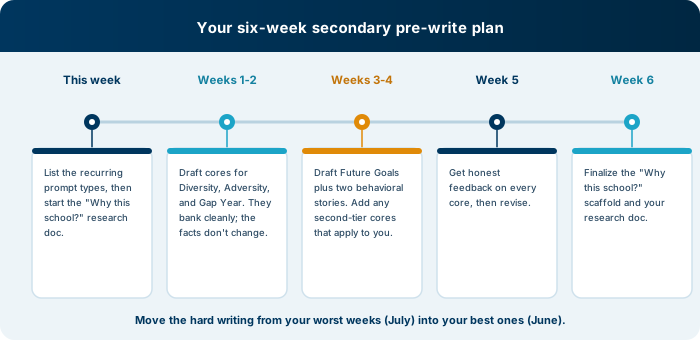
- This week: build your prompt-type list and start the “Why This School?” research doc (2-3 specifics per school).
- Weeks 1-2: draft cores for Diversity, Adversity, and Gap Year — the three that bank most cleanly because they don’t change per school.
- Weeks 3-4: draft Future Goals and your two behavioral stories (teamwork + conflict/leadership). Add any second-tier cores that apply to you — Why Medicine, a meaningful clinical experience, serving the underserved. Decide whether you have a real “Anything Else.”
- Week 5: get feedback on every core from someone who’ll be honest, and revise.
- Week 6: finalize the “Why This School?” scaffold and your research doc so you can assemble per-school essays fast.
When secondaries start arriving in July, you’ll be adapting and submitting — not staring at blank boxes.
Bottom line
Secondaries are where a strong cycle is won or lost, and they arrive faster and in greater volume than almost anyone expects. The applicants who thrive in July are the ones who did the thinking in June. You have a six-week head start right now — the only question is whether you use it.
If you’d like expert eyes on your secondary strategy, your school list, or your essay drafts as you build them, our admissions consulting team works with applicants through the whole cycle. We know which secondaries get read closely and which get skimmed, and the difference is usually decided in exactly the drafts you’d be writing over the next six weeks. For the upstream half of the timeline — when to actually hit submit — see our guide on when to submit AMCAS.
Frequently asked questions
When do medical school secondaries come out for the 2027 cycle?
AMCAS begins transmitting verified applications to schools on June 26, 2026. Most schools send secondaries within 1-2 weeks of receiving your verified primary, so the bulk of secondaries arrive early-to-mid July 2026. Some schools send to everyone who applies without screening, so you may see a few even sooner.
Can you really pre-write secondary essays before you receive them?
Yes, and you should. Schools recycle 80-90% of their prompts year to year, and roughly seven question types cover the overwhelming majority of what you'll see. You can write a strong 400-600 word core draft for each type now, then cut and customize it to each school's exact prompt and word limit when secondaries arrive.
How many secondary essays will I have to write?
It scales with your school list. A 25-school list typically generates 60-75 individual essays. Written from scratch that's roughly 125 hours of work compressed into the busiest weeks of summer. Working from pre-written cores cuts it closer to 50 hours.
How long should a secondary essay be?
Most prompts cap responses between 250 and 500 words, though limits vary widely by school and some are set by character count. Always read each prompt's instructions before writing — answering the wrong word limit, or the wrong question, is the most common secondary mistake.
How fast should I submit a secondary after receiving it?
The working standard is 7-14 days. Most schools use rolling admissions, so a fast, polished turnaround signals genuine interest and gets you reviewed sooner. Pre-writing is what makes a 7-day turnaround possible without the quality collapsing.