
Application Strategy
When to Submit AMCAS in 2026 (And Why Day 1 Isn't Always Best)
How the AMCAS verification queue really works, when to submit, and a submission-readiness checklist from a 527 MD. Day 1 vs. mid-June, broken down.
The 2027 application cycle opens later this month. AMCAS begins accepting submissions on May 28, 2026, and the conventional wisdom for the past decade has been the same: submit on day 1.
That advice isn’t wrong. But it’s incomplete. And following it without thinking can cost you a cycle.
The most important date isn’t the day AMCAS opens. It’s the day your application gets verified and transmitted to medical schools, and verification can take anywhere from 2 to 8 weeks depending on when in the season you submit. A day-1 submission with errors can land in schools later than a clean submission from June 15.
Here’s how the AMCAS timeline actually works in 2026, and how to decide when you’re ready to submit.
The 2026 AMCAS calendar
Application opens: May 1, 2026. You can begin entering data, but the submit button is inactive.
Submission opens: May 28, 2026 (the Thursday after Memorial Day). The moment you hit submit, AMCAS receives your application and adds it to the verification queue.
Verification begins: Late June 2026. Applications are not transmitted to medical schools until they’ve been verified by AAMC staff.
First transmissions to schools: Late June. Day-1 submitters typically clear verification by mid-June and land in schools’ inboxes by late June.
Secondary applications: Late June through August. Most schools send secondaries within 1-2 weeks of receiving your verified primary.
Last verification window: ~October. Submitting in September means waiting 6-8 weeks before schools see anything.
Two facts to internalize:
- Submission ≠ transmission. You can hit submit on May 28 and still not have your application at schools until late June.
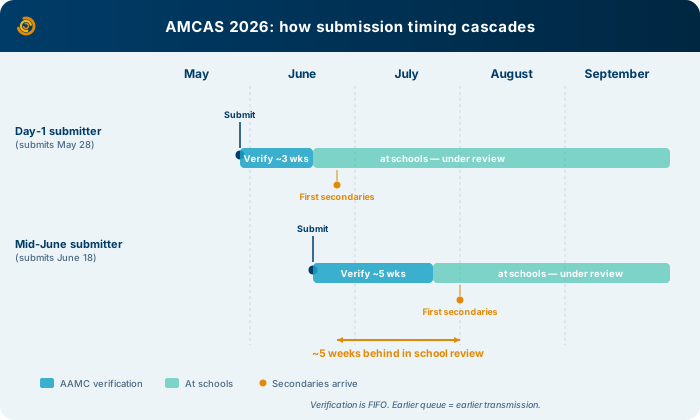
- Verification is FIFO. Applications are processed in the order they’re complete. Earlier submission = earlier place in line = earlier transmission. The queue grows quickly through June, which is why a 3-week submission delay can mean a 5-week downstream delay.
What submitting day 1 actually wins you
If your application is genuinely ready on May 28, day-1 submission is the right play. Here’s what it buys:
Verification by mid-June. Day-1 submitters typically clear AAMC verification within 2-3 weeks. Submitters from mid-June onward wait 4-6 weeks. Late-summer submitters wait 6-8 weeks.
Earliest secondary invitations. Schools send secondaries when they receive your verified primary. Day-1 verified means late-June secondaries. Submitting on July 1 means waiting until August for the same schools to even know you exist.
Rolling admissions advantage. Most medical schools use rolling admissions, evaluating applications as they arrive and filling seats throughout the cycle. By October, many schools have already interviewed and accepted 30-50% of their incoming class. Late submitters compete for a shrinking pool of seats.
Time for secondaries. Schools send 8-15 secondary essays apiece. If you apply to 20 schools, that’s 150-200 essays in 4-6 weeks. Earlier transmission means more breathing room when the secondary deluge hits.
When day 1 is the wrong call
Submitting an unready application is worse than submitting a polished one two weeks later. Three reasons:
1. Errors trigger reverification. If AAMC finds inconsistencies, most commonly with coursework entry or transcript matching, your application gets kicked back. You correct the error, resubmit, and go to the back of the verification queue. A day-1 submission with a transcript mismatch can end up verified after a clean submission from June 15.
2. Bad work and activities entries can’t be fixed. Once your application is submitted, you cannot change your work and activities, your personal statement, or your most meaningful experience essays. If you rushed the W&A section to make day 1 and described a 200-hour clinical role in 30 words of vague language, you’ve capped your application’s strength for the whole cycle.
3. A typo in your personal statement is permanent. Same rule. Submitted means locked. You can re-read your essay six weeks later and find a sentence you’d rewrite, but you cannot.
The submission-readiness checklist
Use this before you decide whether to submit. If you can’t check every box, wait.
Your application data
- All coursework entered exactly as it appears on your official transcript (course names, credit hours, grades). This is the most common verification snag.
- All transcripts requested from every institution where you’ve earned college credit, including dual enrollment and study abroad. Easy to forget.
- Letters of recommendation in motion through Interfolio or your school’s committee letter system.
- Verified MCAT score on file with AAMC, or a confirmed test date with a registered seat.
Your essays
- Personal statement: revised through at least 3 drafts, reviewed by 2+ people you trust to be honest.
- All 15 work and activities entries written, or your shortest list with clear thematic coverage.
- Most meaningful experience essays (up to 3, 1,325 characters each) drafted and revised.
- Every entry proofread for typos, dates, and supervisor contact info.
Your school list
- Initial list of schools where you’ll send your primary. You can add schools later, but the first list locks in your day-1 transmission. If you’re still building it, our Med School Explorer is a free MSAR alternative for comparing every MD and DO program by MCAT, GPA, and admissions odds.
- You’ve checked each school’s typical timeline and secondary policy.
- You’ve confirmed you can afford the application fees. The AMCAS primary plus per-school fees add up fast — if cost is a barrier, see our AAMC FAP guide.
Your MCAT
- Your score is back, OR you’ve registered for an April-or-earlier test date.
If you’re testing in May or June 2026, you can still submit your primary on day 1. AMCAS does not require an MCAT score to submit. Schools won’t review you until they have your score, but your application sits at the front of their queue, ready to flip into active review the moment your score posts. Waiting to submit costs you 2-4 weeks of queue position for no benefit.
The special cases
You’re a May or June MCAT tester. Submit your AMCAS primary as soon as the rest of the application is ready. Don’t wait for your score. Schools won’t review you until your score posts, but having your primary verified and on file means the moment your score comes in, you flip into the active review queue immediately. Holding the submission costs you weeks for no benefit.
You’re a re-applicant. Day 1 matters more for you, not less. Schools that look at re-applicants want to see meaningful improvement, and the earliest applicants get the closest reads. Have your re-application reasons clearly articulated in your personal statement. Wait for the application to be strong, not for a milestone date.
Your committee letter is delayed. You can submit your AMCAS primary without your letters in place. AMCAS will hold your application as “submitted, awaiting letters,” but your verification clock starts as soon as you hit submit. As long as letters arrive within 4-6 weeks of submission, you’re fine.
Your final spring transcript isn’t out yet. Submit using your most recent available transcript. Schools understand that spring grades are pending. The “academic update” mechanism lets you send updated grades later.
Common day-1 mistakes I see every year
Submitting before transcripts are requested. Without your transcripts on file, your application sits unverified until they arrive. People assume the AMCAS verification team will reach out to follow up. They won’t.
Listing courses with the wrong credit hours. Verification fails most often on this. Quarter-system schools often confuse semester-equivalents. Check every row against your transcript, line by line.
Generic work and activities entries. “Volunteered at hospital, learned about patient care” wastes a slot. Each of the 15 W&A entries should give an admissions reader something specific: a number, a story, a skill, a piece of evidence. The most meaningful experience essays carry even more weight.
Listing fewer schools than you should, planning to add them later. Some applicants submit on day 1 with 5 schools and plan to “add more later.” You can, but those additional schools won’t receive you until you’ve added them and your application has been re-transmitted. If you know you want to apply to 20 schools, include all 20 in the first submission.
The bottom-line decision
If on May 28 your application is genuinely ready, with all coursework entered correctly, transcripts requested, essays polished through multiple drafts, and school list set, submit on day 1.
If it isn’t, target the next clean window: roughly June 1-15. This is when most well-prepared applicants submit. Verification at this point is still fast (3-4 weeks), and you arrive at schools by mid-July. That’s well within the early-cycle bucket.
If you can’t be ready by mid-June, take an extra week. A clean submission on June 22 outperforms a sloppy submission on May 28 every cycle.
Where the cycle really gets won
Day 1 vs. mid-June is a smaller decision than it feels. The bigger lever is the quality of what you submit and the speed with which you turn around secondary applications when they arrive in July and August.
If you’d like a second set of eyes on your AMCAS strategy, school list, or essay portfolio, our admissions consulting team works with applicants throughout the cycle. We’ve seen what gets read closely and what gets passed over, and we can help you decide whether you’re truly ready to submit, or whether 10 more days of work would be the highest-leverage decision of your year.
Frequently asked questions
When does AMCAS open in 2026?
AMCAS begins accepting applications on May 28, 2026, the Thursday after Memorial Day. You can start entering your data earlier in May, but the submit button activates on May 28.
How long does AMCAS verification take?
Verification takes about 2-3 weeks for day-1 submitters, 4-6 weeks for mid-June submitters, and 6-8 weeks for late-summer submitters. The queue is FIFO, so each week of delay compounds.
Should I submit AMCAS on day 1?
Only if your application is genuinely ready: coursework entered accurately, transcripts requested, essays revised through multiple drafts, school list set. A clean June 15 submission outperforms a sloppy May 28 submission every cycle.
Can I submit AMCAS without my MCAT score?
Yes. AMCAS does not require an MCAT score to submit. Schools won't review your application until they receive your score, but having your primary verified and on file means you skip to the front of the active review queue the moment your score posts.
What can I change after I submit AMCAS?
Very little. Your personal statement, work and activities, most meaningful experience essays, and coursework entries are locked. You can add schools to your list, update contact info, and send academic updates with new grades, but the core application content cannot be edited.