
Study Planning
MCAT Course vs. Books vs. Tutoring: How to Actually Choose
A 527 scorer's honest framework for choosing between an MCAT course, self-study with books, and 1-on-1 tutoring, by budget, timeline, and diagnostic score.
Every MCAT student faces the same three doors: buy a course, self-study with books, or hire a tutor. The prep industry would like this decision to feel complicated, because complicated decisions get solved with bigger purchases. It is not complicated. The right door depends on three things you already know: your budget, your timeline, and what your diagnostic told you.
I scored a 527, I run a tutoring company, and we publish free MCAT books. I have an obvious interest in all three doors, so this guide handicaps them honestly, including when you should not pay us or anyone.
The thing nobody tells you: the content is identical
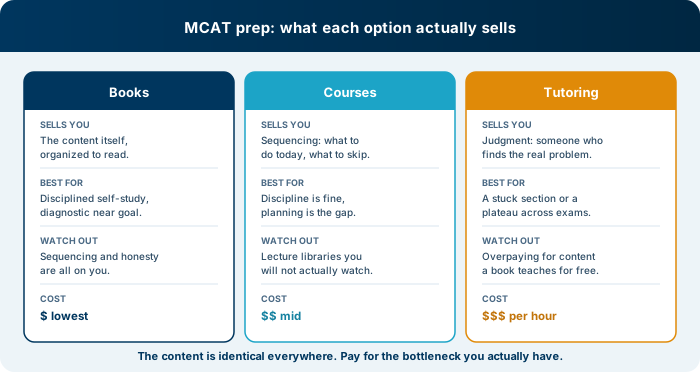
Every course, book set, and tutor teaches the same content, because the AAMC publishes exactly what is on the exam. Nobody has secret biochemistry. What you are actually buying differs by format:
- Books sell you the content itself, organized for reading.
- Courses sell you sequencing: what to do today, what to skip, when to test.
- Tutors sell you judgment: a person who watches you work, finds the real problem, and fixes that.
Price the doors by what they deliver. If sequencing is your problem, do not pay a tutor’s rate for it. If judgment is your problem, no amount of structure will substitute.
Self-study with books: the default, not the fallback
Self-study is the right starting point for most students, and the only door for tight budgets. It works when you can answer yes to three questions: do you have a written week-by-week plan, do you reliably do hard things without external pressure, and was your diagnostic within striking distance (roughly 15 points) of your goal?
If you go this route, your stack is free or nearly free: content review books, a question source, the official AAMC practice materials, and a structured study plan you actually follow. The plan matters more than the books. A mediocre book with a strict schedule beats perfect materials read at random.
Where self-study fails is rarely the content. It fails at sequencing (four weeks lost to re-reading chapters you already knew) and at honesty (nobody notices you have been avoiding CARS for a month).
Courses: paying for sequencing
A course earns its money when the planning itself is your bottleneck. The honest case for a course: you have the discipline to show up daily but you waste that discipline deciding what to do, you re-read strong content because it feels productive, and your timeline is too short to recover from a month of bad sequencing.
The honest case against: most big-brand courses are 60 to 90 hours of recorded lectures pointed at an average student who does not exist. If you watch video at 1.5x while folding laundry, you are buying entertainment, not preparation. The questions to ask any course before paying: does it find out what you already know before telling you what to study, does it test you continuously or just at the end, and does it adapt when you fail something?
That gap, courses that place you instead of lecture you, is exactly what we are building the Premier MCAT Prep Course to close: placement diagnostics first, interactive lessons at the depth you need, and a checkpoint after every sequence. It is in early access now, built on the same six books we give away free.
Tutoring: paying for judgment
Tutoring is the most expensive door per hour and the cheapest per problem solved, when the problem is real. Real problems: a section score that has not moved across three practice exams, a diagnostic more than 15 points from your goal with a fixed test date, retaking after a score you did not expect, or knowing the content cold and still missing passage questions.
What tutoring should not be: paying $85 an hour for someone to walk you through content a book teaches for free. A good tutor assigns the content as homework and spends the hour on what only a human can see: how you reason through a passage, where your process breaks, and what to do about it. That is how we run tutoring, and it is why our packages are built around targeted hours instead of hundred-hour bundles.
The decision, by situation
- Budget under $500, diagnostic close to goal: books, AAMC materials, and a strict plan. Spend the money on official practice exams.
- Decent budget, discipline is fine, planning is the struggle: a course with placement and checkpoints. Avoid lecture libraries.
- One section stuck, or a plateau across practice exams: targeted tutoring hours aimed at exactly that. Do not buy structure when you need judgment.
- Far from goal with a fixed date: tutoring as the spine, books or a course for coverage between sessions.
- Long runway, low budget, high discipline: books now; reassess with a practice exam in eight weeks. You may never need to spend more.
The worst outcome in MCAT prep is not picking the wrong door. It is standing in the hallway for six weeks comparing doors. Pick the cheapest option that matches your actual bottleneck, start this week, and let your first practice exam tell you whether to upgrade.
Frequently asked questions
Do I need a course to do well on the MCAT?
No. Plenty of students score 515+ with books and a question bank alone. A course earns its price when you need structure and sequencing decided for you, not because the content is secret. The content is the same everywhere; the delivery is what you are paying for.
Is MCAT tutoring worth it compared to a course?
Tutoring is worth it when something specific is broken: a section that will not move, a plateau across multiple practice exams, or accountability that self-study has not fixed. A course is structure; a tutor is judgment. They solve different problems.
What is the cheapest way to study for the MCAT?
Free books plus AAMC official practice materials. The AAMC materials are non-negotiable for everyone regardless of what else you buy, because they are the only questions written by the people who write the exam.
Can I combine a course with tutoring?
Yes, and it is often the most efficient setup: the course provides the daily structure and content coverage, and a few targeted tutoring hours fix the sections the course cannot move. That usually costs less than buying a premium course or a large tutoring package alone.