
Study Planning
3-Month MCAT Study Plan: Week-by-Week Framework
A 12-week MCAT study plan balancing content review, passage practice, and full-lengths. Built by a 527 scorer for students who can't take a year off.
Three months is enough time to prepare for the MCAT. It’s not comfortable, and there’s no room for extended breaks, but it works if you have a structure. I’ve seen students go from diagnostic scores in the low 500s to 515+ in twelve weeks. I’ve also seen students waste those same twelve weeks because they spent the first four shopping for the “right” prep book.
The difference is almost always the plan. Not the resources, not the natural ability. The plan.
Here’s the framework I used and the one I give to students who come to me with a 3-month runway.
Week 0: take a diagnostic and be honest about the result
Before you plan anything, take a full-length diagnostic exam under test conditions. AAMC offers a free half-length, or you can use a third-party full-length. The specific test matters less than the conditions: timed, no interruptions, no phone, no pausing.
Your diagnostic score tells you two things:
- How far you need to go (the gap between where you are and where you need to be)
- Which sections need the most work
A student who scores 502 on a diagnostic needs a fundamentally different plan than one who scores 510. The 502 scorer has content gaps. The 510 scorer probably has strategy and endurance problems. Same timeline, different priorities.
Write down your section scores. Rank them from weakest to strongest. Your plan should spend disproportionate time on the weakest section, not equal time on everything.
Weeks 1-4: content review (but not the way you think)
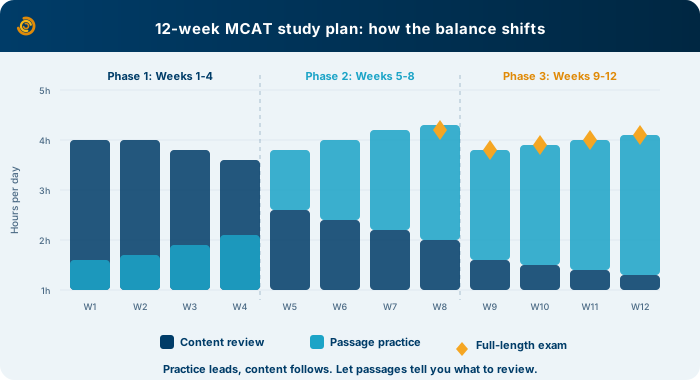
The instinct during content review is to read through an entire prep book cover to cover. This is a bad idea for two reasons. First, you’ll spend 4 weeks reading and retain maybe 30% of it. Second, you’ll have zero practice reps, which means you won’t know if your understanding is actually usable on test day.
Instead, pair content with practice from day one.
Daily structure during weeks 1-4:
- 2-3 hours of targeted content review on your weakest subjects
- 1 hour of passage practice in those same subjects (even if you bomb them)
- 30 minutes of Anki or active recall on what you reviewed that day
The passage practice is non-negotiable even during content review. Passages force you to apply what you just read, which is how you actually learn it. Reading about the citric acid cycle is passive. Answering a passage question that requires you to predict what happens when one enzyme is inhibited is active.
For content resources, pick one and commit. Kaplan books, Khan Academy videos, whatever. The worst thing you can do is bounce between three different resources because you’re convinced you’re missing something. You’re not. The content is the content. The AAMC publishes exactly what’s tested, and our free study guides cover everything from atomic structure to genetics and evolution. Our free resources page has the equation sheet and study guides if you need supplementary material, but you don’t need five sources.
What to cover by week 4:
- Biochemistry fundamentals (amino acids, enzymes, metabolism)
- Your weakest science section’s core topics
- At least a first pass through psych/soc terminology (this section is memorization-heavy and rewards early exposure)
Don’t try to “finish” content review by week 4. You won’t, and that’s fine. Content review continues in the background throughout the entire 12 weeks. What matters is that you’ve built enough foundation to make passage practice productive.
Weeks 5-8: passage volume and timing work
This is where most of your score improvement happens. Not because you learn new content, but because you learn how the MCAT asks questions and where you consistently break.
Daily structure during weeks 5-8:
- 1 hour of content review (targeted, based on what passages exposed as weak)
- 2-3 hours of timed passage sets (full sections when possible)
- 30-45 minutes of thorough review per session
- Continue Anki daily
The shift here is that practice leads and content follows. If you miss 3 questions on electrochemistry in a C/P passage, that night’s content review is electrochemistry. If you miss a bunch of psych/soc questions about social theories, that’s your next review topic. Let the passages tell you what to study.
Start a mistake log. This can be a spreadsheet, a notebook, whatever works. For each question you miss, write down:
- The topic
- Why you missed it (content gap, misread, trap answer, timing)
- What you’d do differently
After two weeks of this, patterns emerge. You’ll see the same two or three topics coming up again and again. Those are your high-yield review targets for the remaining weeks.
Take your first full-length practice exam by the end of week 6. Don’t wait until you “feel ready.” You won’t feel ready. The point of the first full-length is to experience the endurance demands of a 7-hour test, not to hit your target score.
Weeks 9-12: full-length exams and refinement
The final month is about simulation and refinement. You’re not learning new content anymore. You’re sharpening what you already know under realistic conditions.
Take a full-length practice test every 5-7 days. Between full-lengths, review thoroughly. A single full-length exam generates enough data to keep you busy for 2-3 days of targeted review.
The AAMC full-lengths are the gold standard here. If you haven’t taken them yet, save at least 2-3 for this phase. Third-party tests are fine for building endurance, but AAMC tests are the only ones that accurately predict your real score.
Weekly schedule during weeks 9-12:
- Day 1: Full-length exam (simulate test day as closely as possible)
- Days 2-3: Review every question, even the ones you got right
- Days 4-5: Targeted practice on whatever the full-length exposed
- Day 6: Light review, Anki, rest
- Day 7: Repeat
Score tracking matters now. Plot your full-length scores. You should see an upward trend. If you plateau for two consecutive full-lengths, something in your approach needs to change. That’s a good time to get outside input, whether from a tutor, a study partner, or even just posting your mistake log to a forum for feedback.
The things that derail 3-month plans
I’ve watched enough students go through this to know where the common failure points are.
Spending too long on content review. If you’re still “finishing content” in week 7, you’ve allocated your time wrong. Content review should taper, not expand. Force yourself into passages early.
Skipping CARS practice because “I’ll get to it later.” CARS is the section that improves the slowest. If you push it to the last 4 weeks, you’re not giving yourself enough time. Do CARS passages from week 1. Even one passage a day adds up.
Not reviewing full-lengths properly. Taking a practice exam is maybe 20% of the value. The other 80% is the review. If you take a full-length on Saturday and start a new one on Tuesday without reviewing, you’re wasting exams.
Comparing your timeline to Reddit. Someone on r/MCAT studied for 6 months and scored 528. Someone else studied for 6 weeks and scored 520. Neither of those people are you. Your plan should be based on your diagnostic, your schedule, and your target score. That’s it.
A note on flexibility
This plan assumes roughly 25-30 hours per week of focused study. If you’re working or taking classes full-time, stretch it to 4-5 months. The phases stay the same, the weeks just expand. Trying to cram a 3-month plan into available hours that don’t exist will burn you out by week 6.
If you’re not sure whether 3 months is realistic for your situation, we offer free consultations where we can look at your diagnostic score, your schedule, and help you figure out a timeline that actually works. Sometimes the best plan is the one that’s honest about how much time you really have.
Frequently asked questions
Is 3 months enough to study for the MCAT?
Yes, 3 months is enough if you study 25-30 hours per week with a structured plan. If working or in school full-time, consider extending to 4-5 months.
How many hours a day should I study for the MCAT?
During a 3-month plan, expect about 4-5 hours per day of focused study, split between content review, passage practice, and active recall.
When should I start taking MCAT practice exams?
Take your first full-length practice exam by the end of week 6, then take one every 5-7 days during the final month of preparation.
Should I do passage practice during content review?
Yes. Pair content review with passage practice from day one. Passages force you to apply what you learned and reveal which content gaps matter most.