
Application Strategy
AAMC Fee Assistance Program (FAP) 2026: Save $2,000+ on the MCAT
Cut $2,000+ off your MCAT and med school applications. Who qualifies for AAMC FAP, the 2026 income thresholds, and how to apply step by step.
The AAMC Fee Assistance Program (FAP) is the single biggest cost-saver available to premedical students. If you qualify, FAP cuts your MCAT registration fee from $355 to $145, gives you the full AAMC Official Prep Bundle for free (a $390 value), waives up to $1,068 in AMCAS application fees, and includes a free 2-year MSAR subscription. Total program value exceeds $2,000 per applicant.
The total cost of taking the MCAT and applying to medical school can easily exceed $5,000 without FAP. Most premeds don’t realize how much of that cost is avoidable, and many who would qualify never apply because they assume the income thresholds are too low. They aren’t. I’ll walk you through exactly how AAMC FAP works in 2026, who qualifies, how to apply, and how to stack the program with third-party discounts to cut your total prep spending in half.
What the AAMC Fee Assistance Program actually gives you
The FAP isn’t just a discount on registration. It’s a package of benefits that covers the MCAT, your prep materials, and your medical school applications. Here’s what you get in 2026:
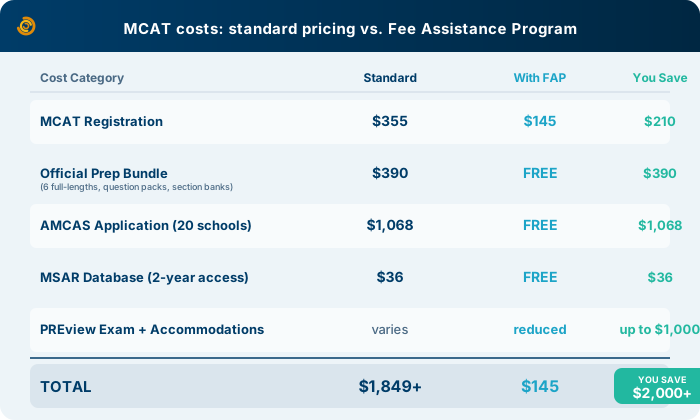
MCAT registration: $145 instead of $355. That’s a $210 savings per attempt.
MCAT Official Prep Online-Only Bundle: Free. This normally costs around $390 and includes all six AAMC full-length practice exams (including the new Practice Exam 6), all four science question packs, both CARS question packs, Section Bank Volumes 1 and 2, the Independent Question Bank, and the CARS Diagnostic Tool. These are the most important prep materials you can use because they’re written by the same people who write the real exam.
AMCAS application fee waiver: Covers up to 20 medical school submissions. This is worth $1,068 at standard pricing. The fee waiver applies automatically when you submit AMCAS — see our guide on when to submit AMCAS for cycle-timing strategy.
MSAR database: Free 2-year subscription (normally $36). This is the definitive source for comparing medical schools by GPA, MCAT, and admissions data. If you don’t qualify for FAP, you don’t have to pay for it either: our Med School Explorer is a free MSAR alternative that covers every US MD and DO program by GPA, MCAT, and admissions odds.
PREview exam discount: Reduced registration fees for the situational judgment test some schools now require.
MCAT accommodations support: Up to $1,000 toward the cost of a medical evaluation if you need to apply for testing accommodations.
ERAS residency discount: 60% off up to 50 residency applications when you eventually apply for residency. That’s years away, but the benefit carries forward.
Add it all up and the total value exceeds $2,000, and that’s before third-party discounts.
Who qualifies for the FAP
Eligibility is based on household income relative to the federal poverty level. In 2026, you qualify if every household on your application (yours and your parents’, if applicable) has a 2025 total family income at or below 400% of the federal poverty level.
Here’s what that looks like in practice:
- Family of 1: $62,600 or less
- Family of 2: $84,600 or less
- Family of 3: $106,600 or less
- Family of 4: $128,600 or less
These thresholds are higher than most students expect. If you’re a single applicant earning under $62,600 per year, which includes most college students, recent graduates, and post-baccs, so you likely qualify.
Important detail about parental income: If you’re under 26, the AAMC requires your parents’ financial information regardless of whether they claim you as a dependent. If you’re 26 or older, only your own household income matters.
You also need to meet these requirements:
- You must have a U.S.-based home address
- You must be preparing to apply to medical school (not currently enrolled or graduated)
- You cannot already hold an MD or DO degree
How to apply for AAMC FAP in 2026
The 2026 FAP application opened on February 2, 2026 and closes in December 2026. Apply as early as possible, because benefits are not retroactive. If you register for the MCAT at full price before getting FAP approval, you won’t receive a refund.
Here’s what you’ll need:
- Your most recent federal tax return (IRS Form 1040). If you didn’t file, have your W-2s, 1099s, or other income documentation ready.
- Your parents’ tax information if you’re under 26.
- Basic personal information like your address, date of birth, and household size.
The application is submitted through the AAMC website. Processing typically takes 2-4 weeks. Once approved, your benefits are applied automatically when you register for the MCAT and when you submit your AMCAS application.
Pro tip: Apply for the FAP before you register for the MCAT. The reduced registration rate only applies if you’re already approved. Don’t lose $210 on timing.
Rescheduling and cancellation fees with FAP
Even with FAP approval, you may face fees if you reschedule or cancel your exam. FAP recipients get reduced rates:
- 60+ days before exam: $20 to reschedule (standard: $50)
- 30-59 days before exam: $40 to reschedule (standard: $100)
- 10-29 days before exam: $80 to reschedule (standard: $200)
- Less than 10 days: No changes allowed
Cancellation with FAP follows the same structure. If you cancel 30+ days before your test date, you’ll receive a partial refund of $175. After that deadline, there’s no refund.
The takeaway: if you think you might need to move your date, do it early. Every week you wait costs more.
Third-party prep discounts for FAP recipients
Once you’re approved for the FAP, several prep companies offer additional discounts:
- Magoosh: Free 12-month self-study MCAT prep subscription for FAP students
- Blueprint Prep: Reduced-tuition scholarships for FAP-approved students
- Kaplan: Up to 60% off MCAT courses for FAP recipients
- Gold Standard MCAT: Sponsored prep access for FAP-approved students
These discounts are typically applied by submitting proof of FAP approval during checkout or through a separate scholarship application. Check each company’s website for current terms.
How to prep effectively on a budget
Even with the FAP, you’ll want to be strategic about where you spend. Here’s a realistic breakdown of what a high-quality, budget-conscious MCAT prep plan looks like:
What you get for free (or nearly free) with FAP
- All AAMC official practice materials (6 full-lengths, question packs, section banks)
- Khan Academy MCAT content review (always free, created in partnership with AAMC)
- Magoosh self-study course (free with FAP)
- Anki flashcard decks (community-created and free; look for MilesDown or JackSparrow decks)
Where you might spend money
- Third-party full-length exams: Blueprint and Kaplan offer additional practice tests. Useful for building stamina in months 1-2 before you start your AAMC materials. Budget $50-150.
- A prep book set: Used Kaplan or Princeton Review book sets can be found for $30-50 online. These are fine for initial content review. The content doesn’t change much between editions.
- A whiteboard or notebook: Sounds trivial, but having a dedicated space for practice problems and review notes matters. $10-20.
Total realistic cost with FAP: $145 (registration) + $50-150 (optional third-party tests) = under $300 total for a complete MCAT prep plan. That’s compared to the $3,000-5,000 most students spend.
What you don’t need to buy
- A $2,000+ prep course. These work for some students, but they’re not necessary for a high score. The core materials are the AAMC practice tests and question banks, and FAP gives you those for free.
- Private tutoring for the entire duration of your prep. If you do want 1-on-1 help, it’s most effective in targeted bursts: a few sessions to diagnose weak areas and build a plan, not 50 hours of content review you could do on your own.
We offer scholarship pricing for students who qualify, because financial constraints shouldn’t determine your MCAT score.
Common FAP mistakes to avoid
Applying after you’ve already registered. This is the most expensive mistake. FAP benefits are not retroactive. If you pay $355 for registration and get approved the next week, you’re out $210. Apply first, register second.
Forgetting parental income documentation. If you’re under 26, the AAMC will reject your application without your parents’ financial data, even if you file taxes independently. Have this ready before you start the application.
Waiting until the last minute. Processing takes 2-4 weeks. If you’re planning to register for a spring or summer exam, apply for the FAP by January or February at the latest.
Not stacking discounts. FAP approval unlocks discounts from multiple third-party companies. Many students don’t realize this. Once you’re approved, check every prep company you’re considering because most of them offer something.
Assuming you don’t qualify. The 400% poverty level threshold is higher than most people expect. A single applicant earning under $62,600 qualifies. If you’re a student with limited income, you almost certainly meet the threshold. It’s worth applying even if you’re not sure.
The bigger picture on MCAT costs
The MCAT is a financial barrier to medicine, and it disproportionately affects students from lower-income backgrounds. That’s not a secret, and it’s not something the AAMC is unaware of. The FAP exists because they recognize the problem.
But the program is underutilized. Many students who qualify never apply, either because they don’t know about it or because they assume the income cutoffs are too low. If you’re reading this and you’re not sure whether you qualify, apply. The worst outcome is a rejected application, and the best outcome saves you over $2,000.
Your financial situation shouldn’t determine the quality of your MCAT prep or limit the number of schools you apply to. The resources exist to level the playing field. Use them.
If you’re looking for additional support, we offer need-based scholarships for MCAT tutoring. A high score opens doors that stay open for the rest of your career. We’d rather help you get there affordably than watch cost be the reason you don’t reach your potential.
Frequently asked questions
What is the AAMC Fee Assistance Program?
The AAMC Fee Assistance Program (FAP) is a financial-aid program for premedical students that reduces the MCAT registration fee, provides the AAMC Official Prep Bundle free, waives AMCAS application fees for up to 20 medical schools, and includes a free 2-year MSAR subscription. Total value exceeds $2,000.
Who qualifies for AAMC FAP in 2026?
You qualify if your household income is at or below 400% of the 2025 federal poverty level. For a family of 1 the threshold is $62,600; family of 2 is $84,600; family of 3 is $106,600; family of 4 is $128,600. Applicants under 26 must also include parents' income on the application.
How much money does AAMC FAP save you?
FAP saves over $2,000 total: $210 on MCAT registration ($145 vs. $355), $390 on the Official Prep Bundle (free), up to $1,068 on AMCAS application fees, $36 on MSAR access, plus reduced PREview fees and up to $1,000 toward accommodations evaluation.
When does the 2026 AAMC FAP application open?
The 2026 FAP application opened February 2, 2026 and closes in December 2026. Apply as early as possible because benefits are not retroactive: if you register for the MCAT at full price before approval, you cannot get a refund.
Can I apply for FAP after registering for the MCAT?
You can apply, but you will not get a refund on a registration you already paid for at full price. FAP benefits only apply to registrations made after your approval date. Always apply for FAP first, then register for the MCAT.
What free MCAT prep does AAMC FAP include?
FAP gives you the AAMC Official Prep Online-Only Bundle free, which includes all six AAMC full-length practice exams (including new Practice Exam 6), all four science question packs, both CARS question packs, Section Bank Volumes 1 and 2, the Independent Question Bank, and the CARS Diagnostic Tool. Normal value: ~$390.