
Comparisons
GRE vs GMAT: Which Test Should You Take?
Most MBA programs now accept both the GRE and the GMAT, so the choice comes down to program acceptance, your strengths, and cost. Here is how the two tests differ and how to decide.
For years the GRE and GMAT served separate worlds: the GMAT for business school, the GRE for everything else. That wall has come down. Most MBA programs now accept both tests and openly state they have no preference, which means the choice is genuinely yours. And a real choice deserves a clear framework rather than a gut call.
Here is how the two tests actually differ, and a straightforward way to decide which one fits you.
The headline difference: flexibility
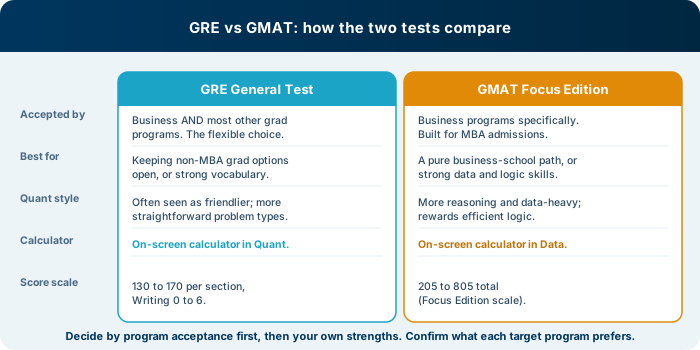
The most consequential difference has nothing to do with the questions. It is about where each score can take you.
The GRE General Test is accepted by business programs and by most other graduate programs, from engineering to public policy to the humanities. It is the flexible, all-purpose option. If there is any chance your plans might shift away from a traditional MBA, the GRE keeps those doors open.
The GMAT, in its current Focus Edition, is built specifically for business-school admissions. It is the specialist’s test. A strong GMAT score signals to admissions committees that you committed to the business track, but the score does not travel outside business programs the way a GRE score does.
So the first question is not “which is easier” but “how sure am I about business school?” If the answer is “completely sure, and only top MBA programs,” the GMAT is a legitimate, sometimes even preferred, choice. If the answer is anything short of that, the GRE’s flexibility is hard to beat.
How the tests differ in style
Both tests measure verbal reasoning, quantitative reasoning, and analytical thinking, but they emphasize different skills.
Quant. The GRE’s quantitative section is often described as more straightforward: recognizable problem types drawn from arithmetic, algebra, geometry, and data analysis, with an on-screen calculator available. The GMAT’s quantitative reasoning leans harder into logic and data interpretation, rewarding efficient reasoning over computation. If you are rusty on math but a clear logical thinker, you may find one fits you noticeably better than the other, so test both with a few practice questions before deciding.
Verbal. The GRE leans more on vocabulary, through Text Completion and Sentence Equivalence questions that reward a precise sense of how words behave in context. The GMAT’s verbal side has historically emphasized reading and reasoning over raw vocabulary. Strong readers who dislike memorizing words sometimes prefer the GMAT’s verbal flavor; strong vocabulary learners often prefer the GRE’s.
Format and scoring. The two tests report on completely different scales, so you cannot compare a GRE section score to a GMAT total directly. Many programs publish a conversion or simply evaluate each test on its own terms. Do not try to convert in your head; look at how your target programs read each score.
A simple way to decide
Run your decision through three filters, in this order:
-
Acceptance and preference. Make a list of your target programs and confirm that each accepts the test you are considering. Note any that state a preference. If a program you care about still leans GMAT, that may settle it. Acceptance always comes before strategy, because a great score on the wrong test does not help.
-
Your strengths. Take a short diagnostic of each test, or at least work a set of practice questions from both. Pay attention to where you feel more fluent. A test that plays to your strengths can be worth several points, and points are what you are after. If the GRE’s calculator-friendly quant and vocabulary suit you, lean GRE; if the GMAT’s data-and-logic style clicks, lean GMAT.
-
Cost and logistics. Both tests carry registration fees and possible score-report and reschedule fees, and the totals vary by region and change over time. The GMAT has often been the pricier of the two, but verify the current fees on each official site. If everything else is a wash, cost and test availability can be the tiebreaker.
For most applicants who are not certain they want a traditional MBA, those three filters point to the GRE, because its acceptance is broad and its style suits a wide range of test-takers. For applicants set on business school who thrive on data-heavy reasoning, the GMAT remains a strong choice.
What not to base the decision on
A few common tiebreakers are weaker than they seem:
- “I heard one is easier.” Difficulty is personal. The test that is easier for your friend may be harder for you. Trust your own diagnostic over secondhand impressions.
- “Everyone in business school takes the GMAT.” That used to be truer than it is now. GRE submissions to MBA programs have grown substantially, and admissions committees are accustomed to evaluating both.
- “I already started studying for one.” Sunk cost is not a reason to take the wrong test. Because the two share so much underlying math and reasoning, switching is less wasteful than it feels, though you will need to relearn the format.
The bottom line
If you want maximum flexibility and a quant section that rewards clean, calculator-assisted problem-solving, the GRE is usually the better bet, and it is the test our team is building prep for. If you are certain about business school and your strengths lean toward data-driven reasoning, the GMAT deserves serious consideration.
Either way, decide deliberately: confirm acceptance, test your strengths against real questions, and weigh the cost. Once you have chosen the GRE, the next step is building a plan. Start with how to study for the GRE and what counts as a good GRE score for your programs. Join the early-access list and our GRE instructors will help you pick a target and a path when prep opens.
Frequently asked questions
Do MBA programs prefer the GRE or the GMAT?
Most MBA programs now accept both and state that they have no preference between them. A handful of programs or specific tracks may still lean toward the GMAT, so the safe move is to confirm acceptance and any stated preference at each program on your list before you commit to a test.
Is the GRE easier than the GMAT?
Neither is objectively easier; they reward different strengths. The GRE's quant is often seen as more straightforward and lets you use a calculator, while the GMAT's quantitative reasoning is more logic and data-heavy. The GRE also leans harder on vocabulary. The right test is the one that fits your strengths and your programs.
Should I take the GRE or GMAT if I might not do an MBA?
Take the GRE. It is accepted by business programs and by most other graduate programs, so it keeps your options open across fields. The GMAT is built specifically for business-school admissions, so it is the more specialized, less flexible choice.
Can I switch from the GMAT to the GRE partway through prep?
Yes, and many people do once they realize a test does not fit their strengths. Because both tests share a lot of underlying math and reasoning, the content overlap is real, but the question formats differ, so budget time to relearn the format of whichever test you switch to.
Which test is cheaper, the GRE or the GMAT?
Costs vary by region and change over time, and both tests carry registration fees plus possible score-report and reschedule fees. The GMAT has often been the more expensive of the two, but you should check the current fees for each on the official sites before deciding, especially if cost is a deciding factor.
Prepping for the GRE?
Join the early-access list to be first when GRE prep opens.