
Study Strategy
How to Study for the GRE
A phase-by-phase GRE study plan that moves from content foundations to timed PowerPrep practice, plus the review loop that turns practice into points.
The GRE rewards preparation more predictably than many admissions tests, because it tests a finite set of skills rather than an open-ended body of knowledge. There is a defined slice of high-school-level math, a vocabulary that shows up in context, and a small number of reasoning patterns that repeat from question to question. Once you learn to see them, your score climbs.
That is the good news. The catch is that the two skills carrying most of your score, vocabulary and quantitative fluency, accumulate rather than switch on. Neither responds well to a frantic final fortnight. So the plan below is ordered deliberately: rebuild the content first, drill the formats second, and add the clock last. The review you do between those steps is where the score actually moves.
How long you actually need
Most people who reach their target spend about two to three months in serious preparation, somewhere between 80 and 150 total hours. How much of that you personally need comes down to how much of the high-school math you still have at your fingertips and how far your target sits above your starting point.
So start with data rather than optimism. Sit a full PowerPrep test under timed conditions before you open a single study guide, and let the result set the schedule. A jump from 155 to 160 in one section is a few weeks of focused work. A jump from 148 to 162 is a longer, more serious commitment, especially if you have not done the underlying math in years.
Whatever the gap, do not compress the work into a frantic week or two. Vocabulary and quantitative reasoning do not consolidate that fast.
The three phases
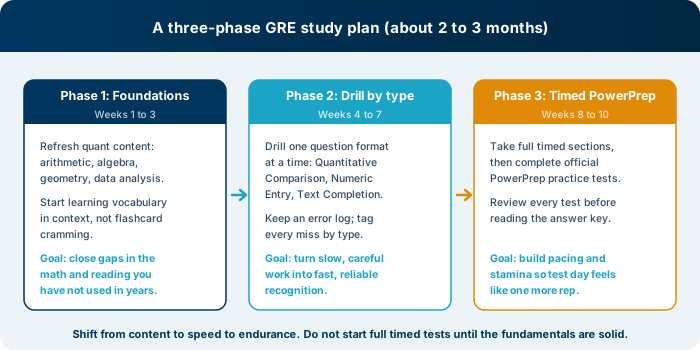
Order matters more than people expect. Sitting full timed tests before your content base is rebuilt mostly rehearses the gaps you already have, at speed. Close them first.
Phase 1: Foundations (roughly weeks 1 to 3). Rebuild the content before you worry about speed. On the quant side that means refreshing arithmetic, algebra, geometry, and data analysis, the four areas the test actually covers. On the verbal side, start learning vocabulary in context and re-acclimating to dense academic reading. Work untimed, prioritizing understanding over pace. Your only goal in this phase is to close the gaps in math and reading you have not touched since college.
Phase 2: Drill by question type (roughly weeks 4 to 7). Now drill one question format at a time until it feels automatic. Spend a few days on Quantitative Comparison, then Numeric Entry, then Text Completion and Sentence Equivalence, and so on. Keep an error log and tag every miss by topic and by format. The log is where the real diagnosis happens. Within a few weeks it usually shows the damage concentrated in a handful of formats, most often Quantitative Comparison on the math side and Text Completion on the verbal side, and those are the ones that earn your hours.
Phase 3: Timed PowerPrep practice (roughly weeks 8 to 10). Only now do you bring in the clock in earnest. Start with single timed sections, then work up to full PowerPrep tests taken in one sitting. What this phase adds is the part no untimed practice can teach you: holding a workable pace through a section-adaptive test, where how you handle the first section determines the difficulty of the second. The knowledge is already in place by now; speed is the remaining variable.
These week ranges are a template, not a law. Stretch or compress them to fit your timeline, but keep the sequence: content, then speed, then endurance.
A week-by-week plan: 4, 8, or 12 weeks
The three phases scale to whatever runway you have. Pick the column that matches the gap between your diagnostic and your target. (For help sizing that gap, see how long to study for the GRE.) The shorter the plan, the more hours per week it demands, and the more it has to assume your skills are already warm.
| Phase | 4-week plan (polish) | 8-week plan (standard) | 12-week plan (rebuild) |
|---|---|---|---|
| Foundations | Week 1: light refresh of weak areas only | Weeks 1 to 3: rebuild math, start vocabulary in context | Weeks 1 to 4: full content rebuild plus daily vocabulary |
| Drill by question type | Week 2: your two weakest formats | Weeks 4 to 6: one format at a time, error log | Weeks 5 to 9: every format, tagged error log |
| Timed practice | Week 3: full timed sections | Week 7: build to full PowerPrep tests | Weeks 10 to 11: multiple PowerPrep tests |
| Final review and taper | Week 4: one PowerPrep test, review, light taper | Week 8: final PowerPrep test, review, taper | Week 12: final test, deep review, taper |
| Target hours per week | 15 to 20 | 10 to 14 | 8 to 12 |
Use the 4-week plan only if your diagnostic is already close to your target. Most people who prepare well land on the 8-week plan. Reserve the 12-week plan for a genuine overhaul, especially recovering math you have not touched in years, since the slow part is content and that is where the extra weeks go.
Per-section strategy
The phases tell you when to do things. These blocks tell you how to study each section, because Verbal, Quant, and Analytical Writing reward different habits.
Verbal: build vocabulary in context and read for structure. The two highest-leverage moves are growing your working vocabulary and learning to read sentences for their logic. For Text Completion and Sentence Equivalence, train yourself to spot the pivot words (“although,” “because,” “despite”) that tell you whether a blank agrees with or contradicts the rest of the sentence, then confirm the meaning fits. For Reading Comprehension, read for the author’s main point and structure rather than every detail, and return to the passage for support before committing to an answer. Because the hardest Verbal items give no partial credit, precision beats breadth.
Quant: relearn a finite content base, then drill formats for speed. Rebuild the four content areas first (arithmetic, algebra, geometry, data analysis), then drill one question format at a time until recognition is automatic. The points come from method choice, not raw computation: learn to estimate, to plug in numbers on Quantitative Comparison, and to set up the problem by hand before touching the on-screen calculator. The deeper format-by-format tactics live in how to improve your GRE Quant score.
Analytical Writing: practice the argument, do not just read samples. You get one “Analyze an Issue” task and about thirty minutes. Build a simple, repeatable structure: a clear thesis that takes a position, two or three body paragraphs each developing one reason with a concrete example, and a brief conclusion. Write a few full timed essays rather than skimming samples and hoping, because the skill being tested is producing a coherent argument under the clock. For writing-intensive fields, this score matters more than most test-takers assume.
The review loop that turns practice into points
If you adopt one habit from this article, make it this one, because most self-studiers never do: review before you look at the key.
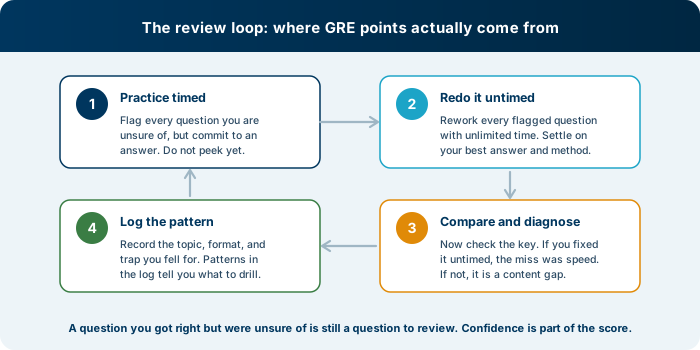
When you finish a timed section, do not check the answers yet. Work back through everything you flagged and solve it again with the clock off. Settle on your best answer and write down the method you used to get there. Only then check the key.
That single extra step is worth the time it costs, because it sorts your misses into two groups that need opposite fixes:
- You got it wrong timed, but right untimed. This is a timing or focus problem. You can do the math or parse the sentence; you just could not do it fast enough under pressure. The fix is pacing practice, not content review.
- You got it wrong both times. This is a genuine content or skill gap. You do not yet know the rule, the formula, or the word. The fix is going back to the fundamentals for that topic.
If you skip this step and just read the explanations, every miss looks the same and you cannot tell which fix you need. That is exactly how people grind through dozens of practice sets without improving. They are practicing, but they are not diagnosing.
One more rule: a question you guessed right still counts as a miss. On a section-adaptive test the minutes you burn deliberating over a shaky question are minutes stolen from questions you could have banked, and the first section decides how hard the second one gets. Speed with confidence is worth real points here.
Vocabulary: in context, not on flashcards alone
GRE Verbal leans heavily on knowing how words behave in a sentence, not just their dictionary definitions. Text Completion and Sentence Equivalence questions reward you for sensing the precise shade of a word and how it fits the logic of the sentence.
The most durable way to build this is to read challenging material and harvest words from it. Keep a running list of unfamiliar words along with the sentence you found them in, then review with spaced repetition. Flashcards have their place for raw coverage, but a word you met in a real sentence sticks far better than a word you crammed off a list. Either way, the goal is to recognize words quickly and confidently under time pressure.
Use official material, and use it carefully
Prep with official ETS questions whenever possible, especially the free PowerPrep practice tests. Third-party questions can be useful for drilling a concept, but the official questions match the real test’s style and its section-adaptive structure in a way imitations rarely do. Keep a couple of the official full-lengths sealed until the end of your prep, so the scores you finish on actually mean something.
Spend them carefully, too. ETS publishes only a handful, and tearing through them with a shallow review burns a scarce resource for almost nothing in return. A single PowerPrep test followed by two hours of honest error-logging will move your score further than three tests you never revisit.
When to get help
Plenty of people reach their target on their own, armed with a plan and the discipline to review honestly. Instruction earns its keep in two situations: your score has flattened out and you cannot see the pattern in your own mistakes, or one section is dragging the total down and you do not know why. Both are blind spots, and blind spots are by definition hard to find from the inside. Someone reading your error log usually spots one in a single sitting.
Diagnosing that kind of stall is what our GRE instructors are being set up to do. For now, once you know your target you can sanity-check your plan against what counts as a good GRE score, size the timeline with how long to study for the GRE, and make sure you are studying the current GRE format rather than an outdated one. If you are wondering how steep the climb is, is the GRE hard is an honest read, and if math is your weak spot, start with how to improve your GRE Quant.
Rebuild the content, drill the formats until recognition is automatic, then earn your pacing under the clock. Review honestly at every step and the score follows. Join the early-access list to get our full study plan and drills when GRE prep opens.
Frequently asked questions
How long should I study for the GRE?
Most people need about two to three months of consistent study, roughly 80 to 150 total hours. The exact number depends on your diagnostic score, your target, and how recently you have used the underlying math and reading skills. A bigger gap to your target means more runway.
How many hours a week should I study for the GRE?
Aim for roughly 8 to 15 focused hours per week. Quality matters more than raw volume. Two deliberate hours with careful review beat four rushed hours of passive practice, especially for vocabulary and Quant.
How do I study GRE vocabulary?
Learn words in context rather than memorizing isolated definitions. Read challenging material, keep a running list of unfamiliar words with the sentence you found them in, and review with spaced repetition. The test rewards knowing how a word behaves, not just a one-line definition.
What practice material should I use for the GRE?
Prioritize official ETS material, especially the free PowerPrep practice tests, because they match the real test's question style and adaptive structure most closely. Use third-party material to drill specific weak spots, but save official full-length tests for clean, realistic score checks late in your prep.
Can I study for the GRE on my own?
Yes. Many people self-study successfully with a structured plan, official practice material, and disciplined review. Outside help earns its keep most when you have plateaued and cannot see your own error patterns, or when one section is dragging your score down.
Prepping for the GRE?
Join the early-access list to be first when GRE prep opens.