
Test Basics
What's on the GRE? The Current Format Explained
The GRE is now a shorter test of about two hours, with one writing task, two Verbal sections, and two Quant sections. Here is the current format, how section-level adaptivity works, and what changed in 2023.
Prep books and forum advice written even a couple of years ago describe a GRE that no longer exists. The format changed meaningfully in 2023, and the test is now far shorter than the one most older resources cover. Here is what the current GRE looks like, section by section.
The current format at a glance
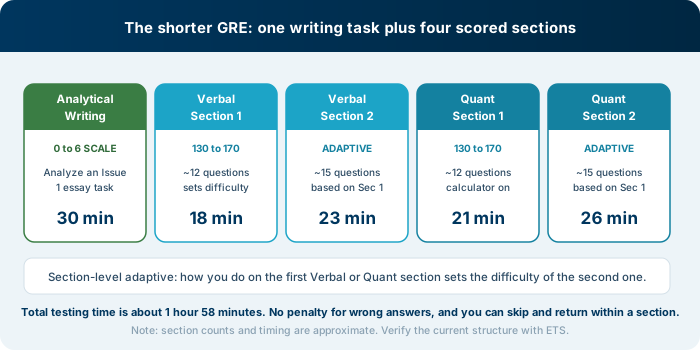
Since September 22, 2023, the GRE General Test takes roughly 1 hour and 58 minutes of testing time. It is built from five parts:
- One Analytical Writing task. A single “Analyze an Issue” essay, about 30 minutes. Scored from 0 to 6 in half-point steps.
- Two Verbal Reasoning sections. Together they hold about 27 questions and feed your 130 to 170 Verbal score.
- Two Quantitative Reasoning sections. Together they hold about 27 questions and feed your 130 to 170 Quant score.
The shortened test dropped the second essay and the unscored sections that used to pad out the old format, which is why the whole appointment is so much faster than the roughly three-hour-forty-five-minute test many older books still describe.
The GRE section breakdown (exact format)
Here is the precise structure ETS publishes for the current test. Analytical Writing always comes first; the Verbal and Quant sections can appear in any order after it.
| Order | Section | Questions | Time |
|---|---|---|---|
| 1 | Analytical Writing (Analyze an Issue) | 1 task | 30 minutes |
| 2 | Verbal Reasoning, Section 1 | 12 questions | 18 minutes |
| 3 | Verbal Reasoning, Section 2 | 15 questions | 23 minutes |
| 4 | Quantitative Reasoning, Section 1 | 12 questions | 21 minutes |
| 5 | Quantitative Reasoning, Section 2 | 15 questions | 26 minutes |
| Total | ~54 questions plus 1 essay | about 1 hour 58 minutes |
A few details that table makes concrete: there are about 27 Verbal questions total across the two Verbal sections and about 27 Quant questions total across the two Quant sections. The test is section-level adaptive, so your performance on the first section of each subject sets the difficulty of the second. An on-screen calculator is available during both Quant sections. Treat the per-section counts and timings as current-but-confirmable, and verify the latest details with ETS, since they can change.
There is no penalty for wrong answers, so you should answer every question even if you are out of time. And within any single section, you can skip a hard question and come back to it before the clock runs out, which is a real strategic advantage worth practicing.
How section-level adaptivity works
The single most important structural fact about the current GRE is that it is section-level adaptive. This is different from a question-by-question adaptive test.
Here is what it means in practice. You take the first Verbal section, and how well you do on it determines the difficulty of the second Verbal section. The same is true on the Quant side: your first Quant section sets the difficulty of the second. The test adapts once per subject, between the two sections, not after every individual question.
Two practical consequences follow:
- The first section of each subject matters a lot. It sets your trajectory. There is no easing in; bring your focus from the first question.
- Within a section, you control your path. Because the test does not adapt mid-section, you can safely skip a brutal question, bank the easy points later in the section, and return to the hard one with whatever time remains. Use that freedom.
Verbal Reasoning: reading and vocabulary in context
Verbal Reasoning mixes three question types: Reading Comprehension, Text Completion, and Sentence Equivalence. Reading Comprehension works much like it does on any serious reading test: find the author’s main point, separate fact from opinion, track how claims are supported, and judge what follows.
Text Completion and Sentence Equivalence are where the GRE’s vocabulary reputation comes from. These questions give you a sentence with one or more blanks and ask you to choose words that fit the logic and tone precisely. They reward knowing how a word behaves in context, not just a one-line definition. That is why we push learning vocabulary in context rather than cramming isolated word lists.
Quantitative Reasoning: high-school math, tested cleverly
Quantitative Reasoning covers four content areas: arithmetic, algebra, geometry, and data analysis. The math itself is high-school level. There is no trigonometry and no calculus. The difficulty lives in the reasoning and the clock, not in advanced content.
The section uses several question formats: Quantitative Comparison, multiple-choice with one answer, multiple-choice with one or more answers, and Numeric Entry, where you type the answer rather than pick it. An on-screen calculator is available, but it is a tool for messy arithmetic, not a substitute for setting up the problem. We break down the content and the format-specific tactics in How to Improve Your GRE Quant Score.
Analytical Writing: one essay, often underrated
Analytical Writing is now a single “Analyze an Issue” task. You are given a claim and asked to take and defend a position, building a clear, well-supported argument in about 30 minutes. It is scored from 0 to 6 in half-point increments by a combination of a trained rater and an automated system.
Plenty of test-takers treat it as an afterthought, which is a mistake for writing-intensive fields. A weak Analytical Writing score can quietly undercut an otherwise strong file, because the score speaks directly to your ability to construct an argument. Practice the essay; do not just skim a sample and hope.
Scoring, score choice, and validity
Three scoring details are worth knowing before test day:
- Scores are valid for five years from your test date, so a score you earn now can support applications for several admissions cycles.
- ScoreSelect lets you choose which test dates’ scores to send to programs. A weaker early attempt does not have to follow you, as long as a program accepts your preferred scores. Always confirm a program’s specific policy.
- No wrong-answer penalty means guessing is strictly better than leaving a blank. Never skip a question on the way out of a section without at least marking an answer.
Why the format favors prepared test-takers
A shorter test with a finite content base and a small set of repeating question formats is, at its core, highly learnable. There is a defined slice of math, a knowable approach to vocabulary in context, and a handful of reasoning patterns that recur. Steady, well-reviewed practice maps directly onto a higher score.
So start with the current format in mind, skip the outdated material built around the old two-essay test, and put your hours where the points are. The full plan is in How to Study for the GRE, and how long to study for the GRE helps you size the timeline. Once you know your target you can sanity-check it against what counts as a good GRE score, and if you are still weighing the climb, is the GRE hard gives an honest section-by-section read. Join the early-access list to get current-format drills and practice when GRE prep opens.
Frequently asked questions
How long is the GRE now?
The current GRE General Test takes roughly 1 hour and 58 minutes of testing time. It was shortened in September 2023, removing the second essay and an unscored research section, so the whole appointment is much faster than the old roughly 3 hour 45 minute test. Verify the exact timing with ETS.
What sections are on the GRE?
The current GRE has one Analytical Writing task, two Verbal Reasoning sections, and two Quantitative Reasoning sections. Across the two Verbal sections there are about 27 questions, and across the two Quant sections about 27 questions. Analytical Writing is a single Analyze an Issue essay.
Is the GRE adaptive?
Yes, the GRE is section-level adaptive. Your performance on the first Verbal section determines the difficulty of the second Verbal section, and the same is true for Quant. Within any single section you can move freely, skip questions, and return to them before time runs out.
Is there a calculator on the GRE?
Yes. An on-screen calculator is available during the Quantitative Reasoning sections. It handles messy arithmetic, but it does not do the thinking for you, so the strategy is to set up the math by hand and use the calculator only for the final computation.
How long are GRE scores valid?
GRE scores are valid for five years from your test date. The ScoreSelect option lets you choose which test dates' scores to send to programs, so a weaker early attempt does not have to follow you if a program accepts your preferred scores.
Prepping for the GRE?
Join the early-access list to be first when GRE prep opens.