
Study Strategy
How Long to Study for the GRE
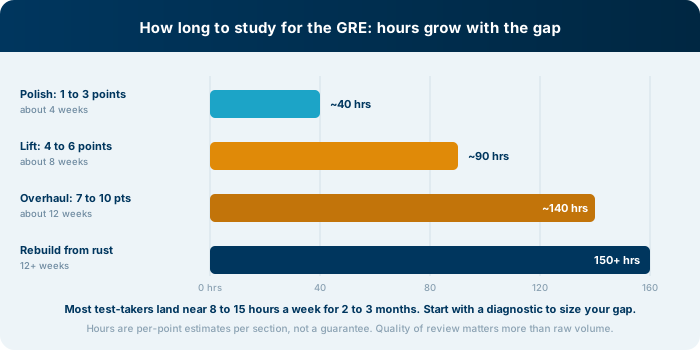
Most people need about 8 to 15 hours a week for 2 to 3 months, roughly 80 to 150 hours total. Here is a table of study time by starting point and target, plus 4, 8, and 12-week tracks.
The honest answer to “how long should I study for the GRE” is that it depends on one number you do not have yet: the gap between where you start and where you need to end up. A person sitting at a 158 Quant who needs a 161 has a very different job from a person at a 148 who needs a 160. So the real first step is not picking a number of weeks. It is taking a diagnostic.
That said, you came here for ranges, and there are good ones. Most people who reach their target spend about 2 to 3 months in serious preparation, somewhere between 80 and 150 total hours, at roughly 8 to 15 hours a week. Below I will turn that into specific numbers by starting point, and give you three concrete tracks depending on how much runway you have.
Take a diagnostic first, then size the gap
Before you can plan anything, sit a full official practice test under timed conditions. The free ETS PowerPrep tests are the right tool because they match the real test’s section-adaptive structure. Do not study first. The point is a clean baseline.
The gap between that diagnostic and your target tells you almost everything about your timeline. A jump of a few points in one section is a few weeks of focused work. A jump of ten points, especially in a section built on skills you have not used since college, is a longer and more serious commitment. If you are not sure what target to aim for, work it out against what counts as a good GRE score first, because the number you choose drives everything downstream.
How long the GRE takes by starting point and target
The table below is the heart of this guide. It maps the gap between your diagnostic and your target to a realistic total study time and a sensible timeline. Read “points to gain” as the improvement you need in a single section, because that is usually where the work concentrates.
| Your situation | Points to gain (per section) | Total hours | Hours per week | Realistic timeline |
|---|---|---|---|---|
| Already near target, just need format and pacing | 0 to 1 | 30 to 50 | 12 to 18 | 3 to 4 weeks |
| Small lift, skills are warm | 1 to 3 | 50 to 80 | 10 to 15 | 4 to 6 weeks |
| Moderate lift | 4 to 6 | 80 to 110 | 8 to 12 | 8 to 10 weeks |
| Large jump | 7 to 10 | 110 to 150 | 8 to 12 | 10 to 14 weeks |
| Rebuilding rusty math or growing vocabulary from scratch | 7+ | 150+ | 8 to 12 | 12 to 16 weeks |
Two patterns are worth pulling out. First, the total hours grow faster than the point gap, because the last few points are the hardest to earn and the underlying skills consolidate slowly. Second, a tight timeline does not reduce the total work; it just compresses it into more hours per week. If you only have four weeks but need a moderate lift, you are signing up for 18-plus hours a week, which is a lot to sustain. It is usually smarter to extend the timeline than to crush the hours.
Choose your track: 4, 8, or 12 weeks
Pick the track that matches your gap from the table above. Each one follows the same sequence we lay out in how to study for the GRE: build content first, then drill question types to fluency, then practice under the clock. The tracks differ only in how much room each phase gets.
| Phase | 4-week track (polish) | 8-week track (standard) | 12-week track (rebuild) |
|---|---|---|---|
| Content foundations | Week 1, light refresh of weak areas only | Weeks 1 to 3, rebuild math and start vocabulary | Weeks 1 to 4, full content rebuild plus daily vocabulary |
| Drill by question type | Week 2, target your two weakest formats | Weeks 4 to 6, one format at a time with an error log | Weeks 5 to 9, every format with a tagged error log |
| Timed practice and review | Weeks 3 to 4, full timed sections then a PowerPrep test | Weeks 7 to 8, build to full PowerPrep tests | Weeks 10 to 12, multiple PowerPrep tests under realistic conditions |
| Target hours per week | 15 to 20 | 10 to 14 | 8 to 12 |
A few honest notes on each:
- The 4-week track is a polish, not a rebuild. It works only if your diagnostic is already close to your target. If math you forgot is the problem, four weeks is not enough and forcing it just builds shaky recall that evaporates by test day.
- The 8-week track is where most well-prepared people land. It gives content, drilling, and timed practice each enough room to do its job without an unsustainable weekly load.
- The 12-week track is for a genuine overhaul, especially recovering quantitative skills you have not used in years, or building GRE vocabulary substantially. The extra weeks are mostly front-loaded into content, because that is the slow part. If math is your weak spot, how to improve your GRE Quant score shows where those hours should go.
Why quality of hours beats quantity
The hour counts above assume focused, reviewed practice. They fall apart if the hours are passive. The single highest-leverage habit in GRE prep is the review loop: when you finish a timed section, redo every uncertain question untimed before you check the key, so you can tell a timing problem apart from a knowledge gap. Two deliberate hours of that beat four hours of grinding fresh questions you never look at again.
This is also why cramming does not scale. Vocabulary in context and quantitative fluency are built slowly through spaced, deliberate practice. You cannot compress 120 hours of consolidation into a frantic week and expect it to hold under pressure. If your timeline is genuinely short, spend it on official practice tests, the current format, and pacing rather than trying to absorb new content fast.
What if your timeline is fixed by a deadline?
Plenty of people are working backward from an application deadline rather than forward from a diagnostic. If the date is fixed and the gap is large, you have three levers: raise your weekly hours, narrow your target to the section that actually matters for your field, or plan to take the test, then retake it if needed. GRE scores are valid for five years and ScoreSelect lets you send your best dates, so a first attempt that falls short is not wasted. It is often the most realistic practice test you will ever take.
Whatever your timeline, the sequence does not change: diagnose, build content, drill to fluency, then practice under the clock, reviewing everything in between like it matters. If you are still deciding whether the climb is worth it, is the GRE hard gives an honest read on the difficulty, and what is on the GRE covers the current, shorter format so you study the right test.
Want a study timeline built around your diagnostic and your deadline? Join the early-access list and our GRE instructors will help you size the gap and build the plan when prep opens.
Frequently asked questions
How long should I study for the GRE?
Most people need about 2 to 3 months of consistent study, roughly 80 to 150 total hours, at 8 to 15 hours per week. The exact number depends on the gap between your diagnostic score and your target, and how recently you have used the underlying math and reading skills. A bigger gap means more runway.
Can I study for the GRE in one month?
One month is enough only if your diagnostic is already close to your target, within about 1 to 3 points in each section, and you can commit roughly 15 to 20 hours a week. A four-week plan is a polish, not a rebuild. If you need to recover rusty math or grow your vocabulary substantially, give yourself 8 to 12 weeks instead.
How many hours a week should I study for the GRE?
Aim for roughly 8 to 15 focused hours per week. Quality matters more than raw volume: two deliberate hours with careful review beat four rushed hours of passive practice, especially for vocabulary and Quant. Shorter timelines require more hours per week to hit the same total.
How many hours total does the GRE take to study for?
Most people who reach their target log between 80 and 150 total hours. A small lift of a few points might take around 40 hours, while a major jump of 7 to 10 points per section, or rebuilding math you have not touched in years, can run past 150 hours.
Is 2 weeks enough to study for the GRE?
Two weeks is rarely enough unless you are already scoring at or near your target and just need to refamiliarize yourself with the format. Vocabulary and quantitative reasoning consolidate slowly, so cramming them into two weeks produces shaky, easily-forgotten gains. If you only have two weeks, focus on official practice tests, the format, and pacing rather than new content.
Prepping for the GRE?
Join the early-access list to be first when GRE prep opens.