
Scores
What Is a Good GRE Score? Percentiles, Averages, and Targets
A good GRE score is one that clears your target programs. Here are the current ETS percentile tables for Verbal and Quant, the average GRE score by field, the AWA scale, and how to set a target.
“What is a good GRE score” is a reasonable question with an unhelpful answer, because the GRE is really three scores and different programs care about different ones. No single figure separates a competitive application from a weak one. A 161 on Quant can be a strong result for a history applicant and a reason to sit the test again for an engineering applicant. What matters is the expectation of the programs on your list, in the section those programs actually weigh.
That said, you need a frame of reference before you can set a target. So this guide does both jobs. First it lays out the hard data: how the scale works, what the current ETS percentile tables say, what the average GRE score is overall and by field. Then it turns all of that into a target you can actually aim for. If you came here searching for “average GRE score,” “GRE score range,” or “good GRE score for grad school,” the section you want is below. They are all really the same question wearing different clothes.
How the GRE scale works (what the GRE is scored out of)
The GRE General Test reports three separate scores. There is no single combined number.
- Verbal Reasoning runs from 130 to 170 in one-point increments.
- Quantitative Reasoning runs from 130 to 170 in one-point increments.
- Analytical Writing runs from 0 to 6 in half-point increments.
So when people ask what the GRE is “scored out of,” the honest answer is that each section has its own scale and programs read them separately. If you add Verbal and Quant together you get a figure from 260 to 340, and you will occasionally see that combined number quoted, but admissions committees almost always look at the two section scores on their own because they mean different things in different fields. Nothing is deducted for a wrong answer, so a blank costs you exactly what a wrong guess does. Put something down for every question, including the ones you are running out of time on.
The scale itself is fixed. What a given score means only emerges from percentiles, which tell you how you did relative to everyone else who took the test. And here the GRE has a quirk that trips up a lot of people: the same scaled score does not mean the same thing on Verbal and Quant.
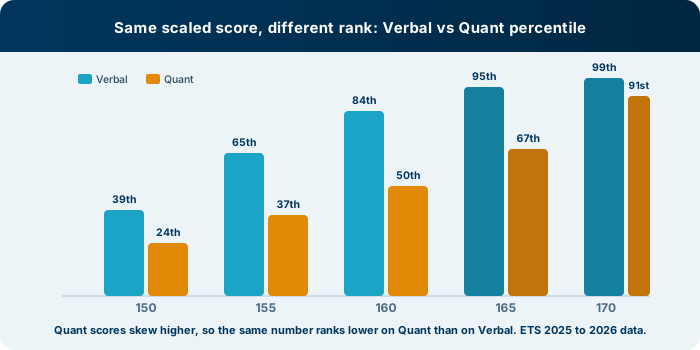
The GRE percentile table (Verbal and Quant, 130 to 170)
This is the table most “good score” articles never actually print. The numbers below come from the official ETS interpretive data for test-takers between July 1, 2021, and June 30, 2024, which is the reference group used on current score reports. ETS updates these annually, so treat them as current-but-moving and verify the latest tables on ets.org before you finalize a target.
| Scaled score | Verbal percentile | Quant percentile |
|---|---|---|
| 170 | 99 | 91 |
| 168 | 99 | 81 |
| 166 | 96 | 71 |
| 165 | 95 | 67 |
| 162 | 89 | 57 |
| 160 | 84 | 50 |
| 158 | 77 | 45 |
| 155 | 65 | 37 |
| 152 | 48 | 29 |
| 150 | 39 | 24 |
| 145 | 21 | 12 |
| 140 | 10 | 5 |
| 135 | 3 | 1 |
Read across any single row and the asymmetry jumps out. A 160 sits at the 84th percentile on Verbal but only the 50th on Quant. A 165 is the 95th percentile on Verbal and the 67th on Quant. The same scaled number ranks far lower on Quant because the Quant pool is dense at the top: a very large share of test-takers, many of them headed into quantitative fields, score high on math.
That single fact is the most important thing to internalize about GRE scoring. A 160 Quant is a perfectly respectable number in absolute terms, but it is merely average in percentile. If you are applying to a quantitative program, you may need a noticeably higher Quant scaled score than you would guess just to clear a competitive percentile.
The Analytical Writing scale (0 to 6)
Analytical Writing is scored separately, from 0 to 6 in half-point steps, by a trained rater working alongside an automated scoring engine. The percentiles here behave differently from the section scores because the scale is so coarse.
| AWA score | Percentile |
|---|---|
| 6.0 | 99 |
| 5.5 | 98 |
| 5.0 | 93 |
| 4.5 | 85 |
| 4.0 | 63 |
| 3.5 | 43 |
| 3.0 | 17 |
| 2.5 | 8 |
Notice how much a single half-point is worth in the middle of the range. Moving from a 3.5 to a 4.5 takes you from the 43rd percentile to the 85th. That is an enormous jump for what is, on the page, one extra notch. For writing-intensive fields, a weak Analytical Writing score can quietly undercut an otherwise strong file, because the score speaks directly to your ability to build an argument. Many competitive programs want to see a 4.5 or higher.
What is the average GRE score?
Here are the current mean scores from ETS, again for the July 2021 to June 2024 reference group:
| Measure | Mean | Standard deviation |
|---|---|---|
| Verbal Reasoning | 151.2 | 8.3 |
| Quantitative Reasoning | 157.6 | 9.9 |
| Analytical Writing | 3.4 | 0.9 |
So the “average GRE score” is roughly 151 Verbal, 158 Quant, and 3.4 on Analytical Writing. Two things are worth pulling out of that. First, the average is not the same scaled number on both sections: the typical test-taker scores about seven points higher on Quant than on Verbal, which is exactly why a 155 feels very different on the two measures. Second, the Quant mean of 157.6 sitting at roughly the 42nd percentile, while the Verbal mean of 151.2 sits near the 43rd, confirms the compression at the top of the Quant scale.
Average GRE score by field
The overall average hides most of what actually matters, because applicants self-select hard by field. A future engineer and a future historian are not aiming at the same numbers, and the ETS data classified by intended graduate major makes that concrete.
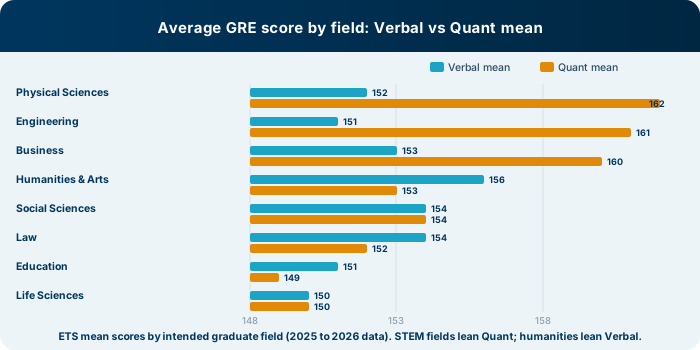
| Intended field | Verbal mean | Quant mean | AWA mean |
|---|---|---|---|
| Physical Sciences | 152 | 162 | 3.4 |
| Engineering | 151 | 161 | 3.4 |
| Business | 153 | 160 | 3.6 |
| Social & Behavioral Sciences | 154 | 154 | 3.9 |
| Law | 154 | 152 | 4.0 |
| Humanities & Arts | 156 | 153 | 4.0 |
| Education | 151 | 149 | 3.7 |
| Life Sciences | 150 | 150 | 3.7 |
The pattern is exactly what you would expect, and it is the single most useful calibration tool on this page. Physical sciences and engineering applicants average around 161 to 162 on Quant. Business sits just behind at 160. Humanities applicants average 156 on Verbal, the highest Verbal mean of any group, with Quant well behind. Notice too that humanities and law lead on Analytical Writing at 4.0, while the quantitative fields sit at 3.4.
Use this table to sanity-check your own target. If you are applying to engineering programs and your Quant is sitting at 157, you are below the average for your field even though 157 is above the overall test-taker mean. If you are applying to humanities programs with a 158 Verbal, you are right around your field’s average and the Quant number matters far less. The relevant comparison is never the overall average. It is the average for the people you are competing against.
A good score is relative to your program list
Here is the part most “good score” articles skip. Graduate admissions is far less formulaic than law school admissions. Most programs read the GRE as one piece of a file that also includes your transcript, statement of purpose, letters, and research or work experience. There is rarely a published median you can target the way law applicants target an LSAT median.
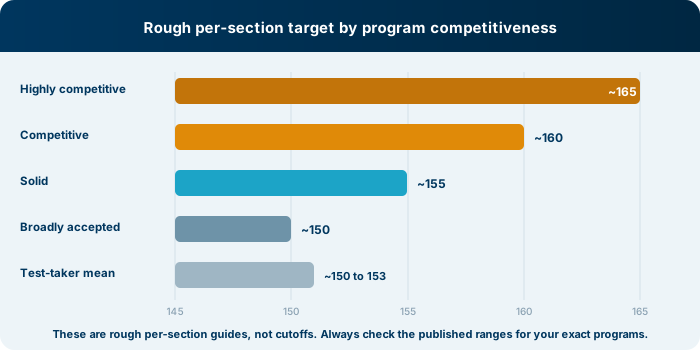
Still, you can build a sensible frame. Programs vary enormously in how much they weigh the GRE and what counts as competitive:
- Highly competitive programs often look for section scores around 165 and up, especially in the section that matters for the field.
- Competitive programs are generally comfortable with scores in the low 160s.
- Solid, well-regarded programs frequently sit in the mid 150s.
- Broadly accepting programs may be fine with scores around 150, which is roughly the test-taker average.
So the honest definition of a good GRE score is: a score that meets or beats the expectations of the programs you want to attend, in the section those programs care about most. For a humanities PhD that means a high Verbal and a strong Analytical Writing score, with Quant mattering less. For an engineering or economics program it means a high Quant. The same score report can read as competitive or as underpowered depending entirely on which door you are knocking on.
What is a good GRE score for grad school?
If you want a single rule of thumb to start from before you have a program list, here it is. For most graduate programs, section scores in the mid 150s are solid and the low 160s are competitive. Pushing into 165-plus in the section your field cares about puts you in strong shape for selective programs. On Analytical Writing, treat 4.5 as the target and 4.0 as the floor for writing-heavy fields.
But “good for grad school” is genuinely field-dependent, and the by-field table above is your real benchmark. A 160 Quant is roughly the 50th percentile, which is fine for a humanities program and below average for an engineering one. A 158 Verbal is the 77th percentile, strong for a STEM applicant and merely average for an English PhD. Anchor the phrase “good enough” to your field, not to the whole testing population.
Set a target for your program
You now have everything you need to turn this data into a number. Work backward from your list:
- List the programs you genuinely want to attend. Be honest about reach, match, and safety.
- Find each program’s published score data, if any. Many post a class profile or an average; when in doubt, email and ask which section they weight. Note which measure the field emphasizes.
- Anchor to your field’s average first. Pull your field’s row from the by-field table above. That mean is your baseline; competitive programs in the field sit above it.
- Set your target in the section that matters at or above the strongest expectation on the realistic part of your list, then add a couple of points of cushion. Test day rarely matches your best practice exam exactly.
- Convert the target back to a percentile using the table near the top, so you know what you are really asking of yourself. A 163 Quant is a different undertaking from a 163 Verbal.
If you do not have a program list yet, a reasonable default for most fields is to build toward roughly 160 in your stronger section and a 155-plus in the other, with a 4.5 on Analytical Writing. That combination opens a wide range of programs, and you can always push higher once you are scoring there consistently.
Is your score good enough, or should you retake?
Once you have a real score in hand, the “good score” question becomes concrete: send it, or retake? Anchor the decision to your program list and the percentile of your current score, not to a vague sense of disappointment. A few rules of thumb:
- If your score is at or above your field’s average and clears your realistic programs, it is good enough. Diminishing returns set in fast near the top of the scale, and a few extra points rarely outweigh a stronger statement or better letters.
- If your weak section is the one your field cares about, a retake is usually worth it. A humanities applicant with a low Verbal, or an engineering applicant with a Quant stuck near the 50th percentile, has the most to gain from another attempt.
- If you under-performed your practice scores by a clear margin, a retake often recovers those points, because the gap is usually nerves or pacing rather than ability.
Mechanically, retaking is low-risk: GRE scores are valid for five years, and ScoreSelect lets you send only the test dates you choose, so a weaker attempt does not have to follow you as long as your programs accept your preferred scores. Always confirm a program’s specific policy before you assume it takes your highest section scores.
Can you reach your target?
Almost certainly, with enough runway. The GRE rewards preparation predictably because it tests a finite, learnable set of skills: a defined body of high-school-level math, vocabulary in context, and a small number of repeating reasoning patterns. The question formats repeat. The trap answers follow patterns. Once you learn to see them, your score climbs.
How much runway depends on the gap between your diagnostic and your target, and we work that out in detail in how long to study for the GRE. If you are wondering how steep the climb actually is, is the GRE hard gives an honest section-by-section answer. When you are ready to build the plan, how to study for the GRE lays out the phases, and if your weak section is the math, how to improve your GRE Quant score goes deeper. It also helps to know exactly what is on the GRE before you start, since the current format is shorter than most older books describe.
A good GRE score, in the end, is not a trophy number. It is the score that clears the bar for a program you are excited to attend. Define it against your list, in the section that matters, then build toward it deliberately.
Want a target set against your specific field and program list? Join the early-access list and our GRE instructors will help you map a realistic goal when prep opens.
Frequently asked questions
What is a good GRE score?
A good GRE score is one at or above the expectations of the programs you want to attend. In absolute terms, a section score around 160 is strong: roughly the 84th percentile on Verbal and the 50th percentile on Quant, per current ETS data. A 165 reaches the 95th percentile on Verbal and the 67th on Quant. What counts as good depends on your field and your specific programs.
What is the average GRE score?
Based on ETS data for test-takers between July 2021 and June 2024, the mean Verbal Reasoning score is about 151, the mean Quantitative Reasoning score is about 158, and the mean Analytical Writing score is about 3.4. The Verbal and Quant scales each run from 130 to 170, and Analytical Writing runs from 0 to 6.
What is the GRE scored out of?
There is no single total score. The GRE reports three separate scores: Verbal Reasoning from 130 to 170, Quantitative Reasoning from 130 to 170, and Analytical Writing from 0 to 6 in half-point steps. A combined Verbal-plus-Quant figure therefore runs from 260 to 340, but programs almost always read the two section scores separately.
Why is a 160 on Quant worth less than a 160 on Verbal?
Because the Quant pool skews higher, the same scaled score ranks far lower in percentile on Quant than on Verbal. Per current ETS data, a 160 is the 84th percentile on Verbal but only the 50th percentile on Quant. So many strong test-takers cluster in the upper Quant range that the percentiles compress sharply up there.
What is a good GRE score for grad school?
For most graduate programs, section scores in the mid 150s are solid and the low 160s are competitive, with highly selective programs often looking for 165 and up in the section that matters for the field. A reasonable default target for many fields is roughly 160 in your stronger section, 155-plus in the other, and a 4.5 on Analytical Writing. Always verify against your specific programs.
Do graduate schools take your highest GRE score?
Many programs consider your highest section scores, and the ScoreSelect option lets you choose which test dates to send. Policies vary widely, so always confirm how a specific program treats multiple attempts before you decide to retake.
Prepping for the GRE?
Join the early-access list to be first when GRE prep opens.