
Section Strategy
How to Improve Your GRE Quant Score
A GRE Quant improvement framework built around the four content areas, the question formats, and the strategies that save time: estimating, plugging in, and using the calculator wisely.
GRE Quant frightens a lot of people who have not done formal math in years. The reassuring news is that the content is finite and high-school level. There is no calculus, no trigonometry, nothing exotic. The section is hard for a different reason: it tests whether you can reason quickly and choose efficient methods under time pressure. That is a learnable skill, and it improves faster than most people expect once you stop solving every problem the long way.
Here is how to think about the section, and the specific habits that turn time pressure into points.
Know the four content areas
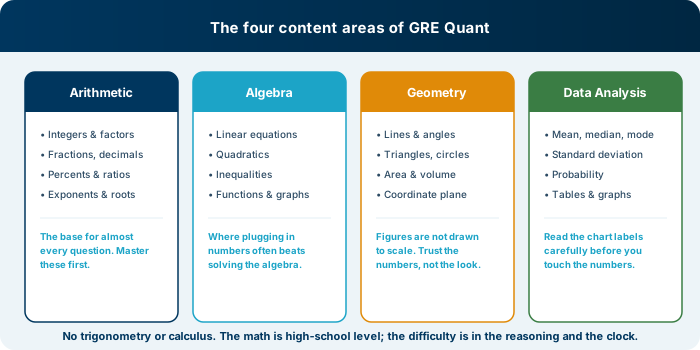
Everything on the section comes from four buckets. Knowing which one a question lives in tells you what tools to reach for:
Arithmetic. Integers, factors and multiples, fractions, decimals, percents, ratios, exponents, and roots. This is the foundation under almost every other question, so if your arithmetic is shaky, fix it first. A percent or ratio error early in a multi-step problem quietly poisons the whole thing.
Algebra. Linear and quadratic equations, inequalities, and functions and their graphs. Algebra is the area where strategy matters most, because you can often avoid the algebra entirely by plugging in numbers, which we will get to below.
Geometry. Lines and angles, triangles, circles, area and volume, and the coordinate plane. The single most important geometry rule on the GRE: figures are not necessarily drawn to scale. Trust the given measurements and relationships, never the way a figure looks.
Data analysis. Mean, median, mode, range, standard deviation, probability, and reading data from tables and graphs. The trap here is rushing past the labels. Read exactly what a chart is measuring before you touch the numbers, because the wrong-answer choices are built for people who misread the axis.
Notice what is not on the list. No trig, no calculus, no proofs. The math is within reach for anyone who learned it once. Your job is to rebuild fluency and then layer strategy on top.
Know the question formats
The same piece of math can appear in four different formats, and the format changes how you should attack it:
- Quantitative Comparison. You are given two quantities and asked which is larger, or whether the relationship cannot be determined. These reward estimation and case-testing over full computation.
- Multiple-choice, one answer. The familiar five-choice format. Elimination and plugging in answer choices both work well here.
- Multiple-choice, one or more answers. You must select every correct choice, with no partial credit. Slow down and evaluate each option independently; this is where rushing costs points.
- Numeric Entry. You type the answer rather than choose it, so there are no choices to eliminate or reverse-engineer. Double-check your arithmetic and the form of the answer the question asks for.
Reading the format before you start is not a formality. It tells you which strategy is even available, and it stops you from grinding through algebra when estimation would have settled the question in fifteen seconds.
The strategies that actually save time
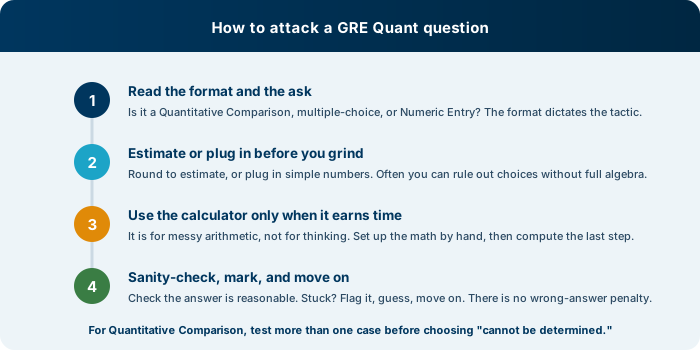
The difference between an average Quant scorer and a strong one is rarely raw math ability. It is method selection. Four habits do most of the work:
Estimate before you compute. A surprising number of questions, especially Quantitative Comparison, can be answered by rounding and approximating. If you can tell that one quantity is clearly bigger without exact arithmetic, you are done. Estimation also catches careless errors: if your computed answer is wildly off your estimate, you made a mistake somewhere.
Plug in numbers. When a problem is full of variables, pick simple, legal numbers and run them through. This turns abstract algebra into concrete arithmetic you can actually see. For “must be true” style questions, test more than one set of numbers, including the awkward ones: zero, one, a negative, and a fraction. Those edge cases are exactly where wrong answers hide.
Use the calculator wisely. The on-screen calculator is for messy arithmetic, not for thinking. Set up the math by hand, decide what to compute, and only then reach for the calculator to crunch the final step. People who type every number into it slow themselves down and lose sight of the structure of the problem.
Sanity-check, then move. Before you commit, ask whether the answer is reasonable in size and sign. Then, if you are stuck, flag the question, put down your best guess, and move on. Because there is no penalty for wrong answers, a guess is always better than a blank, and the freedom to skip and return within a section is one of the test’s best features. Bank the easy points and circle back.
Quantitative Comparison deserves its own playbook
Quantitative Comparison questions trip people up because the fourth answer choice, “the relationship cannot be determined,” feels safe when you are unsure. It is not a safe default. It is only correct when different valid cases genuinely produce different results.
The reliable approach: test cases. Plug in an ordinary number first. Then deliberately test the troublemakers, zero, one, a negative, a fraction, because those are the cases the test writers use to break a relationship that looked stable. If every case you try gives the same outcome, pick the consistent answer. If two valid cases disagree, then and only then is “cannot be determined” correct. Building this habit alone can lift a stubborn Quant score.
How to practice so the score moves
Strategy on paper does nothing until it is automatic under pressure. The path mirrors the one in our GRE study plan:
- Drill by format. Spend a few days on Quantitative Comparison, then Numeric Entry, then the multiple-answer questions, until you recognize each on sight.
- Keep an error log. Tag every miss by content area and format. Within a couple of weeks the pattern is obvious: most of your lost points cluster in two or three places.
- Separate timing misses from content misses. Redo flagged questions untimed before checking the key. If you fix it with more time, the problem is pace. If you cannot, the problem is content. The fixes are completely different.
That last step is the one most self-studiers skip, and it is the reason people grind through hundreds of problems without improving. They practice without diagnosing.
When to get help
If your Quant score has been stuck for weeks despite steady practice, it is usually a blind spot you cannot see from the inside, often a recurring setup error or a format you are quietly avoiding. A second set of eyes on your error log finds it fast, and Quant tends to respond quickly once the right gap is named.
Breaking a stubborn Quant plateau is exactly what our GRE instructors are being set up to help with. For now, pair this with how to study for the GRE and check your target against what counts as a good GRE score for your field, remembering that the same Quant scaled score ranks lower in percentile than the same Verbal score. To size your timeline see how long to study for the GRE; for where Quant sits in the test see the current GRE format; and for an honest read on the difficulty see is the GRE hard. Join the early-access list to get GRE Quant drills and practice when prep opens.
Frequently asked questions
What math is on the GRE Quant section?
GRE Quant covers four content areas: arithmetic, algebra, geometry, and data analysis. The math is high-school level, with no trigonometry and no calculus. The difficulty comes from the reasoning required and the time pressure, not from advanced content.
What are the GRE Quant question formats?
There are four main formats: Quantitative Comparison, multiple-choice with one correct answer, multiple-choice with one or more correct answers, and Numeric Entry, where you type the answer instead of selecting it. Reading the format first tells you which strategy to use.
How do I get faster at GRE Quant?
Speed comes from recognizing question types instantly and from using shortcuts like estimating and plugging in numbers, rather than grinding full algebra on every problem. Drill one format at a time until recognition is automatic, then practice under timed conditions to build pace.
Should I use the GRE on-screen calculator?
Use it only for messy arithmetic, not for thinking. Set up the problem by hand, then use the calculator for the final computation. Reaching for it on every step actually slows you down and can hide setup errors, so treat it as a last step, not a first move.
How do I approach Quantitative Comparison questions?
Compare the two quantities using estimation or by plugging in numbers, and test more than one case, including zero, one, negatives, and fractions. The fourth answer choice, that the relationship cannot be determined, is correct only when different valid cases give different results.
Prepping for the GRE?
Join the early-access list to be first when GRE prep opens.