
Test Basics
What's on the LSAT? The Current Format Explained
The LSAT now has two scored Logical Reasoning sections, one scored Reading Comprehension section, and one unscored experimental section. Here is the current format, what changed when Logic Games were removed, and how it is scored.
If you are looking at old prep books or year-old advice, the LSAT you will actually sit is probably not the test they describe. The format changed meaningfully in 2024, and the most famous part of the old LSAT is gone. This is the definitive rundown of the current test: every section, how many questions, how long, how it is scored, and what the big change means for how you should prepare.
The current format at a glance
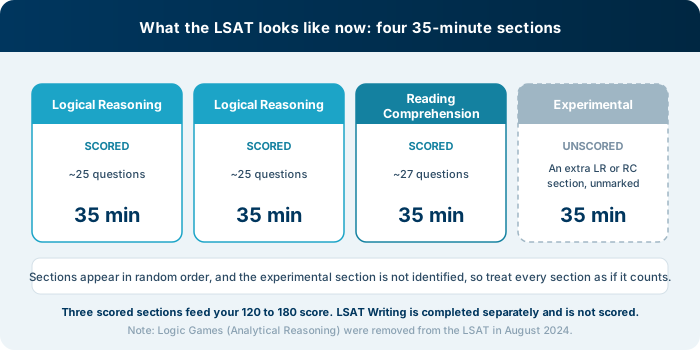
The LSAT is made up of four 35-minute sections. Three of them count toward your score, and one does not. Here is the full breakdown.
| Section | Scored? | Approx. questions | Time |
|---|---|---|---|
| Logical Reasoning | Yes | ~25 | 35 min |
| Logical Reasoning | Yes | ~25 | 35 min |
| Reading Comprehension | Yes | ~27 | 35 min |
| Experimental (LR or RC) | No | ~23 to 27 | 35 min |
| LSAT Argumentative Writing | No | 1 prompt | Separate, untimed setting |
A few things to take from the table:
- Two of the four sections are Logical Reasoning, and both are scored. This is the single most important fact about the current test.
- Three of the four sections count. Together they hold about 75 to 77 scored questions, and your raw number correct converts to the familiar 120 to 180 scaled score.
- The experimental section looks exactly like a real one and is not labeled, so you cannot safely coast through any section.
- There is no penalty for guessing, so you should answer every question even if you are out of time. A blank and a wrong answer cost you the same, and a guess might be right.
On test day, the four multiple-choice sections appear in a random order with one break partway through. Counting check-in and the break, plan for roughly three hours at the test center. LSAT Argumentative Writing is completed separately.
What test day actually looks like
The four sections do not arrive in a tidy “two LR, then RC, then experimental” order. They are shuffled, and because the experimental section is unlabeled, you genuinely cannot tell a scored section from the unscored one while you are in it. A typical sitting runs like this: two sections back to back, a short break, then the remaining two sections. Each section is a hard 35 minutes; when time is called, that section is closed and you move on.
A few practical consequences flow from this structure:
- Stamina is part of the score. Five sections of intense reading and reasoning, counting the experimental one, is genuinely tiring. The mistakes that cost most test-takers points often come in the final section, when focus fades. That is why building endurance, not just accuracy, is a real part of preparation.
- You manage time per section, not per test. You cannot borrow minutes from an easy section to spend on a hard one. Each 35-minute block stands alone, so pacing has to be solid within every section.
- There is no going back across sections. Once a section ends, you cannot return to it. Flag and guess within the section you are in, and never leave a question blank, since there is no guessing penalty.
This is exactly why timed, full-length practice matters so much in the final phase of prep: it is the only way to train for the order, the break, and the fatigue of a real sitting.
Logical Reasoning is now the heart of the test
The single most important thing to understand about the current LSAT is how much it leans on Logical Reasoning. With two scored LR sections out of three, roughly two-thirds of your score comes from your ability to analyze short arguments.
Each Logical Reasoning question gives you a short stimulus, usually an argument, and asks you to do something with it: find the conclusion, identify the assumption it depends on, weaken it, strengthen it, spot its flaw, or draw what must be true. The reasoning patterns repeat from question to question, which is exactly why LR is so learnable. Once you can reliably separate a conclusion from its evidence and name the gap between them, a huge fraction of the section opens up.
The LR questions cluster into a handful of recognizable types, and knowing them is half the battle:
| Question family | What it asks | Examples |
|---|---|---|
| What follows | What the text guarantees | Must Be True, Inference, Main Conclusion |
| Find the gap | What bridges evidence and conclusion | Assumption, Strengthen, Weaken, Evaluate |
| Describe it | How the argument is built | Flaw, Method, Parallel, Point at Issue |
| Apply a rule | Match a principle or resolve a conflict | Principle, Paradox |
Because LR carries so much weight, it is where most of your study time should go. We break down how to attack each of these families, with a worked example for every one, in how to improve your LSAT Logical Reasoning, and the underlying method is laid out in detail in The LSAT Reasoning Method.
Reading Comprehension is the same skill, longer
Reading Comprehension feels different because the passages are long and dense, often drawn from law, science, humanities, or social science. You get four passage sets, one of which is a comparative pair of shorter passages, followed by questions. But the underlying skill is the same one LR tests: find the author’s main point, separate fact from opinion, track how claims are supported, and judge what follows.
Many RC questions are Strengthen, Weaken, or Inference questions wearing a longer costume. That is why strong LR habits transfer directly to RC. The main added challenge is managing a large amount of text under time pressure, which is a matter of active passage mapping rather than re-reading.
What changed in 2024: Logic Games are gone
For decades, the LSAT included a section formally called Analytical Reasoning, universally known as Logic Games: the puzzles where you sequence, group, and match elements under a set of rules. Logic Games were removed in August 2024 and replaced with the second Logical Reasoning section.
This is the change that makes most older prep material out of date. The practical implications:
- The test is less about diagrams and more about arguments. The old Logic Games rewarded a specialized diagramming skill that took weeks to build. The current test rewards careful reading and argument analysis across the board.
- Old “Logic Games strategy” content is now irrelevant to scoring. If a resource spends a third of its pages on game setups, it is describing a test that no longer exists. Do not spend a single hour on game boards.
- The section balance shifted toward LR. Replacing the games section with a second LR section is why Logical Reasoning now drives roughly two-thirds of your score, up from about half on the old format.
- Conditional logic still matters. The if-then reasoning that powered Logic Games did not disappear. It now shows up inside Logical Reasoning questions, so conditional logic remains a core skill worth mastering.
If you started a study plan built around the old format, this is the thing to fix first. Redirect the hours you would have spent on game setups into Logical Reasoning. And if you are budgeting your time from scratch, our guide to how long to study for the LSAT assumes the current, games-free format.
How the LSAT is scored
Your performance on the three scored sections produces a single number on a fixed scale. Here are the basics worth knowing before you set a target.
| Concept | What to know |
|---|---|
| Score scale | 120 to 180, in 1-point increments |
| Scored questions | ~75 to 77 across three sections |
| Raw to scaled | Your number correct is converted to the 120 to 180 scale |
| Wrong-answer penalty | None; always answer every question |
| Median score | Around 152 |
| 160 | Clears roughly 80 percent of test-takers |
| 170 | Sits near the 97th percentile |
The conversion from raw correct answers to a scaled score is set so that scores mean the same thing across different test forms. Because the median sits around 152, a 160 already puts you ahead of roughly 80 percent of test-takers, and the top of the scale is steep: each point near 170 and above represents a much thinner slice of people. We unpack exactly what these numbers mean for admissions in what counts as a good LSAT score.
LSAT Argumentative Writing
Separately from the scored test, you complete LSAT Argumentative Writing, a written argument prompt you type in a separate setting on your own time. It is not scored and does not affect your 120 to 180 number, but a copy is sent to every law school you apply to, so it is not something to ignore. Schools can read it, and a sloppy or unfinished writing sample is an easy, avoidable negative. Treat it as part of your application, just not part of your score.
How to treat the experimental section
The experimental section is unscored and unidentified. You will not know which section it is while you are taking the test. That is by design, and it has one clear consequence: treat every section as if it counts, because for all you know, it does. Do not try to guess which section is experimental and coast through it. People guess wrong and throw away real points.
Logistics: when, how often, and how much
The format is only part of the picture. To actually sit the test, you also need to know the calendar and the costs:
- When it is offered. The LSAT runs about eight times per testing cycle. See the full schedule with deadlines in LSAT test dates 2026-2027.
- How often you can take it. LSAC limits you to three times per testing year, five over five years, and seven in a lifetime. Details in how many times you can take the LSAT.
- What it costs. Registration is currently $253, and the Credential Assembly Service and per-school reports add up on top. Full breakdown in how much the LSAT costs.
Why the format favors prepared test-takers
A test built almost entirely on Logical Reasoning and Reading Comprehension is, at its core, a single repeating skill: read carefully, find the argument, judge what follows. That is learnable in a way that a content-heavy exam is not. There is a finite set of question types and a finite set of trap patterns, and steady practice maps directly onto a higher score.
That is the whole reason we wrote our method around the idea that LR and RC are one skill, not two. Start with a study plan built for the current format, skip the outdated Logic Games material, and put your hours where the points are. Drill the current format free during early access, and join the early-access list to get set up.
Frequently asked questions
What sections are on the LSAT?
The current LSAT has two scored Logical Reasoning sections, one scored Reading Comprehension section, and one unscored experimental section that is either Logical Reasoning or Reading Comprehension. LSAT Writing, now called LSAT Argumentative Writing, is completed separately and is not scored.
Are Logic Games still on the LSAT?
No. Logic Games, formally called Analytical Reasoning, were removed from the LSAT in August 2024. The freed-up section was replaced with an additional Logical Reasoning section, so the test now leans more heavily on Logical Reasoning.
How long is the LSAT?
Each of the four sections is 35 minutes, with one break partway through. Counting check-in and the break, plan for roughly three hours on test day, plus LSAT Argumentative Writing, which is completed separately on your own time.
How many questions are on the LSAT?
There are roughly 75 to 77 scored questions across the three scored sections. The experimental section adds about 23 to 27 more questions that do not count toward your score, so you will answer around 100 questions total on test day.
What is the experimental section on the LSAT?
The experimental section is an unscored section LSAC uses to test new questions for future exams. It looks identical to a real section and is not labeled, so you should treat every section as if it counts.
How is the LSAT scored?
Your raw number of correct answers across the three scored sections is converted to a scaled score from 120 to 180. There is no penalty for wrong answers, so you should answer every question. The median score is around 152, and a 160 clears roughly 80 percent of test-takers.
Is the LSAT all multiple choice now?
The three scored sections and the experimental section are all multiple choice. LSAT Argumentative Writing is a separate written response that you type, but it is not scored and does not affect your 120 to 180 number.
Prepping for the LSAT?
Start with the LSAT prep options available today, or join the update list for new releases.