
Section Strategy
How to Improve Your LSAT Logical Reasoning Score
Logical Reasoning is two-thirds of the current LSAT. Here is how to improve it: read the stem first, separate conclusion from support, anticipate the answer, and review by question family.
If you want to raise your LSAT score, Logical Reasoning is where to spend your time. The current test has two scored LR sections out of three, which means roughly two-thirds of your score rides on this one skill. The encouraging part is that LR is also the most learnable section, because the same handful of argument structures and trap answers appear over and over. Learn to see them and the section opens up.
Here is the method our instructors teach, and the review discipline that makes it stick.
A repeatable process for every question
Most people who struggle with LR are reading passively, drifting through the stimulus and then hoping the right answer jumps out. Strong test-takers run the same deliberate process on every question.
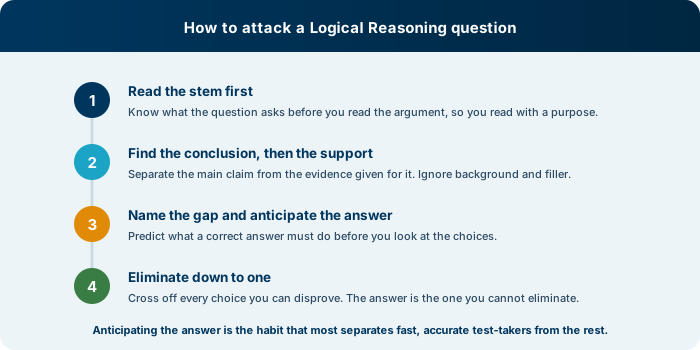
Read the stem first. Before you read the argument, read the question. Knowing whether you are weakening the argument, finding its assumption, or drawing an inference completely changes how you read the stimulus. Read with a job to do, not just to absorb words.
Find the conclusion, then the support. Almost every LR stimulus is an argument: a main claim plus evidence offered for it. Your first move is to separate the two. What is the author actually trying to convince you of, and what are they offering as a reason? Strip away the background and filler. Many wrong answers target the filler.
Name the gap and anticipate the answer. This is the step that separates high scorers from everyone else. Once you see the conclusion and the support, ask what the argument is assuming to get from one to the other. Then predict what a correct answer must do before you read the choices. If you can say “the right answer will show the sample was not representative,” you will spot it instantly and resist the traps.
Eliminate down to one. Do not hunt for the answer that feels right. Cross off every choice you can disprove. For each one, ask whether you can point to a concrete reason it fails. The correct answer is the one left standing, not the one that sounds nicest.
This process feels slow at first. With practice it collapses into a few seconds per question, and your accuracy climbs because you are no longer guessing.
Know the four families
LR has a lot of named question types, but they cluster into four families, and knowing the family tells you what kind of answer to hunt for.
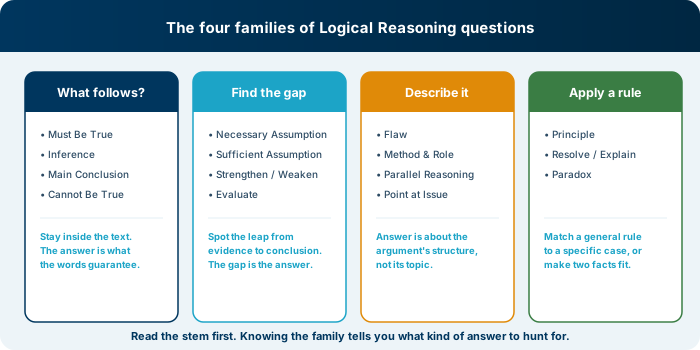
- What follows? Must Be True, Inference, Main Conclusion, and Cannot Be True. Here the answer is whatever the text guarantees. Stay strictly inside the passage; do not bring in outside assumptions.
- Find the gap. Necessary and Sufficient Assumption, Strengthen, Weaken, and Evaluate. These all target the leap between evidence and conclusion. Identify that gap and the answer follows.
- Describe it. Flaw, Method and Role, Parallel Reasoning, and Point at Issue. The answer is about the structure of the argument, not its subject matter. The topic is almost a distraction.
- Apply a rule. Principle and Paradox questions, where you match a general rule to a specific case or reconcile two facts that seem to conflict.
When you read the stem first, the very first thing to register is which family you are in. That single habit prevents a huge share of careless errors, like answering an Inference question as if it were a Strengthen. We go deeper on each type and the trap patterns behind them in The LSAT Reasoning Method, especially the flaw catalog.
A worked example for each family
Theory only goes so far. Here is the process applied to one question from each family, so you can see how reading the stem first and naming the gap actually plays out. Each example uses a short stimulus, the way the real test does.
Find the gap: a Weaken question
Stimulus: A new office policy lets employees work from home two days a week. Since the policy took effect, the company’s overall productivity has risen by 12 percent. Clearly, working from home makes employees more productive.
Stem: Which of the following, if true, most weakens the argument?
Read the stem first: this is a Weaken question, so your job is to find the gap between the evidence (productivity rose after the policy) and the conclusion (working from home caused the rise). The argument treats a correlation as a cause. To weaken it, you want an answer that offers a different explanation for the productivity jump. The right answer will say something like: the company also adopted new project-management software the same month. That introduces an alternative cause, which loosens the link between working from home and the result. Notice what does not weaken it: an answer about employees preferring the policy is irrelevant to whether it caused productivity, and an answer that working from home is cheaper attacks a claim the argument never made. The winning answer attacks the specific causal gap, nothing else.
What follows: a Must Be True question
Stimulus: Every member of the debate team is also in the honors program. No one in the honors program is a first-year student. Maria is on the debate team.
Stem: If the statements above are true, which one of the following must also be true?
This is a What Follows question, so the answer is whatever the text guarantees, no more. Chain the conditions: Maria is on the debate team, so she is in the honors program, and no one in the honors program is a first-year student, so Maria is not a first-year student. That is the right answer. The trap here is going one inch too far. An answer like “Maria is a strong debater” feels reasonable but is not guaranteed by the text, and “all honors students are on the debate team” reverses the first statement (the arrow only runs one way). Stay strictly inside what the statements force to be true.
Describe it: a Flaw question
Stimulus: The mayor’s new recycling program must be working. Ever since it launched, residents have reported feeling more optimistic about the city’s environmental future.
Stem: The reasoning in the argument is flawed because it
A Flaw question asks you to name what is wrong with the argument’s structure, independent of the topic. Separate conclusion from support: the conclusion is that the program is working (that is, actually improving recycling), and the support is that residents feel more optimistic. The gap is obvious once you name it: feelings about the future are not evidence that recycling has actually increased. The right answer describes that move abstractly, something like “treats people’s attitudes as evidence of an actual outcome” or “confuses how people feel about a result with the result itself.” The correct answer to a Flaw question is almost always a generic description of a reasoning error, so do not get pulled toward choices that just restate the topic.
Apply a rule: a Paradox question
Stimulus: A bookstore lowered the price of its bestsellers by 20 percent. Yet in the month after the price cut, the store’s total revenue from bestsellers increased.
Stem: Which of the following, if true, most helps to resolve the apparent discrepancy?
A Paradox question gives you two facts that seem to conflict and asks you to make both true at once. Here: prices went down, but revenue went up. Your job is not to argue with either fact; it is to find the missing piece that lets both hold. The right answer explains how a price cut could raise revenue, for example: the lower prices drew in far more customers, and the increase in copies sold more than made up for the lower price per copy. That reconciles the two facts cleanly. The trap answers either deepen the paradox (a reason fewer people bought books) or are irrelevant to it (information about a different product). The winner is the bridge that makes the surprising pair sensible.
Run these four patterns enough times and the families stop feeling like categories to memorize and start feeling like instructions: the stem tells you what kind of gap to hunt for, and the answer follows.
Master the reasoning that powers the hard questions
Two underlying skills do disproportionate work across LR, and they are worth drilling on their own:
- Conditional logic. If-then reasoning, contrapositives, and the difference between necessary and sufficient conditions appear constantly, and they are the backbone of Assumption and Inference questions. This is the same logic that used to power Logic Games, and it did not leave the test when those games did. Build fluency with conditional logic until contrapositives are automatic.
- Causal reasoning. A large fraction of Strengthen, Weaken, and Flaw questions hinge on an author treating a correlation as a cause. Once you can spot a causal claim and the standard ways to attack or defend it, those questions become formulaic.
Review by cause, not by count
The fastest way to improve is not doing more questions; it is reviewing the ones you did with real diagnosis. For every question you miss, or get right but felt unsure about, answer three questions:
- What family was it, and did I correctly identify that family?
- Which specific trap did I fall for? Did the wrong answer use extreme language, swap necessary for sufficient, address the wrong conclusion, or bring in an outside assumption?
- What would have steered me to the right answer?
Keep an error log and tag every miss by family and by trap. After a couple hundred questions, your log will show that most of your lost points come from two or three specific patterns. That is your study list. Drilling those targeted patterns moves your score far faster than grinding through random sets. This is the same blind-review discipline that turns practice tests into points.
Because Logical Reasoning is two scored sections out of three, it deserves the largest single share of your study hours. If you are planning your timeline, our guide to how long to study for the LSAT builds in heavy LR practice, and the phased structure that puts it to use is in how to study for the LSAT. Once you are scoring where you want, lock in a test date that leaves room for a retake.
Logical Reasoning rewards method and honest review more than raw talent. Run the same process on every question, learn the families, drill the underlying logic, and review by cause. Do that and the biggest section of the current LSAT becomes your most reliable one. Then put the method to work: drill every Logical Reasoning question type, free during early access, with every answer choice explained. Join the early-access list to get your account opened.
Frequently asked questions
How can I improve my LSAT Logical Reasoning score?
Read the question stem first so you know your task, separate the conclusion from its support, anticipate what a correct answer must do before reading the choices, then eliminate down to one. Review every miss by question family and trap pattern so you fix the specific cause, not the symptom.
Why is Logical Reasoning so important on the LSAT?
The current LSAT has two scored Logical Reasoning sections out of three scored sections, so roughly two-thirds of your score comes from Logical Reasoning. It is the highest-leverage section to improve.
Should I read the stimulus or the question first in LR?
Read the question stem first. Knowing whether you are weakening, strengthening, or drawing an inference tells you how to read the argument, so you read with a purpose instead of reading twice.
What are the main types of LSAT Logical Reasoning questions?
They fall into four families: questions about what must follow (Must Be True, Inference, Main Conclusion), questions that target the gap in an argument (Assumption, Strengthen, Weaken, Evaluate), questions that describe the argument (Flaw, Method, Parallel, Point at Issue), and questions that apply a rule (Principle, Paradox).
How long should I spend per LR question?
On average a little under a minute and a half per question to finish a 25-question section in 35 minutes. Easier questions should take well under a minute so you can bank time for the harder ones late in the section.
What is the best way to attack a Weaken question?
Read the stem first so you know you are weakening, then separate the conclusion from the evidence and name the gap between them. Many Weaken questions hinge on a correlation treated as a cause, so the right answer often introduces an alternative explanation. Predict that the correct choice will attack that specific gap, then eliminate choices that address claims the argument never made.
Prepping for the LSAT?
Start with the LSAT prep options available today, or join the update list for new releases.