
Test Logistics
How Many Times Can You Take the LSAT?
LSAC limits you to three LSATs per testing year, five over five years, and seven in a lifetime. Here are the retake rules, how schools treat multiple scores, and when retaking is worth it.
If your first LSAT did not go the way you hoped, the good news is that you almost certainly have another shot, and most law schools will reward your better score. But there are real limits on how often you can sit the test, and a retake only helps if you fix whatever held you back the first time. Here is what you need to know.
The retake limits
LSAC caps how many times you can take the LSAT. The current limits are:
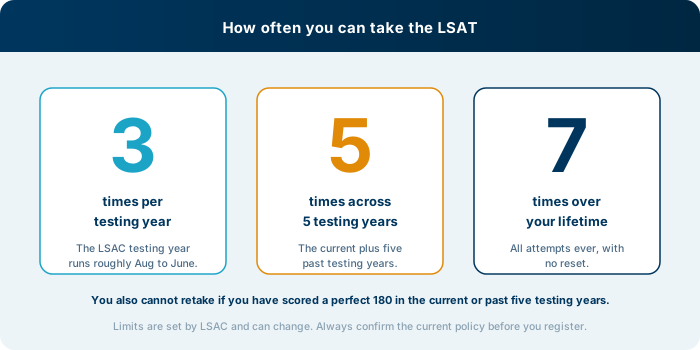
- Three times in a single testing year. The LSAC testing year runs across the cycle of administrations from roughly August to the following June.
- Five times within the current and five past testing years. This is the window in which scores are reportable.
- Seven times over your lifetime. This count does not reset.
There is one more rule worth knowing: you cannot retake the LSAT if you have already scored a perfect 180 within the current or past five testing years. If you have hit the ceiling, LSAC will not let you chase it again.
These limits are set by LSAC and have changed before, so always confirm the current policy on the official LSAC site before you register. For almost everyone, though, the practical takeaway is simple: you have enough attempts to retake if you need to, but not so many that you should treat any sitting casually.
Schools see every score, but use your highest
A common worry is that retaking will look bad because schools can see that you took the test more than once. They can. Your full score history, including cancellations, appears on the report schools receive.
But here is what matters: the large majority of law schools make decisions based on your highest LSAT score, not your average. This is largely because the ABA requires schools to report the high score for each admitted student, which gives schools a strong incentive to consider your best number. A higher retake genuinely helps your application; a lower one generally does not hurt much, because the high score is what counts.
This changes the math on retaking. Since your best score is the one that drives admissions at most schools, the downside of a retake is mostly your time and the registration fee, not your chances. A few schools may still consider the average or ask you to explain multiple attempts, so check the policy of each school on your list, but the dominant pattern strongly favors taking your best shot.
When a retake is worth it
Not every retake makes sense. Use these signals to decide.
Retake when:
- Your score was below your practice average. If you were consistently scoring 165 on practice tests and walked out with a 160, something went wrong on the day, and a retake is likely to recover those points.
- You can name a specific, fixable problem. Nerves wrecked your first section. You misjudged pacing and rushed Reading Comprehension. You had not finished learning a major question type. Concrete problems have concrete fixes.
- A few points clears a target. If your score sits just below the median of a school you want, and that median is within your realistic range, the payoff is high relative to the effort.
Think twice when:
- You already scored at the top of your practice range. If your test matched or beat your best practice tests, there may not be much more to extract without a substantial change in preparation.
- You have not changed anything. Retaking with the same preparation tends to reproduce the same score. A retake should follow a real change in how you study, not just hope.
- Your timeline is tight. Score release takes a few weeks, and you need that score in hand before key application deadlines. Make sure the calendar actually works.
If you do retake, prepare differently
The biggest mistake on retakes is doing the same thing again and expecting a different number. Before you register, diagnose specifically why the first score fell short, then change your preparation to target it.
- If the gap was timing, shift your practice toward full timed sections and pacing drills rather than more untimed work.
- If the gap was a specific question type, go back to fundamentals for that type and drill it to fluency before your next practice test.
- If the gap was nerves or stamina, simulate test conditions more aggressively, including a realistic break and a full-length sitting, so the real day feels familiar.
This is exactly where honest review pays off. The blind-review habit that separates timing problems from understanding problems is the fastest way to figure out which fix you actually need. And if you have plateaued and cannot see your own pattern, that is the moment an outside set of eyes helps most.
A retake is a tool, not a failure. Used well, with a clear diagnosis and a changed plan, it is one of the most reliable ways to move your number into the range your target schools want. Set your goal against what counts as a good LSAT score, then decide. Join the early-access list and our instructors can help you build a retake plan.
Frequently asked questions
How many times can you take the LSAT?
LSAC currently limits you to three times in a single testing year, five times within the current and five past testing years, and seven times over your lifetime. You also cannot retake if you have scored a perfect 180 in the current or past five testing years.
Do law schools see all your LSAT scores?
Yes. Schools receive your full LSAT score history through your CAS report, so they can see every score and any cancellations. However, most schools make admissions decisions based on your highest score.
Do law schools average LSAT scores?
The large majority of law schools consider your highest LSAT score rather than the average, because the ABA requires schools to report the high score. A few may still look at the average, so confirm each school's policy.
Is it worth retaking the LSAT?
A retake is usually worth it when your score was below your consistent practice average, when you can identify a specific fixable problem, or when a few more points would move you above a target school's median. It is less worthwhile if you already scored at the top of your practice range.
How much can you improve on an LSAT retake?
Improvement varies widely. A few points is common, especially if test-day nerves or a timing issue held you back. Larger jumps are possible with more focused preparation, but they require addressing the specific reason the first score fell short.
Prepping for the LSAT?
Start with the LSAT prep options available today, or join the update list for new releases.