
MCAT Logistics
How Long Is the MCAT? 7h 30m on Paper — Test-Day Reality
7 hours 30 minutes is the official answer. What nobody tells you: how the four sections feel back-to-back, what to actually do with each break, and the pacing strategy 527 scorers use to stay sharp through Psych/Soc.
The short answer: about 7 hours and 30 minutes from when you sit down to when you leave. The actual testing time is 6 hours and 15 minutes. The rest is breaks.
But the length is more than a fun fact. It changes how you need to prepare. This isn’t a 3-hour exam you can power through on caffeine. It’s a full workday of high-concentration thinking, and if you haven’t trained for that, your later sections will suffer regardless of how well you know the material.
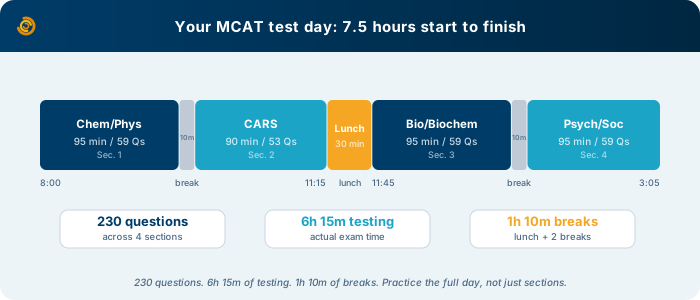
The four sections, in order
The sequence is fixed. You can’t skip around.
Section 1: Chem/Phys (Chemical and Physical Foundations of Biological Systems)
95 minutes. 59 questions. Covers general chemistry, organic chemistry, physics, and biochemistry in the context of biological systems. Passage-based, plus about 15 standalone questions.
Section 2: CARS (Critical Analysis and Reasoning Skills)
90 minutes. 53 questions. Nine passages from humanities and social sciences. No science content. Tests whether you can read a dense, unfamiliar argument and answer questions about it under time pressure.
Section 3: Bio/Biochem (Biological and Biochemical Foundations of Living Systems)
95 minutes. 59 questions. Biology, biochemistry, organic chemistry, and general chemistry. Same passage-based format as Chem/Phys. Usually the most content-heavy section.
Section 4: Psych/Soc (Psychological, Social, and Biological Foundations of Behavior)
95 minutes. 59 questions. Psychology, sociology, and biology as they relate to behavior. A lot of students underestimate this section because they assume it’s “easy,” then get surprised by the vocabulary density.
Total: 230 questions, 375 minutes (6 hours 15 minutes) of testing.
The breaks
After Chem/Phys: 10-minute break.
After CARS: 30-minute break (the lunch break).
After Bio/Biochem: 10-minute break.
All breaks are optional, but take them. The clock runs whether you use them or not, so a shorter break doesn’t buy you extra testing time. Walk around. Eat something. Your brain needs the reset.
A lot of students skip breaks during practice because they want to finish faster. Don’t. On test day, you’ll want them. Practice the way you’ll test. Our 3-month study plan builds full-length simulations into the final phase specifically for this reason.
What the day actually looks like
7:30 a.m. arrive, check in, store belongings.
8:00 a.m. Chem/Phys starts.
9:35 a.m. first break (10 min).
9:45 a.m. CARS starts.
11:15 a.m. lunch break (30 min).
11:45 a.m. Bio/Biochem starts.
1:20 p.m. third break (10 min).
1:30 p.m. Psych/Soc starts.
3:05 p.m. done. Void/score screen, leave.
You’re in that building for about 7.5 hours. Pack food in advance. I brought a sandwich, a banana, trail mix, and water. Some people bring protein bars for the short breaks. The test center provides lockers.
Why the length changes your prep strategy
Here’s what most study guides skip: the difficulty of the MCAT isn’t just the content. It’s the duration. Your brain doesn’t work the same way in hour 6 as it does in hour 1.
I’ve watched students score 128+ on Chem/Phys in practice, then drop to 124 on Psych/Soc (the last section) because they’re mentally gone by that point. The material wasn’t harder. Their focus was.
What this means for your preparation:
Take full-length practice tests. Not half-lengths, not section-by-section drills. Full 7.5-hour simulations with breaks. You need at least 4-5 of these before test day to build the endurance. Our question bank supports both section practice and full-length simulation.
Practice in the morning. The MCAT starts at 8 a.m. If all your studying happens at night, your brain won’t be warmed up when it counts. During the last month of prep, shift to morning sessions.
Practice the breaks. Eat the same food you plan to eat on test day. Walk the same amount. Train your body’s expectations so nothing feels unfamiliar on exam day.
Stack sections in practice. Occasionally do Chem/Phys followed immediately by CARS with a 10-minute break. This mirrors the real test and forces you to switch between very different thinking modes while fatigued.
Common questions
Can I take sections in a different order? No. Always Chem/Phys, CARS, Bio/Biochem, Psych/Soc.
Can I go back to a previous section? No. Once you end a section, it’s locked. You can move between questions within a section, but that’s it.
What if I finish a section early? Your break time doesn’t change. Extra time is best spent reviewing flagged questions, not leaving early.
Can I bring scratch paper? The center provides it. You can get a fresh set at each break.
Can I void my score? Yes, after the last section. If you void, no one sees the score, including you. I generally advise against voiding unless something went seriously wrong (illness, panic attack, technical failure). Most students who think they bombed end up scoring within their practice range.
If you’re looking for help structuring your practice schedule around the endurance demands, our tutors work on this with students regularly. Sometimes the difference between a 510 and a 515 is just learning how to maintain focus through 7 hours. For a complete breakdown of what score you need and how to pick your test date, we have separate guides.
Frequently asked questions
How long is the MCAT?
The MCAT takes about 7 hours and 30 minutes total, with 6 hours and 15 minutes of actual testing time and the rest in breaks.
How many sections does the MCAT have?
The MCAT has four sections: Chem/Phys, CARS, Bio/Biochem, and Psych/Soc, with a total of 230 questions.
How many breaks are there during the MCAT?
There are three breaks: a 10-minute break after Chem/Phys, a 30-minute lunch break after CARS, and a 10-minute break after Bio/Biochem.
What time does the MCAT start?
The MCAT starts at 8:00 a.m. local time, with check-in beginning around 7:30 a.m.
Can you go back to a previous section on the MCAT?
No. Once you end a section, it is locked. You can only move between questions within the current section.