
MCAT Logistics
What Is a Good MCAT Score in 2026? Honest Targets by School Tier
'Good' depends on where you're applying. Here's what 501, 510, 515, and 520+ actually get you at DO, MD, mid-tier, and top-20 programs — from a 527 scorer who has reviewed hundreds of applications.
“What’s a good MCAT score?” is the most common question I get from premeds, and it never has a clean answer. A 510 is excellent for some schools and below average for others. It depends on where you’re applying, the rest of your application, and honestly, what you’re willing to settle for.
But I can give you the numbers and the context to interpret them.
The numbers you need to know
The MCAT is scored from 472 to 528. Each of the four sections scores from 118 to 132, and they add up to your total.
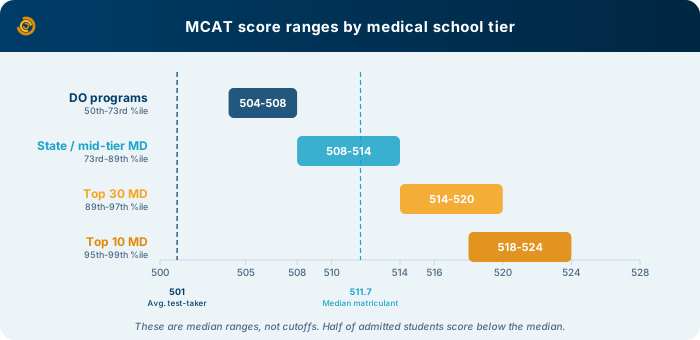
The average score across all test-takers is about 501. This includes people who weren’t seriously preparing, people who walked out early, and people who took it as a trial run. It’s not a useful target.
The median score among students who actually matriculate into U.S. MD programs is about 511.7. Half the people who got into medical school scored below this, half scored above. This is a much more meaningful benchmark.
A 510 puts you at the 79th percentile. Competitive for many state schools and lower-ranked MD programs.
515 is the 91st percentile. Competitive for most medical schools in the country, including many top 30 programs.
520 is the 97th percentile. Only 3% of test-takers score this high. Competitive for essentially every medical school.
“Good” is ultimately defined by your school list, not a single national number. Our Med School Explorer is a free MSAR alternative that shows the median MCAT and GPA for every US MD and DO program, so you can judge your score against the schools you actually care about.
I scored 527 (99.9th percentile). For a detailed percentile breakdown, see our separate guide. I mention this not to brag but because it gives me a specific perspective: I know what it takes to get there, and I also know that most students don’t need to.
What score do you actually need?
State MD schools and mid-tier programs (median MCAT ~508-512): A 508-514 makes you competitive. Many state schools weigh in-state status and GPA heavily, so a 510 with a strong GPA and good clinical experience is often enough. Don’t overinvest in chasing a 520 if these are your targets.
Top 30-50 MD programs (median MCAT ~514-518): You want 514 or higher. A 516-518 is comfortable. Below 512 and you’ll need exceptional strengths elsewhere to compensate.
Top 10-15 programs (Harvard, Hopkins, Stanford, UCSF): Median MCATs at these schools tend to be 519-522. A 518+ is where you start being in range. Below that, your other metrics need to be extraordinary.
DO programs: Median MCATs are typically 504-508. A 505+ makes you competitive at most DO schools. Scoring 510+ means you’re likely a strong candidate for MD programs too.
When your score isn’t the problem
I’ve seen students agonize over getting their MCAT from 515 to 518 when their real issue was a weak personal statement, no clinical experience, or a low GPA. The MCAT matters, but it’s one piece of your application.
A rough rule: if your MCAT is at or above the median for your target schools, your time is better spent on other application components. An extra 2 points on the MCAT is worth less than a well-written personal statement or a meaningful clinical experience.
The exception is if you’re below the median. Then your MCAT is a filter, and some schools will screen you out before a human reads your application. In that case, a retake is worth considering.
Is a retake worth it?
Retaking makes sense when your score is significantly below your target (5+ points), you’ve identified what went wrong, and you have a specific plan to fix it. At minimum, give yourself 2-3 months between attempts.
Retaking doesn’t make sense when your score is already at or near your target school’s median and you’re hoping to squeeze out a few more points. Medical schools see all your attempts. A marginal improvement doesn’t help much, but a score drop hurts.
I’ve worked with students who retook after a 510 and jumped to 518. I’ve also worked with students who retook after a 513 and scored 511. The first student had clear content gaps in chemical kinetics and the respiratory system that she addressed. The second student studied more of the same things and hoped for a different result.
Section balance matters
A 516 with four 129s looks different to an admissions committee than a 516 with a 132, 131, 125, and 128. That 125 can be a red flag, especially at schools with section cutoffs. Some Canadian medical schools have hard CARS minimums. U.S. schools are more flexible, but a section score below 125 raises questions.
If one section is significantly weaker than the others, that’s often a stronger reason to retake than a total score slightly below target. Bringing a 124 up to 127 is more impactful than bringing a 515 up to 517.
How to calibrate your prep
If you’re still studying, here’s how to think about your practice test scores:
Consistently scoring 505-510? You’re in good shape for state schools and DO programs. If you want higher, focus on your weakest section specifically.
Scoring 510-515? Competitive for most MD programs. Push higher if you’re targeting top schools, otherwise test when ready.
Scoring 515+? Strong position. Don’t delay chasing perfection.
Below 505? You likely have content gaps that need targeted review in areas like acids and bases, the endocrine system, or electrostatics. More practice volume alone won’t fix this. Our free resources have study materials, or working with a tutor can help identify exactly where you’re losing points.
You can see how our students have improved their scores on our results page.
The bottom line
A “good” MCAT score is one that makes you competitive where you want to apply. For some people that’s 508. For others it’s 520. Figure out your target schools, look up their median MCATs, and aim for that range. Spending months chasing a number because it looks impressive on Reddit is time you could spend on the rest of your application. If your score isn’t improving despite studying, the problem is usually your approach, not your effort.
Frequently asked questions
What MCAT score do I need for medical school?
The median MCAT for U.S. MD matriculants is about 511.7. For DO programs, 504-508 is competitive. For top 30 MD programs, aim for 514+.
Is 510 a good MCAT score?
A 510 is the 79th percentile and is competitive for many state MD schools and mid-tier programs, especially with a strong GPA.
What is the average MCAT score for MD schools?
The median MCAT score for students who matriculate into U.S. MD programs is about 511.7.
Is it worth retaking the MCAT?
A retake makes sense if your score is 5+ points below your target and you have a specific plan to fix what went wrong. Give yourself 2-3 months between attempts.
What MCAT score do I need for DO schools?
Most DO programs have median MCATs of 504-508, so scoring 505 or above makes you competitive at most DO schools.