
MCAT Logistics
MCAT Practice vs. Actual Scores Compared
See how Kaplan, Blueprint, Princeton Review, and AAMC practice scores compare to real MCAT scores. Interactive converter and deflation data.
You just got your practice test score back, and it’s lower than you expected. Before you panic, there’s something you need to know: your practice test score isn’t your real MCAT score. Depending on which company made the test, your actual MCAT could be 5, 10, or even 15 points higher.
This isn’t a guess. It’s backed by data from hundreds of test-takers who reported both their practice scores and their real results. In my experience tutoring hundreds of students, the pattern is consistent: third-party practice tests almost always make the MCAT look harder than it actually is.
Let me explain why, and give you a tool to see what your score really means.
What “deflation” and “inflation” actually mean
These terms sound complicated, but they’re simple.
Deflation means the practice test is harder than the real MCAT. Your score looks lower than it should. If you scored 505 on a Kaplan practice test, your real MCAT score would likely be closer to 515. The test was deflated by about 10 points.
Inflation is the opposite. The practice test is easier than the real thing, so your score looks higher than it should. This is rare among major test prep companies. None of the major providers consistently inflate scores.
The amount of deflation varies by company, and it varies a lot.
The deflation spectrum: every provider compared
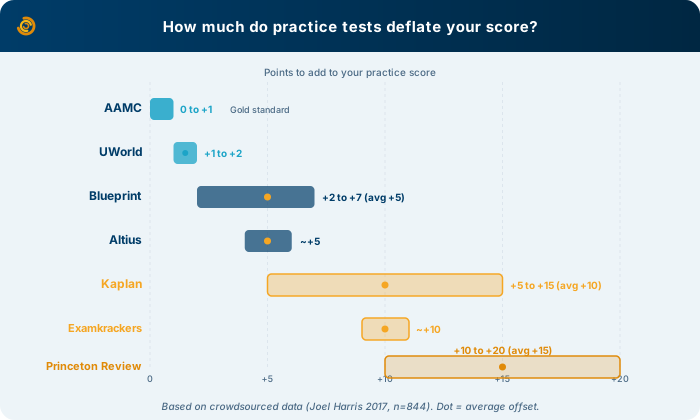
Here’s how each major practice test provider compares to the real MCAT, ordered from most accurate to most deflated.
AAMC (the gold standard)
AAMC full-length practice tests are the closest thing to the real MCAT. They’re written by the same organization that writes the actual exam, use the same scoring algorithm, and test the same reasoning patterns. Most students score within 2-3 points of their AAMC full-length average on test day.
Deflation: 0 to +1 point. Your AAMC score is essentially your real score.
AAMC FL5 and FL4 are considered the most representative of the current exam. FL1 and FL2 are still useful but slightly less predictive, especially in the Psych/Soc section.
UWorld
UWorld practice assessments run slightly harder than the real MCAT but are the closest third-party option to AAMC quality. Their question style emphasizes reasoning over rote memorization, which mirrors the real test well.
Deflation: +1 to +2 points. Very close to your real score.
Blueprint (formerly Next Step)
Blueprint full-length exams are well-regarded and have one of the strongest correlations to actual scores among third-party tests. Their Bio/Biochem section is particularly representative. However, their CARS section can feel different from the AAMC version.
Deflation: +2 to +7 points (average about +5). If you scored 510 on Blueprint, expect roughly 515 on the real thing.
This data comes from Joel Harris’s 2017 analysis of 354 Blueprint data points (R²=0.536).
Altius
Altius tests are among the harder commercial practice exams. Their C/P and B/B sections are solid practice for the real test, but their CARS questions don’t follow AAMC logic closely.
Deflation: about +5 points. Similar to Blueprint.
Kaplan
Here’s where the deflation gets serious. Kaplan practice tests are significantly harder than the real MCAT. Their C/P section tests especially obscure content that rarely appears on the actual exam. Their CARS section uses a different reasoning style than AAMC.
Deflation: +5 to +15 points (average about +10). If you scored 505 on Kaplan, your real score is likely around 515.
Why does Kaplan deflate so much? Kaplan offers a “Higher Score Guarantee” that refunds students if they don’t improve by a certain amount. Their full-lengths are widely reported by students to score below the real exam, which makes early numbers look discouraging and later gains look dramatic. Whatever the reason, factor it into how you read your trend, not a reflection of your ability.
Joel Harris’s analysis of 309 Kaplan data points confirms the roughly 10-point average deflation.
Examkrackers
Examkrackers tests use a percentage-based scoring system rather than the standard 472-528 scale, making direct comparison harder. Students generally report scoring about 10 points higher on the real MCAT.
Deflation: about +10 points. Data is limited and mostly anecdotal.
Princeton Review
Princeton Review has the most extreme deflation of any major provider. Their questions are described as “unbelievably hard,” testing concepts that simply don’t appear on the real MCAT. They also have the weakest correlation to actual scores.
Deflation: +10 to +20 points (average about +15). Joel Harris found that the average student who scored 503 on Princeton Review scored 518 on the real MCAT. That’s a 15-point gap.
Don’t let a Princeton Review score discourage you. It’s the least predictive practice test available.
Why do companies deflate their scores?
Three reasons:
1. Score guarantee programs. Companies like Kaplan guarantee a specific score improvement. If their practice tests deflate by 10 points, almost every student “improves” by at least that much just by taking the real MCAT. The guarantee is easy to fulfill.
2. Different question styles. The AAMC tests reasoning: can you interpret data from a passage you’ve never seen? Third-party companies often test content recall: do you remember this obscure fact? These are different skills, and the content-heavy approach tends to produce lower scores.
3. Scaling algorithms. Each company creates its own scoring curve. These curves are proprietary and can change without warning. A 505 on Kaplan doesn’t mean the same thing as a 505 on Blueprint because the scales are built differently.
What the research says
The most rigorous public analysis comes from Joel Harris (2017), who compiled 844 self-reported practice and real MCAT scores from Reddit’s r/MCAT community and Student Doctor Network. His data confirmed the deflation patterns above, though he noted that self-reporting bias inflates the dataset (the average reported real score was 515, well above the true MCAT average of 500).
A 2020 study by Chen and Corridon found that the median of all practice exam scores was the single best predictor of real MCAT performance (r=0.92), better than the maximum score or most recent score. The takeaway: don’t cherry-pick your best practice test. Use your average.
The MCAT itself has a standard error of measurement of about 2 points, meaning even your real score has a built-in uncertainty of plus or minus 2.
Convert your practice score
Enter your practice test score below to see how it translates to the real MCAT. Use the “By section” tab for a section-by-section breakdown.
Your Kaplan 505 likely translates to
on the real MCAT
This tool uses crowdsourced data and provides estimates, not guarantees. Your best predictor is the average of your last two AAMC full-length exams.
Scoring below your target? Our tutors scored as high as 527 and specialize in closing the gap. Talk to a tutor →
How to actually interpret your practice scores
The calculator above gives you a data-driven estimate, but here’s the bigger picture on how to think about practice scores during your prep.
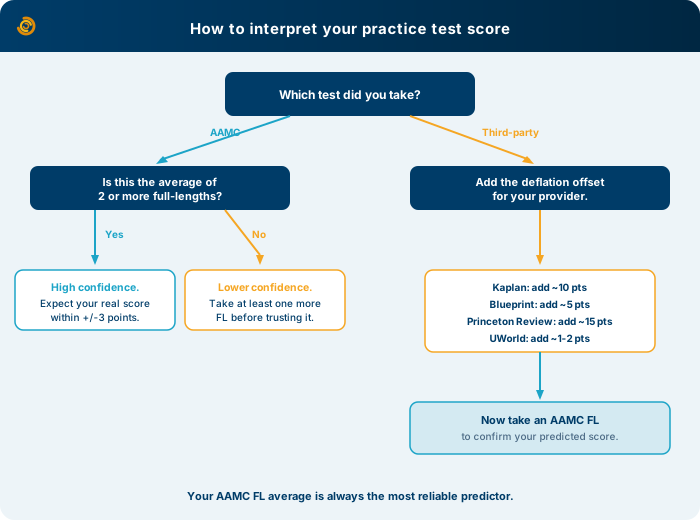
Your AAMC full-length average is your best predictor. Specifically, the average of your last two AAMC FLs taken under strict timed conditions. If that average is 512, your real MCAT will most likely land between 509 and 515. About 70-80% of students score within 3 points of their AAMC average.
Third-party tests are for learning, not predicting. Use Kaplan, Blueprint, and Princeton Review tests to build stamina, identify weak content areas, and practice passage-based reasoning. Don’t use them to predict your score. That’s not what they’re designed for.
Save your AAMC FLs for last. Take them in the final 3-4 weeks of your prep, closest to your real test date. AAMC FL5 is considered the most representative of the current exam, followed by FL4.
Don’t panic about a low Kaplan or Princeton Review score. If you scored 500 on Kaplan, that doesn’t mean you’ll score 500 on the real thing. It likely means you’re tracking closer to 510. Use the converter above to check.
One practice test isn’t enough data. A single FL is a snapshot, not a trend. Score fluctuations of 3-5 points between practice tests are normal. Your average over multiple tests is far more reliable than any single result.
Want MCAT-style practice? Our question bank gives you passage-based questions across all four sections. Try the question bank →
Struggling with CARS? It’s the hardest section to improve, but not impossible. Read our CARS strategy guide →
Building your study plan? See our 3-month MCAT study plan → for a week-by-week schedule that prioritizes score movement.
The bottom line
Here’s what to remember:
- AAMC practice tests are the most accurate predictor of your real score. Trust them.
- Kaplan deflates by about 10 points. Princeton Review deflates by about 15. Don’t panic about low scores on either.
- Blueprint is the most accurate third-party option, deflating by about 5 points.
- Your average across multiple tests is a better predictor than any single test. The median of all your practice scores has the strongest correlation to your real result.
- Practice tests are a compass, not a GPS. Use them for direction. For precision, take AAMC full-lengths close to your test date.
Want personalized score analysis? Our tutors review your practice test data and build a custom study plan. Tutor scores range up to 527 — every one listed publicly. Get started →
Free MCAT resources: Practice questions, equation sheets, and study tools. Browse free resources →