
MCAT Logistics
When to Start Studying for the MCAT
How to decide when to begin MCAT prep based on your class load, baseline score, target, and application timeline.
The most common question I get from premeds isn’t about content or strategy. It’s “when should I start studying?” And my honest answer is always: it depends on things only you know.
That sounds like a non-answer, so let me make it concrete.
Work backward from your test date, not forward from today
The first thing to figure out isn’t when to start studying. It’s when you need to take the exam. And that date is set by your application timeline.
If you’re applying to medical school in June 2027, you want your MCAT score back by May 2027 at the latest (earlier is better). MCAT scores take about a month to come back. That means you’d take the exam by April 2027 at the latest.
Now work backward from your test date. If you need 3 months of prep, start in January. If you need 5 months, start in November. If you need 6, start in October.
The number of months you need depends on exactly two things: how far your baseline is from your target, and how many hours per week you can actually dedicate.
How to figure out your baseline
Take a diagnostic. A real one, timed, under test conditions. Your baseline is not your GPA, not your grade in organic chemistry, not your gut feeling about how ready you are. It’s your score on a practice exam when you sit down cold.
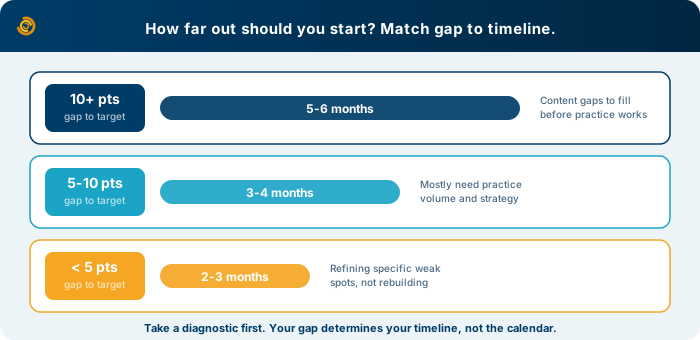
Some rough guidelines based on the diagnostic-to-target gap:
Gap of 10+ points (e.g., diagnostic 500, target 512): Plan for 5-6 months. You have content gaps to fill before practice becomes productive.
Gap of 5-10 points (e.g., diagnostic 508, target 515): Plan for 3-4 months. You probably know most of the content and need practice volume and strategy refinement.
Gap of under 5 points (e.g., diagnostic 513, target 517): Plan for 2-3 months. You’re refining, not rebuilding. The work is more about identifying specific weak spots and drilling them.
These are rough. A student taking 15 credit hours with a part-time job needs more calendar months than a student with a light summer schedule, even if their gaps are the same. What matters is total focused hours, not calendar time.
The “how many hours per week” question
Be honest about this. Studying for the MCAT is not the same as attending class. It requires concentrated, distraction-free work. Scrolling through Anki while watching TV doesn’t count.
Rough benchmarks for total study hours:
- 300-350 hours for a student with strong science foundations and a moderate score target
- 400-450 hours for a student with some content gaps or a higher target score
- 500+ hours for a student rebuilding fundamentals or targeting 520+
Divide your total hours by realistic weekly hours to get your timeline. If you can do 25 focused hours per week (which is a lot alongside classes), 400 hours takes 16 weeks, or about 4 months. If you can only do 15 hours per week, that same 400 hours takes almost 7 months.
Most students overestimate how many hours they’ll actually study per week. If you’ve never tracked your study time before, track it for one week before committing to a timeline. You might be surprised.
The class schedule factor
This is the part most timeline guides ignore. Your available study time isn’t constant. It shifts with your academic calendar.
A few patterns I see often:
Summer studiers: If you can dedicate a full summer to MCAT prep with no or few other obligations, 10-14 weeks is a common and workable timeline. This is the most popular approach and for good reason. Concentrated time without competing demands is the most efficient way to prepare.
School-year studiers: If you’re studying during a semester, expect your weekly hours to be lower and your timeline to stretch accordingly. A common approach is to start content review during a lighter semester and shift to heavy practice during a break. Be realistic about exam weeks and project deadlines. Your MCAT study will lose those weeks entirely.
Gap-year studiers: If you’re taking a gap year, you have the most flexibility. Use it. Don’t rush into a 3-month plan just because you have the time. A 4-5 month plan with built-in buffer weeks for life disruptions is usually more sustainable.
When starting earlier actually helps
Starting earlier helps when the extra time is structured. Six months of focused, phased studying beats three months of cramming. That’s obvious.
But six months of unfocused studying, where you’re “technically” studying but really just reading a prep book intermittently, is often worse than four months of concentrated work. The unfocused approach creates an illusion of preparation without building real skill, and by the time you realize you’re behind, you’ve wasted two months.
If you’re going to start early, have a plan from day one. Even a rough one. Something like:
- Months 1-2: Content review + daily Anki
- Months 3-4: Passage practice + targeted review
- Months 5-6: Full-length exams + refinement
We have study guides on our free resources page that can help you structure this, including a comprehensive study strategy guide written by 520+ scorers.
When starting later is fine
I want to push back on the anxiety that you need 6+ months. Some students genuinely don’t.
If your diagnostic is within 5 points of your target, you have strong science fundamentals from coursework, and you can dedicate 20+ hours per week, a 2-3 month prep window is completely reasonable. I’ve seen students pull it off. I did it myself.
The key is that shorter timelines require discipline. You don’t have recovery weeks. If you waste a week, that’s a meaningful percentage of your total prep time. Shorter timelines also mean you need to be ruthlessly honest about what you actually need to study. No reading the entire Kaplan biochemistry book “just in case.” Study what the diagnostic says you need.
The decision most students avoid
Here’s what I actually think this question is about, most of the time. Students aren’t really asking “when should I start studying?” They’re asking “is it too late?” or “am I behind?” And the anxiety behind those questions often leads to either paralysis (not starting at all) or panic (starting with a frantic, unstructured approach).
If your exam is more than 3 months away, you have time. Check our 2026 MCAT test dates for available dates. If it’s less than 3 months away and your diagnostic is far from your target, consider moving your test date. That’s not failure. That’s strategy. The MCAT isn’t going anywhere, and a score that reflects your ability is worth more than a score that reflects your timeline anxiety.
If you want help figuring out a realistic timeline for your specific situation, our tutors do this regularly. A 30-minute conversation about your diagnostic score, your schedule, and your target can save you weeks of uncertainty about when and how to start.