
Study Planning
How to Score 520+ on the MCAT: A 527 Scorer's Playbook
A 527 scorer's exact playbook: section-by-section score targets, the daily study routine, practice-exam cadence, and the specific habits that separate 520+ scorers from students who plateau at 510-515.
A 520 on the MCAT puts you in the 97th percentile. That means roughly 97 out of every 100 people who sit for this exam score lower than you. It’s the threshold where your MCAT score stops being a question mark in your application and starts being a weapon.
I scored a 527, and our top-tier tutors at Premier MCAT Prep all scored 520 or higher. I’m not saying that to brag. I’m saying it because what follows isn’t theory. It’s the actual playbook, with the specific habits and strategies that got us there.
Here’s what I’ll tell you upfront: scoring 520+ is not about being smarter than everyone else. It’s about being more systematic. The students who hit this mark consistently do things differently than the students who plateau at 510-515, and the differences are identifiable and teachable.
What a 520+ actually requires, section by section
The MCAT has four sections, each scored 118-132. A 520 total means you need to average 130 per section. But in practice, almost nobody scores a flat 130 across the board.
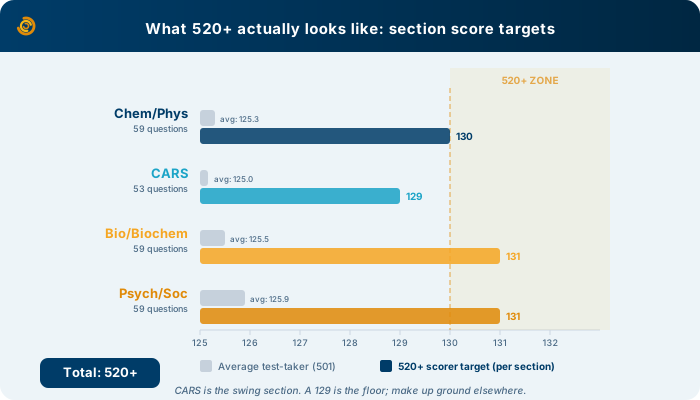
Here’s a more realistic breakdown of how 520+ scores actually distribute:
- Chem/Phys (C/P): 130. This section rewards precise content knowledge and fast calculations. Students who know their equations cold consistently score 130+.
- CARS: 129. This is the hardest section to score high on and the most resistant to short-term improvement. A 129 in CARS is realistic. A 132 is rare. Plan your targets around this reality.
- Bio/Biochem (B/B): 131. This is often the highest section for 520+ scorers because the content is dense but learnable. If you memorize the amino acids, know your metabolic pathways, and practice experimental passages, 131 is achievable.
- Psych/Soc (P/S): 131. The most improvable section. It’s largely vocabulary-based, and students who use the right study materials can go from 126 to 131 in weeks.
The strategic takeaway: you don’t need a 130 in every section. You need a 129+ floor with 131-132 in your strong areas. That’s a much more achievable target than “be perfect everywhere.”
The foundation: content mastery has to be automatic
At the 510 level, you can get by with “I sort of know this.” At the 520 level, you can’t. The difference between a 128 and a 131 in a science section often comes down to 3-4 questions. Those 3-4 questions are usually ones where you either knew the content instantly or you had to burn 90 seconds reconstructing something you half-remembered.
520+ scorers don’t just know the material. They know it fast.
What this looks like in practice:
- You see “Henderson-Hasselbalch” in a passage and you don’t pause. You write the equation and start plugging in numbers.
- Someone says “amino acid with a hydroxyl group on its side chain” and you immediately think serine, threonine, tyrosine.
- You read a passage about an enzyme inhibitor and you know it’s competitive before the question asks, because you recognized the pattern in the data.
This level of automaticity comes from active recall practice, not passive review. Flashcards (Anki), practice questions, and teaching concepts to yourself out loud are what build it. Reading a prep book chapter a third time does not.
A content checklist for 520+ scorers
You should be able to explain these without looking anything up:
- All 20 amino acids: structure, charge at physiological pH, classification
- All major metabolic pathways: glycolysis, TCA, oxidative phosphorylation, beta-oxidation, gluconeogenesis
- Organ systems: renal physiology, cardiovascular mechanics, nervous system divisions
- Physics: optics, circuits, fluids, electrostatics, thermodynamics
- Organic chemistry: reaction mechanisms, stereochemistry, spectroscopy interpretation
- General chemistry: equilibrium, acid-base, electrochemistry, kinetics
- Psych/Soc: all major theories (Piaget, Erikson, Kohlberg), sociological concepts, research methods
If you can’t explain any of these confidently right now, those are your priority content areas. Our equation sheet and study guides cover the physics and chemistry side. For psych/soc, the 86-page document on our resources page is the single best review source I’ve seen.
The skill that separates 515 from 520: passage reasoning
Here’s the uncomfortable truth about the MCAT: most questions aren’t testing whether you know a fact. They’re testing whether you can use facts to interpret new information presented in a passage.
Students who plateau at 515 typically have solid content knowledge. They miss questions because they misread the passage, fell for a trap answer, or ran out of time. These are all reasoning problems, not knowledge problems.
How to build passage reasoning skills
1. Read the passage first, every time. Don’t jump to the questions. I know people say “read the questions first for efficiency.” At the 520+ level, this backfires. The questions test comprehension of the passage as a whole, not isolated facts. You need the full picture before you answer anything.
2. Practice identifying what the passage is actually about. Every MCAT passage has a central experiment, argument, or phenomenon. Before looking at questions, you should be able to say in one sentence what the passage is about. If you can’t, re-read the last paragraph. That’s usually where the main point lands.
3. For each question, identify the reasoning type:
- Recall: You either know it or you don’t. These should take 30 seconds max.
- Passage retrieval: The answer is literally in the passage. Find it, confirm it, move on.
- Reasoning beyond the passage: You need to combine passage info with outside knowledge. These are the hardest and where most points are lost.
- Experimental reasoning: The passage describes an experiment and asks you to predict results, identify controls, or explain outcomes. These reward careful reading more than content knowledge.
4. Review wrong answers with this question: “What did I misunderstand?” Not “what didn’t I know.” At the 520 level, most missed questions come from misunderstanding, not ignorance. Your review should focus on understanding why the right answer is right and why your answer was wrong. Saying “I’ll study that topic more” is almost never the right fix for a reasoning error.
CARS: the section that makes or breaks a 520
CARS is the only section with no science content. It tests reading comprehension, critical analysis, and reasoning. It’s also the section where high scorers lose the most sleep because it’s the hardest to improve quickly.
If you’re already working on CARS strategy, good. Here’s what 520+ scorers do differently:
They read aggressively, not passively. Don’t just absorb the words. Argue with the author. Ask “why is the author making this claim?” and “what would undermine this argument?” as you read. This active engagement is what lets you answer inference questions correctly.
They accept ambiguity. CARS answers are often “best of four mediocre options,” not clearly correct. 520+ scorers are comfortable picking the least wrong answer. Students who struggle with CARS are often looking for certainty that doesn’t exist.
They don’t time-bank. Some students rush through three passages to save extra time for the “hard” one. This backfires. The passages you rush through are where you make careless mistakes. 520+ scorers give each passage roughly equal time and trust their pace.
The realistic CARS target: Aim for 129. If you consistently score 129 on AAMC CARS material, protect that score and build your 520+ from the other three sections. Chasing a 132 in CARS at the expense of practice time in other sections is a bad trade.
Full-length exams: the single most important tool
Nothing predicts your real MCAT score better than your AAMC full-length scores in the final 2-3 weeks. And nothing improves your score faster in the final month than taking and thoroughly reviewing full-length exams.
520+ scorers typically take 8-10 full-length practice exams during their prep. Here’s how they use them:
Phase 1 (months 1-2): third-party full-lengths for stamina
Blueprint, Kaplan, Princeton Review — it doesn’t matter much which company. These tests are harder than the real MCAT (intentionally), so don’t panic about your scores. The purpose of early full-lengths is endurance. You need to get comfortable sitting for 7+ hours and maintaining focus through the final section.
Take one full-length every 1-2 weeks during this phase.
Phase 2 (final month): AAMC full-lengths for calibration
Save your AAMC full-lengths for the last 3-4 weeks. These are the only tests that accurately predict your real score. When 520+ scorers say “I scored a 521 on FL3 and got a 522 on the real thing,” they’re talking about AAMC tests, not third-party tests.
Take AAMC full-lengths every 5-7 days during this phase. Between exams, spend 2-3 days reviewing every question — including the ones you got right. Understanding why you got a question right confirms your reasoning. Understanding why you got one wrong prevents the same mistake on test day.
The review protocol that 520+ scorers use
For every question you miss on a full-length:
- Categorize the error: content gap, passage misread, careless mistake, or timing pressure
- Write down the correct reasoning, not just the correct answer
- If it’s a content gap, add it to your review queue (Anki card, notes, whatever works)
- If it’s a reasoning error, find two similar questions and practice them immediately
For questions you got right but were uncertain about:
- Confirm your reasoning matches the explanation
- If you guessed correctly, treat it as a miss and review it fully
This review process takes 4-6 hours per full-length. It’s tedious. It’s also where most of your score improvement comes from in the final month.
The timing problem nobody talks about
At the 520+ level, you shouldn’t be running out of time. If you are, it’s almost always one of two problems:
Problem 1: You’re spending too long on hard questions. The MCAT gives you about 95 seconds per question in science sections and about 100 seconds per question in CARS. A question that takes you 3 minutes is stealing time from two other questions. 520+ scorers flag hard questions, make their best guess, and move on. They come back if there’s time. They don’t sit and grind.
Problem 2: You’re second-guessing answers. If you’ve read the passage carefully and your reasoning is sound, commit to your answer. Changing answers on review rarely helps and often hurts. Students who second-guess extensively are usually turning right answers into wrong ones.
The 520+ timing rule: If a question takes more than 2 minutes and you’re not making progress, flag it and move on. Come back at the end of the section. This one habit alone can recover 3-5 questions per section.
The study schedule difference
I’ve written about 3-month study plans before. For 520+ specifically, here’s what changes:
You need more practice volume. A 510-targeting student might do 2-3 passages per day. A 520-targeting student should be doing 5-7 passages per day during peak training, plus full-lengths on weekends. The MCAT is partially an endurance test, and endurance comes from volume.
Your content review phase should be shorter. If you’re targeting 520+, you likely already have a strong science foundation. Don’t spend 6 weeks on content review. Spend 2-3 weeks on targeted review of your weakest areas, then shift to full-time passage practice. Let the passages tell you what content you still need to review.
You need an error analysis system. A spreadsheet, a notebook, whatever. Track every missed question by topic and error type. After 2-3 weeks, your spreadsheet will tell you exactly where your points are hiding. Students who track errors systematically improve faster than students who just “do more practice.”
The mindset that gets you there
The difference between a 515 scorer and a 520 scorer is often 8-10 questions across the entire exam. That’s about 2-3 questions per section. The margin is thin, and at this level, mindset matters as much as knowledge.
Accept that you will miss questions. Even on a 528 (perfect score), you can miss several questions due to the scaled scoring. A 520+ does not mean perfection. It means consistent, high-level performance with a few misses you couldn’t prevent.
Stop studying topics you already know. This is the most common waste of time I see in 520+ chasers. They review glycolysis for the fifth time because it feels productive. Meanwhile, they haven’t practiced a single spectroscopy passage. Study what’s hard, not what’s comfortable.
Trust your preparation on test day. The worst thing you can do during the exam is panic because a passage seems hard. Hard passages are hard for everyone. Your percentile position doesn’t change because one passage was difficult. Stay calm, apply your reasoning skills, and keep moving.
When to get help
If you’ve been scoring 512-517 on full-length exams and can’t break through, the problem is usually one of three things:
- A specific content blind spot that keeps costing you 2-3 questions per section
- A reasoning pattern you don’t recognize (like consistently falling for “too extreme” answer choices)
- A section-specific weakness (usually CARS) that’s dragging your composite down
All three of these are fixable, but they’re hard to diagnose on your own. That’s the scenario where working with a tutor who has scored 520+ makes the most difference. Not for content teaching, but for identifying exactly where your points are going and building a targeted plan to get them back.
We offer free consultations if you want someone to look at your practice test scores and tell you honestly where the gaps are. No pressure, no sales pitch. Just an experienced set of eyes on your data.
The bottom line
Scoring 520+ on the MCAT comes down to four things:
- Automatic content knowledge — fast enough that it doesn’t cost you time
- Strong passage reasoning — the ability to extract and apply information under pressure
- Disciplined test strategy — knowing when to move on, when to guess, and how to manage your clock
- Targeted review — studying what’s actually costing you points, not what feels productive
The students who hit this mark aren’t the ones who studied the most hours. They’re the ones who studied the right things in the right order. If you’re systematic about it, 520+ is absolutely within reach.
Frequently asked questions
How hard is it to score 520 on the MCAT?
A 520 is the 97th percentile, meaning only about 3% of test-takers achieve it. It requires automatic content knowledge, strong passage reasoning, and disciplined test strategy.
What percentile is a 520 MCAT?
A 520 MCAT is the 97th percentile. Only about 3 out of every 100 test-takers score 520 or higher.
How long should I study for a 520 MCAT?
Most 520+ scorers study for 3-4 months with a shorter content review phase (2-3 weeks) followed by intensive passage practice and 8-10 full-length exams.
What section scores do I need for a 520 MCAT?
You need to average 130 per section, but realistically aim for a 129+ floor with 131-132 in your strongest areas.
How many practice exams should I take for a 520?
520+ scorers typically take 8-10 full-length practice exams, using third-party tests early for stamina and AAMC tests in the final month for calibration.