
Study Strategy
How Long to Study for the CPA Exam
Plan for roughly 300 to 500 total hours for the CPA Exam: about 120 to 140 for FAR, 70 to 90 for AUD, 80 to 100 for REG, and 80 to 110 for your Discipline, spread over months.
“How long do I need to study for the CPA Exam” is the question every candidate wants a clean number for, and the honest answer comes in two parts. There is a total, roughly 300 to 500 hours, and there is a rhythm, how you spread those hours across weeks and sections without burning out. The total tells you the size of the commitment. The rhythm is what actually gets you through it.
Most candidates fixate on the total and ignore the rhythm, which is backwards. You are almost certainly studying around a job, so the number that matters is not 400 hours in the abstract; it is the 15 or 20 hours a week you can actually protect, turned into a schedule you can sustain. Let’s build both: the hours per section, then a week-by-week plan you can scale to each one.
The total: roughly 300 to 500 hours
Across all four sections, plan for somewhere in the range of 300 to 500 total study hours. That is the consensus range, and it is wide on purpose, because how long you need depends heavily on how fresh the content is for you and how efficiently you study.
Where you land in that range comes down to two honest variables: how recently you studied this material, and how much focused time you can protect each week. A recent accounting graduate working in audit will move faster than someone a decade out of school. The total is a planning anchor, not a promise.
Hours per section
The four sections are not equal, and budgeting them as if they were is the most common planning mistake. FAR is the heaviest by a clear margin. The others sit below it, and your Discipline depends on how much it overlaps with what you already know.
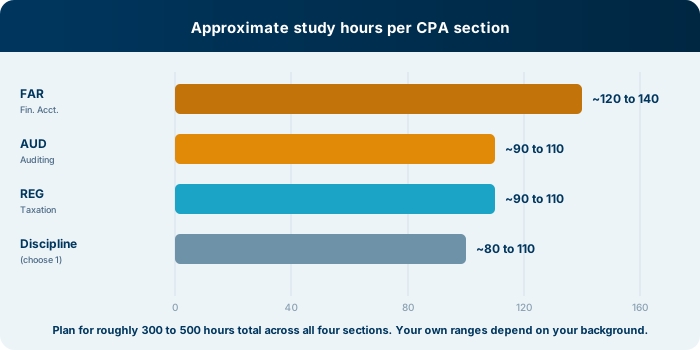
Here is a per-section breakdown to plan against. Treat the ranges as starting estimates you will adjust to your own background, not fixed quotas.
| Section | Approximate study hours | Why |
|---|---|---|
| FAR (Financial Accounting and Reporting) | ~120 to 140 | The heaviest section: a large volume of detailed material across financial reporting frameworks |
| AUD (Auditing and Attestation) | ~70 to 90 | More conceptual and judgment-based; fewer hours for most, especially with audit exposure |
| REG (Taxation and Regulation) | ~80 to 100 | Broad set of tax and business law rules to absorb and apply |
| Discipline (BAR, ISC, or TCP) | ~80 to 110 | Depends heavily on overlap with your background and which Discipline you pick |
| Total | ~300 to 500 | Across all four sections combined |
Two notes on reading this table. First, the ranges overlap and the totals do not add to a single tidy number, because your real total depends on where you fall in each section’s range. Second, your background can shift any row substantially: a career tax preparer may need far less than 100 hours for REG and TCP, while someone cold on tax may need the top of the range or more. We cover how this interacts with which section to sit first in which CPA exam to take first.
Turning hours into a weekly schedule
Hours are meaningless until you convert them into a weekly rhythm. Here is the arithmetic that makes the total feel manageable.
At a sustainable pace of 15 to 20 hours a week, a single section of 80 to 140 hours works out to roughly six to eight weeks. Do that four times, with short breaks between sections, and you are looking at spreading the exam across roughly six to eighteen months depending on your pace and how much life gets in the way. That is the normal range, and consistency over those months matters far more than any single heroic week.
Why 15 to 20 hours rather than more? Because you are likely studying around a full-time job, and a pace you can hold for months beats a sprint you abandon in week three. If you can protect more time, sections move faster; if you can protect less, give each one more calendar weeks. The weekly number is the lever you actually control, so set it honestly and build around it.
A week-by-week plan for one section
Each section should follow the same internal shape, scaled to its hour count. The order of phases matters: learning before drilling, drilling before simulations. Jumping ahead just teaches you to miss the same questions faster.
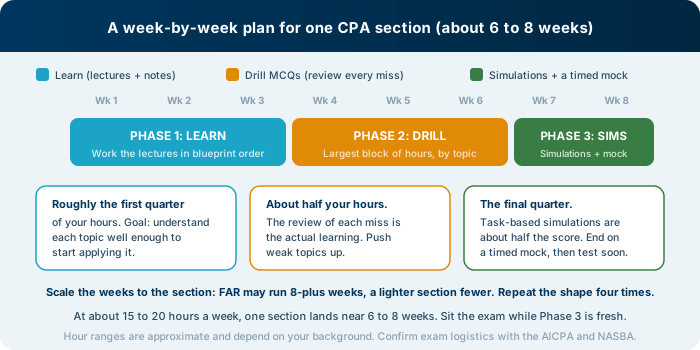
Here is that shape laid out week by week for a roughly seven-week section. Stretch it for FAR, compress it for a lighter section, but keep the proportions.
| Weeks | Phase | What you do | Share of hours |
|---|---|---|---|
| Weeks 1 to 2 | Learn | Work the review-course lectures in blueprint order; take notes; do the short topic quizzes as you go | ~25% |
| Weeks 3 to 5 | Drill MCQs | Drill multiple-choice in volume, organized by topic; review every single miss; push weak topics up | ~50% |
| Weeks 6 to 7 | Simulations + mock | Work task-based simulations (schedules, journal entries, research, analysis); finish with at least one timed practice exam, then review the gaps | ~25% |
A few rules make this plan actually work:
- The review is the learning, not the answering. In the drilling phase, the hours that move your score are the ones you spend understanding why a wrong answer looked right, not racking up question counts.
- Simulations are about half the score, so they get a full phase. Task-based simulations carry roughly half of most sections, and they are the part candidates most often under-practice. Build them in deliberately, not as a last-minute add-on. We explain why the math is unforgiving in what a passing CPA score really is.
- Sit the exam while Phase 3 is fresh. Do not let a long gap open between finishing prep and test day. Content fades fast. Schedule the section so you sit it within a week or two of your mock, not two months later when half of it has leaked out.
Then you repeat the whole shape for the next section. Four reps of this cycle, sequenced in an order that fits your background, is the entire CPA study plan. For the deeper routine inside each phase, including how to use a review course well, see how to study for the CPA Exam.
How the schedule interacts with the pass window
One scheduling constraint shapes everything: once you pass your first section, a conditional-credit window starts, 30 months in most states (some still use 18, so confirm with your state board), to pass the remaining three. The clock starts at your first pass, not when you register.
The practical effect on your timeline is simple. You do not need to rush all four sections back to back, the window is generous, but you cannot pass one section and then stall for half a year either. Keep the weekly rhythm going from section to section so steady progress protects your early passes. The full sequencing logic lives in which CPA exam to take first.
The bottom line
How long to study for the CPA Exam is best answered as a budget and a rhythm together. Budget roughly 300 to 500 total hours, weighted toward FAR and adjusted to your background. Then convert that into 15 to 20 protected hours a week, run each section through the same six-to-eight-week shape (learn, drill, simulate), and keep the rhythm going across all four. The total is large, but broken into weekly blocks and repeated four times, it is a finish line you can actually plan toward.
Hour expectations and window rules vary by person and jurisdiction and can change, so always confirm the current details with the AICPA, NASBA, and your state board before you build your calendar. When you want a week-by-week schedule built around your background and the hours you can actually protect, join the early-access list and our CPA instructors will help you map it out when prep opens.
Frequently asked questions
How long should I study for the CPA Exam?
Plan for roughly 300 to 500 total study hours across all four sections. A common per-section breakdown is about 120 to 140 hours for FAR, 70 to 90 for AUD, 80 to 100 for REG, and 80 to 110 for your Discipline. Your own numbers depend on how fresh the content is for you.
How many hours should I study for each CPA section?
FAR is the heaviest at roughly 120 to 140 hours. AUD typically runs 70 to 90 hours, REG about 80 to 100, and the Discipline 80 to 110 depending on how much it overlaps with what you already know. These are starting estimates, not promises.
How long does it take to pass the CPA Exam?
Most candidates spread the four sections across roughly six to eighteen months, studying around a full-time job. At about 15 to 20 hours a week, a single section lands near six to eight weeks, and the four passes stack up over the months that follow.
How many weeks should I study per CPA section?
At a sustainable 15 to 20 hours a week, one section usually takes about six to eight weeks: roughly the first quarter learning the material, about half drilling multiple-choice, and the final quarter on simulations and a timed mock. Heavier sections like FAR run longer.
Can I study for the CPA Exam in three months?
Passing one or two sections in three months is realistic with steady weekly hours. Passing all four in three months is extremely aggressive and rare, because the total study load is large and the content fades if you rush. Most people spread the sections over more time.
Prepping for the CPA?
Join the early-access list to be first when CPA prep opens.