
Exam Sections
CPA Exam Sections Explained: Core and Discipline (Full Guide)
A complete guide to the CPA Exam sections: AUD, FAR, and REG Core plus one Discipline (BAR, ISC, or TCP). Question counts, time, skill levels, scoring weights, and content-area breakdowns for each.
If you learned about the CPA Exam more than a couple of years ago, the structure you remember is out of date. The exam was reorganized under a model called CPA Evolution, in effect since January 2024, and the way the sections are arranged changed in a meaningful way. This is the complete guide to the current sections: what each one covers, how long it runs, how many questions you face, what skill levels it tests, how it is scored, and the content areas inside it. By the end you will know exactly what you are signing up for, section by section.
The current structure: three Core plus one Discipline
The CPA Exam is now built on a Core plus Discipline model. Every candidate takes the same three Core sections, then chooses one Discipline section from three options. That is four sections total, and you must pass all four.
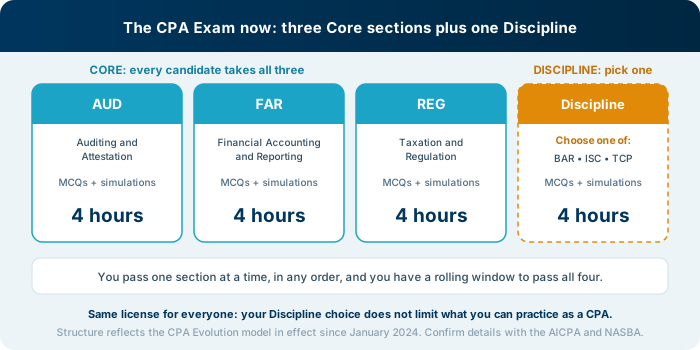
Each section is four hours long, and you sit them one at a time, in any order you like, scheduling each when you are ready. There is no requirement to take them together or in a particular sequence, though the order you choose affects your momentum and timeline, which we cover in which CPA exam to take first. You pass each section on its own by scoring a 75, and we explain what that 75 means in what a passing CPA score really is.
The three Core sections, AUD, FAR, and REG, establish the foundation the profession expects of every CPA. The Discipline, one of BAR, ISC, or TCP, lets you show depth in one area without narrowing your license. Let’s get concrete about the format before we walk through each section individually.
The two question types in every section
No matter which section you are taking, you face two formats, and understanding the split is the key to preparing well.
Multiple-choice questions (MCQs). These are the familiar four-option items, and they test recall and applied understanding across the section’s blueprint. They are the part most candidates over-practice, partly because they are quick and satisfying to drill.
Task-based simulations (TBSs). These are applied, work-realistic tasks: completing a schedule, recording journal entries, researching authoritative literature, or analyzing a scenario and entering your conclusions. They feel like real accounting work, they take longer, and crucially they carry roughly half of each section’s score on most sections. That weighting is exactly why you cannot pass on multiple-choice strength alone, a point we expand on in what a passing CPA score really is.
If you take one thing from the format, let it be this: simulations are about half the exam on most sections, so plan to practice them deliberately, not as a last-minute add-on.
Table 1: time, MCQ count, and simulation count by section
Here is the structural shape of all four sections you will sit. Every section runs four hours, but the mix of multiple-choice questions and simulations differs, and so does how that time feels.
| Section | Length | Multiple-choice questions | Task-based simulations |
|---|---|---|---|
| AUD (Core) | 4 hours | ~78 | 7 |
| FAR (Core) | 4 hours | ~50 | 7 |
| REG (Core) | 4 hours | ~72 | 8 |
| BAR (Discipline) | 4 hours | ~50 | 7 |
| ISC (Discipline) | 4 hours | ~82 | 6 |
| TCP (Discipline) | 4 hours | ~68 | 7 |
A few things to read from this table. The MCQ-heavy sections (AUD and ISC) lean a little more on volume of questions, while FAR and BAR carry fewer MCQs but dense simulations. Question counts are reset periodically by the AICPA, so treat these as the current ballpark and confirm exact counts in the official blueprints before you test. Every section also includes a standardized break partway through that does not count against your four hours.
Table 2: skill-level distribution by section
The CPA Exam does not just test what you know; it tests at different levels of cognitive difficulty, and the mix varies by section. The blueprints classify questions across four skill levels: Remembering and Understanding (recall and comprehension), Application (using knowledge in a scenario), Analysis (breaking down and relating information), and Evaluation (forming judgments, which on this exam appears only in AUD).
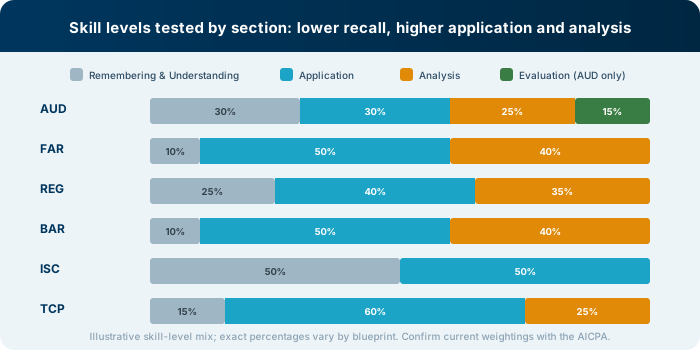
The trend across the exam is that lower-level recall is a minority of most sections, and application and analysis dominate. This is why rote memorization alone falls short: the exam mostly asks you to use what you know.
| Section | Remembering & Understanding | Application | Analysis | Evaluation |
|---|---|---|---|---|
| AUD | ~30% | ~30% | ~25% | ~15% |
| FAR | ~10% | ~50% | ~40% | none |
| REG | ~25% | ~40% | ~35% | none |
| BAR | ~10% | ~50% | ~40% | none |
| ISC | ~50% | ~50% | none | none |
| TCP | ~15% | ~60% | ~25% | none |
What this tells you about studying: FAR and BAR are heavily application-and-analysis, so passive review will not cut it, you have to work problems. AUD is the only section that reaches Evaluation, reflecting the professional judgment auditing demands. ISC sits more on recall and application, which is part of why its preparation feels different from the others. These percentages are illustrative and shift with blueprint updates, so confirm the current mix in the AICPA blueprints for your section.
Table 3: MCQ vs simulation scoring weights by section
Because the two formats carry different weights, knowing the split tells you where to invest your practice. On most sections the weighting is roughly even, but it is not identical everywhere, and ISC in particular leans toward multiple-choice.
| Section | MCQ weight | Simulation weight |
|---|---|---|
| AUD | ~50% | ~50% |
| FAR | ~50% | ~50% |
| REG | ~50% | ~50% |
| BAR | ~50% | ~50% |
| ISC | ~60% | ~40% |
| TCP | ~50% | ~50% |
The practical takeaway is the same one the format section made, with one nuance: on five of the six sections, simulations are about half your score and cannot be neglected. ISC is the exception where multiple-choice carries somewhat more weight, but even there simulations are a large minority you have to practice. Exact weightings are set by the AICPA and can change, so confirm the current splits in the blueprints. For how these weights roll up into your scaled score, see what a passing CPA score really is.
Now that you have the structural picture, let’s walk through each section individually, with the content areas inside it.
AUD: Auditing and Attestation
AUD covers the audit process from start to finish, along with attestation and other assurance engagements. It rewards understanding the logic of an audit, why you do each step and what could go wrong, more than rote memorization. It is also the only section that reaches the Evaluation skill level, because auditing is fundamentally about professional judgment. Many candidates find its concepts connect to a lot of the rest of the exam, which is one reason it is a popular section to sit early.
AUD’s content is organized into four areas, roughly weighted as follows:
| AUD content area | Approximate weight |
|---|---|
| Ethics, professional responsibilities, and general principles | ~15 to 25% |
| Assessing risk and developing a planned response | ~25 to 35% |
| Performing further procedures and obtaining evidence | ~30 to 40% |
| Forming conclusions and reporting | ~10 to 20% |
The center of gravity is clearly in the middle two areas: assessing risk and gathering evidence make up the bulk of the section. If you understand why an auditor assesses risk and how that drives the procedures and evidence that follow, you have the spine of AUD.
FAR: Financial Accounting and Reporting
FAR is the heaviest Core section for most people. It covers the financial accounting and reporting frameworks used by businesses, including the financial statements, specific accounts and transactions, and reporting for state and local governments. There is a large volume of material and a lot of detail, which is why FAR usually demands the most study hours of any section, and why its skill mix leans so heavily on application and analysis. We get into how to budget that time in how long to study for the CPA Exam.
FAR’s content breaks into three areas:
| FAR content area | Approximate weight |
|---|---|
| Financial reporting (statements, disclosures, and the reporting framework) | ~30 to 40% |
| Select balance sheet accounts | ~30 to 40% |
| Select transactions (and state and local government) | ~25 to 35% |
The lesson from FAR’s weighting is that no single area lets you off the hook; the section spreads its weight fairly evenly across reporting, accounts, and transactions, which is part of why it takes the most hours. There is simply a lot of ground, and all of it counts.
REG: Taxation and Regulation
REG covers federal taxation for individuals and entities, along with business law and ethics topics tied to tax practice. If you have a tax background, parts of REG will feel familiar; if you do not, the sheer breadth of tax rules takes real time to absorb. REG is where a lot of memorization meets applied problem-solving, since you have to both know the rules and apply them to scenarios.
REG’s content spans five areas, and taxation dominates:
| REG content area | Approximate weight |
|---|---|
| Ethics, professional responsibilities, and federal tax procedures | ~10 to 20% |
| Business law | ~15 to 25% |
| Federal taxation of property transactions | ~5 to 15% |
| Federal taxation of individuals | ~22 to 32% |
| Federal taxation of entities | ~23 to 33% |
Notice that the two taxation-of-persons-and-entities areas together make up well over half the section. Business law is real but secondary. If you are deciding whether REG is a good early section for you, the answer hinges on how comfortable you are with that tax core. This is also the section most connected to the TCP Discipline, a connection we return to in how to choose your CPA Discipline.
The Discipline section: you choose one
On top of the three Core sections, you choose one Discipline section that lets you go deeper in an area. The single most important thing to understand about the Discipline choice is this: it does not restrict your license. Whichever Discipline you pick, you earn the same full CPA license and can practice in any area a CPA is permitted to. The Discipline is a chance to demonstrate depth in something that fits your strengths and interests, not a specialization that locks you in. Because the choice genuinely matters for how hard your exam feels, we devote a full article to it: how to choose your CPA Discipline. Here, let’s cover what each Discipline actually contains.
BAR: Business Analysis and Reporting
BAR leans into financial analysis, more complex financial reporting topics, and working with data and forecasting. It is the natural fit if you found FAR more interesting than painful, since it builds on similar muscles, and its skill mix mirrors FAR’s heavy application-and-analysis tilt. Candidates headed toward financial planning and analysis, corporate finance, technical accounting, or assurance-heavy roles often choose it.
| BAR content area | Approximate weight |
|---|---|
| Business analysis | ~40 to 50% |
| Technical accounting and reporting | ~35 to 45% |
| State and local governments | ~10 to 20% |
BAR is the most analysis-forward Discipline, which is why it suits candidates who like working with numbers and reasoning through reporting problems rather than memorizing.
ISC: Information Systems and Controls
ISC covers information technology, internal controls, security and privacy, and the assurance work built on top of them, including SOC engagements. Structurally it is the outlier of the six: it carries the heaviest multiple-choice weighting, and its skill mix leans on remembering and applying rules rather than analyzing them. That makes preparing for it feel noticeably different from preparing for the analysis-heavy sections.
| ISC content area | Approximate weight |
|---|---|
| Information systems and data management | ~35 to 45% |
| Security, confidentiality, and privacy | ~35 to 45% |
| Considerations for system and organization controls (SOC) engagements | ~15 to 25% |
If the systems-and-controls material feels intuitive rather than intimidating, ISC plays to a genuine strength, and its more recall-oriented blueprint can suit candidates who prefer that style.
TCP: Tax Compliance and Planning
TCP extends the tax material from Core REG into deeper individual and entity taxation, plus the planning work that sits alongside compliance. Its skill mix is the most application-heavy of any section, which reflects how the job actually works: tax practice is mostly a matter of applying known rules to specific fact patterns rather than recalling them cold. If you want help weighing it against the other two Disciplines, see how to choose your CPA Discipline.
| TCP content area | Approximate weight |
|---|---|
| Tax compliance and planning for individuals and personal financial planning | ~30 to 40% |
| Entity tax compliance | ~30 to 40% |
| Entity tax planning | ~10 to 20% |
| Property transactions (including gains and losses) | ~10 to 20% |
If you found REG’s tax material more familiar than foreign, TCP will likely feel like an extension of strengths you already have, which is exactly the kind of overlap that makes a Discipline the right pick.
What changed under CPA Evolution, and what did not
If the Core-plus-Discipline structure is new to you, it helps to know what the redesign actually changed, because a lot of older advice and study material still describes the previous setup.
What changed is the architecture. The exam used to be four fixed sections that every candidate took, with no choice involved. The current model keeps three of those areas as required Core sections and replaces the fourth fixed section with a Discipline you select. The idea was to keep a common foundation every CPA must demonstrate, while letting candidates show deeper skill in one area that reflects how modern accounting work has specialized, particularly around data, analysis, and technology.
What did not change is just as important. The exam is still scored on the same 0 to 99 scale with a 75 passing standard on every section. It still combines multiple-choice questions and task-based simulations. It is still a demanding, content-heavy exam that rewards months of steady preparation. And it still leads to a single CPA license. So if you have heard that the CPA Exam “changed,” the accurate version is that the section lineup was reorganized, not that the nature of the test was reinvented. The practical lesson: make sure any study material you buy reflects the current Core-plus-Discipline structure, and be skeptical of older resources that still describe four fixed sections.
How each section is scored
Because the question types are consistent across sections, the scoring logic is too. Within a section, your performance on the multiple-choice questions and on the simulations is combined and converted into a single scaled score on the 0 to 99 range, and a 75 passes. The two formats carry roughly equal weight on most sections (with ISC tilted toward multiple-choice), though the exact split varies, so confirm the current weighting in the AICPA blueprint for the section you are sitting.
A couple of practical consequences follow. First, you cannot lean entirely on the format you are strongest at; a candidate who is excellent at multiple-choice but neglects simulations is leaving a large share of the score exposed. Second, because the score is scaled rather than a raw percentage, your practice-question percentage in a review course is a useful trend but not a direct prediction of your scaled result. Treat rising practice scores as a sign you are on track, not as a forecast of the exact number you will see. We unpack the scoring in full in what a passing CPA score really is, and what the section pass rates do and do not tell you in CPA Exam pass rates and difficulty.
How the sections fit your timeline
Because you sit sections one at a time and in any order, you have a lot of control over your path. Most candidates spread the four sections over many months, picking an order that matches their background, often starting with a content-heavy Core section like FAR or AUD. The catch is the conditional-credit window: once you pass your first section, a clock starts for finishing the rest, 30 months in most states now (some still use 18, so confirm with your state board). That deadline, and how to plan around it, is covered in how to study for the CPA Exam and which CPA exam to take first.
The structure is more flexible than it looks. Three Core sections give you a common foundation, one Discipline lets you show depth without narrowing your license, and a consistent two-format design means the same study approach works across all four. Learn the shape of the exam, then build a plan around it.
The CPA Exam structure reflects the CPA Evolution model and can be adjusted over time, so always confirm the current sections, lengths, question counts, content weightings, and window rules with the AICPA and NASBA before you register. When you are ready to plan your four sections, join the early-access list and our CPA instructors will help you sequence them when prep opens.
Frequently asked questions
What are the sections of the CPA Exam?
The CPA Exam has three Core sections every candidate takes, AUD (Auditing and Attestation), FAR (Financial Accounting and Reporting), and REG (Taxation and Regulation), plus one Discipline section you choose from BAR (Business Analysis and Reporting), ISC (Information Systems and Controls), or TCP (Tax Compliance and Planning). That is four sections total, and you must pass all four.
How long is each CPA Exam section?
Each of the four sections is four hours long. You sit one section at a time and can take them in any order. Each combines multiple-choice questions and task-based simulations, with a built-in break partway through.
How many questions are on each CPA section?
It varies by section. The Core sections carry roughly 50 to 78 multiple-choice questions and 7 task-based simulations each, except AUD, which has 7 simulations alongside about 78 MCQs. The Disciplines carry fewer MCQs (around 50 to 82) and 6 or 7 simulations. Confirm current counts in the AICPA blueprints.
How are the CPA sections scored?
On most sections, multiple-choice questions and task-based simulations are weighted roughly 50/50, except ISC, which leans more toward multiple-choice. Your performance on both formats is combined into a single scaled score from 0 to 99, and 75 passes each section.
Do I have to pass all four CPA sections?
Yes. You must pass all three Core sections and one Discipline section, four passes in total, each scored on its own with a passing score of 75. There is no overall average across sections, and your Discipline choice does not limit your license.
Prepping for the CPA?
Join the early-access list to be first when CPA prep opens.