
Study Strategy
How to Study for the CPA Exam
A realistic CPA study plan: how many hours each section takes, a three-phase routine that ends in simulations, what order to sit the sections in, and how to beat the rolling pass window.
The CPA Exam is not a hard test to understand. It is a hard test to outlast. There is no single trick, no clever shortcut, and no way to cram four sections of dense accounting content into a couple of weekends. What it rewards is a realistic plan, sustained over months, that respects how much material there is and how the scoring works.
That is actually good news. The CPA Exam is predictable. The blueprint is published, the question formats are fixed, and the candidates we work with who plan honestly and grind steadily tend to get there. Below is how to build that plan: how many hours to budget, how to spend them per section, what order to sit the sections in, and how to stay inside the pass window.
How many hours you actually need
Across all four sections, plan for somewhere in the range of 300 to 500 total study hours. That breaks down to roughly 80 to 140 hours per section, depending on the section and on your background.
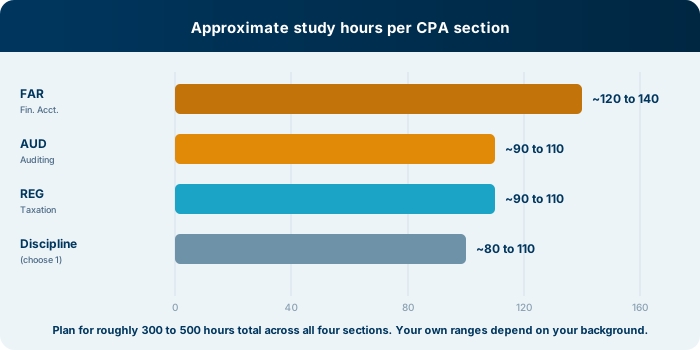
The sections are not equal. FAR, the financial accounting and reporting section, is the heaviest for most people and routinely takes the most hours. AUD and REG tend to sit a step below it, and your Discipline section depends heavily on how much of its content overlaps with what you already know. These ranges are a starting point, not a promise. A recent accounting graduate working in audit will move through AUD faster than someone who has been out of school for a decade, and a career tax preparer will fly through parts of REG and TCP.
The honest way to set your own numbers is to be realistic about two things: how fresh the content is for you, and how much uninterrupted study time you can actually protect each week. Most candidates are studying around a full-time job, which is exactly why the total hour count is the wrong thing to fixate on. What matters is converting it into a weekly rhythm you can sustain without burning out.
Here is a per-section breakdown to budget against. Treat these as starting estimates you adjust to your background, not fixed quotas, and see how long to study for the CPA Exam for the full reasoning.
| Section | Approximate study hours |
|---|---|
| FAR (the heaviest) | ~120 to 140 |
| AUD | ~70 to 90 |
| REG | ~80 to 100 |
| Discipline (BAR, ISC, or TCP) | ~80 to 110 |
| Total | ~300 to 500 |
The three-phase routine for a single section
Treat each section as its own project with the same internal shape. Order matters here. Jumping into practice questions before you have learned the material just teaches you to miss the same questions faster, and starting simulations before your concepts are solid is demoralizing and wasteful.
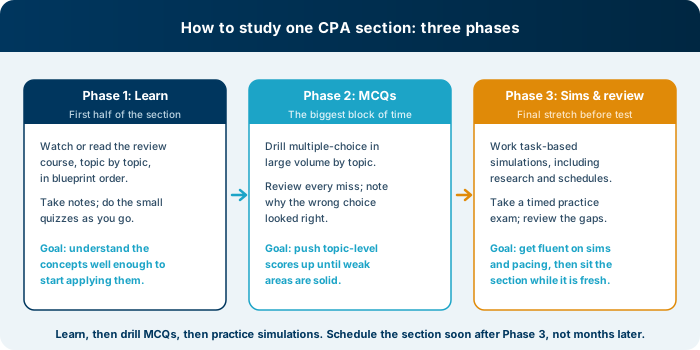
Phase 1: Learn (the first chunk of your time). Work through your review course lecture by lecture, in the order it lays out the blueprint. Take notes, do the short topic quizzes as you go, and resist the urge to rush. Your only goal in this phase is to understand each topic well enough to start applying it. You are building the scaffolding; you are not trying to master anything yet.
Phase 2: Multiple-choice drilling (the largest block). This is where most of your hours go. Drill multiple-choice questions in volume, organized by topic, and review every single miss. The review is the actual learning, not the answering. For each question you get wrong, figure out why the wrong answer looked right and what concept you were missing. Watch your topic-level scores in the course and push the weak areas up. Keep going until your soft spots firm up.
Phase 3: Simulations and review (the final stretch). Now bring in the task-based simulations: the schedules, journal entries, research tasks, and analysis problems that make up roughly half the score. These feel harder because they are closer to real accounting work, and they expose gaps that multiple-choice practice hid. Finish the phase with at least one timed practice exam under realistic conditions, then review the gaps it surfaces. The point of this phase is fluency on simulations and pacing, so the real thing feels like one more rep.
One rule ties the phases together: do not let a long gap open between finishing your prep and sitting the section. The content fades fast. Schedule the exam so you sit it while Phase 3 is still fresh, not two months later when half of it has leaked out of your head.
A concrete week-by-week schedule for one section
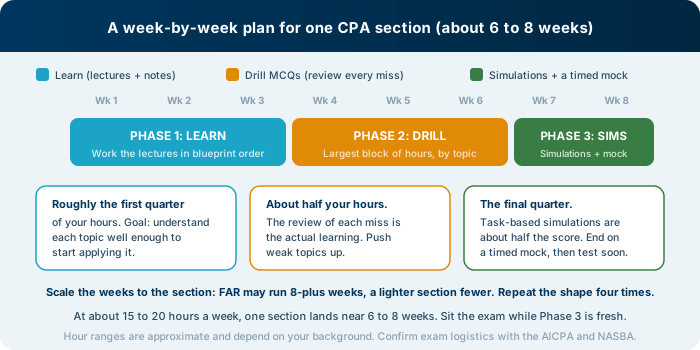
The three phases are easier to follow when you put them on a calendar. At a sustainable pace of 15 to 20 hours a week, a section of 80 to 140 hours lands at roughly six to eight weeks. Here is the shape laid out for a typical seven-week section. Stretch it for FAR, compress it for a lighter section, but hold the proportions, roughly a quarter learning, half drilling, a quarter on simulations and a mock.
| Weeks | Phase | Hours per section spent here | What you do |
|---|---|---|---|
| Weeks 1 to 2 | Learn | ~25% | Work the lectures in blueprint order; take notes; do topic quizzes as you go |
| Weeks 3 to 5 | Drill MCQs | ~50% | Drill multiple-choice by topic in volume; review every miss; push weak areas up |
| Weeks 6 to 7 | Simulations + mock | ~25% | Work the task-based simulations; finish with a timed practice exam; review the gaps; then sit the section |
Then you repeat the whole shape for the next section. Four reps of this cycle, sequenced in an order that fits your background, is the entire plan. For a deeper treatment of the hours and the schedule, see how long to study for the CPA Exam.
Why simulations cannot be an afterthought
It is worth repeating because it is the most common way prepared-feeling candidates fall short. Task-based simulations carry close to half of most sections’ scores, and they are the part candidates most often under-practice. If you spend all your time on multiple-choice because it is faster and more satisfying, you can walk in feeling ready and still land below 75. We cover exactly why in what a passing CPA score really is. Build simulations into Phase 3 deliberately, and earlier if your course supports it.
Use a review course, and use it fully
You can technically self-assemble CPA prep, but almost nobody should. The blueprint is enormous, and a good review course earns its cost by organizing it for you, supplying thousands of vetted practice questions and simulations, and keeping you on a schedule. The candidates we work with who struggle most are usually the ones who bought a course and then drifted from its structure, skipping the simulations or jumping around the lectures.
Pick a course, then actually follow its plan. The structure is the point. Where outside help adds the most value is when you are stuck, when a topic will not click no matter how many times you rewatch the lecture, or when you keep failing one section by a few points and cannot see your own pattern. That last case, where a few points keep separating you from a pass, is what our CPA instructors are being set up to work through with candidates.
What order to take the sections
There is no required order, and you can sit the sections one at a time in whatever sequence you choose. That said, a few patterns help.
Many candidates start with FAR or AUD. FAR is the heaviest, so getting it done early means you tackle the biggest mountain while your motivation is highest and your pass window has the most room. Others prefer to lead with AUD because its concepts connect to a lot of the rest of the exam. If your background is tax-heavy, starting with REG can give you an early, confidence-building win. There is no single correct answer. The best order is the one that fits your strengths and keeps your momentum alive, because momentum is what carries you through a months-long process.
For how the sections themselves are structured, including the Core sections and the Discipline you choose, see the CPA Exam sections explained and how to choose your CPA Discipline.
Beating the rolling pass window
Here is the constraint that makes the CPA Exam a logistics challenge as much as a studying one. Once you pass your first section, a clock starts. You must pass the remaining sections within a rolling window or you begin to lose credit for sections you already passed.
After a NASBA change that most jurisdictions adopted, that window is now 30 months in most states (some still use the older 18-month window, so confirm with your state board). The clock starts the day you pass your first section, not when you register. The exact rule depends on your jurisdiction and it has been changing, so verify your state board’s current policy before you map your dates. The practical implication is the same either way: do not pass one section and then drift for half a year. Sequence your sections so you keep steady forward progress and never put an early pass at risk. We walk through choosing that sequence in which CPA exam to take first.
The CPA Exam rewards endurance and planning more than raw talent. Budget the hours honestly, move through each section in the right order, give simulations the respect they deserve, and keep moving so the pass window stays on your side. Do that and the four passes add up.
Always verify the current hour expectations, section structure, and window rules with the AICPA, NASBA, and your state board, since the details evolve. When you want a section-by-section plan built around your background and schedule, join the early-access list and our CPA instructors will help you put one together when prep opens.
Frequently asked questions
How many hours should I study for the CPA Exam?
Plan for roughly 300 to 500 total hours across all four sections, which works out to about 80 to 140 hours per section. The heavier-content sections like FAR usually take the most time.
What order should I take the CPA sections in?
There is no required order, but many candidates start with FAR or AUD because they are content-heavy and build a foundation the other sections lean on. The best order is the one that fits your background and keeps your momentum going.
How long do I have to pass all four CPA sections?
Once you pass your first section, a rolling conditional-credit window starts for passing the rest. After a NASBA change adopted by most jurisdictions, that window is now 30 months in most states (some still use 18). The exact rule depends on your state board, so confirm it before you start.
Do I need a CPA review course?
A structured review course is strongly recommended. It organizes the enormous blueprint, supplies thousands of practice questions and simulations, and keeps you on pace. Most successful candidates pair a course with heavy practice.
How long does it take to pass the CPA Exam?
Most candidates spread the four sections across roughly six to eighteen months, depending on study pace and work schedule. The total study time is large, so consistency over months matters more than any single cram session.
Prepping for the CPA?
Join the early-access list to be first when CPA prep opens.