
Study Strategy
Which CPA Exam to Take First: Section Order Strategy
There is no required CPA section order, but your first PASS starts the 30-month clock. Here is how to choose between FAR, AUD, and REG first, with pros and cons of each ordering.
Of all the decisions you make about the CPA Exam, the order you sit the sections in feels bigger than it is, and also smaller than it is. It feels bigger because candidates agonize over it as if the wrong choice could sink them. It is smaller than that: there is no required order, and no sequence is “wrong.” But it is also not nothing, because the order you pick shapes your momentum and, through one specific rule, your entire timeline.
That rule is the part most people miss. So before we compare orderings, let’s start with the single fact that should drive the whole decision.
The fact that drives the decision: your first pass starts the clock
Here is what makes section order matter at all. The CPA Exam gives you a conditional-credit window: once you pass your first section, you have a fixed amount of time to pass the rest, or you start losing credit for the sections you already passed.
That window is 30 months in most states now, after a NASBA change that most jurisdictions adopted (some still use the older 18 months, so confirm your jurisdiction’s rule with your state board). But the length is not the key point for ordering. The key point is when the clock starts: the day you PASS your first section. Not when you register. Not when you sit your first exam. When you pass.
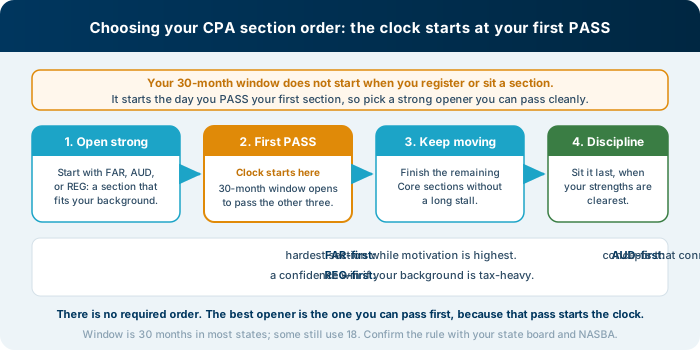
This reframes the whole question. Your opening section is not just “the first thing you study.” It is the section that, once cleared, puts you on the clock for everything else. That has two practical implications:
- Open with a section you are confident you can pass. A failed first attempt does not start the clock (you only condition on a pass), but it does cost you weeks and momentum. You want your opener to be a section you can pass cleanly so the clock starts on your terms.
- Do not pass your first section and then drift. The moment you pass, the window is live. The worst pattern is a strong first pass followed by months of stalling, because that burns the very runway you will need for the harder sections still ahead.
With that fact in hand, the “which section first” question becomes practical rather than abstract. Let’s look at the realistic openers.
The three Core sections are your realistic openers
You will almost certainly open with one of the three Core sections, AUD, FAR, or REG, rather than your Discipline. (We will get to why the Discipline goes last in a moment.) For what each of these sections actually covers, see the CPA Exam sections explained. Here, we are only concerned with the strategy of which to sit first.
Each of the three makes sense as an opener for a different reason, and the right one depends on your background.
Opening with FAR
FAR, Financial Accounting and Reporting, is the heaviest Core section for most people and usually demands the most study hours. Leading with it is the classic “eat the frog” strategy: you tackle the biggest mountain first, while your motivation is at its peak and the rest of your window is wide open.
The appeal is real. Getting FAR behind you early is a genuine psychological boost, and many candidates find that the foundation it builds makes later sections feel more manageable. The trade-off is timing: because FAR takes the longest to prepare for, opening with it pushes back your first pass, which means the clock on the other three starts later than it would with a lighter opener. That is fine if you have a clear runway, but worth naming.
Opening with AUD
AUD, Auditing and Attestation, is the other popular opener, for a different reason. Its concepts, risk, evidence, the logic of why each audit step exists, connect to a lot of the rest of the exam. Leading with AUD means you build a conceptual frame early that pays off in other sections.
AUD also tends to take fewer hours than FAR, so it can get you to your first pass a bit faster, which some candidates prefer so the clock starts while they still have plenty of window left. The trade-off is that AUD rewards understanding over memorization, and if you are coming in cold without audit exposure, its emphasis on professional judgment can feel slippery at first.
Opening with REG
REG, Taxation and Regulation, is the smart opener if your background is tax-heavy. If you have worked in tax, parts of REG will feel familiar, which makes it an early, confidence-building win, and an early win is exactly what you want from a first section, because it starts the clock on a high note rather than a grind.
The trade-off is the mirror image: if you do not have a tax background, the sheer breadth of tax rules in REG takes real time to absorb, and it loses its “easy first win” appeal. REG-first works because of who you are, not because of anything inherent in the section.
Pros and cons of each opening order
Here is the same comparison in one place. Read it against your own background rather than looking for a single “best” row, because the right opener is genuinely person-dependent.
| Open with | Best for | Pros | Cons |
|---|---|---|---|
| FAR first | Candidates who want the hardest section behind them early | Tackles the heaviest section while motivation is highest; builds a foundation for later sections; the rest of the window stays wide open | Longest section to prepare for, so your first pass (and the start of the clock) comes later |
| AUD first | Candidates who want a conceptual foundation that connects to other sections | Concepts carry into the rest of the exam; usually fewer hours than FAR, so a faster first pass | Rewards judgment over memorization, which can feel slippery with no audit background |
| REG first | Candidates with a tax background | An early, confidence-building win; familiar ground if you have done tax work; starts the clock on a high note | Loses its advantage entirely if you have no tax background; broad rule set is slow to learn cold |
| Discipline first | Almost no one | None worth the cost | Locks in your Discipline before Core sections confirm your strengths; the elective comes before you have exam experience |
The pattern across the table is simple: match the opener to your background, and favor a section you can pass cleanly and reasonably quickly, because that pass is what starts your clock.
Where the Discipline section fits: take it last
Notice the bottom row of that table. Opening with your Discipline is the one ordering choice that rarely makes sense, and it is worth saying why, because some candidates are tempted to “get the unique section out of the way.”
Save your Discipline for last, for three reasons. First, the three Core sections build a foundation that makes the Discipline more approachable, BAR builds on FAR’s muscles, ISC and TCP lean on concepts the Core sections introduce. Second, sitting the Core sections first lets you confirm which Discipline actually fits your strengths before you commit; if you found FAR more interesting than painful, that is real evidence for BAR, and you only learn it by taking FAR first. Third, by the time you reach your one elective section, you will have the most exam experience and the smoothest test-day routine.
If you have not chosen a Discipline yet, do not rush it, that decision deserves its own thinking, which we walk through in how to choose your CPA Discipline. For sequencing purposes, just slot it into the fourth position and decide which one later.
A sensible default order
If you want a starting point to adjust from rather than a blank slate, here is a default that works for many candidates and respects everything above:
- FAR or AUD first. Pick FAR if you want the hardest section done early and have the runway for it; pick AUD if you want a faster first pass and a conceptual foundation. If your background is tax-heavy, REG is a fine first instead.
- The remaining two Core sections next. Keep steady forward progress, do not let a long gap open after your first pass, because the clock is now running.
- Your Discipline last, once your strengths and your remaining window are both clear.
This is a default, not a rule. The best order is the one that fits your strengths and, above all, keeps your momentum alive, because momentum is what carries you through a months-long process. We get into how to build the study plan underneath whatever order you choose in how to study for the CPA Exam, and how to budget the time each section needs in how long to study for the CPA Exam.
The bottom line
Which CPA Exam to take first is a real decision, but a low-stakes one once you see what is actually at play. No order is wrong, and the content does not change. What changes is your momentum and your timeline, and both hinge on one fact: your first pass starts the clock. So open with a Core section you can pass cleanly, match the choice to your background, keep moving once the window is live, and take your Discipline last. Get the sequence working for you instead of against you and the four passes add up.
Section order rules and the conditional-credit window vary by jurisdiction and can change, so always confirm the current policy with the AICPA, NASBA, and your state board before you map your dates. When you want a section order built around your specific background and schedule, join the early-access list and our CPA instructors will help you sequence them when prep opens.
Frequently asked questions
Which CPA Exam should I take first?
There is no required order, but most candidates open with a Core section, FAR, AUD, or REG, that fits their background. FAR-first gets the heaviest section done early, AUD-first leads with concepts that connect to the rest, and REG-first is a confidence win if you have a tax background. Take your chosen Discipline last.
Does the order I take the CPA sections in matter?
The order does not change what is on the exam, but it affects your momentum and your timeline. Your 30-month conditional-credit window starts when you pass your first section, so a smart order opens with a section you can pass cleanly and keeps you moving without long gaps.
When does the CPA 30-month window start?
The conditional-credit window starts the day you PASS your first section, not when you register or sit it. From that pass, you have 30 months in most states (some still use 18) to pass the remaining three sections. Confirm your jurisdiction's rule with your state board.
Should I take FAR first?
Taking FAR first is a common and reasonable choice because it is the heaviest section, so you tackle the biggest mountain while motivation is high and the rest of your window has room. The trade-off is that FAR is also the longest to prepare for, which delays your first pass and the start of the clock.
Should I take the Discipline section first or last?
Most candidates take the Discipline section last. Sitting the three Core sections first builds a foundation, lets you confirm which Discipline truly fits your strengths, and means the one elective section comes when you have the most exam experience.
Prepping for the CPA?
Join the early-access list to be first when CPA prep opens.