
Scores
What Is a Passing CPA Exam Score?
A passing CPA Exam score is 75 on a 0 to 99 scale, but that 75 is a scaled competency score, not a percentage correct and not a percentile. Here is what the number actually means.
If you are just starting to research the CPA Exam, the scoring is one of the first things that confuses people, and for good reason. The passing number sounds simple, a 75, but almost everything your intuition tells you about that 75 is wrong. It is not a percentage. It is not a percentile. It is not a grade out of 100 in the way you are used to from school.
So let’s clear it up. Here is what a passing CPA Exam score actually is, what the 75 represents, and how each section arrives at that number. Candidates we work with relax a little once they understand this, because it changes how you think about your practice scores.
The passing score is 75 on a 0 to 99 scale
Every section of the CPA Exam is reported on a scale that runs from 0 to 99, and you need a 75 to pass. That threshold is the same across the board. It does not matter whether you are sitting a Core section or your Discipline section. The bar is 75 every time.
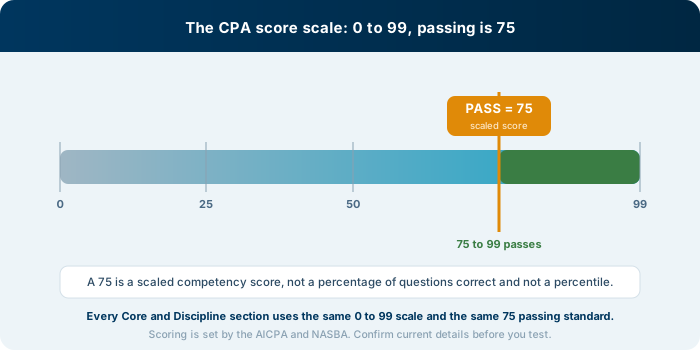
There is no overall average and no way to offset a weak section with a strong one. You pass each section individually by clearing 75 on that section. Score a 74 and you have not passed, even by a hair, and you will need to retake that section. Score an 80 and a 95 and they both count exactly the same way: as a pass.
That is the easy part. The harder part, and the part that trips people up, is understanding what the 75 actually measures.
A 75 is a scaled score, not a percentage correct
Here is the single most important thing to understand: the 75 is a scaled score, not the percentage of questions you got right.
When you took tests in school, an 80 usually meant you answered 80 percent of the questions correctly. The CPA Exam does not work that way. Your raw performance, meaning how many questions you answered correctly and how hard those questions were, is converted through a statistical scaling process into a number on the 0 to 99 scale. A 75 on that scale represents a specific, defined level of competency, the level the profession has decided is the minimum to be a licensed CPA.
The practical consequence surprises people: you do not need to answer 75 percent of the questions correctly to score a 75. Because harder questions are worth more, a candidate who answers a smaller share of questions correctly, but handles difficult items well, can still land at or above the passing standard. There is no published, fixed percentage-correct that guarantees a pass, and chasing one is a mistake.
This is why your practice question bank percentage and your eventual scaled score are not the same measurement. A review course might tell you that candidates who consistently score in a certain range on practice multiple-choice tend to pass, and that is useful guidance, but do not confuse a practice percentage with the scaled 75 you need on exam day. Treat practice percentages as a trend line, not a prediction of your exact score.
A 75 is not a percentile either
The other common misconception is that your score tells you how you ranked against everyone else who tested. It does not.
The CPA Exam is criterion-referenced. That is a technical way of saying you are measured against a fixed standard of competency, not against a curve of other candidates. Your 75 does not mean you beat 75 percent of test-takers, and it does not mean you landed in the 75th percentile. It means you met the competency bar, full stop.
This matters for your mindset. On a curved exam, you are competing against the people who happened to sit the test the same quarter you did, and a strong cohort can pull the curve up against you. On the CPA Exam, that does not happen. If you demonstrate the required competency, you pass, regardless of how anyone else performed. You are not racing other candidates. You are clearing a bar. That is a much more controllable thing to prepare for, because the target does not move based on who else shows up.
How each section reaches your score
So where does the scaled score come from? Each section combines two question formats, and on most sections they carry roughly equal weight.
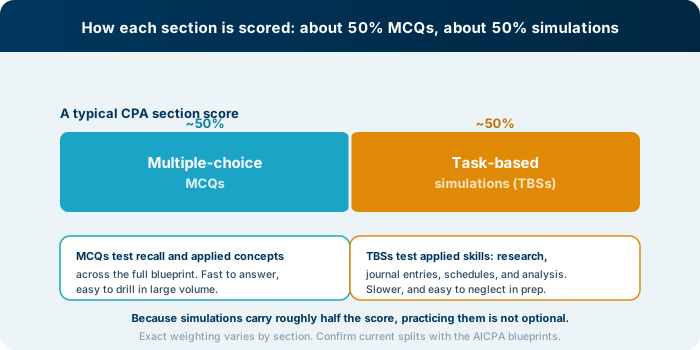
Multiple-choice questions (MCQs) make up about half of a section’s score. These are the familiar four-option items that test your recall and applied understanding across the section’s blueprint. They are quick to answer and easy to drill in large volume, which is why most candidates spend a lot of practice time here.
Task-based simulations (TBSs) make up roughly the other half. These are applied, work-realistic tasks: filling in a schedule, recording journal entries, researching authoritative guidance, or analyzing a scenario. They take longer, they feel more like real accounting work, and they are exactly the part of the exam that under-prepared candidates tend to neglect.
The exact split varies by section, so you should confirm the current weighting in the AICPA blueprints for the section you are taking. But the takeaway holds across the exam: simulations carry close to half your score, so you cannot pass on multiple-choice strength alone. Candidates we work with who plateau just below 75 are very often the ones who drilled thousands of MCQs and barely touched the simulations. The score formula simply will not let you ignore half of it.
When you find out, and what the report shows
One more thing candidates ask about: you do not get your score the moment you finish. The CPA Exam releases scores on a published schedule tied to testing windows, so there is typically a wait of days to weeks between sitting a section and seeing your result. The exact timing changes, so check the current score-release dates with NASBA before you plan around them. The wait is normal; do not read anything into it.
When the score does arrive, a pass simply confirms you cleared the 75 standard for that section. If you do not pass, you generally receive a candidate performance report that breaks down how you did across the section’s content areas and question types, comparing your relative strength area by area. That feedback is genuinely useful, because it points you to where your preparation fell short so a retake can be targeted rather than a blind do-over. A failed section is a setback, not a verdict, and the exam allows you to retake it. Use the performance report to study smarter the second time instead of simply repeating the first attempt.
What this means for your prep
Once you understand the scoring, a few practical rules fall out of it:
- Aim comfortably above the line, not at it. Because you cannot perfectly predict how raw performance scales, prepare to clear 75 with room to spare rather than trying to land exactly on it. Targeting the bar exactly is how a 74 happens.
- Practice simulations deliberately. They are about half the score and the hardest to fake. Build them into your study plan from the start, not as an afterthought in the last week.
- Read practice percentages as trends. A rising MCQ percentage in your review course is a good signal of progress. It is not a forecast of your scaled score, so do not over-read a single number.
- Stop comparing yourself to other candidates. The exam is not curved against them. Your only opponent is the competency standard.
A passing CPA score, in the end, is not mysterious once you stop importing assumptions from school grading. It is a 75 on a 0 to 99 scale, earned by demonstrating a defined level of competency across multiple-choice questions and simulations alike. Build toward that standard with room to spare and the number takes care of itself.
For the official, current scoring details, always verify directly with the AICPA and NASBA, since the specifics can change. When you are ready to map a section-by-section plan that gets you safely past 75, join the early-access list and our CPA instructors will help you build one when prep opens. From there, it helps to understand how to study for the CPA Exam, how long to study for the CPA Exam, and how hard each section is and what the pass rates mean.
Frequently asked questions
What is a passing score on the CPA Exam?
You need a 75 to pass each section of the CPA Exam. Scores are reported on a scale from 0 to 99, and 75 is the same passing standard for all Core and Discipline sections.
Is a 75 on the CPA Exam the same as 75 percent correct?
No. The 75 is a scaled score that reflects your demonstrated competency, not the percentage of questions you answered correctly. You can answer well under 75 percent of items correctly and still earn a scaled 75, depending on item difficulty.
Is the CPA Exam score a percentile?
No. Your CPA score is not a percentile and is not ranked against other candidates. The exam is criterion-referenced, which means you are measured against a fixed competency standard rather than against how others performed.
How is each CPA section scored?
Most sections weight multiple-choice questions and task-based simulations at roughly 50/50. Your performance on both formats is combined and converted to the 0 to 99 scaled score, where 75 passes.
Do I need a 75 on every CPA section?
Yes. You must score at least 75 on each Core section and on your chosen Discipline section. There is no overall average; each section is passed on its own.
Prepping for the CPA?
Join the early-access list to be first when CPA prep opens.