
Decision
How to Choose Your CPA Discipline: BAR, ISC, or TCP
Your CPA Discipline choice, BAR, ISC, or TCP, does not restrict your license. Here is what each one covers and how to pick the one that fits your strengths and career goals.
For most of the CPA Exam, you do not get choices. Everyone takes the same three Core sections. But there is one real decision you have to make, and candidates we work with often overthink it: which Discipline section to take. There are three options, and the choice changes how your exam feels and how well it plays to your strengths.
Here is the good news up front, and it should take a lot of pressure off: your Discipline choice does not limit your CPA license. Whichever one you pick, you become a CPA who can do anything a CPA is allowed to do. So this is not a high-stakes fork in your career. It is a chance to play to your strengths. Let’s break down the three options and how to choose.
First, the rule that removes the fear
Before we compare the three Disciplines, internalize this, because it changes how you should decide. All three Disciplines lead to the same full CPA license. There is no “tax CPA license” or “IT CPA license.” There is one license, and your Discipline section is simply the part of the exam where you demonstrate depth in one area.
That means you are not choosing a career lane. A candidate who takes the tax Discipline can still go into audit. A candidate who takes the information-systems Discipline can still go into financial reporting. Nothing about the Discipline closes a door later. So the right way to choose is not “what am I willing to be stuck with,” it is “where can I show my best work and give myself the smoothest path through this section.” Once the fear of being locked in is gone, the decision gets a lot simpler.
The three Disciplines at a glance
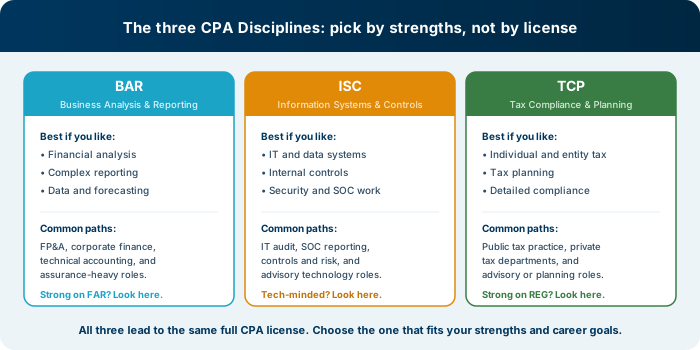
Here is what each option covers and the kind of candidate it tends to suit.
BAR: Business Analysis and Reporting. BAR goes deeper into financial analysis, more complex financial reporting topics, and working with data and forecasting. It is the natural fit if you are strong in and energized by reporting and analytical work. Candidates headed toward financial planning and analysis (FP&A), corporate finance, technical accounting, or assurance-heavy roles often gravitate here. A useful tell: if you found FAR more interesting than painful, BAR is worth a serious look, since it builds on similar muscles.
ISC: Information Systems and Controls. ISC focuses on information technology, internal controls, security, and related assurance work such as SOC engagements. It is the right pick if you are comfortable with IT systems and the controls and risk side of the profession. Candidates aiming at IT audit, SOC reporting, controls and risk advisory, or technology-focused roles tend to choose ISC. If the systems-and-controls material feels intuitive rather than intimidating, that is your signal.
TCP: Tax Compliance and Planning. TCP goes deeper into individual and entity taxation and tax planning. It is the obvious fit if you have a tax background or want a tax-heavy career. Candidates headed for public tax practice, private-company tax departments, or tax advisory and planning roles usually choose TCP. A practical tell: if you found REG’s tax material more familiar than foreign, TCP will likely feel like an extension of strengths you already have.
How to actually decide
With the license fear out of the way, three questions settle the choice for almost everyone.
1. Where are your strengths right now? The single best predictor of how a Discipline will feel is how close it sits to knowledge you already have. The Discipline nearest your existing experience will play to your strengths, which usually means a smoother path through that section. If you have spent two years in tax, TCP leans on familiar ground. If you work in IT audit, ISC does. If reporting and analysis come naturally, BAR does. Do not pick a Discipline that fights your strengths just because it sounds prestigious.
2. Where do you want your career to go? If your strengths and your goals point the same direction, the choice is easy. If they diverge, weigh both honestly. The Discipline does not restrict your license, so you can pick the one that fits your strengths today even if you plan to pivot later, but if you are excited to build toward a specific field, choosing the Discipline that matches it lets your exam prep double as career preparation.
3. Which content genuinely interests you? This one matters more than candidates expect. You are going to spend dozens of hours studying this section. The material you find at least somewhat interesting is the material you will actually study with focus instead of dread. Interest is not a tiebreaker to ignore; over a long prep, it directly affects how well you learn.
Notice what is not on this list: trying to game which Discipline has the friendliest pass rate. Pass rates move quarter to quarter and reflect who is taking each section as much as how hard it is, so chasing them is a poor basis for a choice you will study dozens of hours for. We dig into what those numbers do and do not tell you in CPA Exam pass rates. Choose on strengths, goals, and interest, and let the pass rate be what it is.
Does your Discipline affect how employers see you?
This is the question behind the question for a lot of candidates, so let’s address it directly. Will a firm care which Discipline you took? In most cases, far less than you fear. Employers hire CPAs, and the license is the license. What matters to a hiring manager is that you passed the exam and that you have the skills and experience the role needs. Your Discipline section is one small signal, not a label stamped on your career.
There are mild, sensible alignments worth noting. If you are applying for a tax role, having taken TCP is a small, natural point of consistency on your record. If you are headed into IT audit, ISC lines up neatly. But these are nice-to-haves, not gatekeepers, and no reputable employer is going to turn away an otherwise strong CPA candidate because their Discipline was BAR instead of TCP. The work history you build after licensure will speak far louder than which Discipline section you sat years earlier.
So if part of you is choosing defensively, trying to pick the Discipline that looks best to some imagined future employer, relax that instinct. Pick the one that fits your strengths and the direction you actually want to go. That alignment will show up in your work, which is what employers really evaluate.
A simple way to break a tie
If two Disciplines feel close, do a small, honest experiment before you commit. Pull the AICPA blueprint for each candidate Discipline and read through the topics, or work a short set of sample questions from your review course in each. Pay attention to two things: which set of material you grasp faster, and which one you do not mind sitting with. The Discipline that you both understand more quickly and tolerate more easily is almost always the right call. You are looking for the path of least resistance that also fits where you are headed.
And remember the safety net: because every Discipline leads to the same license, even a “wrong” choice is not a career mistake. The worst case is that one section is a bit harder than another would have been, not that you limited your future. That is a low-stakes decision dressed up as a high-stakes one.
The bottom line
The Discipline choice is the one place the CPA Exam asks for your preference, and it deserves a little thought but not anxiety. Pick the Discipline closest to your strengths, pointed at where you want to go, covering material you can stand to study. BAR for analytical and reporting work, ISC for IT audit and controls, TCP for tax-heavy paths. Any of the three earns you the same full license, so choose the one that gives you the smoothest, most motivated path through that final section.
For the current Discipline content and any rules about when and whether you can change your choice, confirm directly with the AICPA, NASBA, and your state board. When you want help matching a Discipline to your background and goals, or planning the three Core sections around it, join the early-access list and our CPA instructors will help when prep opens. It also helps to understand how the sections fit together, which CPA exam to take first, and how long to study for the CPA Exam.
Frequently asked questions
What are the three CPA Discipline sections?
The three Disciplines are BAR (Business Analysis and Reporting), ISC (Information Systems and Controls), and TCP (Tax Compliance and Planning). You choose one to take alongside the three Core sections.
Does my CPA Discipline choice limit my license?
No. All three Disciplines lead to the same full CPA license. Your choice does not restrict the work you can do as a CPA, so you should pick based on your strengths and interests, not out of fear of being locked in.
Which CPA Discipline is the easiest?
There is no universally easiest Discipline. The one that will feel easiest is the one closest to your existing knowledge. If you have a strong tax background, TCP may feel most natural; if you work in IT audit, ISC may; if you are strong in reporting and analysis, BAR may.
Should I pick BAR, ISC, or TCP?
Pick the Discipline that aligns with your strengths and where you want your career to go. BAR suits analytical and reporting roles like FP&A, ISC suits IT audit and controls work, and TCP suits tax-heavy careers. Any of the three keeps every CPA door open.
Can I change my CPA Discipline later?
You choose your Discipline when you schedule that section, and if you have not yet passed it you generally have flexibility. Confirm the current rules with NASBA and your state board, but the choice is not something you are locked into before you sit the section.
Prepping for the CPA?
Join the early-access list to be first when CPA prep opens.