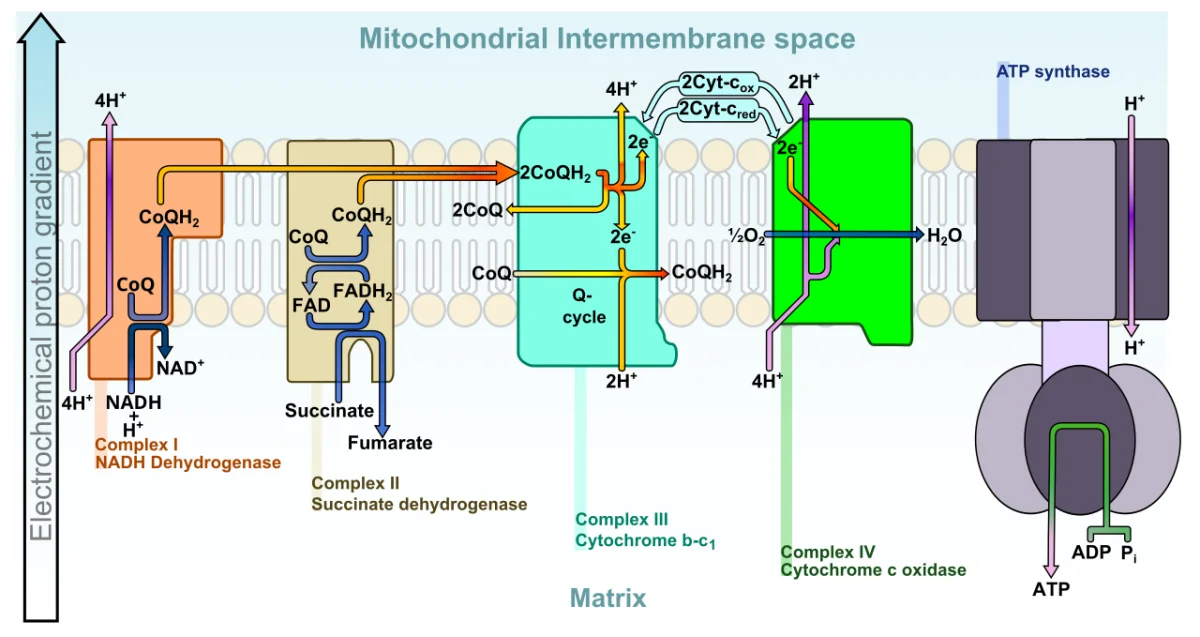
The electron transport chain builds a proton gradient. Protons flow back through ATP synthase, and that flow spins the enzyme like a water mill, producing ATP. This is chemiosmosis, a Nobel-winning insight by Peter Mitchell (1961). This step is the payoff for everything upstream: the purpose of glycolysis, PDH, the TCA cycle, and the ETC is to build the gradient that ATP synthase is about to convert into ATP.
The Proton Motive Force
As the ETC pumps H+ from the matrix to the intermembrane space, two gradients are established:
A chemical gradient: [H+] is higher outside than inside the matrix.
An electrical gradient: the intermembrane space becomes more positive.
Together these make the proton motive force (PMF). The PMF stores energy equivalent to the redox cascade that built it. Mitochondria use the PMF to drive ATP synthesis, thermogenesis, and some transport.
Oxidative phosphorylation in full. The ETC builds the proton motive force. ATP synthase uses the flow of protons back into the matrix to spin its rotor and synthesize ATP. Coupling these two processes is the essence of aerobic ATP production. Credit: Wikimedia Commons, CC BY-SA
ATP Synthase Structure
ATP synthase has two parts:
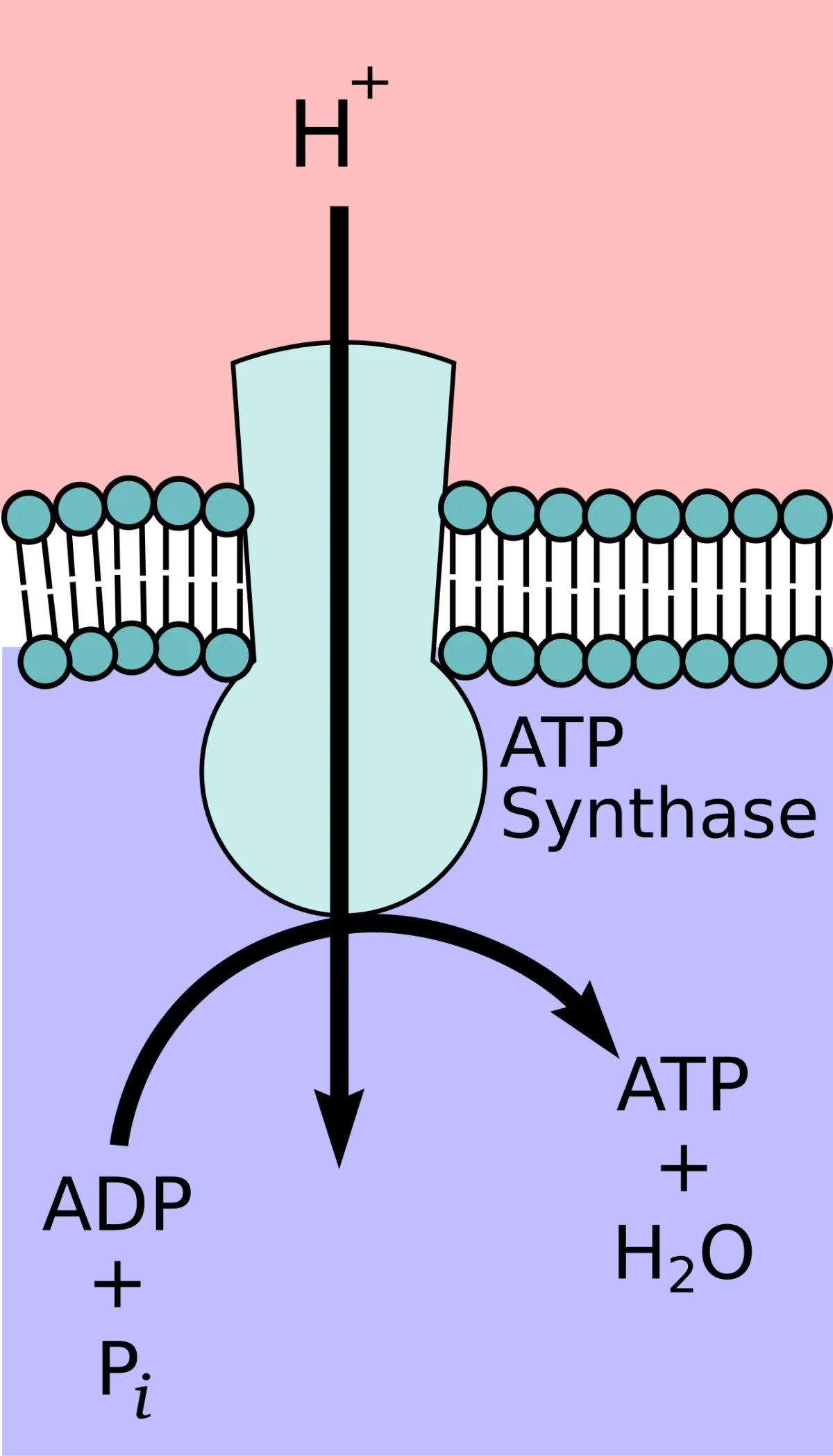
F0 (in membrane): a rotor. Protons flowing through it turn the central stalk. Named “F-zero” because it is inhibited by oligomycin.
F1 (in matrix): a stationary head with three catalytic sites. As F0 turns the stalk, F1’s catalytic sites cycle through three conformations (open, loose, tight), producing ATP from ADP + Pi with each rotation.
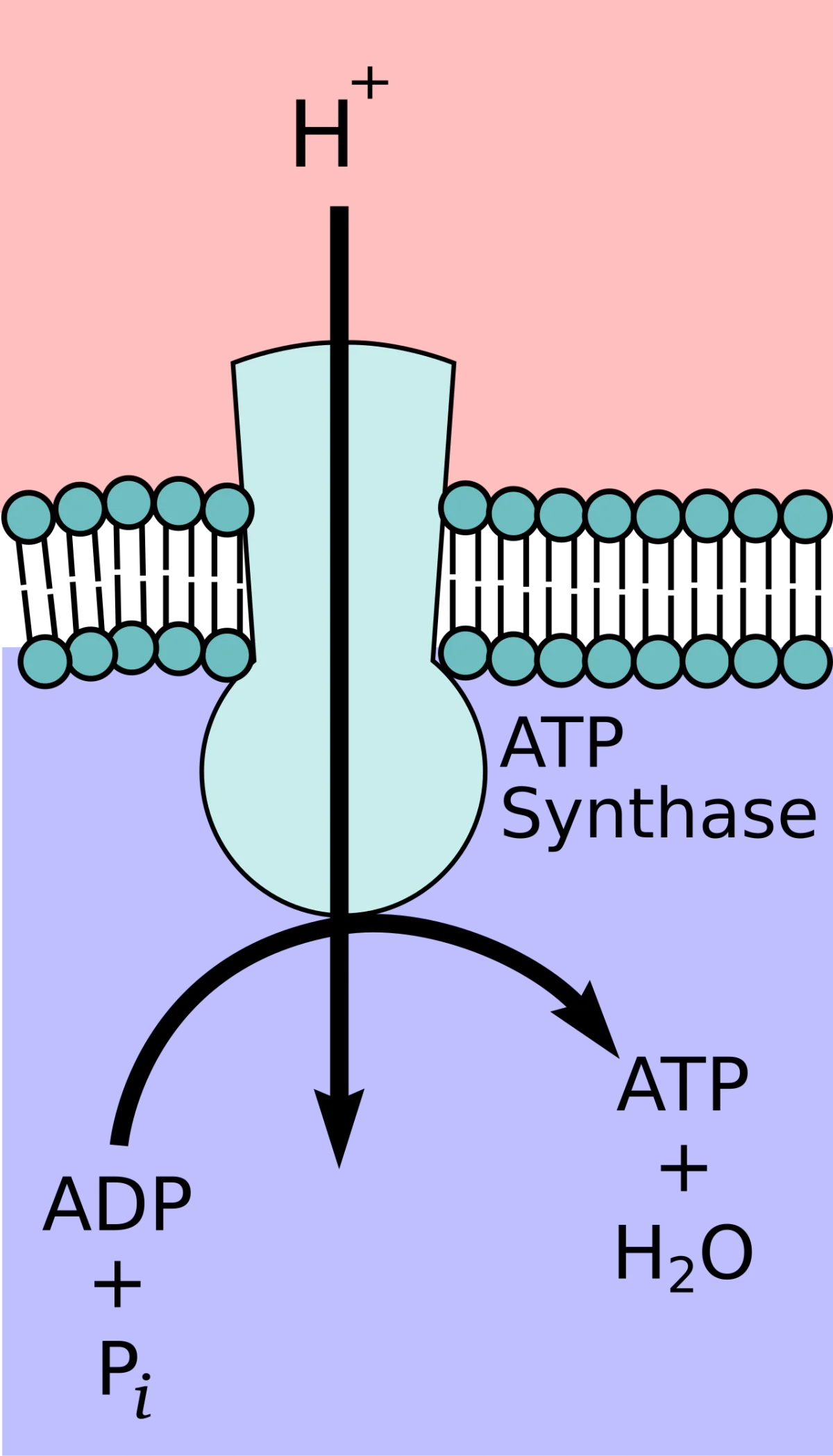
ATP synthase. F0 (membrane-embedded rotor) and F1 (matrix-facing ATP-forming head). Proton flow through F0 spins the central stalk, driving conformational changes in F1 that synthesize ATP. Credit: Wikimedia Commons, CC BY-SAThe rotary mechanism of ATP synthesis. Protons flowing through F0 rotate the stalk. The three F1 catalytic sites cycle through open (O), loose (L), and tight (T) conformations, producing ATP with each rotation. Per full rotation: 3 ATP. Credit: Wikimedia Commons, CC BY-SA
The Rotary Mechanism
Each full rotation of the F1 head produces 3 ATP. The number of protons required per rotation depends on the species (~8-14); in humans, roughly 4 H+ per ATP synthesized. This is why NADH (~10 H+ pumped) yields ~2.5 ATP, and FADH2 (~6 H+) yields ~1.5 ATP.
Coupling
ATP synthase normally couples proton flow directly to ATP synthesis. If you block proton pumping (an ETC inhibitor) or block proton return (an ATP synthase inhibitor like oligomycin), both shut down. If you put a “hole” in the membrane that lets protons leak back without going through ATP synthase, the PMF dissipates as heat without making ATP - see the next section on uncouplers.
What is the proton motive force, and what builds it?
Click to reveal answer
The proton motive force (PMF) is the combined chemical and electrical gradient of protons across the inner mitochondrial membrane, higher outside the matrix. It is built by the electron transport chain (Complexes I, III, IV), which uses the energy from electron flow to pump protons from matrix to intermembrane space. The PMF stores the energy harvested by the ETC.
How does ATP synthase produce ATP from the proton gradient?
Click to reveal answer
Protons flow through the F0 membrane rotor, causing it to rotate. This rotation turns a central stalk that drives conformational changes in the F1 catalytic head. The three F1 catalytic sites cycle through open, loose, and tight conformations, binding ADP + Pi in one and releasing ATP in the next. Each full rotation of F1 produces about 3 ATP.
What happens to ATP production if you punch a hole in the inner mitochondrial membrane that lets protons leak?
Click to reveal answer
The proton gradient dissipates - protons leak back into the matrix without passing through ATP synthase, so no ATP is made. The energy originally stored in the gradient is released as heat. The ETC keeps running (in fact, speeds up because matrix NADH is still processed), but no ATP is produced. This is uncoupling, the basis of thermogenesis in brown fat and the mechanism of DNP.