Picture a wealthy philanthropist handing a check to someone who needs it. The donor does not miss the money - they had more than enough - and the recipient is thrilled to receive it. Once the transfer is complete, the two are bound together by gratitude and obligation. Ionic bonding works the same way, except the currency is electrons and the binding force is electrostatic attraction.
A metal atom has a low ionization energy, meaning it barely holds onto its outermost electrons. A nonmetal has a high electron affinity, meaning it desperately wants an extra electron to complete its valence shell. When these two meet, the metal hands over one or more electrons, forming a positively charged cation and a negatively charged anion. The opposite charges then attract each other powerfully, creating an ionic bond.
Why Does Electron Transfer Happen?
Two atomic properties drive the process:
Ionization energy (IE) is the energy required to remove an electron from a gaseous atom. Metals (especially alkali and alkaline earth metals) have low IE values, so removing their valence electrons costs relatively little energy.
Electron affinity (EA) is the energy released when a gaseous atom gains an electron. Nonmetals (especially halogens) have very negative EA values, meaning they release substantial energy when they pick up that extra electron.
The combination of low IE (easy to lose) and high EA (eager to gain) makes the overall transfer energetically favorable. Sodium and chlorine are the textbook example: Na loses one electron to become Na+, Cl gains one electron to become Cl-, and the resulting NaCl is held together by the attraction between those opposite charges.
Coulomb’s Law and Electrostatic Attraction
The force holding the cation and anion together is governed by Coulomb’s law.
This formula tells you everything you need for the MCAT. The force of attraction increases when the charges are larger (compare Na+Cl- to Mg2+O2-) and when the ions are closer together (smaller ionic radii). Both of these factors will reappear when we discuss lattice energy.
Crystal Lattice Structure
Ionic compounds do not exist as discrete molecules. Instead, every cation is surrounded by multiple anions, and every anion is surrounded by multiple cations, forming a three-dimensional repeating pattern called a crystal lattice.
Ionic to covalent is one axis, not two boxes
Bonding
1
Scroll sideways to see the whole map.
Why the cut-offs are dashed1.7 is a convention, not a physical boundary, and different textbooks put it at 1.7 or 1.8. HF sits at 1.78 and is unmistakably a covalent molecular gas, which is exactly the point: nothing changes state at the line. Use the number to rank bonds, not to classify them absolutely.
What a dipole actually isA polar bond has a δ+ and a δ− end. A polar molecule needs those bond dipoles not to cancel: CO₂ has two strongly polar bonds and no net dipole because they point opposite ways, while water's two bonds are bent apart and add up.
Where the lattice comes fromIonic compounds are not molecules. Once electrons are transferred, every cation attracts every nearby anion, so the ions stack into a repeating lattice held by electrostatic attraction in all directions. That is why they are hard, brittle, high-melting, and conduct only once melted or dissolved.
There is one bond type, measured two ways. Every bond involves electrons being shared unequally; ionic simply means the sharing is so lopsided that it is easier to call it a transfer. Placing real compounds on the axis shows the categories overlapping rather than snapping.
Think of a checkerboard that extends in all three dimensions. Each red square is surrounded by black squares, and each black square is surrounded by red squares. There is no single “NaCl molecule” - just a vast, organized network of alternating Na+ and Cl- ions. This is why we write “NaCl” as a formula unit rather than a molecular formula.
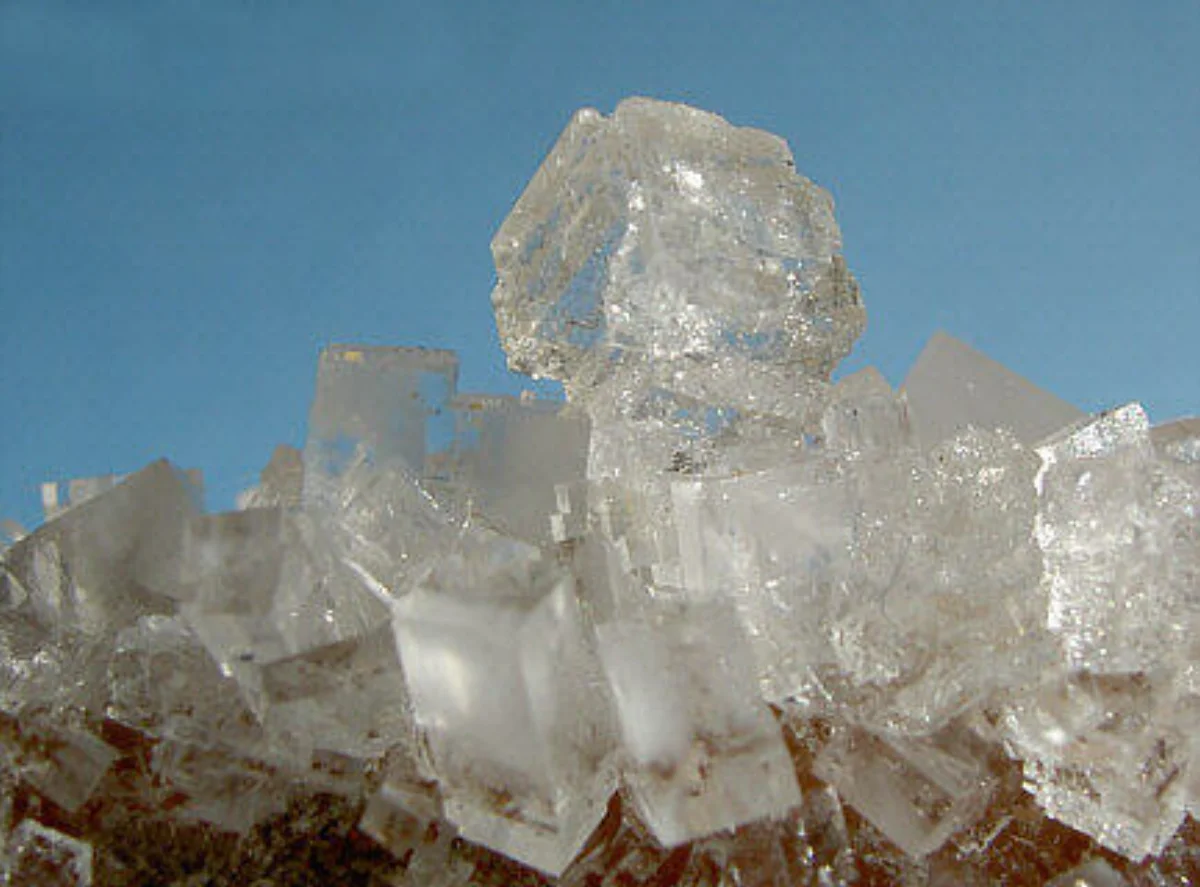
Real halite (NaCl) crystals. Notice the cubic crystal shape with flat faces meeting at 90-degree angles - a direct result of the cubic crystal lattice structure at the atomic level. Credit: Wikimedia Commons, public domain
Lattice Energy
Lattice energy is the energy released when gaseous ions come together to form one mole of a solid ionic compound. It can also be defined in the reverse direction - the energy required to completely separate one mole of a solid ionic compound into gaseous ions.
The magnitude of lattice energy depends on the same factors as Coulomb’s law:
Charge magnitude: Higher charges mean stronger attraction and greater lattice energy. MgO (Mg2+ and O2-) has a much higher lattice energy than NaCl (Na+ and Cl-).
Ionic radius: Smaller ions pack closer together, increasing attraction and lattice energy. LiF has a higher lattice energy than KBr because both Li+ and F- are smaller than K+ and Br-.
Properties of Ionic Compounds
The crystal lattice structure and strong electrostatic forces give ionic compounds a predictable set of physical properties:
High melting and boiling points. It takes enormous energy to disrupt the lattice. NaCl melts at 801 degrees C. MgO, with its +2/-2 charges, melts at 2,852 degrees C.
Brittle, not malleable. When a force shifts one layer of the lattice, like-charged ions suddenly face each other. The repulsion shatters the crystal. This is the opposite of metals, which can bend because their delocalized electrons act as a buffer.
Conduct electricity when dissolved or molten, but not as solids. In the solid state, ions are locked in place and cannot move. Dissolve the compound in water or melt it, and the ions become free to carry charge.
Soluble in polar solvents. Water molecules (which are polar) can surround and stabilize individual ions through ion-dipole interactions, pulling the lattice apart. Ionic compounds are generally insoluble in nonpolar solvents like hexane.
The Born-Haber Cycle
The individual steps in the Born-Haber cycle for NaCl are:
Sublimation of solid Na to gaseous Na (endothermic)
Ionization of gaseous Na to Na+ (endothermic - this is IE)
Dissociation of Cl₂ into 2 Cl atoms (endothermic)
Electron addition to gaseous Cl to form Cl- (exothermic - this is EA)
Formation of the crystal lattice from gaseous ions (exothermic - this is lattice energy)
If a passage gives you four of these values plus the overall enthalpy of formation, you can solve for the fifth. No memorization needed - just apply Hess’s law.
Common MCAT Traps
Be careful with these frequently tested distinctions:
Ionic compounds form formula units, not molecules. “NaCl molecule” is technically incorrect.
Solid ionic compounds do NOT conduct electricity. They must be dissolved or molten for ions to move.
Lattice energy increases with charge and decreases with ionic radius. Do not confuse this with bond energy, which applies to covalent bonds.
Which has a higher lattice energy: NaCl or MgO? Explain why.
Click to reveal answer
MgO has a much higher lattice energy. Mg2+ and O2- each carry charges of magnitude 2, while Na+ and Cl- each carry charges of magnitude 1. Since lattice energy is proportional to the product of the charges (q₁ x q₂), MgO’s lattice energy is roughly four times greater from charge alone. Additionally, Mg2+ and O2- are smaller ions than Na+ and Cl-, which further increases the lattice energy.
Why do solid ionic compounds fail to conduct electricity, while molten ionic compounds conduct well?
Click to reveal answer
In the solid state, ions are locked into fixed positions in the crystal lattice and cannot move to carry charge. When the compound is melted, the lattice breaks apart, freeing the ions to move through the liquid. Mobile charge carriers are required for electrical conductivity, so only the molten (or dissolved) form conducts.
In a Born-Haber cycle, which step typically releases the most energy?
Click to reveal answer
The lattice energy step (formation of the solid lattice from gaseous ions) releases the most energy. This large exothermic contribution is what makes the overall formation of the ionic compound energetically favorable, despite the endothermic costs of ionization and sublimation.
Imagine two roommates splitting the rent on an apartment. Neither can afford the place alone, so they pool their resources and share the cost. Both benefit, and the arrangement only works because each person contributes. Covalent bonding follows the same logic - two atoms share electrons because neither one can simply take them from the other. This is the dominant bonding strategy between nonmetal atoms, which have similar (and relatively high) electronegativities.
Why Sharing Instead of Transferring?
In ionic bonding, one atom clearly dominates: the metal has such a low ionization energy that it readily gives up electrons. In covalent bonding, neither atom is willing to surrender electrons because both have relatively high electronegativities. The compromise is sharing.
When two nonmetals approach each other, their atomic orbitals overlap and the shared electrons spend time in the region between both nuclei. This concentration of negative charge between the two positive nuclei acts as “electrostatic glue,” holding the atoms together.
Single, Double, and Triple Bonds
Atoms can share more than one pair of electrons. The number of shared pairs determines the bond type:
Ionic to covalent is one axis, not two boxes
Bonding
1
Scroll sideways to see the whole map.
Why the cut-offs are dashed1.7 is a convention, not a physical boundary, and different textbooks put it at 1.7 or 1.8. HF sits at 1.78 and is unmistakably a covalent molecular gas, which is exactly the point: nothing changes state at the line. Use the number to rank bonds, not to classify them absolutely.
What a dipole actually isA polar bond has a δ+ and a δ− end. A polar molecule needs those bond dipoles not to cancel: CO₂ has two strongly polar bonds and no net dipole because they point opposite ways, while water's two bonds are bent apart and add up.
Where the lattice comes fromIonic compounds are not molecules. Once electrons are transferred, every cation attracts every nearby anion, so the ions stack into a repeating lattice held by electrostatic attraction in all directions. That is why they are hard, brittle, high-melting, and conduct only once melted or dissolved.
There is one bond type, measured two ways. Every bond involves electrons being shared unequally; ionic simply means the sharing is so lopsided that it is easier to call it a transfer. Placing real compounds on the axis shows the categories overlapping rather than snapping.
Single bond: one shared pair (2 electrons). Example: H-H in H₂, C-H in methane.
Double bond: two shared pairs (4 electrons). Example: O=O in O₂, C=O in CO₂.
Triple bond: three shared pairs (6 electrons). Example: N≡N in N₂, C≡C in acetylene.
More shared pairs mean a stronger, shorter bond. A triple bond is stronger and shorter than a double bond, which is stronger and shorter than a single bond between the same two atoms. This relationship between bond order, bond strength, and bond length is tested repeatedly on the MCAT.
Bond Order
Bond order is simply the number of bonding electron pairs shared between two atoms. For a single bond, bond order = 1. For a double bond, bond order = 2. For a triple bond, bond order = 3.
In molecules with resonance structures, bond order can be a non-integer. For example, each C-O bond in the carbonate ion (CO₃²-) has a bond order of 34 (approximately 1.33), because four bonding pairs are distributed across three equivalent C-O bonds.
Nonpolar Covalent Bonds
When two identical atoms form a covalent bond, they share electrons perfectly equally. There is zero electronegativity difference, so neither atom pulls the shared electrons toward itself. These are nonpolar covalent bonds.
Examples include H₂, O₂, N₂, Cl₂, and F₂ - any diatomic molecule made from the same element. The electron density is distributed symmetrically between the two nuclei.
This is one end of the bonding spectrum. As the electronegativity difference between the two atoms increases, the bond becomes polar covalent, and eventually ionic. We will explore the polar covalent region in the next section.
Coordinate Covalent Bonds
In a standard covalent bond, each atom contributes one electron to the shared pair. In a coordinate covalent bond (also called a dative bond), both electrons in the shared pair come from the same atom.
The atom that donates both electrons is called the Lewis base (it has a lone pair to give). The atom that accepts the electron pair is the Lewis acid (it has an empty orbital to receive).
Classic examples:
NH₄+ (ammonium): Ammonia (NH₃) has a lone pair on nitrogen. When H+ approaches, nitrogen donates both electrons to form the fourth N-H bond. All four N-H bonds in NH₄+ are identical - you cannot tell which one was the coordinate covalent bond.
H₃O+ (hydronium): Water has two lone pairs on oxygen. One lone pair is donated to H+ to form the third O-H bond.
The critical MCAT takeaway: once a coordinate covalent bond forms, it is indistinguishable from a regular covalent bond. The distinction only matters when describing how the bond was formed, not how it behaves.
Properties of Covalent Compounds
Covalent compounds (also called molecular compounds) have properties that differ sharply from ionic compounds because they exist as discrete molecules held together by relatively weak intermolecular forces, rather than as a lattice of ions held by strong electrostatic forces.
Lower melting and boiling points. To melt or boil a covalent compound, you only need to overcome the intermolecular forces between molecules - not break covalent bonds. These forces (London dispersion, dipole-dipole, hydrogen bonds) are much weaker than the ion-ion attractions in a crystal lattice.
Poor electrical conductors. Covalent compounds have no free ions or delocalized electrons to carry charge. Even when dissolved, they typically do not produce ions (with notable exceptions like acids).
Variable solubility. Polar covalent compounds tend to dissolve in polar solvents (like water). Nonpolar covalent compounds tend to dissolve in nonpolar solvents (like hexane). “Like dissolves like” is the guiding principle.
Ionic vs. Covalent: A Side-by-Side Comparison
| Property | Ionic Compounds | Covalent Compounds |
|----------|----------------|-------------------|
| Formation | Electron transfer (metal + nonmetal) | Electron sharing (nonmetal + nonmetal) |
| Basic unit | Formula unit (crystal lattice) | Discrete molecule |
| Melting/boiling point | High (strong lattice forces) | Low to moderate (weak intermolecular forces) |
| Electrical conductivity | Conducts when dissolved or molten | Generally does not conduct |
| Solubility | Soluble in polar solvents | Polar in polar solvents, nonpolar in nonpolar solvents |
| State at room temperature | Usually solid | May be solid, liquid, or gas |
| Hardness | Hard but brittle | Soft or waxy (many exceptions) |
Network Covalent Solids: The Exception
Not all covalent compounds have low melting points. Network covalent solids like diamond (C), silicon dioxide (SiO₂), and silicon carbide (SiC) consist of atoms connected by covalent bonds in a continuous three-dimensional network - no discrete molecules at all. These materials have extremely high melting points, often exceeding those of ionic compounds.
Diamond melts at roughly 3,550 degrees C, far above NaCl’s 801 degrees C. The difference is that breaking a network covalent solid requires breaking actual covalent bonds, not just overcoming intermolecular forces.
If a passage describes a covalent compound with an unusually high melting point, think network covalent solid.
What is a coordinate covalent bond, and how does it differ from a regular covalent bond after formation?
Click to reveal answer
A coordinate covalent bond is formed when one atom donates both electrons in the shared pair. However, once formed, it is completely indistinguishable from a regular covalent bond. The distinction only describes the bond’s origin, not its properties. Examples include the fourth N-H bond in NH₄+ and the third O-H bond in H₃O+.
Rank the following in order of increasing bond strength and decreasing bond length: C-C, C=C, C≡C.
Click to reveal answer
Increasing bond strength: C-C < C=C < C≡C.Decreasing bond length: C-C > C=C > C≡C. As bond order increases, more shared electron pairs pull the nuclei closer together (shorter bond) and require more energy to break (stronger bond). A triple bond is the shortest and strongest; a single bond is the longest and weakest.
A compound has a very high melting point but is composed entirely of nonmetal atoms bonded covalently. What type of solid is it most likely?
Click to reveal answer
A network covalent solid. Unlike typical molecular covalent compounds (which have low melting points because only weak intermolecular forces must be overcome), network covalent solids like diamond (C) and quartz (SiO₂) have continuous three-dimensional covalent bonding. Melting requires breaking strong covalent bonds throughout the entire structure, producing extremely high melting points.
Think of a tug-of-war between two people of unequal strength. The stronger person does not yank the rope away entirely - that would be an ionic bond. Instead, the rope shifts toward the stronger side while both players still hold on. That unequal pull is exactly what happens in a polar covalent bond: the electrons are shared, but not equally.
In the previous section, we saw that identical atoms share electrons perfectly (nonpolar covalent) and that vastly different atoms transfer electrons outright (ionic). Polar covalent bonds occupy the middle ground - the most common type of bond in biological molecules and the one most frequently tested on the MCAT.
Electronegativity Difference Determines Bond Type
Electronegativity is an atom’s ability to attract shared electrons toward itself in a covalent bond. The difference in electronegativity between two bonded atoms tells you where the bond falls on the bonding spectrum:
| Electronegativity Difference | Bond Type | Example |
|------------------------------|-----------|---------|
| 0 to ~0.4 | Nonpolar covalent | H-H, C-H |
| ~0.4 to ~1.7 | Polar covalent | O-H, N-H, C-O |
| Greater than ~1.7 | Ionic | Na-Cl, K-F |
These cutoffs are approximate guidelines, not rigid rules. The MCAT will not ask you to memorize exact boundaries. What matters is understanding that bonding is a continuum, and electronegativity difference is the variable that moves you along it.
Partial Charges and the Dipole
In a polar covalent bond, the more electronegative atom pulls the shared electrons closer to itself. This creates an uneven distribution of electron density:
Ionic to covalent is one axis, not two boxes
Bonding
1
Scroll sideways to see the whole map.
Why the cut-offs are dashed1.7 is a convention, not a physical boundary, and different textbooks put it at 1.7 or 1.8. HF sits at 1.78 and is unmistakably a covalent molecular gas, which is exactly the point: nothing changes state at the line. Use the number to rank bonds, not to classify them absolutely.
What a dipole actually isA polar bond has a δ+ and a δ− end. A polar molecule needs those bond dipoles not to cancel: CO₂ has two strongly polar bonds and no net dipole because they point opposite ways, while water's two bonds are bent apart and add up.
Where the lattice comes fromIonic compounds are not molecules. Once electrons are transferred, every cation attracts every nearby anion, so the ions stack into a repeating lattice held by electrostatic attraction in all directions. That is why they are hard, brittle, high-melting, and conduct only once melted or dissolved.
There is one bond type, measured two ways. Every bond involves electrons being shared unequally; ionic simply means the sharing is so lopsided that it is easier to call it a transfer. Placing real compounds on the axis shows the categories overlapping rather than snapping.
The more electronegative atom develops a partial negative charge, written as delta minus (the Greek lowercase delta followed by a minus sign).
The less electronegative atom develops a partial positive charge, written as delta plus.
These are not full charges like in ionic bonds - the electrons are still shared, just unevenly. In H-Cl, chlorine is more electronegative (3.0 vs. 2.1), so the electron cloud shifts toward chlorine. Chlorine becomes slightly negative, hydrogen becomes slightly positive.
Dipole Moment
A dipole moment is a vector quantity that describes the separation of charge in a bond or molecule. It has both magnitude and direction.
Every polar bond has a bond dipole. But whether the entire molecule has a net dipole moment depends on something more subtle - and this is where the MCAT loves to test you.
Bond Polarity vs. Molecular Polarity
This is one of the most important distinctions in all of general chemistry for the MCAT: a molecule can contain polar bonds and still be nonpolar overall.
Bond polarity asks: is this individual bond polar? (Check the electronegativity difference between the two atoms.)
Molecular polarity asks: does the entire molecule have a net dipole moment? (Check whether the individual bond dipoles cancel each other out.)
The bond dipoles cancel when the molecular geometry is perfectly symmetric. They do not cancel when the geometry is asymmetric.
When Dipoles Cancel: Symmetric Molecules
Consider CO₂. Each C=O bond is polar (oxygen is more electronegative than carbon). But the molecule is linear, with the two C=O bonds pointing in exactly opposite directions. The two bond dipoles are equal in magnitude and opposite in direction. They cancel perfectly, producing a net dipole moment of zero. CO₂ is a nonpolar molecule despite having polar bonds.
Other examples of polar bonds canceling due to symmetry:
BF₃ (trigonal planar): three identical B-F dipoles arranged at 120 degree angles cancel out.
CCl₄ (tetrahedral): four identical C-Cl dipoles arranged tetrahedrally cancel out.
SF₆ (octahedral): six identical S-F dipoles cancel out.
The pattern: if all outer atoms are identical and the geometry is symmetric (no lone pairs on the central atom distorting the shape), the dipoles cancel and the molecule is nonpolar.
When Dipoles Do Not Cancel: Asymmetric Molecules
Now consider water (H₂O). Each O-H bond is polar, with the dipole pointing toward oxygen. If water were linear (like CO₂), these two dipoles would cancel. But water is bent (bond angle approximately 104.5 degrees) because oxygen has two lone pairs pushing the bonds closer together. The two O-H dipoles point in roughly the same general direction and partially reinforce each other. The result is a strong net dipole moment. Water is a polar molecule.
Other examples where dipoles do not cancel:
NH₃ (trigonal pyramidal): three N-H dipoles do not cancel because the lone pair on nitrogen creates an asymmetric shape.
CHCl₃ (chloroform): three C-Cl bonds and one C-H bond - the dipoles cannot cancel because the surrounding atoms are not all the same.
SO₂ (bent): two S=O dipoles do not cancel due to the bent geometry.
The Geometry Connection
Molecular polarity depends on both bond polarity and molecular geometry. You cannot determine whether a molecule is polar by looking at individual bonds alone. You must know the three-dimensional shape.
This is why VSEPR theory (covered in Section 3.6) matters so much. If you can predict the geometry, you can predict whether dipoles cancel. The MCAT tests this connection constantly.
Key geometries that produce nonpolar molecules (assuming all outer atoms are the same): linear (2 bonds, no lone pairs), trigonal planar, tetrahedral, trigonal bipyramidal, and octahedral.
Key geometries that produce polar molecules: bent, trigonal pyramidal, seesaw, T-shaped, and square pyramidal. These shapes have lone pairs or asymmetric arrangements that prevent dipole cancellation.
Why Does Molecular Polarity Matter?
Molecular polarity determines:
Solubility: Polar molecules dissolve in polar solvents (water). Nonpolar molecules dissolve in nonpolar solvents (hexane, oils). “Like dissolves like.”
Intermolecular forces: Polar molecules experience dipole-dipole forces in addition to London dispersion forces, giving them higher boiling points than similarly sized nonpolar molecules.
Biological function: The polarity of water is what makes it the “universal solvent” of biology. Cell membrane structure depends on the polar heads and nonpolar tails of phospholipids.
Understanding polarity is not just a bonding topic - it is the foundation for solubility, intermolecular forces, acid-base chemistry, and countless biochemistry concepts. Every minute you invest here pays dividends across the entire MCAT.
CO₂ has two polar C=O bonds. Is the molecule polar or nonpolar? Explain.
Click to reveal answer
Nonpolar. CO₂ is linear, so the two C=O bond dipoles point in exactly opposite directions. They are equal in magnitude and cancel each other completely, resulting in a net dipole moment of zero. Polar bonds do not guarantee a polar molecule - geometry determines whether the dipoles cancel.
Water has an electronegativity difference of about 1.4 for each O-H bond. Why is water a polar molecule while CO₂ (with similar bond polarity) is not?
Click to reveal answer
Geometry. Water is bent (approximately 104.5 degrees) due to two lone pairs on oxygen, so its two O-H bond dipoles do not point in opposite directions and cannot cancel. CO₂ is linear (180 degrees) with no lone pairs on carbon, so its two C=O dipoles point in exactly opposite directions and cancel perfectly. Same concept (polar bonds), different geometry, opposite outcome.
Classify the following bonds as nonpolar covalent, polar covalent, or ionic: (a) H-H, (b) C-O, (c) K-F.
Click to reveal answer
(a) Nonpolar covalent - identical atoms, electronegativity difference = 0. (b) Polar covalent - electronegativity difference is approximately 1.0 (between 0.4 and 1.7). (c) Ionic - electronegativity difference is approximately 3.2 (greater than 1.7). Remember: these cutoffs are approximate guidelines, not rigid boundaries.
Imagine you are an architect sketching the floor plan of a building. You do not need to show every nail and wire - just the walls, doors, and rooms so someone can understand the layout at a glance. A Lewis structure does the same thing for a molecule. It is a simplified blueprint that shows which atoms are connected, where the bonding electrons sit, and where the lone pairs hide.
Learning to draw Lewis structures quickly and accurately is one of the highest-return skills for the MCAT. Once you have a correct Lewis structure, you can predict molecular geometry, polarity, formal charge, resonance, hybridization, and reactivity - all from a single diagram.
The Octet Rule
Most atoms “want” to have 8 electrons in their valence shell. This is because a filled valence shell (like the noble gases) represents maximum stability. Hydrogen is the exception - it is satisfied with just 2 electrons, matching the electron configuration of helium.
The octet rule is the driving force behind Lewis structures. Every step of the drawing process is designed to give as many atoms as possible a full octet.
Step-by-Step Procedure for Drawing Lewis Structures
Follow these five steps every time. With practice, you will be able to fly through them in under a minute.
Step 1: Count total valence electrons.
Add up the valence electrons for every atom in the molecule. For polyatomic ions, add one electron for each negative charge or subtract one for each positive charge.
Step 2: Draw the skeleton structure.
Place the least electronegative atom in the center (hydrogen and fluorine are always terminal). Connect each outer atom to the central atom with a single bond. Each single bond uses 2 electrons.
Step 3: Subtract bonding electrons.
Take the total from Step 1 and subtract the electrons used in your single bonds. The remaining electrons are what you have left to distribute.
Step 4: Distribute remaining electrons as lone pairs.
Place lone pairs on the outer atoms first, giving each a full octet (or duet for hydrogen). Then place any leftover electrons on the central atom.
Step 5: Check the central atom’s octet.
If the central atom has fewer than 8 electrons, convert one or more lone pairs from an adjacent atom into double or triple bonds until the central atom has a full octet.
Worked Example: Lewis Structure of CO₃²⁻
Let us walk through the carbonate ion step by step.
Step 1: Count valence electrons. Carbon has 4, each oxygen has 6, and the 2- charge adds 2 more: 4 + 3(6) + 2 = 24 electrons.
Step 2: Carbon is the central atom (least electronegative). Draw three C-O single bonds. This uses 6 electrons.
Step 4: Distribute lone pairs on the three oxygens first. Each oxygen needs 6 more electrons (3 lone pairs) to complete its octet. That uses 3 x 6 = 18 electrons. All remaining electrons are now placed.
Step 5: Check carbon. Carbon currently has only 6 electrons (3 single bonds = 6 electrons). It needs 2 more. Convert one lone pair from an oxygen into a double bond. Now carbon has 8 electrons (2 single bonds + 1 double bond = 8 electrons), and the oxygen that donated the lone pair still has 8 electrons (1 double bond + 2 lone pairs = 8).
The result: carbon is double-bonded to one oxygen and single-bonded to the other two. Each single-bonded oxygen carries a formal charge of -1.
Formal Charge
Not all valid Lewis structures are equally good. Formal charge tells you how to pick the best one. It measures whether an atom “owns” more or fewer electrons than it brought to the molecule.
Rules for the Best Lewis Structure
When you can draw more than one valid Lewis structure, choose the one that:
Minimizes formal charges. A structure where every atom has a formal charge of 0 is better than one with charges of +1 and -1.
Places negative formal charges on more electronegative atoms. If formal charges are unavoidable, the negative charge should sit on the atom that attracts electrons more strongly (higher electronegativity).
Avoids placing positive formal charges on electronegative atoms. Oxygen or fluorine with a +1 formal charge is a red flag.
Resonance Structures
Sometimes you can draw more than one equally valid Lewis structure for the same molecule. These are resonance structures. In our CO₃²⁻ example, the double bond could be placed on any of the three oxygens, giving three equivalent resonance structures.
The critical point: the real molecule is not any single resonance structure. It is a resonance hybrid - an average of all contributing structures.
Key Properties of Resonance
Resonance stabilizes a molecule by delocalizing electrons over a larger area. More resonance structures generally means greater stability.
All resonance structures must be valid Lewis structures (correct number of electrons, no exceeded octets for second-period elements).
Equivalent resonance structures (like the three structures of CO₃²⁻) contribute equally to the hybrid. Non-equivalent structures contribute unequally, with the more stable structure contributing more.
Resonance structures are connected by a double-headed arrow (↔), not an equilibrium arrow (⇌). The double-headed arrow means “these are representations of the same molecule,” not “these interconvert.”
Common MCAT Resonance Examples
CO₃²⁻ (carbonate): three equivalent structures, each C-O bond order is 34
NO₃⁻ (nitrate): three equivalent structures, identical to carbonate’s pattern
O₃ (ozone): two equivalent structures, each O-O bond order is 1.5
Benzene (C₆H₆): two equivalent structures with alternating single and double bonds; the hybrid has six identical bonds of order 1.5
Lewis structures: count first, then draw
Bonding
1
Scroll sideways to see the whole map.
Formal charge, in one lineFormal charge = valence electrons − lone-pair electrons − number of bonds. Work it out for every atom; the sum must equal the overall charge on the species. When two structures both obey the octet rule, the better one is the one with formal charges nearest zero, and with any negative charge sitting on the most electronegative atom.
Resonance is not flippingThe three carbonate structures are not states the ion moves between. The real ion is a single average of all three, which is why all three C–O bonds are identical in length — longer than a double bond, shorter than a single — and why the charge is spread evenly over all three oxygens.
Which elements may expandOnly period 3 and beyond. Nitrogen cannot have five bonds and oxygen cannot have three in a neutral structure, however tempting it looks; phosphorus and sulfur, one row down, can. That single restriction resolves most disputed Lewis structures on the exam.
The count comes first, the picture second. Available minus needed, halved, gives the bonds; everything left over is lone pairs. Draw it that way and the octet rule is arithmetic rather than a guess.
What is the formal charge on the double-bonded oxygen in one resonance structure of CO₃²⁻?
Click to reveal answer
0. Using FC = Valence - Dots - Sticks: the double-bonded oxygen has 6 valence electrons, 4 lone pair electrons, and 2 bonds. FC = 6 - 4 - 2 = 0. The two single-bonded oxygens each have FC = 6 - 6 - 1 = -1, and the carbon has FC = 4 - 0 - 4 = 0. The total is 0 + (-1) + (-1) + 0 = -2, matching the ion’s charge.
How do resonance structures differ from one another?
Click to reveal answer
Only in the placement of electrons (bonds and lone pairs). The atoms remain in the same positions. If atom positions change, the structures are constitutional isomers, not resonance structures. The real molecule is a hybrid (average) of all valid resonance structures.
You draw two Lewis structures for a molecule. In Structure A, all atoms have formal charges of 0. In Structure B, one atom has +1 and another has -1. Which is the better (more stable) Lewis structure?
Click to reveal answer
Structure A. The best Lewis structure minimizes formal charges. A structure with all formal charges of zero is more stable than one with separated charges (+1 and -1), even if both structures are technically valid.
The octet rule is one of the most useful guidelines in chemistry - but it is not a law. Several important molecules flatly refuse to follow it, and the MCAT expects you to recognize all three categories of rule-breakers.
There are three categories of exceptions: incomplete octets, expanded octets, and odd-electron species. Let us look at each one.
Exception 1: Incomplete Octets
Some atoms are stable with fewer than 8 electrons in their valence shell. The most important examples for the MCAT are:
Hydrogen (H): satisfied with 2 electrons (duet rule). Hydrogen’s valence shell is the 1s orbital, which holds a maximum of 2 electrons.
Helium (He): also satisfied with 2 electrons, for the same reason.
Beryllium (Be): stable with 4 electrons. BeCl₂ is a classic example - beryllium has only two bonds and no lone pairs, giving it just 4 valence electrons.
Boron (B): stable with 6 electrons. BF₃ and BH₃ are the most commonly tested examples. In BF₃, boron forms three single bonds and has no lone pairs, giving it only 6 electrons around it.
Why do these atoms tolerate incomplete octets? They simply do not have enough valence electrons or enough orbitals to reach 8. Hydrogen has only one orbital in its valence shell (1s). Boron has only 3 valence electrons and tends to form only 3 bonds rather than forcing a fourth.
Exception 2: Expanded Octets
Elements in Period 3 and beyond can accommodate more than 8 electrons around them. This is called an expanded octet or hypervalency.
Lewis structures: count first, then draw
Bonding
1
Scroll sideways to see the whole map.
Formal charge, in one lineFormal charge = valence electrons − lone-pair electrons − number of bonds. Work it out for every atom; the sum must equal the overall charge on the species. When two structures both obey the octet rule, the better one is the one with formal charges nearest zero, and with any negative charge sitting on the most electronegative atom.
Resonance is not flippingThe three carbonate structures are not states the ion moves between. The real ion is a single average of all three, which is why all three C–O bonds are identical in length — longer than a double bond, shorter than a single — and why the charge is spread evenly over all three oxygens.
Which elements may expandOnly period 3 and beyond. Nitrogen cannot have five bonds and oxygen cannot have three in a neutral structure, however tempting it looks; phosphorus and sulfur, one row down, can. That single restriction resolves most disputed Lewis structures on the exam.
The count comes first, the picture second. Available minus needed, halved, gives the bonds; everything left over is lone pairs. Draw it that way and the octet rule is arithmetic rather than a guess.
The reason is simple: starting in Period 3, atoms have d orbitals available. These extra orbitals provide additional “seats” for electrons beyond the usual 8.
Common MCAT examples of expanded octets:
| Molecule | Central Atom | Electrons Around Central Atom | Geometry |
|----------|-------------|-------------------------------|----------|
| PCl₅ | Phosphorus | 10 | Trigonal bipyramidal |
| SF₆ | Sulfur | 12 | Octahedral |
| ClF₃ | Chlorine | 10 | T-shaped |
| XeF₂ | Xenon | 10 | Linear |
| IF₅ | Iodine | 12 | Square pyramidal |
| SO₄²⁻ | Sulfur | up to 12 | Tetrahedral |
Notice that phosphorus (Period 3), sulfur (Period 3), chlorine (Period 3), xenon (Period 5), and iodine (Period 5) are all in Period 3 or later. They all have accessible d orbitals.
How to Recognize an Expanded Octet
When you draw a Lewis structure and the central atom already has a full octet but there are still leftover electrons to place, put those extra electrons on the central atom as lone pairs - but only if the central atom is in Period 3 or beyond.
For example, in XeF₂: xenon has 8 valence electrons, each fluorine has 7, for a total of 22. After drawing two Xe-F bonds (4 electrons) and filling octets on fluorine (12 electrons for lone pairs), you have 6 electrons left. These go on xenon as three lone pairs, giving xenon 10 total electrons. This is acceptable because xenon is in Period 5.
Exception 3: Odd-Electron Species (Free Radicals)
If a molecule has an odd total number of valence electrons, it is mathematically impossible for every atom to have a full octet. At least one atom will be stuck with 7 electrons.
These molecules are called free radicals, and they are typically very reactive because that unpaired electron desperately seeks a partner.
Key MCAT examples:
NO (nitric oxide): 5 + 6 = 11 valence electrons. Nitrogen has only 7 electrons around it. Despite being a radical, NO is an important biological signaling molecule (vasodilation, immune response).
NO₂ (nitrogen dioxide): 5 + 2(6) = 17 valence electrons. Again, an odd number means at least one atom cannot have a full octet.
O₂ (molecular oxygen): Although the Lewis structure appears to give every atom a full octet, molecular oxygen is actually a diradical with two unpaired electrons. This is a limitation of Lewis structures - they cannot always capture the full electronic picture. Molecular orbital theory handles this correctly.
Summary: Three Categories at a Glance
| Exception Type | What Happens | Key Examples | Why It Occurs |
|---------------|-------------|--------------|---------------|
| Incomplete octet | Fewer than 8 electrons | H (2), Be (4), B (6) | Not enough valence electrons or orbitals |
| Expanded octet | More than 8 electrons | PCl₅, SF₆, ClF₃, XeF₂ | d orbitals available (Period 3+) |
| Odd-electron species | Odd number of total electrons | NO, NO₂ | Cannot pair all electrons into full octets |
MCAT Strategy
When the MCAT gives you a molecule and asks about bonding, do a quick check:
Is the central atom in Period 2? Then it must obey the octet rule (no exceptions for C, N, O, F).
Is the central atom in Period 3 or later? Then an expanded octet is possible if needed.
Is the total number of valence electrons odd? Then you have a free radical.
Is the central atom boron or beryllium? Then an incomplete octet is expected.
Why can phosphorus form PCl₅ with 10 electrons around it, but nitrogen cannot form NCl₅?
Click to reveal answer
Phosphorus is in Period 3 and has empty 3d orbitals that can accommodate extra electrons beyond 8. Nitrogen is in Period 2 and has no d orbitals available, so it can never exceed 8 electrons. This is why PCl₅ exists but NCl₅ does not.
What are the three categories of exceptions to the octet rule? Give one example of each.
Click to reveal answer
1. Incomplete octets - atoms with fewer than 8 electrons (e.g., BF₃ - boron has only 6). 2. Expanded octets - atoms with more than 8 electrons (e.g., SF₆ - sulfur has 12). 3. Odd-electron species - molecules with an odd total electron count (e.g., NO - 11 total valence electrons, so at least one atom has only 7).
Which four elements NEVER exceed 8 valence electrons?
Click to reveal answer
C, N, O, and F. All are in Period 2 and lack d orbitals. They can never accommodate more than 8 electrons in their valence shell. Remember: “C, N, O, F Never Overflow.”
If you have ever tied balloons together at a birthday party, you already understand VSEPR theory intuitively. Tie two balloons at their knots - they point in opposite directions (180 degrees apart). Tie three together - they spread into a triangle (120 degrees). Tie four - they form a tetrahedron (109.5 degrees). The balloons naturally push apart as far as possible to minimize crowding.
Electron groups around a central atom do the exact same thing.
What Is VSEPR?
VSEPR stands for Valence Shell Electron Pair Repulsion. The core idea is simple: electron groups around a central atom are all negatively charged, so they repel each other. To minimize that repulsion, they arrange themselves as far apart as possible in three-dimensional space.
This arrangement determines the shape of the molecule - which in turn determines its polarity, reactivity, and biological function.
Steric Number: Counting Electron Groups
Before you can predict geometry, you need to count the electron groups around the central atom. This count is called the steric number.
An electron group is any of the following:
A single bond (counts as 1 group)
A double bond (counts as 1 group)
A triple bond (counts as 1 group)
A lone pair (counts as 1 group)
The critical rule: each multiple bond counts as only ONE electron group, no matter how many electron pairs it contains. A double bond has 4 electrons and a triple bond has 6, but each occupies one region of space around the central atom.
The Five Base Electron Geometries
The steric number directly tells you the electron geometry - the arrangement of all electron groups (both bonds and lone pairs) around the central atom.
These five geometries are the foundation of everything in VSEPR. Memorize them cold.
Electron Geometry vs. Molecular Geometry
Here is where many students get tripped up. Electron geometry describes the arrangement of all electron groups, including lone pairs. Molecular geometry describes the arrangement of only the atoms - what you would actually “see” if you could photograph the molecule.
When there are no lone pairs, the two geometries are identical. But when lone pairs are present, the molecular geometry is a subset of the electron geometry - because lone pairs are invisible in the molecular shape.
We will explore this distinction in full detail in the next section. For now, understand that the electron geometry is determined by the steric number, and the molecular geometry depends on how many of those groups are bonds versus lone pairs.
Steric Number 2: Linear Geometry
With only two electron groups, the groups point in opposite directions to maximize their distance. The bond angle is exactly 180 degrees.
Examples: CO₂ (two double bonds), HCN (one triple bond + one single bond), BeCl₂ (two single bonds).
All three molecules are perfectly linear. Note that CO₂ has double bonds and HCN has a triple bond, but each multiple bond still counts as one electron group.
Steric Number 3: Trigonal Planar Geometry
Three electron groups arrange in a flat triangle with 120-degree angles between them. All atoms lie in the same plane.
Examples: BF₃ (three single bonds, no lone pairs), formaldehyde H₂CO (two single bonds + one double bond), NO₃⁻ (resonance hybrid with three equivalent bonds).
Steric Number 4: Tetrahedral Geometry
Four electron groups point toward the corners of a tetrahedron, with bond angles of 109.5 degrees. This is a three-dimensional shape - it cannot be drawn accurately in two dimensions.
Examples: CH₄ (four single bonds), NH₄⁺ (four single bonds), CCl₄ (four single bonds).
The tetrahedral geometry is the most common on the MCAT because carbon forms four bonds in the vast majority of organic molecules.
Steric Number 5: Trigonal Bipyramidal Geometry
Five electron groups create a more complex shape with two distinct positions:
Equatorial positions (3 groups in the “belt”): 120 degrees apart from each other, 90 degrees from the axial positions.
Axial positions (2 groups on “top” and “bottom”): 180 degrees from each other, 90 degrees from the equatorial positions.
Example: PCl₅ (five single bonds to phosphorus).
This geometry is unique because not all positions are equivalent - the equatorial and axial positions have different bond angles. This matters when lone pairs are present, because lone pairs preferentially occupy equatorial positions (where there is more room).
Steric Number 6: Octahedral Geometry
Six electron groups point toward the corners of an octahedron, with all bond angles at 90 degrees. Unlike the trigonal bipyramid, all six positions are equivalent.
Example: SF₆ (six single bonds to sulfur).
An octahedron looks like two square-based pyramids glued at their bases. All positions have the same relationship to the central atom.
Comprehensive VSEPR Reference Table
This table summarizes the electron geometries, molecular geometries, and bond angles for all steric numbers. The molecular geometry column shows what happens when some electron groups are lone pairs rather than bonds.
VSEPR: one rule, applied eight times
Molecular geometry
1
Scroll sideways to see the whole map.
The whole ruleCount the steric number: bonded atoms plus lone pairs on the central atom, treating a double or triple bond as one group. Arrange that many groups as far apart as they will go. Then name the shape using only the atoms — lone pairs are invisible in the name but very much present in the geometry.
Why lone pairs squeeze the angleA lone pair is held by one nucleus instead of two, so it spreads out closer to the central atom and pushes harder than a bonding pair. Each one shaves a few degrees off: methane is 109.5°, ammonia with one lone pair is 107°, water with two is 104.5°.
Electron geometry versus molecular geometryWater's electron geometry is tetrahedral, because four groups surround the oxygen. Its molecular geometry is bent, because two of those groups are lone pairs and you do not name them. Questions that seem contradictory are almost always asking about different one of these two.
Count the groups, spread them out, then describe only the atoms. Every shape below is the same rule applied to a different count. The lone pairs are drawn in so that the difference between electron geometry and molecular geometry is visible rather than something to memorise.
Count the steric number (bonds + lone pairs on the central atom).
Determine the electron geometry from the steric number.
Determine the molecular geometry by noting how many of those groups are lone pairs.
This four-step process works for every VSEPR problem on the MCAT. Practice it until it becomes automatic.
Why VSEPR Matters for the MCAT
VSEPR is not just an abstract exercise in geometry. Molecular shape determines:
Polarity: A molecule’s shape determines whether bond dipoles cancel or add up. CO₂ is linear and nonpolar; H₂O is bent and very polar.
Reactivity: The shape of an enzyme’s active site must match the shape of the substrate (lock-and-key model). Molecular geometry is central to biochemistry.
Physical properties: Boiling points, melting points, and solubility all depend on intermolecular forces, which depend on molecular polarity, which depends on shape.
Understanding VSEPR connects bonding to virtually every other topic on the MCAT.
What is the steric number of the central atom in SF₄, and what is its molecular geometry?
Click to reveal answer
Steric number = 5; molecular geometry = seesaw. Sulfur has 4 bonding groups and 1 lone pair, giving a steric number of 5. The electron geometry is trigonal bipyramidal, but the lone pair occupies an equatorial position, making the molecular (visible) geometry a seesaw shape with bond angles of approximately 90° and 120°.
CO₂ and H₂O both have three atoms. Why is CO₂ linear while H₂O is bent?
Click to reveal answer
Different steric numbers due to lone pairs. In CO₂, carbon has a steric number of 2 (two double bonds, no lone pairs), giving a linear geometry (180°). In H₂O, oxygen has a steric number of 4 (two bonds + two lone pairs), giving a tetrahedral electron geometry. With two of those groups being lone pairs, the molecular geometry is bent (~104.5°). The lone pairs on oxygen change the shape entirely.
A molecule has a steric number of 4 with one lone pair on the central atom. What are the electron geometry and molecular geometry?
Click to reveal answer
Electron geometry: tetrahedral. Molecular geometry: trigonal pyramidal. The four electron groups (3 bonds + 1 lone pair) arrange in a tetrahedron, but since lone pairs are “invisible” in the molecular shape, the three bonded atoms form a trigonal pyramid. Bond angles are approximately 107°, slightly less than the ideal 109.5° due to lone pair repulsion. NH₃ is the classic example.
Imagine you are arranging five people around a circular table. If all five are visible guests, you would describe the seating arrangement based on all five positions. But what if two of those seats are occupied by invisible people? The physical chairs are still there, still taking up space, still forcing the visible guests to adjust - but when someone asks you to describe the arrangement, you only describe where the visible people are sitting. That is the difference between electron geometry and molecular geometry.
Electron geometry describes the arrangement of all electron groups around a central atom - bonding pairs and lone pairs alike. Molecular geometry describes only where the atoms are. The lone pairs are still present and still influencing shape, but they are invisible when naming the molecular geometry.
Why Lone Pairs Compress Bond Angles
Not all electron groups are equal. A lone pair of electrons sits closer to the central atom than a bonding pair does, because it is not being shared with another nucleus that would pull it outward. Because the lone pair is held closer, its electron cloud spreads out more and demands extra space.
The key consequence: every lone pair on a central atom compresses the bond angles between the remaining bonded atoms. A perfect tetrahedral angle is 109.5 degrees, but add one lone pair (as in NH3) and the angles drop to about 107 degrees. Add two lone pairs (as in H2O) and they fall further to about 104.5 degrees.
The Two-Step Process
To determine molecular geometry on the MCAT, always follow two steps:
Count all electron groups around the central atom (bonds + lone pairs). This gives you the electron geometry.
Ignore the lone pairs and describe only the positions of the atoms. This gives you the molecular geometry.
A single bond, double bond, and triple bond each count as one electron group. Only the number of positions matters for geometry, not the bond order within each position.
Geometries Derived from Tetrahedral (4 Electron Groups)
When a central atom has four electron groups, the electron geometry is always tetrahedral. The molecular geometry depends on how many of those groups are lone pairs.
Lone Pairs
Bonding Groups
Molecular Geometry
Approximate Bond Angle
Example
0
4
Tetrahedral
109.5 degrees
CH4
1
3
Trigonal pyramidal
~107 degrees
NH3
2
2
Bent
~104.5 degrees
H2O
CH4 (methane): Four bonding pairs, zero lone pairs. Electron geometry = tetrahedral. Molecular geometry = tetrahedral. Bond angles are a perfect 109.5 degrees.
NH3 (ammonia): Three bonding pairs plus one lone pair. Electron geometry = tetrahedral. Molecular geometry = trigonal pyramidal. The lone pair squeezes the H-N-H angles down to about 107 degrees.
H2O (water): Two bonding pairs plus two lone pairs. Electron geometry = tetrahedral. Molecular geometry = bent. Two lone pairs compress the H-O-H angle even further to about 104.5 degrees.
Geometries Derived from Trigonal Bipyramidal (5 Electron Groups)
Five electron groups create a trigonal bipyramidal electron geometry with two distinct positions: three equatorial positions (in the plane, 120 degrees apart) and two axial positions (above and below, 90 degrees from equatorial). Lone pairs always occupy equatorial positions first because there is more room there.
Lone Pairs
Bonding Groups
Molecular Geometry
Example
0
5
Trigonal bipyramidal
PCl5
1
4
Seesaw
SF4
2
3
T-shaped
ClF3
3
2
Linear
XeF2
SF4 (sulfur tetrafluoride): Four bonding pairs plus one equatorial lone pair. The resulting shape looks like a playground seesaw - two atoms up and down (axial) and two out to the sides (equatorial), with a gap where the lone pair sits.
ClF3 (chlorine trifluoride): Three bonding pairs plus two equatorial lone pairs. The remaining three atoms form a T-shape - one axial up, one axial down, and one equatorial out to the side.
XeF2 (xenon difluoride): Two bonding pairs plus three equatorial lone pairs. The three lone pairs fill the entire equatorial plane, leaving only the two axial fluorines. Molecular geometry = linear, even though the electron geometry is trigonal bipyramidal. This is a favorite MCAT question - a molecule that looks linear but has five electron groups.
Geometries Derived from Octahedral (6 Electron Groups)
Six electron groups form an octahedral electron geometry where all positions are equivalent (90 degrees apart). When lone pairs appear, they position themselves opposite each other to minimize repulsion.
Lone Pairs
Bonding Groups
Molecular Geometry
Example
0
6
Octahedral
SF6
1
5
Square pyramidal
BrF5
2
4
Square planar
XeF4
BrF5 (bromine pentafluoride): Five bonding pairs plus one lone pair. Remove one vertex from the octahedron and you get a square base with one atom on top - square pyramidal.
XeF4 (xenon tetrafluoride): Four bonding pairs plus two lone pairs. The two lone pairs sit opposite each other (trans positions, both axial), leaving four fluorines in a flat square - square planar. This is another heavily tested geometry.
The Complete Geometry Reference
Here is a summary of all five base electron geometries and every molecular geometry that derives from them:
Electron Groups
Electron Geometry
Lone Pairs
Molecular Geometry
2
Linear
0
Linear
3
Trigonal planar
0
Trigonal planar
3
Trigonal planar
1
Bent
4
Tetrahedral
0
Tetrahedral
4
Tetrahedral
1
Trigonal pyramidal
4
Tetrahedral
2
Bent
5
Trigonal bipyramidal
0
Trigonal bipyramidal
5
Trigonal bipyramidal
1
Seesaw
5
Trigonal bipyramidal
2
T-shaped
5
Trigonal bipyramidal
3
Linear
6
Octahedral
0
Octahedral
6
Octahedral
1
Square pyramidal
6
Octahedral
2
Square planar
Notice that “bent” appears twice - once from trigonal planar (3 groups, 1 LP, ~120 degrees) and once from tetrahedral (4 groups, 2 LP, ~104.5 degrees). Similarly, “linear” appears in multiple rows. Always specify the electron geometry if asked to distinguish them.
Common MCAT Traps
Confusing electron geometry with molecular geometry. Water has a tetrahedral electron geometry but a bent molecular geometry. If an answer choice says “tetrahedral” for water, it is only correct if the question specifically asks about electron geometry.
Forgetting that multiple bonds count as one group. CO2 has two double bonds, giving it two electron groups - not four. Its electron geometry and molecular geometry are both linear.
Assuming bent always means the same angle. Bent from a trigonal planar parent has angles near 120 degrees (like SO2), while bent from a tetrahedral parent has angles near 104.5 degrees (like H2O).
NH3 has four electron groups but only three bonded atoms. What are its electron geometry and molecular geometry, and why do the bond angles differ from the ideal?
Click to reveal answer
Electron geometry = tetrahedral (4 groups). Molecular geometry = trigonal pyramidal (3 bonded atoms, 1 lone pair). The lone pair on nitrogen takes up more space than a bonding pair because it is held closer to the atom and spreads out more. This extra repulsion compresses the H-N-H bond angles from the ideal 109.5 degrees down to approximately 107 degrees.
XeF2 has a linear molecular geometry but is NOT derived from a linear electron geometry. Explain how this is possible.
Click to reveal answer
Xenon in XeF2 has five electron groups (2 bonding pairs + 3 lone pairs), giving it a trigonal bipyramidal electron geometry. The three lone pairs occupy all three equatorial positions, leaving the two bonding pairs in the axial positions - directly opposite each other at 180 degrees. The molecular geometry (atoms only) is linear, even though the electron geometry is trigonal bipyramidal.
Both SO2 and H2O have a "bent" molecular geometry. Do they have the same bond angle? Why or why not?
Click to reveal answer
No, they have different bond angles. SO2 has three electron groups (trigonal planar electron geometry, 1 lone pair), so its bent angle is close to 120 degrees. H2O has four electron groups (tetrahedral electron geometry, 2 lone pairs), so its bent angle is approximately 104.5 degrees. The parent electron geometry determines the ideal angle, and the number of lone pairs determines how much compression occurs.
Take one can of red paint and three cans of blue paint. Mix them all together and you get four identical cans of purple paint. The original colors are gone - you cannot scoop the red back out. You started with four cans, and you end with four cans, but now they are all the same new color. That is hybridization.
In atomic terms, a carbon atom has one 2s orbital and three 2p orbitals that look nothing alike - the s orbital is a sphere, and the p orbitals are dumbbells oriented along different axes. But when carbon forms four bonds (as in methane), those four different orbitals mix together to create four identical hybrid orbitals called sp3 hybrids. Each one is the same shape, the same energy, and points toward a corner of a tetrahedron. The original s and p orbitals no longer exist on that atom.
The Golden Rule: Orbitals In = Orbitals Out
The number of hybrid orbitals produced always equals the number of atomic orbitals that were mixed. Mix two orbitals, get two hybrids. Mix six orbitals, get six hybrids. No orbitals are created or destroyed - they are just reshaped.
This is why the name of the hybridization tells you everything. “sp3” means one s orbital + three p orbitals were mixed, producing four hybrid orbitals. “sp2” means one s + two p orbitals were mixed, producing three hybrids. The superscripts in the name are literally a recipe.
The Shortcut: Steric Number = Hybridization
Here is the fastest way to determine hybridization on the MCAT. Count the steric number - the total number of electron groups (bonds + lone pairs) around the central atom. That number maps directly to the hybridization.
| Steric Number | Orbitals Mixed | Hybridization | Geometry |
|:---:|:---|:---:|:---|
| 2 | 1 s + 1 p | sp | Linear |
| 3 | 1 s + 2 p | sp2 | Trigonal planar |
| 4 | 1 s + 3 p | sp3 | Tetrahedral |
| 5 | 1 s + 3 p + 1 d | sp3d | Trigonal bipyramidal |
| 6 | 1 s + 3 p + 2 d | sp3d2 | Octahedral |
That is the entire system. No exceptions, no special cases for the MCAT. Count groups, read off the hybridization.
sp3 Hybridization (4 Groups)
Mix one s orbital and three p orbitals to get four sp3 hybrid orbitals aimed at the corners of a tetrahedron. This is the most common hybridization in organic molecules.
Hybridisation, sigma and pi, and what bond order does
Bonding
1
Scroll sideways to see the whole map.
Counting to the hybridisationCount the groups attached to the atom, exactly as for VSEPR: four means sp³, three means sp², two means sp. The number of orbitals you mix always equals the number of groups you need to point at.
Sigma and pi, and what rotatesThe first bond between two atoms is always sigma, formed head-on. Every bond after that is pi, formed from p orbitals overlapping side-on above and below. A sigma bond alone lets the ends spin freely; a pi bond locks them, which is exactly why alkenes have cis and trans forms and alkanes do not.
One chain, three consequencesMore s character pulls the bonding electrons closer to the nucleus, so sp bonds are shorter and stronger than sp³ bonds, and sp carbons are more electronegative. Bond order, bond length and bond energy are three readings of the same quantity.
Bond order, length and strength move together. Adding a pi bond pulls the two carbons closer and makes the connection harder to break: 154 pm and 347 kJ/mol for a single bond, 120 pm and 839 kJ/mol for a triple. Shorter is always stronger, for the same pair of atoms.
CH4 (methane): Carbon has four bonding groups, zero lone pairs. Steric number = 4, so hybridization = sp3. The four C-H bonds point to the corners of a tetrahedron with 109.5-degree angles.
NH3 (ammonia): Nitrogen has three bonding groups plus one lone pair. Steric number = 4, so hybridization = sp3. The lone pair occupies one of the four sp3 orbitals. Even though the molecular geometry is trigonal pyramidal, the hybridization is still sp3 because hybridization depends on total electron groups, not just bonded atoms.
H2O (water): Oxygen has two bonding groups plus two lone pairs. Steric number = 4, hybridization = sp3. Two of the four sp3 orbitals hold lone pairs.
sp2 Hybridization (3 Groups)
Mix one s orbital and two p orbitals to get three sp2 hybrid orbitals in a trigonal planar arrangement (120 degrees apart). One p orbital remains unhybridized and is available to form a pi bond.
BF3 (boron trifluoride): Boron has three bonding groups, zero lone pairs. Steric number = 3, hybridization = sp2. The three B-F bonds are in a plane with 120-degree angles. Boron is electron-deficient here (only six electrons around it), which is why BF3 is a strong Lewis acid.
Ethylene (C2H4): Each carbon has three groups (two C-H bonds plus one C=C bond - remember, a double bond counts as one group). Steric number = 3, so each carbon is sp2 hybridized. The three sp2 orbitals form the trigonal planar framework, and the leftover unhybridized p orbital on each carbon overlaps sideways to form the pi bond of the double bond.
Carbonate ion (CO3 2-): The central carbon has three groups (three C-O bonds, some of which are double bonds in resonance structures). Steric number = 3, hybridization = sp2. The ion is flat and trigonal planar.
sp Hybridization (2 Groups)
Mix one s orbital and one p orbital to get two sp hybrid orbitals pointing in opposite directions (180 degrees apart). Two p orbitals remain unhybridized and can form up to two pi bonds.
CO2 (carbon dioxide): Carbon has two groups (two double bonds). Steric number = 2, hybridization = sp. The two C=O bonds point in opposite directions, making the molecule linear. The two unhybridized p orbitals on carbon each overlap with a p orbital on an oxygen to form two pi bonds.
BeCl2 (beryllium chloride): Beryllium has two bonding groups. Steric number = 2, hybridization = sp. Linear geometry with 180-degree bond angles.
HCN (hydrogen cyanide): Carbon has two groups (one C-H single bond and one C-N triple bond). Steric number = 2, hybridization = sp. The triple bond contains one sigma bond and two pi bonds formed by the two unhybridized p orbitals.
Expanded Octet Hybridization (5 and 6 Groups)
Elements in period 3 and below have access to d orbitals, which allows them to form more than four hybrid orbitals.
sp3d (5 groups): PCl5 is the classic example. Phosphorus has five bonding groups, so it mixes one s, three p, and one d orbital to create five sp3d hybrid orbitals in a trigonal bipyramidal arrangement.
sp3d2 (6 groups): SF6 is the textbook case. Sulfur has six bonding groups, so it mixes one s, three p, and two d orbitals to create six sp3d2 hybrid orbitals in an octahedral arrangement.
The Unhybridized Orbital Connection
Here is a detail that links this section directly to the next one: any p orbital that is not used in hybridization remains unhybridized and is available for pi bonding.
sp3: All three p orbitals are used in hybridization. Zero unhybridized p orbitals. Zero pi bonds possible.
sp2: Two p orbitals are hybridized, one remains. One unhybridized p orbital. One pi bond possible.
sp: One p orbital is hybridized, two remain. Two unhybridized p orbitals. Two pi bonds possible.
This is why double bonds require sp2 hybridization (they need one unhybridized p orbital for the pi bond) and triple bonds require sp hybridization (they need two unhybridized p orbitals for two pi bonds). The connection between hybridization and bond type is not a coincidence - it is built into the system.
Common MCAT Traps
Forgetting to count lone pairs. The nitrogen in NH3 is sp3 (four groups), not sp2 (three bonds). Always count lone pairs as electron groups.
Counting double/triple bonds as multiple groups. A double bond is one group. A triple bond is one group. Only the number of positions matters.
Assuming hybridization determines molecular geometry. Hybridization determines electron geometry. If lone pairs are present, the molecular geometry will differ from what the hybridization alone might suggest. NH3 is sp3 hybridized (tetrahedral electron geometry) but trigonal pyramidal in molecular geometry.
What is the hybridization of the central atom in each: CH4, BF3, CO2, NH3, H2O?
Click to reveal answer
CH4 = sp3 (4 groups). BF3 = sp2 (3 groups). CO2 = sp (2 groups). NH3 = sp3 (4 groups - 3 bonds + 1 lone pair). H2O = sp3 (4 groups - 2 bonds + 2 lone pairs). Remember, lone pairs count as electron groups. The steric number (total groups) directly determines hybridization.
An sp2-hybridized carbon has how many unhybridized p orbitals? How does this relate to the types of bonds it can form?
Click to reveal answer
An sp2-hybridized carbon has one unhybridized p orbital. The three sp2 hybrid orbitals form three sigma bonds (or hold lone pairs) in a trigonal planar arrangement. The single remaining unhybridized p orbital extends above and below the plane and can overlap laterally with a neighboring p orbital to form one pi bond. This is exactly what happens in a carbon-carbon double bond: one sigma bond (from sp2 overlap) plus one pi bond (from unhybridized p orbital overlap).
Why can nitrogen form sp3 hybrid orbitals but never sp3d? What determines whether an atom can use expanded hybridization?
Click to reveal answer
Nitrogen is in period 2 and does not have accessible d orbitals. Expanded hybridization (sp3d and sp3d2) requires mixing d orbitals into the hybrid set, and only elements in period 3 or below have d orbitals in their valence shell that are low enough in energy to participate. Period 2 elements (C, N, O, F) are limited to a maximum of sp3 hybridization and cannot exceed an octet.
Think about two ways to shake hands. In the normal handshake, you extend your arm straight out and grab the other person’s hand directly - palm to palm, along the line connecting your two bodies. Now imagine a different greeting: you and a friend stand side by side and link arms at the elbows, touching along the length of your forearms rather than at the tips. The first handshake is a sigma bond - head-on, direct overlap along the axis between two nuclei. The side-by-side arm link is a pi bond - lateral overlap above and below that axis.
Sigma Bonds: Head-On Overlap
A sigma (σ) bond forms when two orbitals overlap end-to-end, directly along the line (internuclear axis) connecting the two bonded nuclei. The electron density in a sigma bond is concentrated right between the nuclei, like a cylinder of electron cloud wrapping around the axis.
Hybridisation, sigma and pi, and what bond order does
Bonding
1
Scroll sideways to see the whole map.
Counting to the hybridisationCount the groups attached to the atom, exactly as for VSEPR: four means sp³, three means sp², two means sp. The number of orbitals you mix always equals the number of groups you need to point at.
Sigma and pi, and what rotatesThe first bond between two atoms is always sigma, formed head-on. Every bond after that is pi, formed from p orbitals overlapping side-on above and below. A sigma bond alone lets the ends spin freely; a pi bond locks them, which is exactly why alkenes have cis and trans forms and alkanes do not.
One chain, three consequencesMore s character pulls the bonding electrons closer to the nucleus, so sp bonds are shorter and stronger than sp³ bonds, and sp carbons are more electronegative. Bond order, bond length and bond energy are three readings of the same quantity.
Bond order, length and strength move together. Adding a pi bond pulls the two carbons closer and makes the connection harder to break: 154 pm and 347 kJ/mol for a single bond, 120 pm and 839 kJ/mol for a triple. Shorter is always stronger, for the same pair of atoms.
Sigma bonds can form from many different orbital combinations:
s orbital + s orbital (as in H2)
s orbital + p orbital (as in HF)
p orbital + p orbital, overlapping head-on (as in F2)
Hybrid orbital + hybrid orbital (as in C-C bonds)
Hybrid orbital + s orbital (as in C-H bonds)
The common thread is always the same: the orbitals point directly at each other and overlap along the internuclear axis.
Pi Bonds: Lateral Overlap
A pi (π) bond forms when two unhybridized p orbitals line up parallel to each other and overlap sideways - above and below the internuclear axis. The electron density in a pi bond sits in two lobes, one above the plane and one below it. There is actually a node (zero electron density) right along the internuclear axis itself.
Pi bonds can only form from p orbitals overlapping laterally. They cannot form from s orbitals (which have no directional lobes to overlap sideways) and they do not form from hybrid orbitals (which are used for sigma bonding).
A pi bond is always the “second” or “third” bond between two atoms. You must have a sigma bond in place first - the head-on framework holds the atoms together at the correct distance for the p orbitals to overlap sideways.
The Counting Rule
This is one of the most tested concepts in general chemistry on the MCAT. Memorize this pattern:
Single bond = 1 sigma bond
Double bond = 1 sigma + 1 pi bond
Triple bond = 1 sigma + 2 pi bonds
Every bond between two atoms contains exactly one sigma bond. The sigma bond is always first. Any additional bonds beyond the first are pi bonds.
Rotation: Sigma Allows It, Pi Prevents It
Here is where sigma and pi bonds have a critical functional difference.
Sigma bonds allow free rotation. Because the electron density wraps symmetrically around the internuclear axis (like a cylinder), rotating one atom relative to the other does not disrupt the overlap. Imagine spinning a pencil that is stuck through the center of a donut - the donut does not care which way the pencil faces. Single bonds rotate freely, which is why molecules like ethane (C2H6) have rapidly interconverting conformations.
Pi bonds prevent rotation. The lateral overlap of p orbitals depends on those orbitals staying parallel. If you tried to rotate one atom 90 degrees, the p orbitals would become perpendicular to each other, the overlap would drop to zero, and the pi bond would break. This is why double bonds are rigid.
Worked Example: Ethylene (C2H4)
Ethylene has a carbon-carbon double bond with two hydrogens on each carbon.
Count the bonds:
4 C-H bonds: each is a single bond = 4 sigma bonds
1 C=C bond: the double bond = 1 sigma + 1 pi bond
Total: 5 sigma bonds + 1 pi bond
Each carbon is sp2 hybridized (3 groups: 2 H atoms + 1 C atom). The three sp2 orbitals form the three sigma bonds. The one unhybridized p orbital on each carbon overlaps laterally to form the single pi bond. The molecule is planar because sp2 hybridization creates a flat, 120-degree framework, and the pi bond locks everything in place.
Worked Example: Hydrogen Cyanide (HCN)
HCN has a single bond from H to C and a triple bond from C to N.
Count the bonds:
1 H-C bond: single bond = 1 sigma bond
1 C≡N bond: triple bond = 1 sigma + 2 pi bonds
Total: 2 sigma bonds + 2 pi bonds
Carbon is sp hybridized (2 groups: H and N). The two sp orbitals form the two sigma bonds (one to H, one to N). The two unhybridized p orbitals on carbon overlap laterally with two p orbitals on nitrogen to form the two pi bonds. The molecule is linear because sp hybridization produces a 180-degree geometry.
Worked Example: Acetic Acid (CH3COOH)
This slightly more complex molecule lets you practice on a real MCAT-style question.
Draw the structure: H3C - C(=O) - O - H. The molecule has:
3 C-H bonds on the methyl group: 3 sigma bonds
1 C-C bond: 1 sigma bond
1 C=O bond: 1 sigma + 1 pi bond
1 C-O bond: 1 sigma bond
1 O-H bond: 1 sigma bond
Total: 7 sigma bonds + 1 pi bond
Notice that the methyl carbon (4 groups) is sp3 hybridized, while the carbonyl carbon (3 groups) is sp2 hybridized. Different carbons in the same molecule can have different hybridizations.
Bond Strength and Bond Length
Sigma bonds are generally stronger than pi bonds because head-on overlap is more effective than lateral overlap. However, a double bond (sigma + pi) is stronger overall than a single bond (sigma only), and a triple bond is stronger still.
Correspondingly, bond length decreases as bond order increases. A triple bond is shorter than a double bond, which is shorter than a single bond. More shared electrons pull the nuclei closer together.
| Bond Type | Bond Order | Relative Strength | Relative Length |
|:---|:---:|:---|:---|
| Single (sigma only) | 1 | Weakest | Longest |
| Double (sigma + pi) | 2 | Moderate | Moderate |
| Triple (sigma + 2 pi) | 3 | Strongest | Shortest |
These trends connect directly to the next section on bond energy, bond length, and bond order.
Common MCAT Traps
Saying pi bonds are “weaker” so double bonds are weak. Pi bonds individually are weaker than sigma bonds, yes. But a double bond (sigma + pi together) is stronger than a single bond (sigma only). The MCAT tests this distinction.
Forgetting that the first bond is always sigma. Even in a triple bond, one of the three bonds is a sigma bond. There is no such thing as a pure pi-bond-only connection between two atoms.
Miscounting bonds. Each hydrogen forms exactly one bond (one sigma). When counting sigma bonds in a molecule, do not forget the C-H, N-H, and O-H bonds - they add up quickly.
How many sigma and pi bonds are in a molecule of C2H2 (acetylene)?
Click to reveal answer
3 sigma bonds and 2 pi bonds. Acetylene has one H-C sigma bond on each end (2 total) and one C≡C triple bond (1 sigma + 2 pi). Grand total: 3 sigma + 2 pi. Each carbon is sp hybridized (2 groups), and the two unhybridized p orbitals on each carbon form the two pi bonds.
Why does a carbon-carbon double bond prevent rotation while a single bond allows it?
Click to reveal answer
The sigma bond allows rotation because its electron density is symmetrically distributed around the internuclear axis - rotating does not break the overlap. The pi bond, however, depends on lateral (side-by-side) overlap of parallel p orbitals. Rotating one carbon 90 degrees would make the p orbitals perpendicular, destroying the overlap and breaking the pi bond. Since breaking a bond requires significant energy, the double bond is effectively rigid under normal conditions.
A nitrogen atom in a molecule forms one double bond and one single bond. What is its hybridization, and how many unhybridized p orbitals does it have?
Click to reveal answer
Count the groups: 1 double bond (1 group) + 1 single bond (1 group) + 1 lone pair (likely, to satisfy the octet) = 3 groups. Hybridization = sp2. With sp2 hybridization, one of the three p orbitals remains unhybridized. That single unhybridized p orbital forms the pi bond component of the double bond. The three sp2 orbitals hold the two sigma bonds and the lone pair.
Think of bond order like the number of ropes tying two boats together. One rope (single bond) is easy to cut and gives the boats lots of room to drift apart - the boats sit far from each other because the single rope is not pulling them very tight. Two ropes (double bond) are harder to cut and pull the boats closer together. Three ropes (triple bond) are the hardest to cut and keep the boats closest together. More ropes mean a tighter, shorter, stronger connection between the two boats.
That analogy captures the three-way relationship that the MCAT loves to test: bond order, bond energy, and bond length are all connected, and once you know one, you can predict the other two.
Bond Order
Bond order is simply the number of bonding electron pairs shared between two atoms. For straightforward molecules:
Single bond = bond order 1
Double bond = bond order 2
Triple bond = bond order 3
When resonance structures exist, bond order becomes fractional. You calculate it by dividing the total number of bonds across all resonance structures by the number of bond positions.
The Key Relationships
Here is the central pattern. Memorize the direction of each arrow:
Hybridisation, sigma and pi, and what bond order does
Bonding
1
Scroll sideways to see the whole map.
Counting to the hybridisationCount the groups attached to the atom, exactly as for VSEPR: four means sp³, three means sp², two means sp. The number of orbitals you mix always equals the number of groups you need to point at.
Sigma and pi, and what rotatesThe first bond between two atoms is always sigma, formed head-on. Every bond after that is pi, formed from p orbitals overlapping side-on above and below. A sigma bond alone lets the ends spin freely; a pi bond locks them, which is exactly why alkenes have cis and trans forms and alkanes do not.
One chain, three consequencesMore s character pulls the bonding electrons closer to the nucleus, so sp bonds are shorter and stronger than sp³ bonds, and sp carbons are more electronegative. Bond order, bond length and bond energy are three readings of the same quantity.
Bond order, length and strength move together. Adding a pi bond pulls the two carbons closer and makes the connection harder to break: 154 pm and 347 kJ/mol for a single bond, 120 pm and 839 kJ/mol for a triple. Shorter is always stronger, for the same pair of atoms.
Higher bond order → shorter bond length → greater bond energy (stronger bond)
And the inverse:
Lower bond order → longer bond length → lower bond energy (weaker bond)
Notice that bond energy and bond length are inversely related to each other but both track with bond order in predictable ways. A triple bond is the shortest and strongest. A single bond is the longest and weakest.
| Bond | Bond Order | Bond Length (pm) | Bond Energy (kJ/mol) |
|:---|:---:|:---:|:---:|
| C - C | 1 | 154 | 347 |
| C = C | 2 | 134 | 614 |
| C ≡ C | 3 | 120 | 839 |
Notice that doubling the bond order does not double the energy. Going from a single to a double bond adds about 267 kJ/mol, but going from a double to a triple adds only about 225 kJ/mol. Each additional pi bond contributes less than the sigma bond did, because lateral overlap is less effective than head-on overlap.
Bond Dissociation Energy
Bond dissociation energy (BDE) is the energy required to break one mole of a specific bond in the gas phase, producing two radical fragments. It is always endothermic and always reported as a positive value.
For example, the BDE of the O-H bond in water is about 463 kJ/mol. That means you must put in 463 kJ of energy to break one mole of O-H bonds in water molecules (in the gas phase). Breaking bonds always costs energy.
The reverse process - forming a bond - always releases energy. When two atoms come together and form a bond, the system drops to a lower energy state and gives off exactly the same amount of energy that would be needed to break that bond.
Breaking bonds = endothermic = requires energy input (positive)
Forming bonds = exothermic = releases energy (negative)
Estimating Enthalpy of Reaction from Bond Energies
You can use tabulated average bond energies to estimate the enthalpy change of a reaction. The logic is simple: break all the bonds in the reactants (costs energy), then form all the bonds in the products (releases energy). The difference tells you whether the overall reaction absorbed or released energy.
Here is how to apply this formula step by step:
Draw out the full Lewis structures of all reactants and products.
Identify every bond that is broken in the reactants.
Identify every bond that is formed in the products.
Look up the average bond energy for each type of bond.
Sum the energies of all bonds broken (this is a positive number).
Sum the energies of all bonds formed (this is also entered as a positive number in the formula).
Subtract: ΔH = (energy in) - (energy out).
If the result is negative, the reaction is exothermic (more energy released forming bonds than consumed breaking them). If positive, the reaction is endothermic.
Bond Order in Resonance Structures
When a molecule has resonance structures, the actual bond order is the average across all contributing structures. This gives fractional bond orders.
Benzene (C6H6): Each carbon-carbon bond alternates between single and double in the two main resonance structures. That gives each C-C bond an order of (1 + 2) / 2 = 1.5. As a result, every C-C bond in benzene has the same length (140 pm), which falls between a typical C-C single bond (154 pm) and a C=C double bond (134 pm). The energy of each bond also falls between single and double bond values.
Carbonate ion (CO3 2-): Three resonance structures each place the double bond on a different oxygen. Bond order = 4 total bonds / 3 positions = 1.33 for each C-O bond. Every C-O bond in carbonate is identical in length and strength.
Common MCAT Traps
Confusing bond energy with bond length trends. They are inversely related. Stronger bonds (higher energy) are shorter, not longer.
Using the wrong sign convention for ΔH calculations. Always subtract bonds formed from bonds broken when using positive bond energy values.
Treating resonance bonds as alternating. In benzene, all six C-C bonds are identical at bond order 1.5. They do not flip back and forth between single and double.
Forgetting that BDE values are averages. The C-H bond energy is slightly different in methane vs. ethane vs. benzene. Tables give average values, so enthalpy estimates from bond energies are approximations.
Rank the following in order of increasing bond length: C≡C, C-C, C=C.
Click to reveal answer
C≡C (120 pm) < C=C (134 pm) < C-C (154 pm). Higher bond order means shorter bond length. The triple bond pulls the two carbons closest together because three shared electron pairs create the strongest attraction between nuclei, resulting in the shortest internuclear distance.
Using bond energies, how do you determine whether a reaction is exothermic or endothermic?
Click to reveal answer
Apply ΔH ≈ Σ(bonds broken) - Σ(bonds formed). Sum the bond energies of all bonds broken in the reactants and subtract the sum of bond energies of all bonds formed in the products. If ΔH is negative, the reaction is exothermic (more energy released forming new bonds than consumed breaking old ones). If ΔH is positive, the reaction is endothermic.
What is the bond order of each C-C bond in benzene, and how does its bond length compare to typical C-C and C=C bonds?
Click to reveal answer
Bond order = 1.5. Benzene has two equivalent resonance structures that alternate single and double bonds. Averaging gives (1 + 2) / 2 = 1.5 for each C-C bond. The actual bond length is 140 pm, which falls between a C-C single bond (154 pm) and a C=C double bond (134 pm). All six C-C bonds in benzene are identical.
Imagine three ways to stick two surfaces together. Velcro is quick and easy to pull apart - it works through lots of tiny, weak hooks that grab temporarily. Glue is stronger and more directional - you have to apply it in the right spots and it holds with moderate force. Industrial-strength adhesive is the strongest of the three - it creates a bond so tight that you might tear the material before the adhesive gives way. Now imagine a fourth option: welding. That fuses the materials into one piece, and it operates on a completely different level of strength.
Intermolecular forces work the same way. They are the forces between molecules, and they come in a range of strengths. But they are all dramatically weaker than the intramolecular bonds (covalent, ionic) that hold atoms together within a molecule. The MCAT tests both the types of intermolecular forces and how they affect physical properties, so you need to understand the hierarchy.
Intramolecular vs. Intermolecular: The Critical Distinction
Before diving into the types, be absolutely clear on this distinction. The MCAT will try to confuse you.
Intramolecular forces are the bonds within a molecule - covalent bonds, ionic bonds. These hold atoms together to form molecules or formula units. They are strong (hundreds of kJ/mol).
Intermolecular forces (IMFs) are the attractions between separate molecules. These are much weaker (typically 1-40 kJ/mol). When water boils, you are breaking intermolecular forces (hydrogen bonds between water molecules), not intramolecular forces (the O-H covalent bonds within each water molecule). The water molecules themselves remain intact.
Type 1: London Dispersion Forces (LDF)
London dispersion forces (also called van der Waals forces or induced dipole forces) are present in every molecule - polar or nonpolar, large or small. They arise from temporary, instantaneous dipoles caused by the random motion of electrons.
At any given instant, the electrons in a molecule might be slightly more concentrated on one side than the other, creating a fleeting dipole. This temporary dipole can induce a complementary dipole in a neighboring molecule, and the two temporary dipoles attract each other. A fraction of a second later, the electrons shift and the dipole disappears, but a new one forms immediately. These flickering attractions add up.
Three factors increase the strength of London dispersion forces:
Molecular weight: More electrons means larger temporary dipoles.
Surface area: More contact area between molecules means more opportunities for induced dipoles. Long, straight-chain molecules have stronger LDFs than compact, spherical molecules of the same molecular weight.
Polarizability: How easily the electron cloud can be distorted. Larger atoms with more loosely held electrons are more polarizable.
Type 2: Dipole-Dipole Interactions
Dipole-dipole interactions occur between polar molecules that have permanent dipole moments. The positive end (δ+) of one molecule is attracted to the negative end (δ-) of a neighboring molecule.
Unlike London dispersion forces, dipole-dipole interactions are directional and persistent. They do not flicker in and out of existence. As long as the molecules have a permanent dipole, the attraction is always there.
The strength of dipole-dipole interactions depends on the magnitude of the dipole moment. Molecules with larger electronegativity differences between bonded atoms and asymmetric geometries will have stronger dipole-dipole forces.
Examples: HCl, acetone (CH3COCH3), formaldehyde (CH2O). These molecules all have permanent dipoles and align so that opposite partial charges face each other.
Note that polar molecules also experience London dispersion forces in addition to dipole-dipole interactions. IMFs are cumulative - you add all applicable types together.
Type 3: Hydrogen Bonding
Hydrogen bonding is a special, extra-strong type of dipole-dipole interaction. It occurs when a hydrogen atom bonded directly to F, O, or N interacts with a lone pair on another F, O, or N atom.
Why is hydrogen bonding so much stronger than regular dipole-dipole forces? Two reasons. First, F, O, and N are the three most electronegative small atoms, so the dipole on the H-F, H-O, or H-N bond is very large. Second, hydrogen is tiny - it has no inner electron shells to shield its nucleus, so a nearby lone pair can get extremely close to the partially positive hydrogen, creating an unusually strong electrostatic attraction.
Hydrogen bonding has enormous biological importance:
Water’s properties: The high boiling point, high specific heat, high heat of vaporization, and surface tension of water are all due to extensive hydrogen bonding between water molecules.
DNA base pairing: The two strands of the double helix are held together by hydrogen bonds between complementary bases (A-T has 2 H-bonds, G-C has 3 H-bonds).
Protein structure: Alpha helices and beta sheets in protein secondary structure are stabilized by hydrogen bonds between backbone N-H and C=O groups.
Why Water’s Boiling Point is So High
Water (H2O, MW = 18 g/mol) boils at 100 degrees C. Compare that to H2S (MW = 34 g/mol), which boils at -60 degrees C. H2S is almost twice as heavy, yet boils 160 degrees lower. Why?
Intermolecular forces, weighed against real boiling points
Intermolecular forces
1
Scroll sideways to see the whole map.
Hydrogen bonding has a narrow definitionIt needs hydrogen bonded directly to nitrogen, oxygen or fluorine, and a lone pair on a neighbouring N, O or F to accept it. The H–C bonds in methane do not qualify however many of them there are, which is why methane boils at −161 °C.
Why dispersion still wins sometimesDispersion is the weakest force per contact, but it scales with surface area and polarisability. Enough of it beats a stronger force used once: octane boils at 126 °C on dispersion alone, well above polar H₂S at −60 °C.
What this predictsStronger intermolecular forces mean higher boiling point, higher melting point, higher viscosity, higher surface tension and lower vapour pressure. They are five ways of asking the same question, so answer them all from the same ladder.
Water is the proof. H₂O and H₂S sit one row apart in the same group and H₂S is the heavier molecule, so on mass alone it should boil higher. It boils 160 °C lower, because water is the one that can hydrogen bond.
Water forms extensive hydrogen bonds - each molecule can participate in up to four hydrogen bonds simultaneously (two from its two O-H bonds donating, two from its two lone pairs accepting). H2S cannot form hydrogen bonds because sulfur is not electronegative enough. It relies only on dipole-dipole and London dispersion forces, which are far weaker.
This is why water is a liquid at room temperature while similarly sized molecules like methane (CH4, bp = -161 degrees C) and ammonia (NH3, bp = -33 degrees C) are gases. Hydrogen bonding is the key.
Comparison Table: Intermolecular Forces
| Force | Present In | Strength | Example |
|:---|:---|:---:|:---|
| London dispersion | All molecules | Weakest (0.05 - 40 kJ/mol) | Ar, CH4, I2 |
| Dipole-dipole | Polar molecules | Moderate (5 - 25 kJ/mol) | HCl, acetone |
| Hydrogen bonding | Molecules with H-F, H-O, or H-N | Strong (10 - 40 kJ/mol) | H2O, NH3, HF |
| Ion-dipole | Ions in polar solvents | Strongest IMF (50+ kJ/mol) | NaCl in water |
Note: Ion-dipole forces are covered in the next section but included here for the complete ranking. Within similar-sized molecules, the ranking above holds. However, for very large molecules, London dispersion forces can rival or exceed hydrogen bonding in magnitude.
IMFs and Physical Properties
Stronger intermolecular forces make it harder to separate molecules from each other. This has predictable effects on every physical property the MCAT might test:
Boiling point: Stronger IMFs → higher boiling point (more energy needed to pull molecules apart into the gas phase)
Melting point: Stronger IMFs → higher melting point
Surface tension: Stronger IMFs → higher surface tension (molecules at the surface are pulled inward more strongly)
Viscosity: Stronger IMFs → higher viscosity (molecules resist flowing past each other)
Vapor pressure: Stronger IMFs → lower vapor pressure (fewer molecules have enough energy to escape into the gas phase)
Predicting Relative Boiling Points
On the MCAT, you will frequently be asked to rank molecules by boiling point. Here is the decision framework:
Identify the strongest IMF each molecule can form. Hydrogen bonding beats dipole-dipole beats LDF (for similar-sized molecules).
If two molecules have the same type of strongest IMF, compare molecular weight. Higher MW means stronger LDFs, so higher boiling point.
If molecular weights are similar, compare surface area. Longer, more extended molecules have more surface contact and stronger LDFs than compact, branched molecules.
Example: Rank the boiling points of CH4, CH3OH, and CH3CH2CH2CH3 (butane).
CH4: nonpolar, LDF only, very low MW. Lowest boiling point.
Butane: nonpolar, LDF only, but MW = 58 (higher than CH4). Moderate boiling point.
CH3OH (methanol): polar, can form hydrogen bonds (O-H group). Highest boiling point despite having a lower MW than butane.
Result: CH4 < butane < CH3OH.
Common MCAT Traps
Saying nonpolar molecules have “no intermolecular forces.” Wrong. All molecules have London dispersion forces. Nonpolar molecules just lack dipole-dipole and hydrogen bonding.
Calling any O-H interaction a hydrogen bond. The hydrogen must be bonded directly to F, O, or N. An O-H group on one molecule hydrogen bonds with a lone pair on F, O, or N of another molecule. A C-H bond next to an oxygen does not count.
Ignoring London dispersion forces in polar molecules. Polar molecules have dipole-dipole (and possibly H-bonding) forces in addition to LDFs. All three types are cumulative.
Confusing boiling with bond breaking. Boiling breaks intermolecular forces, not covalent bonds. When water boils, the O-H bonds remain intact. You get individual H2O molecules in the gas phase, not separated atoms.
What are the three main types of intermolecular forces, in order of increasing strength (for similar-sized molecules)?
Click to reveal answer
London dispersion forces < dipole-dipole interactions < hydrogen bonding. LDFs are present in all molecules and arise from temporary dipoles. Dipole-dipole forces occur between polar molecules with permanent dipoles. Hydrogen bonding is a special, extra-strong dipole-dipole force requiring H bonded to F, O, or N interacting with a lone pair on F, O, or N.
Which three atoms must hydrogen be bonded to in order to form hydrogen bonds? What mnemonic helps you remember?
Click to reveal answer
F, O, and N. Remember “FON - Phone a Friend for H-bonds.” These are the three most electronegative small atoms. Hydrogen bonding requires H bonded directly to one of these atoms (donor), interacting with a lone pair on another F, O, or N atom (acceptor). H bonded to Cl or S does not form hydrogen bonds because those atoms are too large and not electronegative enough.
Why does water (MW 18) have a much higher boiling point than H2S (MW 34)?
Click to reveal answer
Water forms extensive hydrogen bonds; H2S cannot. Oxygen is electronegative enough (and small enough) to participate in hydrogen bonding, so each water molecule can form up to four hydrogen bonds with its neighbors. Sulfur is less electronegative and too large, so H2S relies only on weaker dipole-dipole and London dispersion forces. The far stronger hydrogen bonding network in water requires much more energy to disrupt, resulting in a boiling point over 160 degrees higher.
How do stronger intermolecular forces affect vapor pressure, and why?
Click to reveal answer
Stronger IMFs lead to lower vapor pressure. Vapor pressure measures how easily molecules escape from the liquid phase into the gas phase. When intermolecular forces are strong, molecules are held tightly in the liquid and fewer have enough kinetic energy to break free. The result is fewer molecules in the gas phase above the liquid, meaning lower vapor pressure. This is the inverse of the boiling point trend - substances with high boiling points have low vapor pressures.
Picture a celebrity stepping out of a building into a crowd of eager fans. The fans instantly swarm around the celebrity, each one pushing to get as close as possible, all oriented toward the star. The fans on one side face one direction, the fans on the other side face the opposite direction, but every single one of them is pointed directly at the celebrity in the center. That is exactly what happens when an ion dissolves in water.
When you drop a crystal of NaCl into water, the polar water molecules rush toward each ion and surround it completely. The sodium ion (Na+) is positive, so water molecules orient their partially negative oxygen ends toward it. The chloride ion (Cl-) is negative, so water molecules flip around and point their partially positive hydrogen ends toward it. Each ion ends up completely enveloped by an organized shell of water molecules. This is solvation - or, when the solvent is specifically water, hydration.
What Are Ion-Dipole Forces?
An ion-dipole interaction is the electrostatic attraction between a full charge (an ion) and a partial charge (the dipole of a polar molecule). Because a full charge is much larger than a partial charge, ion-dipole forces are the strongest of all intermolecular forces - even stronger than hydrogen bonding.
The strength of an ion-dipole interaction depends on two factors:
Charge density of the ion: Smaller, more highly charged ions have stronger ion-dipole forces. Li+ interacts with water more strongly than K+ because lithium is smaller and its charge is more concentrated.
Dipole moment of the solvent: Solvents with larger dipole moments create stronger ion-dipole interactions. Water, with its large dipole moment (1.85 D), is an excellent solvent for ionic compounds.
The Complete IMF Strength Ranking
Now that we have covered all the intermolecular forces, here is the full ranking from strongest to weakest (for similarly sized species):
| Rank | Force | Present In | Typical Strength |
|:---:|:---|:---|:---|
| 1 | Ion-dipole | Ions in polar solvents | 50 - 600+ kJ/mol |
| 2 | Hydrogen bonding | H bonded to F, O, or N | 10 - 40 kJ/mol |
| 3 | Dipole-dipole | Polar molecules | 5 - 25 kJ/mol |
| 4 | London dispersion | All molecules | 0.05 - 40 kJ/mol |
Ion-dipole forces are in a class of their own. They bridge the gap between true intermolecular forces and ionic/covalent bonds in terms of strength.
How Dissolution Actually Works
Dissolving an ionic compound is an energy tug-of-war with three steps:
Breaking solute-solute interactions: The ionic bonds in the crystal lattice must be overcome. This requires energy (endothermic). For NaCl, this is the lattice energy.
Breaking solvent-solvent interactions: Some hydrogen bonds between water molecules must be disrupted to make room for the ions. This also requires energy (endothermic).
Forming solute-solvent interactions: New ion-dipole forces form between the ions and water molecules. This releases energy (exothermic). This is the hydration energy.
Dissolution occurs spontaneously when the energy released by forming new ion-dipole interactions (step 3) is large enough to compensate for the energy required to break the lattice (step 1) and disrupt solvent structure (step 2). The overall enthalpy of dissolution can be positive (endothermic) or negative (exothermic), depending on the specific compound.
”Like Dissolves Like”
This is one of the most useful rules in all of chemistry, and the MCAT tests it constantly.
Polar solvents dissolve polar and ionic solutes. Water (polar) dissolves NaCl (ionic) because ion-dipole forces between water and the ions can replace the ionic interactions in the crystal. Water also dissolves glucose (polar) because dipole-dipole and hydrogen bonding forces between water and glucose can replace the intermolecular forces in solid glucose.
Nonpolar solvents dissolve nonpolar solutes. Hexane (nonpolar) dissolves fats and oils (nonpolar) because London dispersion forces between hexane and the oil molecules can replace the LDFs holding the oil molecules together.
Polar and nonpolar do not mix. This is why oil and water separate. Water molecules are held together by strong hydrogen bonds. For oil to dissolve, it would need to disrupt those hydrogen bonds and replace them with something of comparable strength. But oil is nonpolar and can only offer weak London dispersion forces - nowhere near strong enough to compensate. The water molecules would rather stick together than interact with oil, so the two phases separate.
Why Oil and Water Don’t Mix
This deserves a closer look because it illustrates “like dissolves like” at the molecular level.
Water molecules form a tight network of hydrogen bonds. Each water molecule participates in up to four hydrogen bonds, and this network is quite stable energetically.
When a nonpolar molecule (like a hydrocarbon in oil) is forced into water, the water molecules around the nonpolar intruder cannot form hydrogen bonds with it. Instead, they reorganize into a more ordered cage-like structure around the nonpolar molecule, maintaining their hydrogen bonds with each other but losing some of the randomness (entropy) they would normally have.
This decrease in entropy is thermodynamically unfavorable. Combined with the lack of strong attractive forces between water and oil, the system strongly prefers to keep the nonpolar molecules separated from the water. This is the basis of the hydrophobic effect, which is critical in biochemistry for understanding protein folding and membrane formation.
Biological Applications
Ion-dipole interactions and the “like dissolves like” principle show up throughout MCAT biology and biochemistry:
Cell membranes: The phospholipid bilayer works because the nonpolar tails cluster together (away from water) while the polar heads face the aqueous environment. This is “like dissolves like” at work.
Protein folding: Hydrophobic amino acid side chains fold into the interior of proteins (away from water), while hydrophilic side chains face the aqueous exterior.
Drug solubility: A drug must be polar enough to dissolve in blood (aqueous) but nonpolar enough to cross cell membranes (lipid bilayer). This balance is central to pharmacology.
Ion channels and transport: The hydration shell around ions (formed by ion-dipole forces) must be partially stripped away for ions to pass through membrane channels. This costs energy and is why ion channels are selective.
Common MCAT Traps
Ranking ion-dipole too low. Ion-dipole is the strongest intermolecular force, stronger than hydrogen bonding. Many students forget this because it is discussed last or separately from the “big three” IMFs.
Saying ionic bonding dissolves NaCl. Ionic bonding holds NaCl together in the solid crystal. Ion-dipole interactions are what pull the ions apart and stabilize them in solution.
Applying “like dissolves like” too rigidly. Some molecules have both polar and nonpolar regions (like ethanol: a polar -OH group and a nonpolar -CH2CH3 chain). These amphiphilic molecules can dissolve in both polar and nonpolar solvents to varying degrees.
Forgetting that dissolution involves breaking AND forming forces. Dissolving is not just about the attractive forces between solute and solvent. You also have to break the solute-solute and solvent-solvent forces first. A compound is soluble only when the new interactions compensate adequately.
Intermolecular forces, weighed against real boiling points
Intermolecular forces
1
Scroll sideways to see the whole map.
Hydrogen bonding has a narrow definitionIt needs hydrogen bonded directly to nitrogen, oxygen or fluorine, and a lone pair on a neighbouring N, O or F to accept it. The H–C bonds in methane do not qualify however many of them there are, which is why methane boils at −161 °C.
Why dispersion still wins sometimesDispersion is the weakest force per contact, but it scales with surface area and polarisability. Enough of it beats a stronger force used once: octane boils at 126 °C on dispersion alone, well above polar H₂S at −60 °C.
What this predictsStronger intermolecular forces mean higher boiling point, higher melting point, higher viscosity, higher surface tension and lower vapour pressure. They are five ways of asking the same question, so answer them all from the same ladder.
Water is the proof. H₂O and H₂S sit one row apart in the same group and H₂S is the heavier molecule, so on mass alone it should boil higher. It boils 160 °C lower, because water is the one that can hydrogen bond.
What is the strongest intermolecular force, and in what situation does it occur?
Click to reveal answer
Ion-dipole interactions are the strongest IMF. They occur between an ion (full charge) and a polar molecule (partial charge). The most common example is the dissolution of ionic compounds in water, where water molecules orient their partially charged ends toward each ion. Ion-dipole forces are stronger than hydrogen bonding, dipole-dipole, and London dispersion forces.
When NaCl dissolves in water, how do water molecules orient around each ion?
Click to reveal answer
Water orients its oxygen (δ-) toward Na+ and its hydrogens (δ+) toward Cl-. The partially negative oxygen end of water is attracted to the positive sodium cation, while the partially positive hydrogen ends are attracted to the negative chloride anion. Each ion becomes surrounded by an organized shell of oriented water molecules. This process is called hydration (or solvation), and the stabilizing force is the ion-dipole interaction.
Why does oil not dissolve in water? Explain using intermolecular forces.
Click to reveal answer
Oil is nonpolar; water is polar. The forces are mismatched. Water molecules are held together by strong hydrogen bonds. For oil to dissolve, it would need to disrupt those hydrogen bonds and replace them with new solute-solvent interactions. But nonpolar oil can only offer weak London dispersion forces - far too weak to compensate for the lost hydrogen bonds. Water molecules prefer to maintain their hydrogen bonding network, so oil is excluded and the two phases separate. This is the “like dissolves like” principle in action.