
Ionic Bonding
Picture a wealthy philanthropist handing a check to someone who needs it. The donor does not miss the money - they had more than enough - and the recipient is thrilled to receive it. Once the transfer is complete, the two are bound together by gratitude and obligation. Ionic bonding works the same way, except the currency is electrons and the binding force is electrostatic attraction.
A metal atom has a low ionization energy, meaning it barely holds onto its outermost electrons. A nonmetal has a high electron affinity, meaning it desperately wants an extra electron to complete its valence shell. When these two meet, the metal hands over one or more electrons, forming a positively charged cation and a negatively charged anion. The opposite charges then attract each other powerfully, creating an ionic bond.
Why Does Electron Transfer Happen?
Two atomic properties drive the process:
Ionization energy (IE) is the energy required to remove an electron from a gaseous atom. Metals (especially alkali and alkaline earth metals) have low IE values, so removing their valence electrons costs relatively little energy.
Electron affinity (EA) is the energy released when a gaseous atom gains an electron. Nonmetals (especially halogens) have very negative EA values, meaning they release substantial energy when they pick up that extra electron.
The combination of low IE (easy to lose) and high EA (eager to gain) makes the overall transfer energetically favorable. Sodium and chlorine are the textbook example: Na loses one electron to become Na+, Cl gains one electron to become Cl-, and the resulting NaCl is held together by the attraction between those opposite charges.
Coulomb’s Law and Electrostatic Attraction
The force holding the cation and anion together is governed by Coulomb’s law.
This formula tells you everything you need for the MCAT. The force of attraction increases when the charges are larger (compare Na+Cl- to Mg2+O2-) and when the ions are closer together (smaller ionic radii). Both of these factors will reappear when we discuss lattice energy.
Crystal Lattice Structure
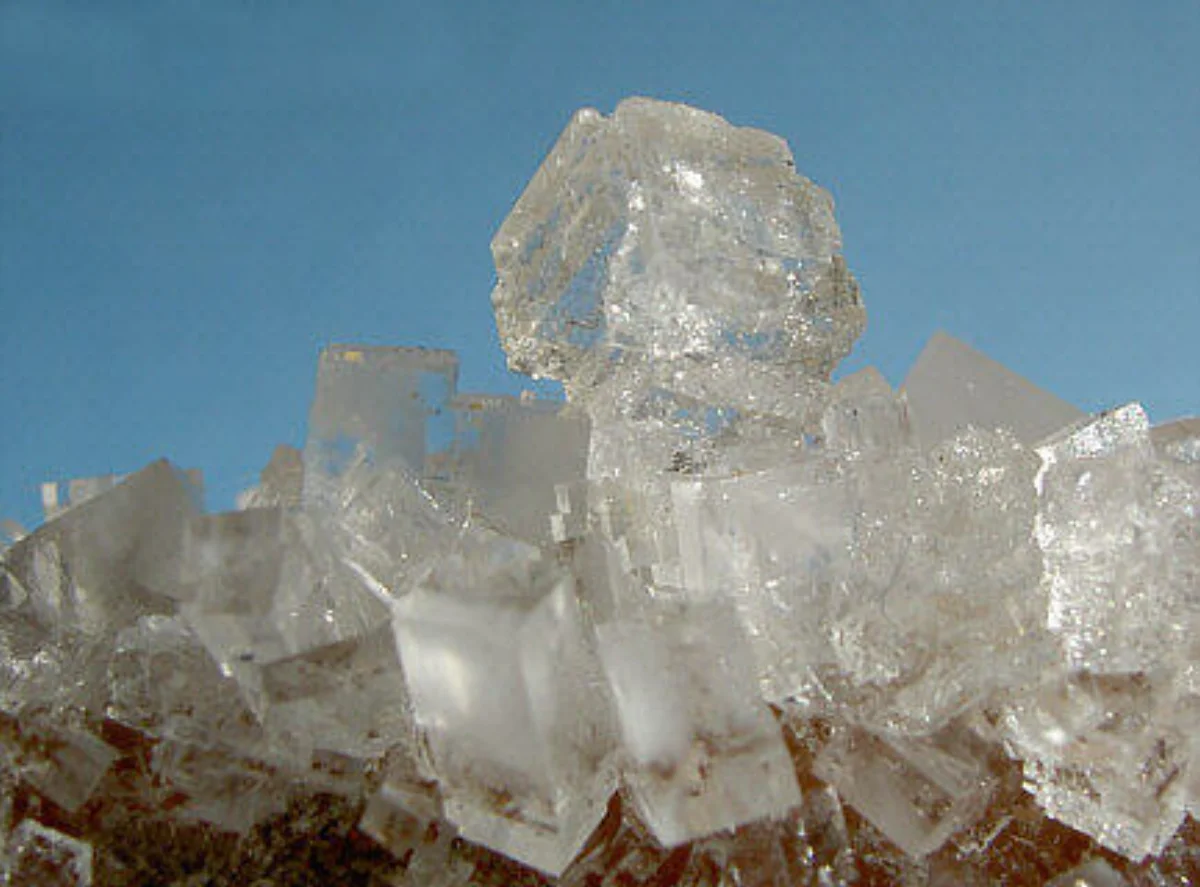
Ionic compounds do not exist as discrete molecules. Instead, every cation is surrounded by multiple anions, and every anion is surrounded by multiple cations, forming a three-dimensional repeating pattern called a crystal lattice.
Ionic to covalent is one axis, not two boxes
Scroll sideways to see the whole map.
Why the cut-offs are dashed1.7 is a convention, not a physical boundary, and different textbooks put it at 1.7 or 1.8. HF sits at 1.78 and is unmistakably a covalent molecular gas, which is exactly the point: nothing changes state at the line. Use the number to rank bonds, not to classify them absolutely.
What a dipole actually isA polar bond has a δ+ and a δ− end. A polar molecule needs those bond dipoles not to cancel: CO₂ has two strongly polar bonds and no net dipole because they point opposite ways, while water's two bonds are bent apart and add up.
Where the lattice comes fromIonic compounds are not molecules. Once electrons are transferred, every cation attracts every nearby anion, so the ions stack into a repeating lattice held by electrostatic attraction in all directions. That is why they are hard, brittle, high-melting, and conduct only once melted or dissolved.
Think of a checkerboard that extends in all three dimensions. Each red square is surrounded by black squares, and each black square is surrounded by red squares. There is no single “NaCl molecule” - just a vast, organized network of alternating Na+ and Cl- ions. This is why we write “NaCl” as a formula unit rather than a molecular formula.
Lattice Energy
Lattice energy is the energy released when gaseous ions come together to form one mole of a solid ionic compound. It can also be defined in the reverse direction - the energy required to completely separate one mole of a solid ionic compound into gaseous ions.
The magnitude of lattice energy depends on the same factors as Coulomb’s law:
- Charge magnitude: Higher charges mean stronger attraction and greater lattice energy. MgO (Mg2+ and O2-) has a much higher lattice energy than NaCl (Na+ and Cl-).
- Ionic radius: Smaller ions pack closer together, increasing attraction and lattice energy. LiF has a higher lattice energy than KBr because both Li+ and F- are smaller than K+ and Br-.
Properties of Ionic Compounds
The crystal lattice structure and strong electrostatic forces give ionic compounds a predictable set of physical properties:
High melting and boiling points. It takes enormous energy to disrupt the lattice. NaCl melts at 801 degrees C. MgO, with its +2/-2 charges, melts at 2,852 degrees C.
Brittle, not malleable. When a force shifts one layer of the lattice, like-charged ions suddenly face each other. The repulsion shatters the crystal. This is the opposite of metals, which can bend because their delocalized electrons act as a buffer.
Conduct electricity when dissolved or molten, but not as solids. In the solid state, ions are locked in place and cannot move. Dissolve the compound in water or melt it, and the ions become free to carry charge.
Soluble in polar solvents. Water molecules (which are polar) can surround and stabilize individual ions through ion-dipole interactions, pulling the lattice apart. Ionic compounds are generally insoluble in nonpolar solvents like hexane.
The Born-Haber Cycle
The individual steps in the Born-Haber cycle for NaCl are:
- Sublimation of solid Na to gaseous Na (endothermic)
- Ionization of gaseous Na to Na+ (endothermic - this is IE)
- Dissociation of Cl₂ into 2 Cl atoms (endothermic)
- Electron addition to gaseous Cl to form Cl- (exothermic - this is EA)
- Formation of the crystal lattice from gaseous ions (exothermic - this is lattice energy)
If a passage gives you four of these values plus the overall enthalpy of formation, you can solve for the fifth. No memorization needed - just apply Hess’s law.
Common MCAT Traps
Be careful with these frequently tested distinctions:
- Ionic compounds form formula units, not molecules. “NaCl molecule” is technically incorrect.
- Solid ionic compounds do NOT conduct electricity. They must be dissolved or molten for ions to move.
- Lattice energy increases with charge and decreases with ionic radius. Do not confuse this with bond energy, which applies to covalent bonds.
MgO has a much higher lattice energy. Mg2+ and O2- each carry charges of magnitude 2, while Na+ and Cl- each carry charges of magnitude 1. Since lattice energy is proportional to the product of the charges (q₁ x q₂), MgO’s lattice energy is roughly four times greater from charge alone. Additionally, Mg2+ and O2- are smaller ions than Na+ and Cl-, which further increases the lattice energy.
In the solid state, ions are locked into fixed positions in the crystal lattice and cannot move to carry charge. When the compound is melted, the lattice breaks apart, freeing the ions to move through the liquid. Mobile charge carriers are required for electrical conductivity, so only the molten (or dissolved) form conducts.
The lattice energy step (formation of the solid lattice from gaseous ions) releases the most energy. This large exothermic contribution is what makes the overall formation of the ionic compound energetically favorable, despite the endothermic costs of ionization and sublimation.