A carboxylic acid has the structural unit -COOH: a carbonyl group (C=O) and a hydroxyl group (-OH) attached to the same carbon. That one carbon carries two different oxygen-based groups, and the electronic interaction between them is what gives carboxylic acids their distinctive chemistry.
Hybridization and Geometry
The carboxylic acid carbon is sp² hybridized. Its three sp² orbitals form:
One sigma bond to the C=O oxygen.
One sigma bond to the O-H oxygen.
One sigma bond to the R group (an alkyl, aryl, or H).
The remaining p orbital forms the pi bond with the C=O oxygen, completing the C=O double bond.
Because of sp² geometry, the three sigma bonds lie in a plane at 120° angles. The two oxygens (and the R group) are all coplanar with the carbon.
Bond Lengths Reveal Resonance
The C-O bonds in neutral carboxylic acids are NOT identical:
C=O bond: about 1.21 Å (shorter, double bond).
C-OH bond: about 1.31 Å (longer, single bond).
For comparison, a typical C-O single bond in an alcohol is 1.43 Å - longer than the carboxylic acid’s C-OH. The carboxylic acid’s C-OH is shorter because partial double-bond character from resonance of the O-H lone pair into the C=O pi system pulls them closer.
In the conjugate base (carboxylate, RCOO⁻), the two C-O bonds become EQUIVALENT - both about 1.26 Å. This averaging comes from perfect resonance: both oxygens share the negative charge and bond order equally (each C-O is 1.5 in the hybrid).
The Two Oxygens Have Different Roles
In the neutral acid:
Carbonyl O (C=O): more electronegative partial charge concentration; accepts hydrogen bonds.
Hydroxyl O (O-H): donates the acidic proton AND can also accept hydrogen bonds via its remaining lone pair.
In the conjugate base (after deprotonation), both oxygens are equivalent and both carry partial negative charge.
Drawing Carboxylic Acids
Common representations:
Expanded: R-C(=O)-O-H or R-C(=O)-OH.
Condensed: R-COOH or R-CO₂H.
Skeletal: R with a triangle-wedge showing the carbonyl and a hydroxyl on the same carbon.
On the MCAT, recognize -COOH, -CO₂H, and the structural formula interchangeably. They all mean the same thing.
Contrast with Related Functional Groups
Aldehyde: -CHO. One C=O, one C-H. No OH. Not acidic at the O (no OH). Alpha-H is weakly acidic.
Ketone: R-CO-R’. One C=O, two C-R. No OH. Not acidic at O. Alpha-H is weakly acidic.
Ester: R-CO-OR’. One C=O, one C-OR’. No OH, no acid.
Amide: R-CO-NR’₂. One C=O, one C-NR’₂. No acidic H at the amide itself (N-H is only weakly acidic).
Carboxylic acid: R-CO-OH. One C=O, one C-OH. The OH is acidic (pKa ~4-5).
Only the carboxylic acid has the -OH directly attached to the acyl C=O, and that is what gives it its strong acidity compared to the others.
Why are the two C-O bond lengths different in a neutral carboxylic acid but identical in its conjugate base (carboxylate)?
Click to reveal answer
In the neutral acid, one bond is a true C=O double bond (shorter) and the other is a C-O single bond with partial double-bond character (longer). In the carboxylate anion, perfect resonance averages the two bonds - both oxygens share the negative charge equally, giving each C-O a bond order of 1.5 and identical bond length (~1.26 Å). This averaging is one of the clearest experimental signatures of resonance stabilization.
Carboxylic acids take priority over most other functional groups in IUPAC nomenclature. The -COOH carbon is almost always C1 of the parent chain, and the suffix is -oic acid (replacing the final “-e” of the parent alkane name).
IUPAC Rules
Find the longest carbon chain containing the COOH.
The COOH carbon is always C1 (since it is terminal and gets priority).
A handful of carboxylic acids have common names the MCAT uses regularly:
IUPAC
Common name
Structure
Methanoic acid
Formic acid
HCOOH
Ethanoic acid
Acetic acid
CH₃COOH
Propanoic acid
Propionic acid
CH₃CH₂COOH
Butanoic acid
Butyric acid
CH₃(CH₂)₂COOH (rancid butter smell)
Pentanoic acid
Valeric acid
CH₃(CH₂)₃COOH
Hexanoic acid
Caproic acid
CH₃(CH₂)₄COOH
Benzoic acid
Benzoic acid
C₆H₅COOH (retained in IUPAC)
Ethanedioic acid
Oxalic acid
HOOC-COOH
Propanedioic acid
Malonic acid
HOOC-CH₂-COOH
Butanedioic acid
Succinic acid
HOOC-(CH₂)₂-COOH
Pentanedioic acid
Glutaric acid
HOOC-(CH₂)₃-COOH
Hexanedioic acid
Adipic acid
HOOC-(CH₂)₄-COOH
Common names dominate for biologically important carboxylic acids: acetic acid (vinegar), lactic acid (milk), citric acid (citrus fruits), oxalic acid (spinach), succinic acid (Krebs cycle). Each has a biological story.
Dicarboxylic Acids
Dicarboxylic acids use the suffix -dioic acid with numbering giving the lowest locants to both COOH groups:
Fumaric acid and maleic acid are cis/trans isomers. Fumarate is a Krebs cycle intermediate; maleate is an industrial precursor. The two differ dramatically in physical properties (maleic acid has higher solubility and lower melting point due to weaker packing).
Carboxylic Acid vs Higher-Priority Groups
Carboxylic acids are highest priority in the standard IUPAC list (besides a few rare functional groups like sulfonic acids). Lower-priority groups become prefixes:
An alcohol + a carboxylic acid: the acid takes the -oic acid suffix; the alcohol becomes “hydroxy-”.
A ketone + a carboxylic acid: the acid takes the suffix; the ketone becomes “oxo-”.
Fatty acids (long-chain carboxylic acids) are named by chain length:
Capric acid = decanoic acid (C10).
Lauric acid = dodecanoic acid (C12).
Myristic acid = tetradecanoic acid (C14).
Palmitic acid = hexadecanoic acid (C16).
Stearic acid = octadecanoic acid (C18).
Oleic acid = (9Z)-octadec-9-enoic acid (C18, one cis double bond at 9).
Linoleic acid = (9Z,12Z)-octadeca-9,12-dienoic acid (C18, two cis double bonds).
The “C:n” shorthand (like C18:1 for oleic acid) specifies chain length:number of double bonds. This is the standard notation in lipid biochemistry.
What is the IUPAC name of 2-hydroxypropanoic acid (common name: lactic acid)? What is the role of each suffix/prefix?
Click to reveal answer
Structure: CH₃CH(OH)COOH. IUPAC: 2-hydroxypropanoic acid. "Propan-" = 3-carbon chain. "-oic acid" = carboxylic acid is the highest-priority group and gets the suffix. "2-hydroxy-" = the alcohol is a lower-priority group and becomes a prefix with locant 2 (the middle carbon). The carboxylic acid C is C1 automatically because it takes priority.
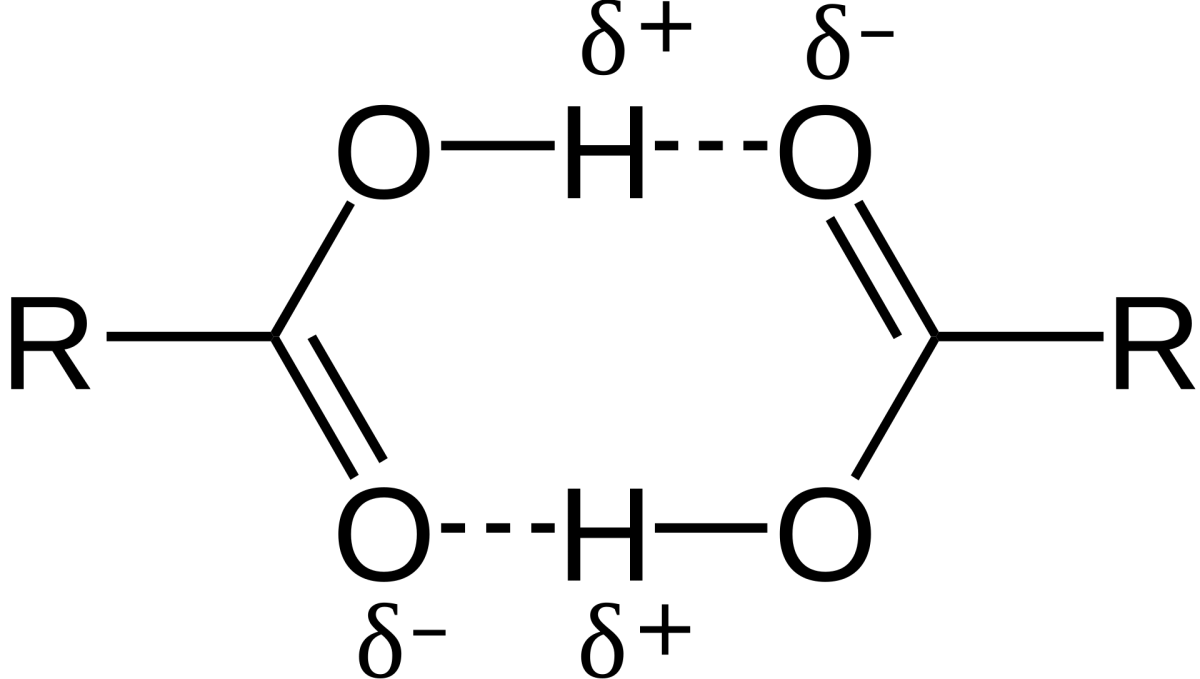
Carboxylic acids have anomalously high boiling points for their molecular weight. Acetic acid (MW 60) boils at 118°C - higher than 1-propanol (MW 60, 97°C) and much higher than propanal (MW 58, 48°C). The reason is a unique feature of carboxylic acids: they form hydrogen-bonded dimers in the liquid state.
Carboxylic acid dimer: two COOH groups form a planar cyclic dimer held by TWO hydrogen bonds. This effectively doubles the molecular weight of the diffusing unit, raising boiling points significantly. Credit: Wikimedia Commons, CC BY-SA
The Cyclic Dimer
Two carboxylic acid molecules face each other so that each one’s -COOH can hydrogen-bond to the other’s. The result is a planar, cyclic 8-membered ring with two simultaneous hydrogen bonds:
R-C(=O)-O-H · · · O=C-(O-H) · · · O=C-R
Each molecule donates one H (from its OH) to the other’s C=O, and accepts an H (on its C=O) from the other’s OH. Both donor-acceptor relationships happen simultaneously.
The cyclic dimer is stable enough to persist partially in the gas phase - acetic acid vapor contains significant amounts of dimer at moderate temperatures. In the solid and liquid phases, dimerization dominates.
Boiling Points Comparison
For C2 molecules:
Compound
MW
Boiling point
IMF
Ethane (CH₃CH₃)
30
-89°C
London
Ethanol (CH₃CH₂OH)
46
78°C
H-bond (monomer)
Acetic acid (CH₃COOH)
60
118°C
H-bond (dimer)
Even though acetic acid is larger than ethane and similar-sized to ethanol, its dimer makes it behave like a “C4 molecule” (MW 120) for boiling-point purposes.
Water Solubility
Short-chain carboxylic acids (C1-C4) are fully miscible with water in all proportions. They hydrogen-bond strongly with water on both the carbonyl oxygen (H-bond acceptor) and the -OH (both donor and acceptor).
Longer-chain carboxylic acids (C6 and up) become progressively less water-soluble as the hydrophobic chain grows. Fatty acids (C12-C24) are essentially insoluble in water but form micelles and bilayers in aqueous environments - the basis of soap and membrane chemistry.
Melting Points
Due to strong intermolecular H-bonding (even more extensive in solid dimers), carboxylic acids often have relatively high melting points compared to similar-sized alcohols or ketones:
Formic acid: 8°C.
Acetic acid: 17°C (hence “glacial” acetic acid, which becomes a crystalline solid below this temperature).
Benzoic acid: 122°C.
Stearic acid: 69°C.
Dicarboxylic Acids Have Even Higher Melting Points
Diacids like succinic acid (C4, 188°C) and malonic acid (C3, 136°C) have higher melting points than monoacids because they can form extensive hydrogen-bonded networks with multiple partners. The more -COOH groups per molecule, the more potential H-bonds, and the tighter the solid-state packing.
Solvation in Water
When a short-chain carboxylic acid dissolves in water, it:
Breaks the cyclic dimer structure.
Forms new H-bonds with water molecules.
Partially dissociates (pKa ~4-5) to the carboxylate anion.
At physiological pH (7), carboxylic acids are almost entirely deprotonated. Blood acetic acid is essentially all acetate at pH 7.4. Similarly, amino acid carboxyl groups, lactate, pyruvate, and Krebs cycle intermediates all exist as their carboxylate forms at physiological pH.
Why does acetic acid (MW 60) boil at 118°C, while 1-propanol (MW 60) boils at only 97°C? Both have hydrogen bonding.
Click to reveal answer
Acetic acid forms cyclic dimers in the liquid phase via TWO simultaneous hydrogen bonds between two molecules. This effectively doubles the molecular weight of the diffusing unit, requiring much more energy to vaporize. 1-Propanol forms single, extended H-bond chains (each molecule H-bonds to one or two neighbors), so its effective vaporization unit is closer to the single molecule. The dimer is a defining feature of carboxylic acid physical behavior.
Carboxylic acids are about a million times more acidic than alcohols. Acetic acid has pKa 4.76; ethanol has pKa 16. That difference is about 11 pKa units, equal to a factor of 10¹¹ in Ka. The single reason is that the carboxylate conjugate base is stabilized by resonance, while the alkoxide conjugate base is not.
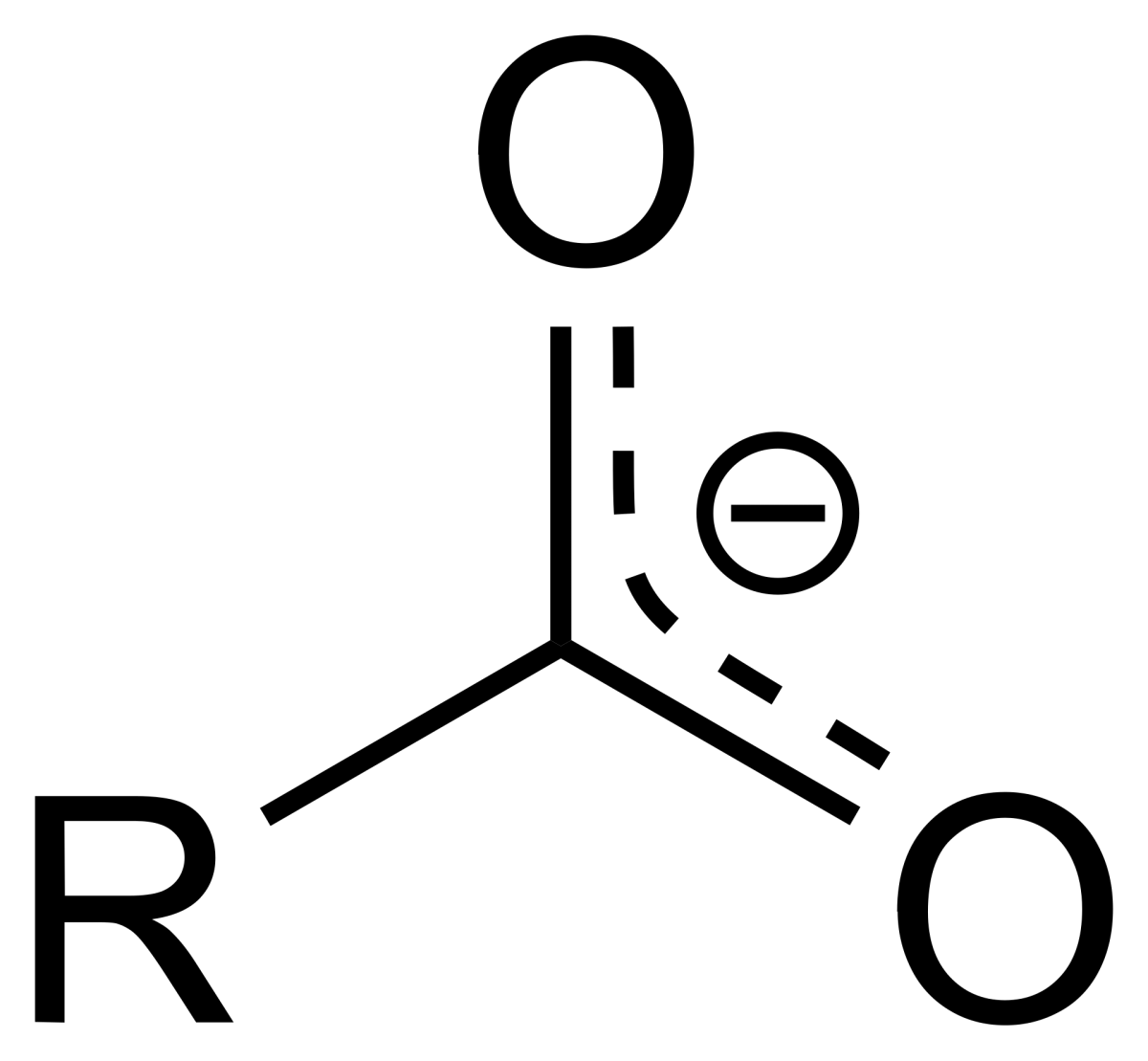
Carboxylate resonance: the negative charge is delocalized equally between the two oxygens via two equivalent resonance structures. In the true hybrid, each C-O bond has order 1.5 and each oxygen carries −½ formal charge. Credit: Wikimedia Commons, CC BY-SA
The Resonance Picture
When a carboxylic acid loses its proton (H⁺), the conjugate base has TWO equivalent resonance structures:
Structure 1:R-C(=O)-O⁻. Negative charge on the oxygen that used to have the H; C=O on the other oxygen.
Structure 2:R-C(-O⁻)=O. Negative charge on the oxygen that was C=O; the former C-OH becomes a double bond.
These two structures are equivalent (same energy, same connectivity), so the real carboxylate anion is a 50:50 hybrid. The negative charge is distributed equally between the two oxygens, and both C-O bonds are equivalent (bond order 1.5).
Why This Makes Carboxylic Acids Strong Acids
The alkoxide anion from an alcohol (RCH₂-O⁻) has the negative charge on ONE oxygen with no resonance partner. Its energy is higher than a resonance-delocalized anion.
The carboxylate anion (RCOO⁻) spreads the same negative charge over TWO equivalent oxygens. Charge delocalization always reduces energy. The more atoms sharing a charge, the more stable the anion.
Quantifying the effect: carboxylate’s resonance stabilization is about 30-40 kJ/mol, which corresponds to about 10¹¹ in Ka. The observed pKa difference (16 - 4.8 ≈ 11) matches perfectly.
Comparison with Phenols
Phenols (aromatic ring -OH) have pKa ~10. Their conjugate base (phenoxide) delocalizes charge into the aromatic ring (4 contributing structures, hitting C2, C4, and C6 positions). Phenol is about a million times more acidic than ethanol but a million times less acidic than a typical carboxylic acid.
Why the ranking carboxylic acid > phenol > alcohol?
Carboxylate: 2 equivalent atoms sharing charge; both are electronegative oxygens.
Phenoxide: 4 atoms sharing charge; but 3 of them are carbons (less electronegative than O); only 1 is oxygen. Net effect: less stabilization than carboxylate despite more resonance partners.
Alkoxide: 1 atom (oxygen); no resonance.
The quality of the atoms sharing the charge matters as much as the number of atoms.
pKa Values to Memorize
Substrate
pKa
Strong mineral acids (HCl, H₂SO₄)
< 0
Halo-carboxylic acids (e.g., chloroacetic)
2-3
Typical carboxylic acids
4-5
Aliphatic amino acid alpha-COOH
~2
Phenols (unsubstituted)
10
Ammonium (R-NH₃⁺)
9-10
Water
15.7
Alcohols
16-18
Terminal alkyne
25
Alpha-H of ester
25
Alpha-H of ketone
20
Alkane
~50
Anchor: carboxylic acid pKa ≈ 4-5 is a memorize-now number. It is the most common acid on the MCAT and a biological pKa benchmark.
Behavior at Physiological pH
At pH 7, a carboxylic acid with pKa 4 is about 3 pKa units above its pKa. From Henderson-Hasselbalch: 10^(7-4) = 1000-fold preference for the deprotonated form. So carboxylic acids at physiological pH are essentially 99.9% carboxylate.
This is critical in biochemistry. “Acetic acid” as metabolized by cells is really acetate; “fatty acid” in the bloodstream is fatty acid anion (bound to albumin); “lactic acid” produced in muscle is lactate. The dissociation is essentially complete under biological conditions.
Ethanol has pKa ~16; acetic acid has pKa ~5. Both have an O-H group. Explain the 11-pKa difference.
Click to reveal answer
The conjugate base of ethanol (ethoxide, CH₃CH₂O⁻) has the negative charge localized on one oxygen with no resonance delocalization. The conjugate base of acetic acid (acetate, CH₃COO⁻) has the negative charge delocalized equally over two equivalent oxygens via resonance - two equal resonance structures contribute to the hybrid. This charge delocalization stabilizes the anion by about 30 kJ/mol, which translates to an 11-pKa difference in acidity (a factor of 1011 in Ka). Same O-H bond, completely different conjugate base stability.
Electron-withdrawing substituents near the -COOH group stabilize the conjugate base by pulling electron density away through sigma bonds, lowering pKa. Electron-donating substituents do the opposite. This through-bond effect is called induction, and it explains the variation in pKa among substituted carboxylic acids.
The Chloroacetic Acid Series
A classic MCAT example - how each additional chlorine on acetic acid’s methyl group lowers the pKa:
Compound
Structure
pKa
Acetic acid
CH₃COOH
4.76
Chloroacetic acid
ClCH₂COOH
2.87
Dichloroacetic acid
Cl₂CHCOOH
1.29
Trichloroacetic acid
Cl₃CCOOH
0.65
Each additional chlorine lowers pKa, but not by a constant amount. The steps shrink as the chlorines accumulate: about 1.9 units for the first (4.76 to 2.87), about 1.6 for the second (2.87 to 1.29), only about 0.6 for the third (1.29 to 0.65). Each new chlorine is pulling on a carboxyl group the earlier ones have already drained, so the inductive effect attenuates. The cumulative result is still dramatic: three chlorines lower pKa from 4.76 to 0.65, making trichloroacetic acid comparable in strength to HCl in water.
Why? Each chlorine pulls electron density toward itself through the sigma C-Cl bond. This electron density comes partially from the adjacent carbon, which then pulls from its neighbor, and so on - a sigma-bond polarization chain. The net effect is to reduce electron density at the -COO⁻ oxygen in the conjugate base, stabilizing the negative charge.
Halogen Ranking for Inductive Effect
All halogens are electron-withdrawing, but not equally:
F is most electronegative (3.98) - strongest inductive pull.
Cl (3.16) - next strongest.
Br (2.96) - weaker.
I (2.66) - weakest pull via induction.
So fluoroacetic acid (pKa 2.59) is more acidic than chloroacetic (2.87), which is more acidic than bromoacetic (2.90) - tracking electronegativity. But fluoride is also a strong base (poor leaving group), while iodide is weak (good leaving group) - that difference comes from the C-X bond strength, not induction.
Distance Dependence
Inductive effects fall off sharply with distance. A chlorine on the alpha-carbon has a much bigger effect than a chlorine on the beta- or gamma-carbon:
Substrate
pKa
Relative effect
Butanoic acid
4.82
reference
2-chlorobutanoic acid (Cl on alpha)
2.86
strong effect
3-chlorobutanoic acid (Cl on beta)
4.05
moderate effect
4-chlorobutanoic acid (Cl on gamma)
4.52
small effect
Each carbon of distance reduces the inductive effect by roughly a factor of 3-5. By 5 carbons away, the effect is negligible.
Electron-Donating Groups Raise pKa
Alkyl groups are weakly electron-donating (relative to H) and slightly raise pKa:
Acetic acid (CH₃COOH): pKa 4.76 (methyl is weakly donating).
Propanoic acid (CH₃CH₂COOH): pKa 4.88.
Butanoic acid: pKa 4.82.
The effect is small (0.1-0.5 pKa units) because alkyl groups donate weakly. Larger alkyl groups do not progressively raise pKa much beyond methyl.
Electron-donating groups with lone pairs that can donate into the COOH (like amines, methoxy via resonance) raise pKa more dramatically. An amino acid’s alpha-carboxylic acid is often around pKa 2 (lower than acetic) because of the nearby -NH₃⁺, which is inductively electron-withdrawing.
Ortho, Meta, Para Effects on Benzoic Acid
For substituted benzoic acids, the position of the substituent matters:
Benzoic acid substituent
pKa
Unsubstituted
4.19
p-methylbenzoic
4.36 (weak donor)
p-chlorobenzoic
3.98 (withdrawer)
p-nitrobenzoic
3.42 (strong withdrawer)
m-nitrobenzoic
3.49
o-nitrobenzoic
2.17 (also ortho effect beyond induction)
Ortho effects can be large because of direct proximity; meta effects are purely inductive; para effects combine induction + resonance.
Trichloroacetic acid (pKa 0.65) > 2-bromoacetic acid (pKa 2.9) > formic acid (pKa 3.75) > acetic acid (pKa 4.76) ≈ butanoic acid (pKa 4.82). Three electron-withdrawing chlorines dominate. One bromine still gives a big effect but less than three chlorines. Formic acid has no alkyl donor (just H), so it is slightly more acidic than acetic (one methyl donor) or butanoic (longer alkyl donor). Adding alkyl carbons beyond methyl has only minor effect.
A dicarboxylic acid has two -COOH groups. Each can ionize separately, giving two distinct pKa values: pKa1 (first ionization) and pKa2 (second ionization). Critically, pKa1 < pKa2 because once the first carboxylate forms, its negative charge destabilizes removal of the second proton.
The pKa Splitting Pattern
Diacid
pKa1
pKa2
Gap
Oxalic (HOOC-COOH)
1.25
3.81
2.56
Malonic (HOOC-CH₂-COOH)
2.85
5.70
2.85
Succinic (HOOC-(CH₂)₂-COOH)
4.21
5.64
1.43
Glutaric (HOOC-(CH₂)₃-COOH)
4.34
5.27
0.93
Adipic (HOOC-(CH₂)₄-COOH)
4.43
5.41
0.98
Fumaric (trans-HOOC-CH=CH-COOH)
3.03
4.44
1.41
Maleic (cis-HOOC-CH=CH-COOH)
1.83
6.07
4.24
Note two patterns:
pKa1 < pKa2 always. The first deprotonation is easier than the second because the second one is disfavored by the electrostatic cost of creating a second anion near the first.
Shorter diacids have more separation between pKa1 and pKa2. Oxalic (2 C between COOHs: 1 bond, so ~3 Å) has pKa2 - pKa1 ≈ 2.5. Adipic (4 C between) has the two pKas much closer together (~1 unit separation).
The shorter the chain between the two COOH groups, the stronger the electrostatic interaction between them, and the greater the pKa splitting.
Maleic Acid: The Extreme Case
Maleic acid has cis-C=C between two COOH groups. The two carboxylic acid groups are held close in space (~3 Å), and after pKa1 (1.83, very acidic), the resulting monoanion forms an intramolecular hydrogen bond with the remaining COOH. This stabilizes the monoanion, making pKa1 very low. But the hydrogen bond also stabilizes the monoanion enough that removing the second H is very hard - pKa2 is 6.07, much higher than typical.
Result: maleic acid has pKa1 = 1.83 and pKa2 = 6.07 - a huge 4-unit gap. Fumaric (trans) does not have the intramolecular H-bond (the two COOHs are on opposite sides), so its gap is much smaller.
Oxalic Acid: The Most Acidic Simple Diacid
Oxalic acid (pKa1 = 1.25) is one of the strongest common carboxylic acids because the adjacent COOH strongly withdraws electrons from the ionizing COOH. Each COOH’s carboxylate would destabilize the adjacent carboxylate, but the first ionization is significantly accelerated by the inductive effect of the unionized second COOH.
Oxalic acid is toxic in high doses because its calcium salt (calcium oxalate) forms kidney stones. Rhubarb leaves and spinach contain enough oxalic acid to be moderately toxic in large quantities.
Biological Dicarboxylic Acids
The Krebs cycle (TCA cycle) is full of dicarboxylic acids:
Oxaloacetate (OAA): HOOC-CO-CH₂-COOH. A 4-carbon diacid with a ketone. Starting material of the cycle.
Malate: HOOC-CHOH-CH₂-COOH. 4-carbon diacid with a hydroxyl.
Fumarate: trans-HOOC-CH=CH-COOH. 4-carbon diacid with a double bond.
Succinate: HOOC-(CH₂)₂-COOH. 4-carbon diacid (no extras).
All of these are fully ionized at pH 7 (both COOHs deprotonated). Their pKa values (around 3-5 for the first, 4-6 for the second) are well below physiological pH.
Amino Acids: Another pKa Splitting Story
Amino acids have both a -COOH (pKa ~2) and a -NH₃⁺ (pKa ~9). At pH 7, the COOH is deprotonated (5 units above its pKa → 99.999% deprotonated) and the NH₃⁺ is still protonated (2 units below its pKa → 99% protonated). The result is the zwitterion: +H₃N-CHR-COO⁻.
The isoelectric point (pI) of a simple amino acid is (pKa1 + pKa2)/2. For glycine: (2.35 + 9.78)/2 = 6.06. This calculation is covered in more detail in the Biochemistry book on amino acids.
Explain why maleic acid (cis-2-butenedioic acid) has pKa1 = 1.83 but pKa2 = 6.07 - a gap of over 4 units, which is much larger than similar acids.
Click to reveal answer
The cis-C=C between the two COOH groups holds them close in space. After pKa1, the resulting monoanion is stabilized by a strong intramolecular hydrogen bond between the remaining COOH's OH and the carboxylate O⁻. This H-bond makes pKa1 lower (more acidic than expected) AND makes pKa2 higher (the H-bond holds the second H onto the ring, making it harder to remove). Fumaric acid (trans) cannot form this intramolecular H-bond, so its pKa1-pKa2 gap is only 1.4 units.
Carboxylic acids can be reduced to primary alcohols, but only with LiAlH₄ (lithium aluminum hydride). NaBH₄ is not strong enough, and catalytic hydrogenation (H₂/Pd) does not touch the COOH group. The net transformation:
R-COOH → R-CH₂OH (primary alcohol).
This reduction takes a carbon from oxidation state +3 (carboxylic acid) to oxidation state −1 (primary alcohol), a 4-electron reduction.
Why LiAlH₄ Works and NaBH₄ Does Not
NaBH₄ is mild enough to reduce only highly electrophilic carbonyls (aldehydes, ketones). Carboxylic acids have a problem: their acidic -OH proton (pKa 4-5) would deprotonate the borohydride or react with any basic reducing agent, effectively neutralizing it. More importantly, the neutral COOH is less electrophilic than an aldehyde or ketone because one of the oxygens has a lone pair that can donate into the carbonyl.
LiAlH₄ is strong enough to overcome both issues:
LiAlH₄ first acts as a strong base to deprotonate the -COOH, converting it to the lithium carboxylate R-COO⁻ Li⁺ (with H₂ gas released).
Then LiAlH₄ attacks the carboxylate’s carbonyl carbon, reducing it via multiple hydride transfers, through aldehyde-like intermediates, down to the primary alcohol alkoxide.
Aqueous workup protonates the alkoxide to give the alcohol.
Net stoichiometry: one COOH needs two to four equivalents of hydride (depending on mechanism specifics) plus a proton from workup.
AlH₂ + R-CHO → R-CH₂OAlH (hydride addition to the aldehyde intermediate).
Aqueous workup → R-CH₂OH.
The aldehyde intermediate is not isolated because LiAlH₄ is aggressive enough to reduce it faster than it can be isolated.
LiAlH₄ Reduces Many Functional Groups
The strong reducing power of LiAlH₄ is not selective:
Carboxylic acids → primary alcohols.
Esters → primary alcohols (+ alcohol byproduct from the OR group).
Amides → amines.
Nitriles → primary amines.
Ketones → secondary alcohols.
Aldehydes → primary alcohols.
Epoxides → alcohols.
If a substrate has multiple reducible groups, LiAlH₄ reduces all of them. To reduce only a ketone selectively (not a carboxylic acid or ester), use NaBH₄ instead.
DIBAL-H: Stopping at the Aldehyde
DIBAL-H (diisobutylaluminum hydride, iBu₂AlH) is a “single-hydride” reducing agent. At low temperature (-78°C) and with carefully controlled stoichiometry (one equivalent), DIBAL-H can reduce an ester to an aldehyde (stopping at the aldehyde stage) because only one hydride is delivered before the intermediate escapes the Al coordination sphere.
The analogous reaction on carboxylic acids (1 equiv DIBAL-H) gives the aldehyde as well, but this requires precise conditions and is rarely a clean MCAT question.
Borane (BH₃) or B₂H₆: An Alternative
Borane (BH₃) in THF reduces carboxylic acids (but not esters, amides, or nitriles, selectively) to primary alcohols. Unlike LiAlH₄, borane is SELECTIVE for carboxylic acids over esters, making it useful when both are present.
So if you need to reduce ONLY a carboxylic acid in a molecule that also has an ester, use BH₃/THF (or BH₃·Me₂S). NaBH₄ would not touch either. LiAlH₄ would reduce both.
Biological Reduction
Cells do not reduce carboxylic acids back to alcohols directly. The typical metabolic sequence reverses the oxidation pathway: acetate is activated as acetyl-CoA (a thioester) before any reduction. The thioester is a much better electrophile than the free carboxylic acid, and enzyme systems (like fatty acid synthase) use NADPH to reduce it in steps.
The lab LiAlH₄ reduction skips this activation by using an aggressive reagent. The biological equivalent takes more steps but uses less energy per step.
Which reagent will convert butanoic acid (CH₃(CH₂)₂COOH) to 1-butanol (CH₃(CH₂)₂CH₂OH)? What product(s) might the wrong reagent give?
Click to reveal answer
Use LiAlH₄ in dry THF/ether, then aqueous workup, to reduce butanoic acid to 1-butanol. NaBH₄ would NOT work - it is too mild to reduce carboxylic acids (no reaction). H₂/Pd catalytic hydrogenation also does not touch the COOH. BH₃/THF would also work and is more selective if other reducible groups are present.
The Fischer esterification is the classic route from carboxylic acid to ester:
R-COOH + R’-OH ⇌ R-COO-R’ + H₂O (with acid catalyst, typically H₂SO₄ or HCl)
The reaction is reversible, and the equilibrium constant is close to 1 for most substrates. To push it forward (toward ester), you either use excess alcohol (flood the reactant side) or remove water as it forms (distill it out, or use molecular sieves or a Dean-Stark trap).
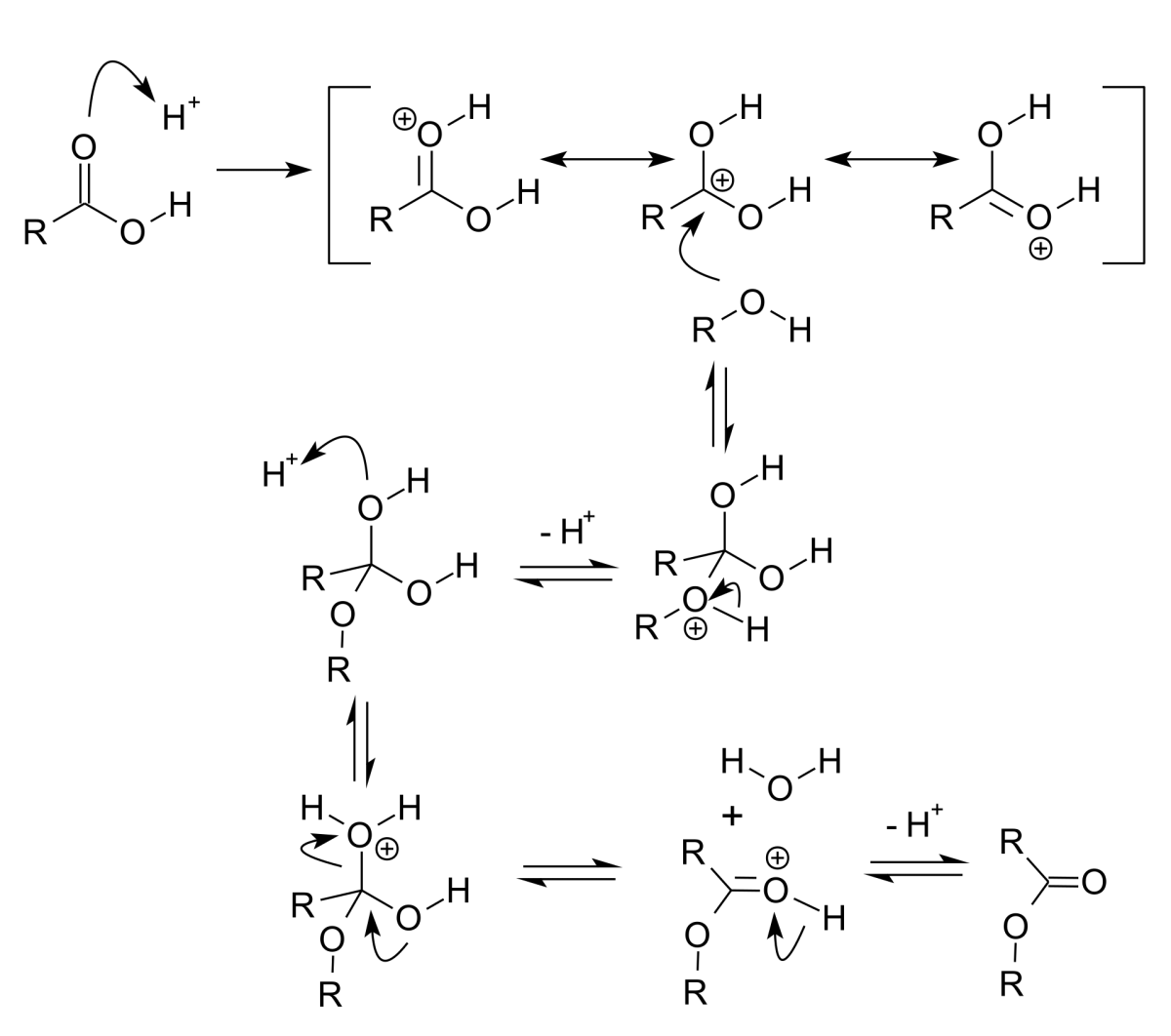
Fischer esterification mechanism: acid catalyst protonates the carbonyl oxygen, alcohol attacks, a proton shuffle exchanges groups, and water is lost to reveal the ester. The reverse direction is ester hydrolysis under acidic conditions. Credit: Wikimedia Commons, CC BY-SA
The Mechanism (PADPED)
The mnemonic for the six steps: PADPED = Protonate, Attack, Deprotonate, Protonate, Eliminate, Deprotonate.
Protonate the carbonyl oxygen. Acid (H⁺) adds to the C=O oxygen, activating the carbon as a strong electrophile.
Alcohol attacks the carbonyl carbon. The alcohol’s lone pair attacks the activated carbonyl C, forming a tetrahedral intermediate with protonated oxonium on the new O-R’.
Deprotonate the alcohol-derived OH. A water molecule (or the conjugate base of the catalyst) removes the proton from the O-R’ group, giving a neutral tetrahedral intermediate.
Protonate the original -OH. The acid catalyst protonates the original OH that came from the carboxylic acid, turning it into a good leaving group (H₂O).
Eliminate water. The C-OH(H)⁺ bond breaks, water leaves, and the pi bond reforms (this time going to form the C=O of the ester).
Deprotonate. Water removes the proton from the new C=O⁺ to give the neutral ester.
Net result: R-COOH + R’-OH → R-COO-R’ + H₂O.
Note that TWO protonations and TWO deprotonations happen (not counting the catalyst turnover). The acid catalyst is regenerated at the end.
Why It Is Called “Fischer”
Named after Emil Fischer (19th century), who studied the synthesis of esters systematically. Today, Fischer esterification is the standard name for acid-catalyzed carboxylic acid + alcohol → ester conversion.
Driving the Equilibrium Forward
The equilibrium constant Keq for Fischer esterification is often near 1. To get high ester yields, chemists use:
Excess alcohol. Flooding the reaction with alcohol pushes equilibrium to the ester side (Le Chatelier). Typical conditions: 5-10 equivalents of alcohol.
Dean-Stark trap. A device that continuously removes water as it forms (by azeotropic distillation). Keeps the water out of the reaction mixture.
Molecular sieves. Crystalline aluminosilicates that selectively absorb water. Add them to the reaction mixture to keep water concentration low.
Use a volatile alcohol and distill off water + alcohol azeotrope to enhance removal.
Without one of these techniques, the ester yield is limited to ~65% before equilibrium is reached.
Reverse Reaction: Ester Hydrolysis
Under acidic conditions with excess water, the same mechanism runs in reverse: ester + water → carboxylic acid + alcohol. This is called acid-catalyzed ester hydrolysis.
Under basic conditions, ester hydrolysis runs through a slightly different mechanism and is called saponification - the carboxylate product is stable and cannot re-attack, so the reaction goes to completion (irreversible). Saponification is covered in Chapter 9 under esters.
When Fischer Is Not the Best Choice
For certain esters, Fischer esterification does not work well:
Tertiary alcohols often undergo E1 elimination under the acidic conditions instead of SN1 ester formation. Use a different route (e.g., acid chloride + alcohol).
Sterically hindered carboxylic acids (like pivalic acid, (CH₃)₃CCOOH) are slow to esterify. Same alternative applies.
Phenols do not esterify cleanly via Fischer; the aromatic ring is a poor nucleophile and the OH is less basic than aliphatic alcohols. Use an acid chloride + pyridine instead.
For these difficult cases, the standard workaround is: convert the carboxylic acid to its acid chloride (with SOCl₂), then react with the alcohol (plus pyridine to mop up HCl). This goes to completion quickly.
Biological Esters
Biology uses esters everywhere:
Triglycerides (fats and oils): glycerol + 3 fatty acids via 3 ester bonds.
Cocaine, aspirin, benzocaine: all pharmaceutical esters.
Enzymes (esterases) hydrolyze these esters using a similar mechanism to acid hydrolysis - with a catalytic acid group in the active site replacing the Brønsted acid catalyst.
A chemist combines acetic acid and ethanol with catalytic H₂SO₄, but gets only 66% ester after 24 hours. Suggest two modifications to increase the yield.
Click to reveal answer
(1) Use excess ethanol (5-10 equivalents relative to acetic acid) to push the equilibrium forward by Le Chatelier. (2) Remove water as it forms using a Dean-Stark trap or molecular sieves, which prevents the reverse hydrolysis and pulls the equilibrium further toward the ester. Either modification alone typically improves the yield to 85-95%; using both together can push the yield above 95%.
A carboxylic acid is a poor electrophile compared to its derivatives. To make it useful for nucleophilic acyl substitution reactions, we often convert it into a more reactive derivative: an acyl halide (most reactive), an anhydride (next), or an activated ester. Each conversion uses a specific reagent. The full reactivity ladder and nucleophilic acyl substitution mechanism are detailed in Chapter 9.
Acid Chloride Formation (Most Important)
The workhorse reagent is thionyl chloride (SOCl₂). It converts RCOOH to RCOCl in one step:
R-COOH + SOCl₂ → R-COCl + SO₂↑ + HCl↑
Both byproducts (SO₂ and HCl) are gases that escape the reaction, driving the equilibrium forward. The product acid chloride is much more reactive than the starting acid and ready for use in subsequent reactions.
Oxalyl chloride ((COCl)₂) is another useful variant for milder conditions.
Why Acid Chlorides Are So Reactive
Once you have R-COCl, the chloride is an excellent leaving group. Any nucleophile (water, alcohol, amine) will react with it rapidly. Acid chlorides are the “hot reagent” for installing carbonyl derivatives onto any nucleophile.
Practical uses:
R-COCl + R’-OH → R-COOR’ + HCl (ester). Done in pyridine to neutralize HCl.
R-COCl + R’-NH₂ → R-CONHR’ + HCl (amide). Usually with pyridine or tertiary amine base.
R-COCl + R’COO⁻ → R-CO-O-CO-R’ + Cl⁻ (anhydride).
R-COCl + H₂O → R-COOH + HCl (hydrolysis back to the acid; rarely intentional).
Anhydride Formation
An anhydride has the structure R-CO-O-CO-R’. It can be symmetric (both R groups the same) or mixed (different R groups on each side).
Ways to form anhydrides:
Heat the carboxylic acid. For simple acids (acetic → acetic anhydride), this is inefficient. For cyclic anhydrides (succinic anhydride from succinic acid), intramolecular condensation gives a 5- or 6-membered ring anhydride cleanly on heating.
Specialized coupling reagents (DCC - see below) can form anhydrides as intermediates on the way to other products.
Amide Formation from Carboxylic Acids
Converting RCOOH + R’NH₂ → RCONR’H + H₂O requires activation because amines are not nucleophilic enough to displace OH⁻ (which is a poor leaving group) from the carboxylic acid carbonyl. Common solutions:
Route via acid chloride. R-COOH + SOCl₂ → R-COCl. Then R-COCl + R’-NH₂ + pyridine → R-CONR’H + pyridinium chloride. Two-step but clean.
Route via DCC coupling. Use DCC (dicyclohexylcarbodiimide) to activate the -COOH. The DCC reacts with the acid to form an O-acylisourea, which is a very electrophilic intermediate. An amine attacks this O-acylisourea to give the amide + DCU (dicyclohexylurea) byproduct.
Mixed anhydride method. Treat RCOOH with ethyl chloroformate and triethylamine to form a mixed anhydride. The amine then attacks the mixed anhydride at the “desired” carbonyl to give the amide.
Direct thermal amide formation. Heat the carboxylic acid with amine at high temperature. Works but slow and often needs a removable water trap.
DCC coupling is the standard method in peptide synthesis because it works under mild conditions and does not racemize chiral alpha-centers. Related reagents (EDC, HATU, PyBOP) are used in more demanding substrates.
Relative Reactivity Ladder (Preview of Ch 9)
Once you have various carboxylic acid derivatives, the order of reactivity in nucleophilic acyl substitution is:
The better the leaving group, the faster the derivative reacts. Chloride is a great leaving group; amide nitrogen is terrible (strong base). You can go “down” the ladder easily (acid chloride → anhydride → ester → amide), but going “up” requires activation.
Biological Parallel: Acyl-CoA
Cells activate carboxylic acids by converting them to thioesters (RCO-S-CoA) rather than acid chlorides. Acetyl-CoA (CH₃CO-S-CoA) is the biological equivalent of an acid chloride: a reactive carbonyl derivative ready to transfer the acetyl group to amines, alcohols, or other nucleophiles. Coenzyme A’s thiol (-SH) is a soft nucleophile, and its thioester linkage is about 107 more reactive than a regular ester but less reactive than an acid chloride.
The enzyme acetyl-CoA synthetase activates acetate using ATP (acetate + ATP → acetyl-AMP → acetyl-CoA + AMP + PPi), exchanging the phosphate anhydride bond for a thioester. This is biology’s cleaner, energy-neutral version of SOCl₂ activation.
A chemist wants to convert acetic acid (CH₃COOH) to methyl acetate (CH₃COOCH₃). Describe a route via an acid chloride intermediate, and compare it to Fischer esterification.
Click to reveal answer
Two-step route: (1) CH₃COOH + SOCl₂ → CH₃COCl + SO₂ + HCl. (2) CH₃COCl + CH₃OH (with pyridine as base) → CH₃COOCH₃ + pyridinium chloride. This route is fast, essentially irreversible, and works at room temperature. Compare Fischer esterification: CH₃COOH + CH₃OH + H₂SO₄ cat. → CH₃COOCH₃ + H₂O. Fischer is reversible and requires water removal or excess alcohol. The acid chloride route is cleaner but requires two steps and harsher reagents; Fischer is simpler but lower-yielding without driving the equilibrium.
Nucleophilic acyl substitution (NAS) is the fundamental mechanism for all carboxylic acid derivatives. It has two phases: (1) addition of a nucleophile to the carbonyl C, then (2) elimination of a leaving group to restore the carbonyl. The net result is that one group on the acyl carbon has been replaced by another - substitution at the carbonyl.
This mechanism is the key distinction between carboxylic acids/derivatives and aldehydes/ketones. Aldehydes and ketones CANNOT do NAS because they have no leaving group attached to the carbonyl carbon (just H or R). Carboxylic acids and their derivatives all have a leaving group (OH, Cl, OR, NR₂) that can be kicked out.
The Two-Phase Mechanism
Phase 1: Addition. Exactly like the aldehyde/ketone addition mechanism of Chapter 6:
Nucleophile attacks the carbonyl C.
Pi bond breaks, electrons flow to oxygen.
Result: a tetrahedral alkoxide intermediate.
Phase 2: Elimination. Different from aldehyde/ketone chemistry:
The alkoxide oxygen reforms the C=O double bond.
Electrons flow back to kick out whatever leaving group is attached to the carbon (Cl, OR, OH, NR₂).
Result: the original carbonyl is restored, but now with a new substituent in place of the leaving group.
Net: R-CO-LG + Nu⁻ → R-CO-Nu + LG⁻. Substitution of Nu for LG at the acyl carbon.
Why Aldehydes and Ketones Don’t Do NAS
In an aldehyde (R-CHO), the groups on the carbonyl are R and H. Neither is a leaving group (H⁻ is an incredibly strong base; R⁻ is too). After nucleophilic addition, the tetrahedral intermediate can only protonate the alkoxide - it cannot eliminate H or R. So the reaction is stuck at the tetrahedral alcohol stage (the addition product), and NAS does not happen.
Carboxylic acid derivatives, on the other hand, always have at least one good leaving group (Cl, OR, OCOR’, OH after protonation, NR₂ as a poor LG). The tetrahedral intermediate collapses by kicking out the LG, restoring the C=O and giving the substitution product.
Wait - “aldehyde > ester”? Yes, aldehydes are more electrophilic than esters (because ester’s OR donates by resonance, reducing electrophilicity). But aldehydes cannot DO NAS (no leaving group), so they only react via addition.
For the actual NAS mechanism (which requires a leaving group), the order is:
acyl halide > anhydride > ester > amide
With carboxylic acid sitting roughly between ester and anhydride in reactivity - it can be protonated to activate further, but OH⁻ is a poor LG.
Why Chloride Is a Great Leaving Group in NAS
In the tetrahedral intermediate after nucleophile attack, the leaving group has to depart with the bond electrons. Chloride is a weak base (stable as Cl⁻), so it leaves easily. OR⁻ (alkoxide) is a strong base (~pKa 16 for its conjugate acid), so it leaves much more reluctantly - that is why esters react more slowly than acid chlorides.
Acid vs. Base Catalysis
NAS can work under acidic or basic conditions, with slightly different mechanisms:
Base-catalyzed NAS: The nucleophile is already anionic (hydroxide, alkoxide, amide). No acid catalysis needed. Mechanism: attack → tetrahedral intermediate → LG leaves → restore C=O.
Acid-catalyzed NAS: Neutral nucleophile (water, alcohol, amine). Acid protonates the carbonyl oxygen first, activating it. Then the neutral nucleophile attacks; a proton shuffle converts the alcohol-like OH to a better leaving group; that LG leaves with acid assistance. This is the Fischer esterification pattern from Section 8.8.
Tetrahedral Intermediate Stability
In many NAS reactions, the tetrahedral intermediate can be detected or even isolated. Its stability determines whether the reaction proceeds cleanly:
Stable intermediate → reaction works well.
Unstable intermediate → reaction collapses back to starting material, giving low yield.
Temperature, base strength, and substrate steric/electronic properties all influence this balance.
Amide hydrolysis: R-CO-NR’₂ + H₂O → R-COOH + HNR’₂. Slow under mild conditions; requires strong acid or base.
Acid chloride + nucleophile: R-COCl + Nu → R-CO-Nu + Cl⁻. Very fast with any nucleophile.
Why is a ketone NOT a substrate for nucleophilic acyl substitution, even though it has an electrophilic carbonyl carbon that can be attacked by a nucleophile?
Click to reveal answer
A ketone's carbonyl carbon has two R (alkyl) substituents. Neither R nor H is a leaving group (R⁻ and H⁻ are extremely strong bases that cannot leave). After a nucleophile attacks, the tetrahedral intermediate cannot eliminate anything - it just protonates to give the tetrahedral alcohol (nucleophilic ADDITION product, not substitution). Carboxylic acid derivatives have Cl, OR, NR₂, or OCOR' attached, all of which CAN leave, allowing the carbonyl to reform with a new nucleophile - substitution.
Decarboxylation is the loss of CO₂ from a carboxylic acid. It is generally not favorable for simple carboxylic acids (they just sit stable), but it occurs readily for beta-keto acids and beta-dicarboxylic acids via a 6-membered cyclic transition state. Decarboxylation is the central mechanism of the acetoacetic and malonic ester syntheses (Chapter 7) and the oxidative decarboxylations in glycolysis and the Krebs cycle.
Beta-Keto Acids Decarboxylate Easily
A beta-keto acid has a ketone two carbons away from the carboxylic acid, giving the pattern:
R-CO-CH₂-COOH (alpha-C between the ketone and the COOH)
When heated, beta-keto acids lose CO₂ via a concerted mechanism through a 6-membered cyclic transition state:
The acidic H of the COOH is transferred to the ketone oxygen (not the alpha-C).
Simultaneously, the C-COOH bond breaks.
CO₂ leaves.
The result is an enol, which rapidly tautomerizes to the ketone (the final product).
The 6-membered cyclic TS involves atoms: COOH’s O-H, its C=O, the alpha-C, the ketone’s C=O, and the ketone’s O. A geometrically convenient 6-membered ring.
Malonic Acid Also Decarboxylates
Malonic acid and malonic acid derivatives (like malonate esters) decarboxylate similarly. The mechanism goes through the same 6-membered cyclic TS, just using the second COOH as the proton acceptor.
Note: dicarboxylic acids with the two COOHs farther apart (like succinic acid, 4-carbon diacid) do NOT decarboxylate readily because the 6-membered cyclic TS is not possible.
Summary: Which Acids Decarboxylate?
Rule: decarboxylation is favorable whenever a 6-membered cyclic transition state can form for concerted CO₂ loss. This requires:
An acidic H on the COOH (present on all carboxylic acids).
A nearby carbonyl (ketone or second carboxylate) positioned to accept the H.
The position of the second carbonyl must be at the BETA carbon (two bonds away from the COOH carbon).
All of these are beta-decarboxylations (or equivalent) with cofactor-assisted 6-membered TS chemistry.
Predict whether each acid will decarboxylate readily on heating: (a) acetic acid, (b) acetoacetic acid (beta-keto acid), (c) malonic acid (1,3-diacid), (d) succinic acid (1,4-diacid).
Click to reveal answer
(a) Acetic acid: NO. No nearby carbonyl to accept the proton; no 6-ring TS possible. (b) Acetoacetic acid: YES. Beta-keto acid - the carbonyl is perfectly positioned for a 6-membered TS. (c) Malonic acid: YES. 1,3-diacid - the second carboxylate can accept the proton in a 6-ring TS. (d) Succinic acid: NO. 1,4-diacid - the COOHs are too far apart for a 6-membered TS. Succinic acid is a stable Krebs intermediate, not a decarboxylation substrate.
Carboxylic acids are ubiquitous in biology. Nearly every metabolic pathway involves carboxylate-bearing intermediates, and many of the molecules you recognize from biochemistry (amino acids, fatty acids, Krebs cycle intermediates) are really just carboxylic acids with specific substitutions.
Fatty Acids
A fatty acid is a long-chain carboxylic acid. Typical structures: CH₃-(CH₂)_n-COOH, where n is 12, 14, 16, 18, or higher. They are the building blocks of triglycerides (fats and oils) and phospholipids (membrane components).
Saturated fatty acids (no double bonds) pack tightly and are solid at room temperature (e.g., stearic acid, palmitic acid). Unsaturated fatty acids (cis double bonds) have kinks that prevent tight packing, so they are liquid at room temperature (oleic acid, linoleic acid in olive oil).
At physiological pH, fatty acids exist as fatty acid anions (pKa of COOH ~4-5; pH 7 gives 99.9% deprotonated). In cell membranes, fatty acid tails are esterified into triglycerides or phospholipids, and the COOH is no longer free.
Soap and Micelles
Soap is a salt of a fatty acid (typically a sodium or potassium salt of C12-C18 fatty acids). The molecule has:
A polar “head” (the COO⁻ Na⁺).
A long hydrophobic “tail” (the alkyl chain).
In water, soap molecules aggregate into micelles: spherical clusters with the hydrophobic tails pointing inward and the polar heads pointing outward into water. Micelles can solubilize oils and grease by trapping them in the hydrophobic interior.
This amphipathic behavior - one polar head + one hydrophobic tail - is the foundation of biological membranes. Phospholipid bilayers in cell membranes are a more elaborate version of the same chemistry, with a polar phosphate head group and two fatty acid tails.
Amino Acids as Dicarboxylic-Like Systems
An amino acid has both a COOH (pKa ~2) and an NH₃⁺ (pKa ~9). At physiological pH, the COOH is fully deprotonated (to COO⁻) and the NH₃⁺ is fully protonated, giving the zwitterion:
⁺H₃N-CH(R)-COO⁻
This zwitterionic structure has no net charge (positive on N balances negative on O). The ISO-electric point (pI) is the pH at which the amino acid has zero net charge on average. For simple amino acids with a non-ionizable side chain: pI = (pKa₁ + pKa₂) / 2.
Amino acids are biology’s dipeptide-forming units. A peptide bond is an amide bond (covered in Ch 9): the COOH of one amino acid + the NH₂ of the next → peptide bond + H₂O. This is another carboxylic-acid-to-amide conversion.
The Krebs Cycle: A Parade of Carboxylates
The citric acid cycle (Krebs cycle, TCA cycle) is full of carboxylic acid/carboxylate intermediates. Each has a specific structure:
Intermediate
Structure (as free acid)
Pyruvate
CH₃-CO-COOH
Acetyl-CoA
CH₃-CO-S-CoA
Citrate
HOOC-CH₂-C(OH)(COOH)-CH₂-COOH (tricarboxylic!)
Isocitrate
Similar, with OH shifted
Alpha-ketoglutarate
HOOC-CO-CH₂-CH₂-COOH
Succinyl-CoA
HOOC-CH₂-CH₂-CO-S-CoA
Succinate
HOOC-(CH₂)₂-COOH
Fumarate
trans-HOOC-CH=CH-COOH
Malate
HOOC-CH(OH)-CH₂-COOH
Oxaloacetate
HOOC-CO-CH₂-COOH
At pH 7, every one of these is the anion of its corresponding carboxylic acid - citrate has three negative charges; the others have two. Enzymes like aconitase, fumarase, and the dehydrogenases work with the anionic forms.
Carboxylic Acids in Pharmaceuticals
Many drugs are carboxylic acids:
Aspirin (acetylsalicylic acid): contains a COOH and an ester. Both are important in its mechanism.
Ibuprofen (a 2-arylpropionic acid): the COOH is a key pharmacophore.
Penicillin (beta-lactam antibiotics): the free COOH is essential for binding to the bacterial target enzyme.
Statins (cholesterol drugs): carboxylic acid form is active; ester prodrug form is more oral-bioavailable.
The COOH group’s ionization at physiological pH affects both pharmacokinetics (absorption, distribution) and target engagement. Most COOH-containing drugs are given as sodium or potassium salts to improve solubility.
The Acetyl-CoA Connection
Acetyl-CoA (CH₃-CO-S-CoA) is biology’s activated carboxylic acid. It is a thioester of acetic acid and coenzyme A. Key properties:
More reactive than a regular ester because the thioester’s S-R group is a better leaving group than O-R (S is less electronegative, less lone-pair donation into carbonyl).
Used for: citrate synthesis (condenses with oxaloacetate in the Krebs cycle), fatty acid synthesis (enters FAS), cholesterol synthesis, ketone body formation, acetylation of histones (gene regulation).
Biology uses thioesters instead of direct carboxylic acids because they are better electrophiles for acyl transfer reactions. The ATP-driven activation of acetate to acetyl-CoA is essentially a biological equivalent of SOCl₂ activation.
At physiological pH (7.4), what is the predominant ionization state of glycine (COOH pKa ~2, NH₃⁺ pKa ~9), and what is the overall net charge?
Click to reveal answer
Glycine exists as the zwitterion ⁺H₃N-CH₂-COO⁻, with net charge zero. The COOH (pKa ~2) is 5.4 units below pH 7.4, so it is essentially 100% deprotonated (COO⁻). The NH₃⁺ (pKa ~9) is 1.6 units above pH 7.4, so it is about 97% protonated (NH₃⁺). Positive on N + negative on O = net zero. This is why amino acids (and peptides) are dipolar, water-soluble molecules at physiological pH.