
Test Logistics
How Many Questions Is the NCLEX?
The NCLEX is a variable-length adaptive test ranging from about 85 to 150 items for both RN and PN, with a maximum testing time near five hours. Here is what controls the length and the three ways it ends.
“How many questions is the NCLEX?” has a frustrating but honest answer: it depends, and it is supposed to. The NCLEX is a variable-length test, which means two people sitting the same exam on the same day can answer very different numbers of questions and both pass. The length is not random, though. It is controlled by how the adaptive engine decides you have demonstrated, or failed to demonstrate, the competence of a safe entry-level nurse.
Here is the range you can expect, why it varies, and the three distinct ways the test can come to an end.
The range: about 85 to 150 items
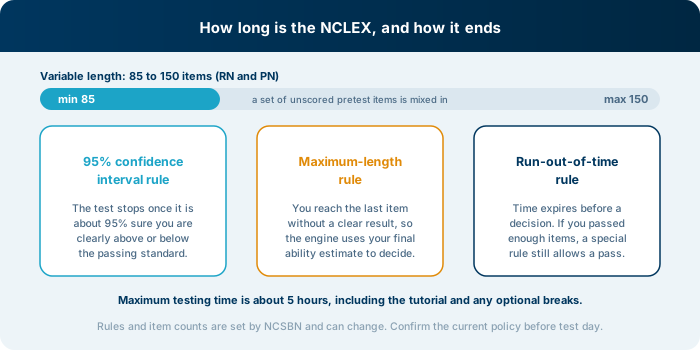
For the NCLEX-RN, the test ranges from a minimum of about 85 items to a maximum of about 150. The NCLEX-PN uses a similar 85 to 150 range. So whatever happens, you will answer at least roughly 85 questions and no more than roughly 150.
That spread exists because the test stops as soon as it has enough information to make a confident pass or fail decision, which we explain in depth in what is a passing NCLEX score. If your performance is clearly above or clearly below the passing standard, the test reaches confidence quickly and ends near the lower end of the range. If you are performing close to the standard, it needs more questions to get confident and pushes toward the upper end.
Because item counts and rules are set by the NCSBN and can change, treat these numbers as the current general ranges and confirm the specifics before test day.
It is worth saying plainly that the RN and PN exams share this variable-length, adaptive design. The content and the level of the questions differ, but the mechanics of how the test decides when to stop are the same family. So if you are preparing for the PN, the mental model in this article still applies: a similar question range, the same kind of confidence-based stopping, and the same advice not to read your result from the length.
Not every question counts
Mixed in among the scored questions is a set of unscored pretest items. These are questions the NCSBN is trying out for possible use on future exams, and they do not affect your result. They are not labeled, and you cannot tell them apart from scored questions while you are testing.
The practical implication is simple and important: treat every question as if it counts, because you have no way of knowing which ones do not. Coasting on a question you suspect is experimental is a great way to throw away a real point, since your guess about which is which will often be wrong.
You also have a time limit
The other thing that can govern your test is the clock. The maximum testing time is about five hours, and that figure includes the opening tutorial and any optional breaks you take. So your actual question-answering time is somewhat less than five hours once you account for those.
Most candidates finish comfortably before the limit, but pacing still matters. You do not want time to be the thing that decides your test, especially since some Next Generation NCLEX item types, like multi-question case studies, take longer to work through than a single multiple-choice item. Practicing those formats under realistic timing during your prep keeps the clock from becoming a surprise.
The three ways the NCLEX ends
This is the part worth understanding clearly, because it is also the part students invent myths about. There are three distinct stopping rules, and your test ends when one of them is met.
1. The 95 percent confidence interval rule. This is the most common way the test ends. As you answer, the engine keeps a running estimate of your ability with a margin of uncertainty around it. The moment it is about 95 percent confident that your true ability is clearly above the passing standard, you pass; clearly below, you fail. When this rule triggers, the test can stop anywhere from the minimum length upward.
2. The maximum-length rule. If you reach the last available item without the confidence rule ever triggering, the test ends because there are no more questions to give. This happens when your performance hovers right around the standard, so the engine never gets confident. In that case it makes its decision based on your final ability estimate: if that estimate sits above the standard you pass, and if it sits below you fail.
3. The run-out-of-time rule. If testing time expires before either of the rules above resolves, the test ends on the clock. A special provision still applies here. Roughly speaking, if you have answered enough items and your performance was sufficient, you can still pass even though time ran out, while if there was not enough evidence of competence, you do not. The details are set by the NCSBN, so confirm them rather than relying on summaries.
The key insight is that several different conditions can produce both a pass and a fail. The rule that stops your test does not, by itself, tell you the outcome.
There is also a detail people often miss about the maximum-length and run-out-of-time rules. In both cases, the test is no longer asking “can I get confident?” It is making the best decision it can with the evidence it has. That is why your steady accuracy throughout the exam matters so much. If you drift into careless errors late in a long test, you can pull your final ability estimate down at exactly the moment it is about to be used to decide your result. Finish as carefully as you started.
Why you cannot read your result from the length
Every cycle, the nursing students we work with walk out and immediately try to decode their fate from the number of questions. “It stopped at 85, I must have passed.” “It went to 150, I must have failed.” Both readings are unreliable.
A short test means the engine got confident fast, which happens when you are clearly above or clearly below the standard. That is two very different outcomes producing the same short length. A long test means you were close to the line, which again can resolve either way. People who pass and people who fail routinely report similar question counts.
This is exactly why stopping at 85 questions, the minimum, does not tell you whether you passed: the confidence rule ends a short test for a clear pass and a clear fail alike.
So the most useful advice we can give about the length is to ignore it as a predictor. Answer every question as well as you can, do not waste energy counting, and wait for the official result. Trying to reverse-engineer your fate from the question count only adds stress to an already stressful day, and it is usually wrong anyway.
What this means for test day
A few practical habits follow from all of this:
- Pace yourself, but do not rush. You have roughly five hours, and most people do not need all of it. Move steadily. Speeding up to “beat” the test does not help, since accuracy is what drives the engine.
- Treat every question as scored. You cannot spot the pretest items, so give each one your full attention.
- Be ready for longer formats. Case studies and other NGN items take more time per question, which is one more reason to practice them in advance, as we recommend in how to study for the NCLEX. If you are wondering how tough the test is overall, we cover that, with current pass rates, in is the NCLEX hard.
- Do not count. Whatever number you land on, it is not a verdict. Let the official result do its job.
The honest one-line answer to the question is this: expect somewhere between about 85 and 150 questions, finishing within roughly five hours, with the exact number determined by how clearly you demonstrate safe, competent practice. Confirm the current ranges and rules with the NCSBN, then stop worrying about the count and focus on the judgment behind each answer.
Want to walk in confident about the format, the timing, and the formats that take longest? Join the early-access list and our NCLEX instructors will help you prepare for test-day logistics when prep opens.
Frequently asked questions
How many questions is the NCLEX?
The NCLEX is variable length. The NCLEX-RN ranges from a minimum of about 85 items to a maximum of about 150, and the NCLEX-PN uses a similar 85 to 150 range. The exact number you see depends on how clearly your performance lands above or below the passing standard.
How long do you have to take the NCLEX?
The maximum testing time is about five hours, which includes the tutorial and any optional breaks. Most people finish well before the limit, but you should pace yourself so time never becomes the reason the test ends.
Are all NCLEX questions scored?
No. A set of unscored pretest items is mixed in among the scored questions. These are being tried out for future exams. They are not labeled, so you should treat every question as if it counts.
What are the three ways the NCLEX can end?
The 95 percent confidence interval rule, where the test is confident you are clearly above or below the standard; the maximum-length rule, where you reach the last item; and the run-out-of-time rule, where testing time expires before a clear decision.
Does a shorter NCLEX mean I passed?
Not reliably. A short test usually means your performance was clearly above or clearly below the standard, so it can end either way. Many people who pass and many who fail see a similar number of questions. Do not try to read your result from the length.
Prepping for the NCLEX?
Join the early-access list to be first when NCLEX prep opens.