
Test Logistics
What It Means to Stop at 85 Questions on the NCLEX
Stopping at 85 questions can mean a pass or a fail. Here is why the minimum-length test does not reveal your result, what the 95 percent confidence rule actually shows, and what to do after.
If your NCLEX shut off at 85 questions, you are almost certainly reading this in the parking lot, heart pounding, trying to decide whether to celebrate or panic. Take a breath. The honest answer is the one nobody wants to hear in that moment: stopping at 85 does not tell you whether you passed. It can happen for a clear pass and it can happen for a clear fail.
That sounds like a non-answer, so let me actually explain it, because once you understand the mechanics, the number stops feeling like a verdict and starts feeling like what it is: a sign the test got confident, in one direction or the other.
Why 85 is the magic number
The NCLEX is a computerized adaptive test, and it has a minimum length. For both the NCLEX-RN and the NCLEX-PN, the test will not stop before you have answered about 85 scored items, and it will not run past about 150. That floor of 85 is why so many people fixate on it: it is the earliest the test is allowed to end, so it feels like it should mean something special.
It does mean something, just not what most people assume. The test reached 85 and then stopped, which tells you the adaptive engine hit its confidence threshold at the very first opportunity. It does not tell you which side of the line it got confident about.
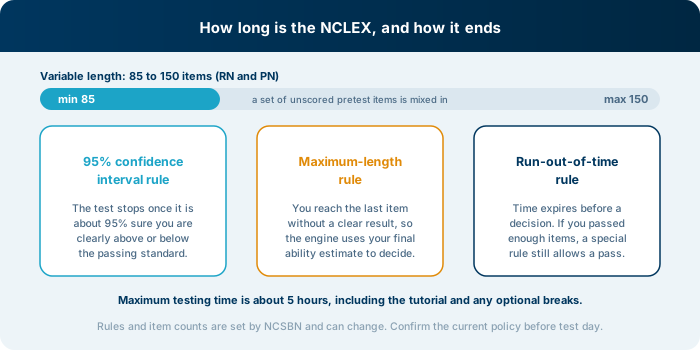
We cover the full length range and the three ways the test can end in how many questions the NCLEX is. For the stop-at-85 question specifically, only one of those three rules is in play, and it is the one worth understanding clearly.
The 95 percent confidence rule cuts both ways
Here is the mechanism, and it is the whole key to the stop-at-85 mystery.
As you answer, the test keeps a running estimate of your ability with a band of uncertainty around it. After the minimum number of items, it checks: is it about 95 percent confident that your true ability is clearly on one side of the passing standard? If yes, it stops immediately. If no, it keeps asking.
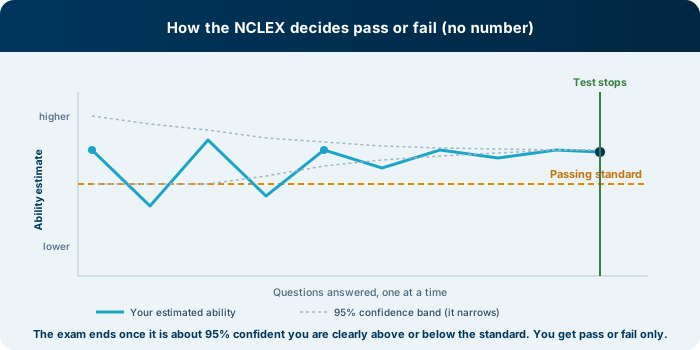
Now look closely at what “clearly on one side” allows:
- If the test is 95 percent confident you are clearly above the standard, it stops. You pass at 85.
- If the test is 95 percent confident you are clearly below the standard, it also stops. You fail at 85.
Both outcomes satisfy the rule. The engine is not trying to push you to a passing length or a failing length. It is trying to resolve uncertainty, and uncertainty resolves fastest when your performance is consistent, whether consistently strong or consistently weak. A steady, confident test-taker who is comfortably above the line and a struggling test-taker who is clearly below it can both trigger the cutoff at the minimum. Same number, opposite results.
This is exactly why “it stopped at 85, I passed” is a myth, and so is “it stopped at 85, I failed.” The number is a measure of how quickly the test got confident, not what it got confident about.
So what does stopping at 85 actually tell you?
One real thing: your performance was consistent enough that the test did not need to keep probing. It found a clear answer fast. A test that drags toward 150, by contrast, usually means you were hovering right around the standard, so the engine needed many items to make up its mind.
That is genuinely all you can infer. Consistent performance, resolved quickly. The direction, pass or fail, is sealed inside the official result and nowhere else.
If it helps to weigh the odds honestly: most first-time, US-educated candidates pass the NCLEX, so for that group a stop at 85 is more often a pass than a fail simply because passing is the more common outcome overall. But “more likely” is not “certain,” and reading a clear fail as a pass because the test was short is exactly the trap this rule sets. Treat the count as uninformative and wait for the result. You will save yourself days of false confidence or needless dread.
The “all easy” or “all hard” feeling is also unreliable
A close cousin of the question-count myth is the difficulty myth: “every question felt hard, so I must have been doing well and getting bumped up,” or the reverse, “everything felt easy, so I must have been failing.”
Do not trust this either. The adaptive engine targets questions near your ability level, so a well-calibrated test should feel hard to almost everyone, because it keeps finding the edge of what you can do. Feeling challenged the whole way through is normal and expected at every ability level. It is not evidence of anything. Your sense of how a question went is a notoriously poor predictor of whether you got it right, which is one more reason to stop trying to reverse-engineer your fate from the experience.
What to do after the test stops at 85
The hours and days after the exam are their own kind of hard. A few things actually help:
- Stop counting and stop re-litigating. You cannot recompute your result from the number of questions, the difficulty, or that one cardiac item you are sure you blew. The analysis only feeds the anxiety, and it is built on a signal that does not exist.
- Know the realistic timeline. Your official result comes from your board of nursing, often within roughly six weeks, sometimes much faster. Some jurisdictions offer an unofficial quick results service for a fee a couple of business days after you test. Confirm what your state offers rather than refreshing your inbox hourly.
- Do not start re-studying in a panic. If you walked out unsure, that is normal and not a reason to immediately book a retake or buy a new question bank. Wait for the actual result before you decide anything.
- Plan for either outcome calmly. If you pass, wonderful. If you do not, the candidate performance report that comes with a failing result shows where you were weak, which makes a focused retake very doable. A fail is a setback, not a referendum on whether you can be a nurse.
The reassurance, stated plainly
Stopping at 85 means the test got confident quickly. That is a sign of a consistent performance, and consistent performances are usually good ones, but the rule that ends a short test ends it for a clear pass and a clear fail alike. You genuinely cannot know from the number. Anyone who tells you 85 guarantees a pass, or guarantees a fail, is selling certainty the test does not provide.
So put the math down. You did the test you came to do. The result is already determined, the count cannot reveal it, and torturing yourself for six weeks will not change it. The most useful thing you can do now is rest, and trust that the preparation you put in is what actually decided the outcome, not the number on the final screen.
If you want to walk into your next test (or your first) understanding the engine cold, so the stop screen never sends you spiraling, that is exactly what we build. Join the early-access list and our NCLEX instructors will help you prepare for the format, the logic, and the nerves when prep opens. And because exam rules are set by the NCSBN and can change, confirm the current minimum and policy with them directly.
Frequently asked questions
Does stopping at 85 questions mean I passed the NCLEX?
Not by itself. The test can stop at the 85-item minimum for either a pass or a fail. It shuts off at 85 when it is about 95 percent confident your ability is clearly above the passing standard (a pass) or clearly below it (a fail). The length alone does not tell you which one happened.
Is stopping at 85 a good sign or a bad sign?
It is neither, on its own. A 85-item stop means the computer reached confidence quickly, which happens when your performance was clearly on one side of the standard. Plenty of people who pass and some who fail both stop at 85. Do not read your result from the number.
Why did my NCLEX stop at 85 questions?
Because the adaptive engine became about 95 percent confident your true ability was clearly above or clearly below the passing standard after the minimum number of scored items. Once it is that confident, it has no reason to keep asking, so it stops at the minimum.
Did I fail if the NCLEX stopped at 85?
Not necessarily. Most candidates who stop at 85 pass, because most test-takers are above the standard, but a clear fail also ends at 85. The only way to know is the official result. The question count is not a reliable predictor either way.
How can I tell if I passed before official results?
You cannot tell for certain from the test itself. Some jurisdictions offer an unofficial quick results service for a fee a couple of business days after testing, and your board of nursing posts the official result, often within about six weeks. The number of questions is not a signal you can trust.
Prepping for the NCLEX?
Join the early-access list to be first when NCLEX prep opens.