
Test Basics
What Is the Next Generation NCLEX (NGN)?
The Next Generation NCLEX launched in April 2023 with new item types and a focus on clinical judgment. Here are the case studies, bowtie, matrix, and other formats, plus the six-step model behind them.
If you went through nursing school before 2023, or learned the test from older resources, the NCLEX you will actually sit looks meaningfully different from the one you may be picturing. On April 1, 2023, the exam became the Next Generation NCLEX, usually called the NGN. It is still a pass or fail computerized adaptive test, but it added new question formats and a sharper focus on one thing: clinical judgment.
This is the comprehensive guide to that redesign. It walks through what the NGN is and why it exists, the six-step clinical judgment model that gives the whole exam its spine, every new item type you will encounter, and the partial-credit scoring that makes some NGN questions behave very differently from the all-or-nothing multiple choice you grew up with. If you want each item type worked through with a concrete example, we cover that in NGN question types with examples; here the goal is the full picture, end to end.
What changed on April 1, 2023, and why
The launch date matters, so anchor to it: April 1, 2023 is when the NCLEX became the Next Generation NCLEX. Every candidate testing since then has sat the NGN. If a study resource predates that date and does not mention case studies or the clinical judgment model, it is describing the old exam, and you should treat its picture of the test as incomplete.
The reason for the redesign is the most important context you can have. For years the NCLEX leaned heavily on standard multiple-choice questions. Those still appear, but the NCSBN, the organization behind the exam, had been studying a stubborn problem: a meaningful share of practice errors by newly licensed nurses trace back not to gaps in knowledge but to gaps in judgment, the reasoning that turns knowledge into a safe decision at the bedside. A nurse can know a drug’s class cold and still fail to recognize, in the moment, that this patient should be assessed before that one. The old format, one fact per bubble, was not well suited to measuring that.
So the NGN added item types that ask you to do more than recognize a fact. You weigh evidence, choose among several correct-looking options, place actions in order, complete a clinical conclusion piece by piece, and follow a patient as their condition develops across several screens. The shift is from “do you know this” to “can you decide what to do with it, and in what order.” That is clinical judgment, and it is the through-line of the entire redesign.
It helps to know what did not change, too, because a lot of NGN anxiety comes from imagining a completely foreign exam. The NCLEX is still a pass or fail computerized adaptive test. It still draws on the same core nursing content you learned in school. It still mixes in unscored pretest items, still ranges from roughly 85 to 150 questions, and still ends through the same stopping rules, all of which we cover in how many questions the NCLEX is. The passing standard is still set by the NCSBN and reviewed periodically. The NGN is an evolution of a familiar test, not a replacement for it. The new formats and the judgment focus sit on top of the foundation you already have.
The six steps of clinical judgment
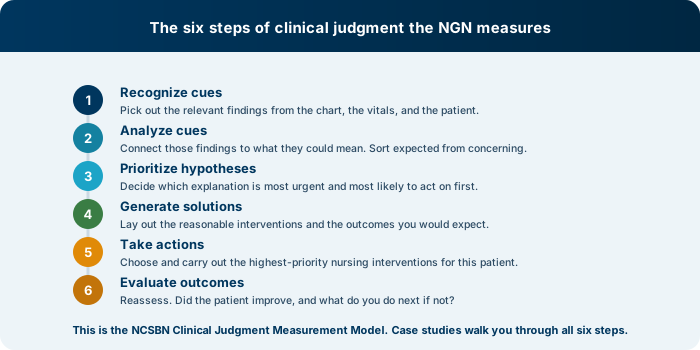
The NGN is built on the NCSBN Clinical Judgment Measurement Model. It breaks the reasoning a nurse uses into six cognitive steps:
- Recognize cues. Pick out the relevant findings from the chart, the vital signs, and the patient in front of you.
- Analyze cues. Connect those findings to what they could mean, sorting expected results from concerning ones.
- Prioritize hypotheses. Decide which explanation is most urgent and most likely, so you know what to address first.
- Generate solutions. Lay out the reasonable interventions and the outcomes you would expect from each.
- Take actions. Choose and carry out the highest-priority nursing interventions for this patient.
- Evaluate outcomes. Reassess. Did the patient improve, and what do you do next if they did not?
This model is not just academic background. It is the literal scaffolding of the case study questions. A six-question unfolding case study typically devotes one question to each of the six steps, in order: question one asks you to recognize cues, question two to analyze them, and so on through evaluating outcomes. When a case walks you from “which findings are concerning” to “did the intervention work,” it is marching you through these six steps deliberately. Knowing the model is therefore not optional trivia; it tells you, before you even read a case question, what kind of thinking it is about to ask for. If you feel a case shifting from “what is going on” toward “what do I do,” you know you have crossed from the analysis steps into the action steps, and you can read each question with the right lens.
It is also worth knowing that NCSBN frames these six cognitive steps inside a broader model that accounts for the things that influence judgment in the real world, the specific patient, the environment, time pressure, and the nurse’s own knowledge and experience. You will not be quizzed on that outer layer by name, but it explains why case studies give you so much context: the chart, the setting, the history. The test wants your judgment to operate on a realistic situation, not a sterile fact.
The new item types, in full
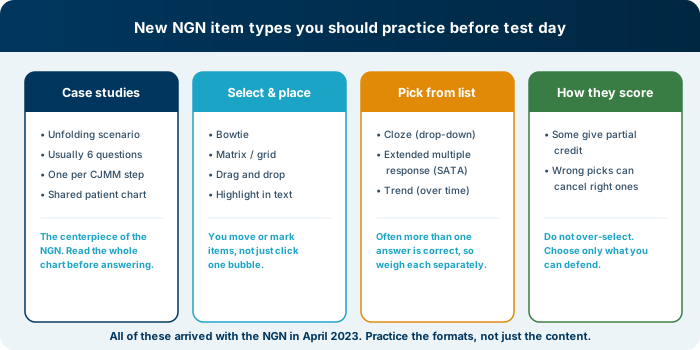
Here are the formats the NGN introduced. You do not need to master every nuance today, but you should make sure none of them is a surprise on test day. For a worked example of each one, see NGN question types with examples.
Unfolding case studies. The centerpiece of the NGN. An unfolding case study presents one patient whose situation develops across several screens, typically with six questions attached. The questions track the six clinical-judgment steps and share a single, growing patient chart, so the whole scenario hangs together as one story. Read the entire chart before you start answering, because later questions depend on the full picture, and information revealed in an early screen often matters for a later decision. Case studies are also where the most points are concentrated, which is why they reward the most deliberate reading.
Bow-tie. A single item shaped like a bow tie. You choose the priority condition or problem in the center, then select the related actions to take on one side and the parameters to monitor on the other. It packs three steps of judgment, prioritizing, acting, and evaluating, into one screen, which makes it one of the densest item types on the exam.
Matrix or grid. A table where you make a choice in each row, for example marking each finding as expected or unexpected, or each action as indicated, contraindicated, or non-essential. You are evaluating several items at once, and each row is its own small decision.
Extended multiple response. This is the family that includes select-all-that-apply (SATA). More than one option can be correct, and you choose every option that applies, sometimes up to a stated limit. These reward careful, option-by-option judgment and punish hedging.
Cloze (drop-down). Sentences with embedded drop-down menus, where you complete the statement by selecting the correct option from each menu. Often used to build a clinical conclusion piece by piece, for example “the client is experiencing [problem] as evidenced by [finding], so the priority is [action].”
Highlight. You click to highlight the relevant words or findings directly in a passage or chart, for example marking which assessment findings in a nursing note require follow-up. This format tests cue recognition in realistic, messy chart language.
Drag-and-drop. You move items into place, such as ordering the steps of a procedure into a sequence or sorting findings into categories. Some drag-and-drop items also function as a way to build a bow-tie or fill a response area.
Trend. A question that gives you data over time, such as vital signs or lab values across several readings, and asks you to interpret the direction things are moving rather than a single snapshot. The skill is reading change, spotting a patient sliding toward instability, not just evaluating the latest number.
Standard multiple-choice questions have not gone away. The NGN simply surrounds them with formats that test reasoning more directly. Most NGN questions reach you in two ways: as a question inside an unfolding case study, where six items share one patient, or as a standalone item (sometimes called a bow-tie or stand-alone NGN item) that presents a short scenario and a single new-format question. Either way, the same item types described above are the building blocks.
How NGN scoring is different: partial credit explained
On older-style multiple-choice questions, scoring is all or nothing: you get the item right or you do not. Several NGN item types work differently. Many use partial-credit (polytomous) scoring, meaning you can earn credit for the parts you get right even if you do not get the whole item perfect. Understanding the three main scoring methods changes how you should answer.
Plus/minus scoring (0/1/minus). Each correct selection earns a point, but each incorrect selection subtracts one, with the item score not allowed to drop below zero. This is the method that makes over-selecting dangerous. On a select-all item scored this way, grabbing an extra option you cannot defend does not just fail to help, it can cancel out a point you already earned. Plus/minus is commonly associated with formats like select-all-that-apply and highlight.
0/1 scoring (dyadic). Each correct response earns a point and there is no penalty for a wrong one, scored per row, per blank, or per cell. Matrix items and cloze drop-downs often work this way. Here there is no downside to careful, complete attention to every row or blank, because a mistake on one does not drag down the others.
All-or-nothing (rationale) scoring. Some items, including certain bow-tie and ordering items, must be entirely correct to earn any credit. The whole response area, or the full sequence, has to be right. These are the items where one careless placement costs you the entire point, so they reward the most deliberate work.
The practical upshot is a single discipline that serves you across all of them: choose only what you can actually defend. On plus/minus items, over-selecting actively hurts you. On all-or-nothing items, a single wrong piece sinks the whole thing. On 0/1 items, careful attention to each part pays off directly. Hedging by selecting everything that looks vaguely plausible is exactly the habit the scoring is designed to penalize. We go deeper into that discipline, especially for select-all-that-apply, in how to answer NCLEX priority questions. Because scoring rules are set by the NCSBN and can be updated, confirm the current details with the NCSBN rather than relying on any single guide.
Where the NGN items sit inside the adaptive test
A common question is how all these new formats fit into the computerized adaptive test that decides your pass or fail. The short version: they are woven in alongside standard items, and the adaptive engine still drives the experience.
The most visible structural piece is that the NGN typically front-loads a set of case studies early in the exam, each a six-question unfolding scenario, before moving into a longer stretch of standalone items, both standard multiple choice and standalone NGN formats. So you should expect to meet case studies relatively soon after you start, which is one more reason to be fluent in them before test day rather than discovering the format under pressure.
Underneath, the engine works the way it always has. It keeps a running estimate of your ability, adjusts the difficulty of what it serves you, and stops when it can make a confident pass or fail decision. The test still ranges from about 85 to 150 items and still ends through the three stopping rules, and the question count still does not reveal your result. The redesign changed what the questions look like and how some of them are scored; it did not replace the adaptive machinery that makes the NCLEX the NCLEX. That is reassuring, because everything you already understand about pacing, treating every item as scored, and not reading your fate into the length still applies.
What the NGN means for how you study
The redesign rewards a particular kind of preparation, and punishes the wrong kind.
Memorization alone is not enough. You can know a drug’s class and still miss a question that asks which patient to assess first. The NGN tests what you do with knowledge, so your practice has to build reasoning, not just recall.
Practice the formats deliberately. A bowtie or a six-question case study should feel routine by test day. Seek these item types out during your prep so the structure never costs you time or confidence. This is exactly why we sequence format practice into the final phase of our NCLEX study plan.
Learn the six steps well enough to anticipate questions. When you can feel a case study moving from “recognize cues” toward “take actions,” you read each question with the right lens. That awareness alone prevents a lot of avoidable misses.
Read rationales like they are the lesson. Because the test is measuring judgment, the explanation for why an action comes first, or why a finding is expected, is the thing actually worth learning. High-volume question practice with careful review is the most direct way to build NGN-style judgment.
If you are wondering whether all of this makes the exam harder, the honest answer is that it raises the judgment bar, which we unpack alongside the current pass rates in is the NCLEX hard. The reassuring part: the redesign rewards exactly the kind of preparation you can control, so a candidate who practices the formats and reasons through rationales is well positioned, not disadvantaged, by the change.
The short version
The Next Generation NCLEX, live since April 1, 2023, is the same pass or fail adaptive exam with a stronger spine: it measures clinical judgment through the six-step Clinical Judgment Measurement Model and a set of new item types, case studies, bow-tie, matrix, SATA, cloze, highlight, drag-and-drop, and trend, built to test reasoning rather than recall, many of them scored with partial credit rather than all or nothing. None of it is out to trick you. It is trying to find out whether you can think like a safe nurse.
Prepare accordingly. Build judgment through questions, learn the six steps, and make every new format familiar before you sit down. And because exam specifics evolve, verify the current format with the NCSBN. Join the early-access list and our NCLEX instructors will help you prep for the NGN formats specifically when prep opens.
Frequently asked questions
What is the Next Generation NCLEX?
The Next Generation NCLEX, or NGN, is the current version of the exam, launched on April 1, 2023. It added new item types and a stronger focus on measuring clinical judgment, the reasoning a nurse uses to make safe decisions, rather than testing recall alone.
What new item types does the NGN include?
The NGN added unfolding case studies, bowtie items, trend items, matrix or grid items, extended multiple response (select-all-that-apply), cloze (drop-down) items, highlight items, and drag-and-drop. Standard multiple-choice questions still appear too.
What is a case study on the NGN?
An unfolding case study presents a patient scenario that develops across several screens, typically with six questions tied to one patient. The questions usually move through the steps of clinical judgment, from recognizing cues to evaluating outcomes, using a shared patient chart.
What is the Clinical Judgment Measurement Model?
It is the NCSBN framework the NGN is built on. It breaks clinical judgment into six cognitive steps: recognize cues, analyze cues, prioritize hypotheses, generate solutions, take actions, and evaluate outcomes. Case study questions are mapped to these steps.
How are NGN items scored?
Some NGN item types use partial-credit scoring, so you can earn credit for partially correct answers rather than all or nothing. Because of how this works, you should avoid over-selecting on items where wrong choices can offset right ones. Confirm current scoring details with the NCSBN.
Prepping for the NCLEX?
Join the early-access list to be first when NCLEX prep opens.