
Section Strategy
NGN Question Types With Examples
Every Next Generation NCLEX item type, worked through with an example: bow-tie, matrix, SATA, cloze, highlight, drag-and-drop, trend, and the unfolding case study, plus a table of what each tests and how it scores.
The fastest way to make the Next Generation NCLEX less intimidating is to stop thinking of the new item types as abstract “formats” and start seeing them as concrete questions you have already practiced. A bow-tie is not scary once you have built three of them. A matrix is just a checklist. This article walks through every NGN item type with a worked example, so none of them is a surprise on test day.
First, the overview. Then each type, one at a time, with a real example you can picture.
Every NGN item type at a glance
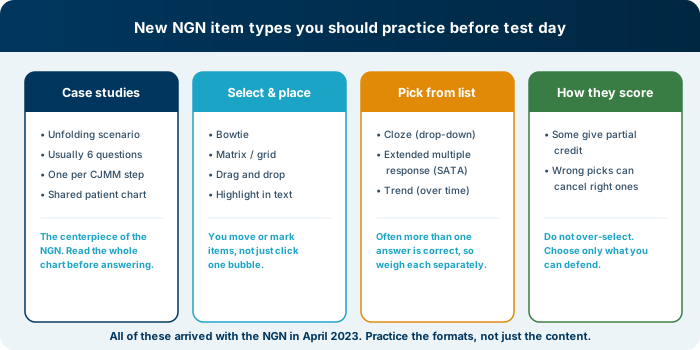
Here is the full set, what each one is testing, and how it tends to be scored. Keep this table as your map, then read the worked examples below.
| Item type | What it asks you to do | What it tests | Typical scoring |
|---|---|---|---|
| Unfolding case study | Follow one patient across ~6 questions on a shared chart | All six steps of clinical judgment | Each question scored by its own item type |
| Bow-tie | Place the priority problem, actions, and parameters to monitor | Prioritizing, acting, and evaluating in one screen | Often all-or-nothing per zone |
| Matrix / grid | Make a choice in every row of a table | Analyzing many findings or actions at once | Partial credit (0/1 per row) |
| Extended multiple response (SATA) | Select every option that applies | Weighing each option independently | Partial credit, often plus/minus |
| Cloze (drop-down) | Complete sentences using drop-down menus | Building a clinical conclusion piece by piece | Partial credit (0/1 per blank) |
| Highlight | Click the relevant words in a passage or chart | Recognizing cues in context | Partial credit, often plus/minus |
| Drag-and-drop | Move items into order or into categories | Sequencing or sorting clinical information | Partial credit or all-or-nothing |
| Trend | Interpret data across several time points | Spotting the direction a patient is moving | Varies by how it is presented |
| Standard multiple choice | Pick the one best answer | Recall and single-best-action judgment | All-or-nothing |
Scoring approaches are set by the NCSBN and can change; treat the right-hand column as the general pattern and confirm current details with the NCSBN. We explain the underlying scoring methods, plus/minus, 0/1, and all-or-nothing, in our NGN pillar guide.
The unfolding case study
This is the centerpiece of the NGN, so it is worth understanding first. An unfolding case study gives you one patient whose situation develops across several screens, usually with six questions attached to a shared, growing chart.
Worked example. Screen one shows a 68-year-old admitted with shortness of breath: history, vital signs, a nursing note. The questions then march through clinical judgment:
- Which findings require follow-up? (recognize cues, often a highlight or SATA item)
- What do these findings most likely indicate? (analyze cues, often a cloze or matrix)
- Which condition is the priority? (prioritize hypotheses, often a bow-tie or multiple choice)
- Which interventions are appropriate? (generate solutions, often SATA)
- What should the nurse do first? (take actions, often multiple choice or drag-and-drop)
- Did the interventions work, and what next? (evaluate outcomes, often a matrix or trend)
The single most important habit: read the entire chart before answering anything, because later questions depend on information revealed earlier, and the case is designed to hang together as one story. The six questions map directly to the six steps of the Clinical Judgment Measurement Model, so if you know the model, you can anticipate where each case is headed.
Bow-tie
A bow-tie item asks you to assemble a clinical picture in a single screen. You typically choose the priority problem in the center, the actions to take on one side, and the parameters to monitor on the other.
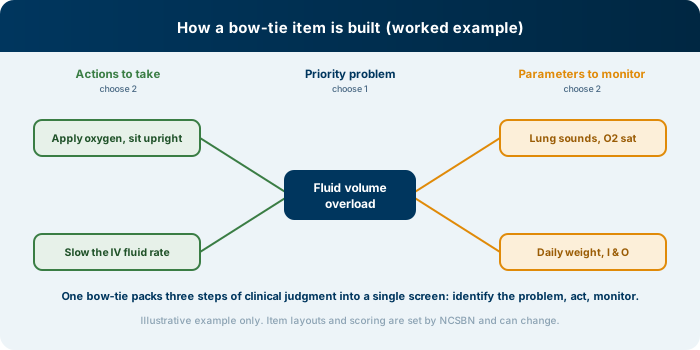
Worked example. A post-operative patient has crackles in the lungs, a rising respiratory rate, and a fast-running IV. From the answer banks you would place:
- Priority problem (center): fluid volume overload.
- Actions to take: apply oxygen and sit the patient upright; slow the IV fluid rate.
- Parameters to monitor: lung sounds and oxygen saturation; daily weight and intake/output.
The distractor options are real nursing actions, just not the priority for this patient, which is exactly the kind of “all the answers look reasonable” challenge the NGN loves. A bow-tie compresses three steps of judgment, identify, act, monitor, into one item, so slow down and treat each zone as its own decision.
Matrix or grid
A matrix item is a table where you make a choice in every row. The classic versions ask you to mark each finding as expected or unexpected, or each nursing action as indicated, contraindicated, or non-essential.
Worked example. For a patient with suspected dehydration, you might see a grid of findings, dry mucous membranes, bounding pulse, low urine output, flat neck veins, with columns for “consistent with dehydration” and “not consistent.” You evaluate each row on its own. Because matrix items usually give partial credit (one point per correct row), there is no penalty for working carefully through every line, and no benefit to rushing.
Extended multiple response (select-all-that-apply)
This is the family that includes the familiar select-all-that-apply (SATA). More than one option is correct, and you choose every option that applies, sometimes with a stated limit, sometimes not.
Worked example. “Which findings should the nurse report to the provider?” with seven options, of which four belong. The winning habit, which we cover in depth in how to answer NCLEX priority questions, is to treat each option as its own true-or-false question against the patient and stem. Decide yes or no on each independently. Do not assume a fixed number are correct, and do not let one strong option pull weaker ones in. On items that use plus/minus scoring, a wrong selection can cancel a right one, so over-selecting hurts you. Choose only what you can defend.
Cloze (drop-down)
A cloze item is a sentence, or a few sentences, with embedded drop-down menus. You complete each blank by selecting the correct option, building a clinical conclusion piece by piece.
Worked example. “The nurse determines the client is experiencing [drop-down: hypoglycemia / hyperglycemia / dehydration] as evidenced by [drop-down: blood glucose 52 / blood glucose 320 / temperature 101]. The priority action is to [drop-down: give 15 g fast-acting carbohydrate / administer insulin / encourage fluids].” Each blank is scored on its own, so a wrong first choice does not automatically doom the rest. Read the whole sentence before committing, because the blanks often constrain each other.
Highlight
A highlight item asks you to click the relevant words directly in a passage or chart, most often to mark the findings that require follow-up.
Worked example. You are shown a nursing note: “Client is alert, oriented x4. Reports chest pain 7/10 radiating to the left arm. Skin cool and diaphoretic. Lungs clear. Denies nausea.” You highlight the phrases that are concerning, chest pain radiating to the arm, cool and diaphoretic skin, while leaving the normal findings unmarked. This directly tests the first step of clinical judgment, recognizing cues, in realistic chart language. Over-highlighting can cost you on plus/minus scoring, so highlight only what genuinely needs follow-up.
Drag-and-drop
A drag-and-drop item asks you to move items into place, either into a sequence or into categories.
Worked example (ordering). “Place the steps for administering a subcutaneous injection in the correct order,” and you drag five steps into sequence. Worked example (categorizing). “Sort each finding as a sign of fluid overload or fluid deficit.” Sequencing items often score all-or-nothing because the order has to be right as a whole, so this is one format where careful, deliberate placement matters most.
Trend
A trend item gives you data across several time points, vital signs or lab values over multiple readings, and asks you to interpret the direction things are moving rather than a single snapshot.
Worked example. A flowsheet shows blood pressure dropping (128/82, then 110/70, then 92/60) while heart rate climbs (88, 102, 118) over three sets of vitals. The question asks what this pattern suggests and what the nurse should do. The skill is reading change over time, recognizing, here, a patient trending toward instability, not just evaluating the latest number. Trend items reward stepping back to see the trajectory.
How to practice these so they feel routine
Seeing each type once is not the same as being fluent in it. A few habits turn these formats from threats into reliable points:
- Practice every format on purpose. Do not let test day be the first time you meet a bow-tie or a six-question case study. Build reps in each type. This is the final phase of our NCLEX study plan.
- Read the rationale every time. The reasoning behind each answer is the clinical judgment the test actually scores. Skimming the score and moving on wastes the question.
- Mind the scoring. On any item where wrong choices can offset right ones, select only what you can defend. The discipline of not over-selecting is worth real points across SATA, highlight, and matrix items.
- Use the case study as judgment practice. Because each case walks the six-step model, working cases trains the exact reasoning pattern the whole exam rewards.
The NGN item types look like a long, scary list until you have worked through each one a few times. Then they become what they actually are: different containers for the same question the NCLEX always asks, what does a safe nurse do here, and why? That is also why the formats, while demanding, do not make the test a gamble; we put the difficulty in context, with pass rates, in is the NCLEX hard, and we explain why the number of questions you answer tells you nothing about how you did on them. Because formats and scoring are set by the NCSBN and can change, confirm the current item types and rules with them as you prepare.
Want guided practice on every NGN format with rationales you can learn from? Join the early-access list and our NCLEX instructors will drill the item types with you when prep opens.
Frequently asked questions
What are the NGN question types?
The Next Generation NCLEX includes the unfolding case study plus several standalone item types: bow-tie, matrix or grid, extended multiple response (select-all-that-apply), cloze (drop-down), highlight, drag-and-drop, and trend. Standard multiple-choice questions still appear too.
What is a bow-tie question on the NCLEX?
A bow-tie item asks you to assemble a clinical picture in one screen. You typically choose the priority problem in the center, the nursing actions to take on one side, and the parameters to monitor on the other. It packs identifying the problem, acting, and evaluating into a single item.
What is a matrix or grid item?
A matrix item is a table where you make a choice in every row, for example marking each finding as expected or unexpected, or each action as indicated or contraindicated. You are evaluating several items at once rather than picking a single answer.
How are NGN question types scored?
Several NGN item types use partial-credit scoring, so you can earn credit for the parts you get right. Scoring methods include plus or minus (where wrong choices subtract), 0 or 1 per correct response, and all-or-nothing for some items. Because over-selecting can cost you on plus/minus items, choose only what you can defend. Confirm current scoring with the NCSBN.
What is an unfolding case study?
An unfolding case study presents one patient whose situation develops across several screens, usually with six questions tied to a shared chart. The six questions typically move through the steps of clinical judgment, from recognizing cues to evaluating outcomes.
Prepping for the NCLEX?
Join the early-access list to be first when NCLEX prep opens.