
Scores
What Is a Passing NCLEX Score?
The NCLEX is pass or fail with no numeric score. Here is how the computerized adaptive test decides, what the 95 percent confidence rule means, and why there is no number to chase.
If you are searching for “what is a passing NCLEX score,” you are asking a reasonable question that happens to have an unusual answer. There is no passing score, because there is no score at all. The NCLEX does not hand back a number, a percent, or a percentile. It gives you exactly one of two results: pass or fail.
That sounds strange if every other exam in your life came with a grade. So let’s unpack how a test with no number still decides who passes, what the famous “95 percent confidence rule” actually means, and why this format changes how you should prepare.
The NCLEX is pass or fail, full stop
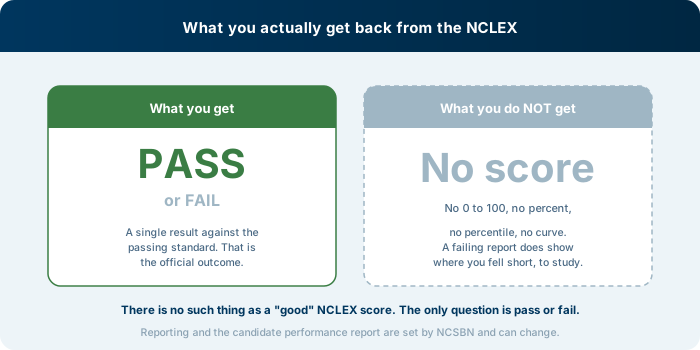
The single most important fact about NCLEX scoring is that the outcome is binary. You either meet the passing standard or you do not. There is no 0 to 100, no scaled score like the MCAT or LSAT, and no class rank. The percentage of questions you got right is not your result, and it would not even mean much if it were, because the difficulty of your questions changed as you answered them.
The only place a number-like detail appears is on a failing result. If you do not pass, your candidate performance report shows roughly how you did across the content areas, so you know where to focus before a retake. That is a study tool, not a score.
This trips people up because it is the opposite of almost every test they have taken. A class exam tells you 88 out of 100. The SAT and MCAT hand back scaled numbers and percentiles. The NCLEX deliberately does none of that. It is not ranking you against your cohort or measuring how far above the line you landed. It is answering a single yes-or-no question about whether you are ready to practice safely, and then it tells you the answer.
So the honest answer to “what is a passing NCLEX score” is this: a passing score is simply a result that clears the passing standard. There is nothing else to hit.
How a test with no number decides
The NCLEX is a computerized adaptive test, usually shortened to CAT. Adaptive means the test responds to you in real time. Here is the loop, simplified:
- You answer a question.
- If you answer it correctly, the next question tends to be a little harder. If you miss it, the next one tends to be a little easier.
- With every answer, the test updates its estimate of your ability.
Over many questions, the test homes in on the level you can reliably perform at. The goal is not to count how many you got right. The goal is to locate your ability precisely enough to compare it against a fixed line called the passing standard.
That passing standard is set by the NCSBN, the organization behind the exam, and it represents the minimum competence expected of a safe entry-level nurse. Your job is not to beat other test-takers. It is to clear that line.
The passing standard is a logit, not a number of correct answers
When people imagine a “passing score,” they picture something like 70 out of 100. The NCLEX passing standard is nothing like that. It is expressed in logits, short for log-odds units, which are a measure of ability on the same scale the test uses to rate item difficulty. The scale is roughly -2.00 (low ability, or very easy items) to +2.00 (high ability, or very hard items), and the zero point is arbitrary, it carries no meaning in terms of nursing content by itself.
What makes logits useful is that when the test knows your ability in logits and an item’s difficulty in logits, it can compute the probability you will answer that item correctly. That is the entire engine. The passing standard is simply a fixed point on this ability scale, and the test is asking one question: is your ability, in logits, above or below that point?
The exact value is set by the NCSBN and revised on a regular cycle. The current NCLEX-RN passing standard is 0.00 logits, in place since April 2023, and the NCLEX-PN standard is -0.18 logits. The two are not directly comparable, because RN and PN abilities are measured on their own scales. You will never need to calculate any of this yourself, but it is worth understanding why there is no percent-correct cutoff to chase: the standard lives on an ability scale, not a points scale.
The 95 percent confidence rule, explained simply
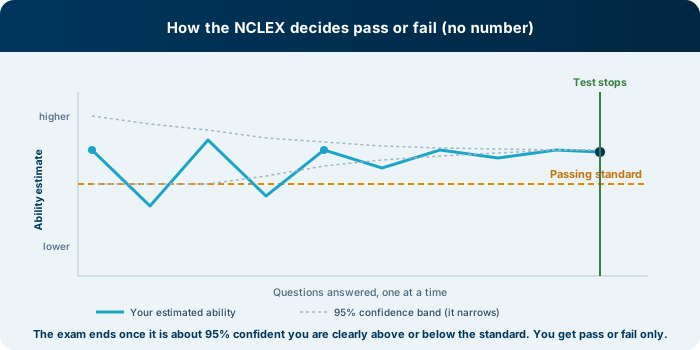
Here is where most explanations get either too vague or too technical. The mechanism is actually intuitive once you picture it.
Imagine the test is trying to figure out whether your ability is above or below the passing standard. After a few questions, its estimate of you is rough, with a wide band of uncertainty around it. That band is too wide to be sure which side of the line you are on. So the test keeps asking questions.
As you answer more, two things happen at once. The estimate of your ability settles, and the band of uncertainty around it shrinks. The exam ends the moment it can say, with about 95 percent confidence, that your true ability is clearly on one side of the passing standard.
- If that band lands clearly above the line, you pass.
- If it lands clearly below the line, you fail.
- If you are sitting right on top of the line, the test cannot get confident, so it keeps going until it hits another stopping rule.
This is what nursing students mean when they talk about the “95 percent confidence interval rule.” It is not a percent correct. It is a confidence threshold about which side of the standard you are on.
Why the number of questions does not tell you much
Every cycle, students walk out convinced that a short test means a pass and a long test means a fail, or the reverse. Neither is reliable.
A short test usually means your performance was clearly above or clearly below the standard, so the test got confident quickly. Notice that this can go either way. A long test usually means you were performing close to the standard, so the test needed many questions to get confident, and that too can end in either result.
The nursing students we work with often spiral after the exam because they answered “too many” or “too few” questions and tried to read their fate into it. We tell them the same thing every time: the question count is not a signal you can trust. Wait for the official result and do not torture yourself with the math.
There are exactly three ways the test can end, and naming them helps demystify the length:
- The 95 percent confidence rule. The most common ending. The test stops the moment it is about 95 percent confident your ability is clearly above the standard (pass) or clearly below it (fail). This can trigger anywhere from the minimum length up.
- The maximum-length rule. If you reach the last available item without the confidence rule ever resolving, the test ends and decides based on your final ability estimate: above the standard passes, below fails.
- The run-out-of-time rule. If testing time expires first, the test ends on the clock, with a special provision that can still allow a pass if you answered enough items and your performance was sufficient.
Only the first is the confidence rule, and we cover all three in depth, including the famous stop at 85 and the full length range, in how many questions the NCLEX is. The takeaway is that several different stopping conditions can each produce a pass or a fail, so the length alone is not diagnostic.
What the pass rates look like
Even though there is no score, there are pass rates, and they are genuinely reassuring for most candidates. Here are the 2024 first-time figures from the NCSBN.
| Exam and candidate group | 2024 pass rate |
|---|---|
| NCLEX-RN, first-time, US-educated | about 91% |
| NCLEX-RN, repeat, US-educated | about 51% |
| NCLEX-RN, first-time, internationally educated | about 54% |
| NCLEX-PN, first-time, US-educated | about 88% |
| NCLEX-PN, repeat, US-educated | about 42% |
Approximate, from NCSBN 2024 data. Pass rates shift year to year and the standard is reviewed periodically, so confirm current figures with the NCSBN.
The headline is the top row: roughly nine in ten first-time US-educated RN candidates clear the standard, with the PN first-time rate close behind. The much lower repeat rates mostly reflect who is in that group, everyone who was below the standard last time, rather than a harder exam. We dig into what those numbers mean, and what makes the test challenging in the first place, in is the NCLEX hard.
Partial-credit scoring on the newer item types
One more scoring wrinkle is worth knowing, because it is easy to assume “pass or fail” means every individual question is also all or nothing. It is not. Since the Next Generation NCLEX arrived in April 2023, several item types use partial-credit scoring, so you can earn credit for the parts of an item you get right.
The practical catch is that some of those items, select-all-that-apply and highlight, for example, use a plus/minus method where a wrong selection can cancel out a correct one. So over-selecting is not a free hedge; it can actively cost you. The safe habit, across every partial-credit format, is to choose only what you can defend. We break down the three scoring methods, plus/minus, 0/1, and all-or-nothing, in our NGN guide and in NGN question types with examples. None of this changes the final outcome being a simple pass or fail; it just shapes how individual items contribute to the ability estimate that decides it.
When your result actually arrives
Because there is no score on the screen, the wait for the result is its own ordeal, so it helps to know the realistic timeline. Your official result comes from your board of nursing, not from the testing center, and it often posts within about six weeks of your test, sometimes considerably faster depending on your jurisdiction.
Many states also offer an unofficial quick results service for a fee, typically available a couple of business days after you test. It is not your official license decision, but it can shorten the agonizing wait. Availability and timing vary by jurisdiction, so confirm what your state offers rather than assuming. Whatever you do, do not try to infer your result in the meantime from how many questions you answered or how hard the test felt, both are unreliable, as we explain in what it means to stop at 85.
What this means for how you prepare
A pass or fail test with an adaptive engine has real consequences for your study plan.
Chasing a number is pointless, so chase competence instead. Because there is no score to optimize, the right target is simple: be reliably above the passing standard across every content area. That means closing your weak spots rather than padding your strong ones.
You cannot game the adaptivity. Some students try to guess whether a question is “hard” to infer how they are doing. Do not. You will be wrong often, and the worry just burns focus. Treat every question as the only one that matters and answer it as well as you can.
Breadth matters more than peaks. A score-based test can sometimes be rescued by being excellent in one area. The NCLEX standard is about overall safe practice, so a serious gap in, say, pharmacology or prioritization can sink you even if you are strong elsewhere. Even coverage is the goal.
Practice the way the test thinks. The adaptive engine is measuring clinical judgment, not trivia recall, especially since the Next Generation NCLEX arrived in April 2023. The best preparation is high-volume question practice where you read every rationale and build the reasoning the test rewards. We lay out exactly how to do that in how to study for the NCLEX.
So, what is a passing score?
It is whatever result clears the standard, and that is genuinely all there is to it. There is no magic number, no percent to hit, and no curve to beat. The exam quietly estimates whether a safe, competent entry-level nurse is sitting in the chair, and then it tells you yes or no.
That should be freeing. You are not racing a percentile. You are demonstrating that you can practice safely. Build broad, reliable competence, practice the judgment the test measures, and the pass takes care of itself. Because the passing standard is reviewed periodically and can change, always confirm the current standard with the NCSBN before you register.
Want a study plan built around clearing the standard with room to spare? Join the early-access list and our NCLEX instructors will help you map a realistic path when prep opens.
Frequently asked questions
What is a passing NCLEX score?
There is no passing number. The NCLEX is scored pass or fail only. The computerized adaptive test estimates your ability as you answer and compares it to a fixed passing standard. When it is about 95 percent confident you are clearly above or below that standard, it stops and you pass or fail.
Is the NCLEX scored out of 100 or as a percentage?
No. The NCLEX does not give a number, a percent correct, a percentile, or a curve. You receive only a pass or fail result. The percentage of questions you answer correctly is not your score because the test adjusts difficulty as you go.
What does the 95 percent confidence interval rule mean?
As you answer questions, the test keeps a running estimate of your ability with a margin of uncertainty around it. The exam ends as soon as it is about 95 percent confident your true ability is clearly on one side of the passing standard, above it to pass or below it to fail.
Does answering more NCLEX questions mean I failed?
Not necessarily. The test length is variable, and many people who pass and many who fail answer a similar number of questions. A long test usually means your performance was close to the standard, which can end either way. Stopping early is not automatically good or bad.
How do I find the official NCLEX passing standard?
The passing standard is set by the NCSBN and is reviewed on a regular cycle, so it can change. It is expressed in logits, an ability unit, rather than a number of correct answers. The current NCLEX-RN standard is 0.00 logits (set April 2023) and the NCLEX-PN standard is -0.18 logits. Always confirm the current values directly with the NCSBN.
When do NCLEX results come out?
Your official result comes from your board of nursing, often within about six weeks of testing, sometimes sooner. Many jurisdictions also offer an unofficial quick results service for a fee, typically a couple of business days after you test. Confirm what your state offers, since timing and availability vary.
What is the NCLEX pass rate?
In 2024, the first-time pass rate for US-educated candidates was about 91 percent for the NCLEX-RN and about 88 percent for the NCLEX-PN, per NCSBN data. Repeat-taker rates are much lower, roughly in the 40s to low 50s percent. These figures change year to year, so confirm current numbers with the NCSBN.
Prepping for the NCLEX?
Join the early-access list to be first when NCLEX prep opens.