
Study Strategy
How to Study for the NCLEX: A 30-Day Study Plan
A concrete 30-day NCLEX study plan, week by week and day by day, pairing targeted content review with high-volume questions, NGN item practice, and rationale review that builds clinical judgment.
The NCLEX is not a test you can cram facts for the night before, but it is also not as mysterious as the forums make it sound. It is a hard but very passable exam that rewards a specific, learnable kind of thinking: looking at a patient situation and deciding what a safe nurse does next. The good news is that this skill is built through a clear process, and the process is mostly about doing questions and learning from them honestly.
The plan below is built around two ideas. Move through phases in the right order, and review every question as if it is teaching you something, because it is. Volume alone will not move you. Volume plus real review will.
How long you actually need
Most candidates do well with roughly four to eight weeks of focused preparation, but the honest answer depends on two things: how recently you finished nursing school and how solid your foundation already is.
Studying soon after graduation tends to help, because the content is still fresh and you are mainly converting knowledge into exam-style judgment rather than relearning from scratch. If it has been a while, or if you struggled with the material the first time, give yourself more runway. The nursing students we work with who try to compress serious gaps into ten frantic days usually wish they had started sooner.
The best way to set your timeline is to take a readiness or diagnostic assessment early. The gap between where you score and a comfortable pass tells you how much work is left.
Consistency beats intensity here. A daily rhythm of focused study, with questions every single day, builds the reasoning faster than a few marathon sessions on the weekend. The nursing students we work with who keep a steady pace, even a modest one, tend to retain more and burn out less than the ones who cram in bursts and then disappear for days. Pick a schedule you can actually sustain for the whole stretch, and protect it.
The 30-day NCLEX study plan
If you want a concrete schedule rather than a philosophy, here is a 30-day plan, organized into four weeks. It assumes you are studying soon after graduation with a reasonable foundation. If your diagnostic reveals big gaps, stretch the early weeks; if you are already scoring near a comfortable pass, compress the later ones. The structure is what matters, not the exact day count.
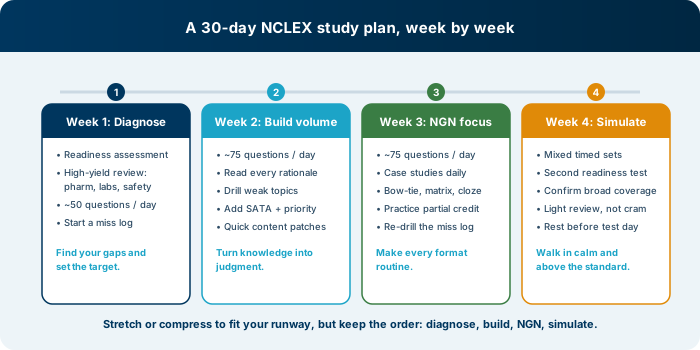
| Week | Daily content focus | Daily questions | NGN item practice | Review habit |
|---|---|---|---|---|
| Week 1: Diagnose | Take a readiness assessment day 1; then high-yield review: pharmacology, labs, safety, prioritization | ~50/day, tied to that day’s topic | Light: meet each format once | Read every rationale; start a miss log |
| Week 2: Build volume | Quick targeted patches on topics the questions expose | ~75/day, mixed across content | Add select-all and priority items | Read every rationale; re-drill logged misses |
| Week 3: NGN focus | Spot-fix remaining weak areas | ~75/day | Daily case studies; bow-tie, matrix, cloze, highlight; practice partial-credit discipline | Re-drill the miss log; study why wrong answers are wrong |
| Week 4: Simulate | Light review only, no new content | Mixed timed sets | A second readiness test; confirm broad coverage | Light review; rest the day before test day |
A few notes on using it. The question counts are illustrative, not a quota; the point is steady daily volume that ramps up, not hitting an exact number. The miss log is the connective tissue across all four weeks: every question you get wrong, or get right but felt unsure about, goes in it, and you keep re-drilling those topics until they stop appearing. And notice the shape of the plan: it moves from diagnosing and content, to volume, to format-specific drilling, to simulation. That order is deliberate, and the next section explains why.
The three phases behind the plan
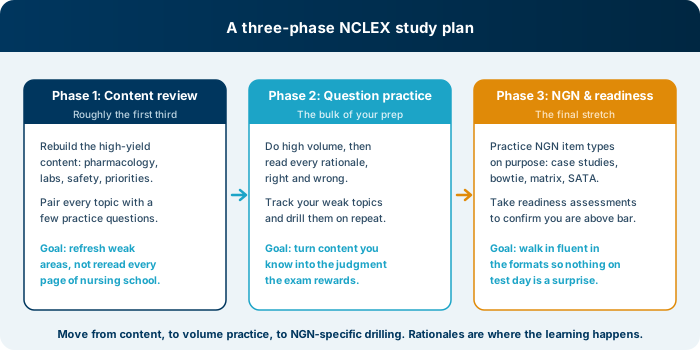
Order matters. Doing endless questions before you have refreshed your weak content just teaches you to miss the same things repeatedly. Reviewing every page of nursing school before you touch a question wastes the time you should spend building judgment. Sequence the work.
Phase 1: Targeted content review (roughly the first third). Refresh the high-yield material, with extra attention to the areas the exam leans on hardest: pharmacology, lab values, infection control and safety, and prioritization. The word that matters here is targeted. You are not rereading every lecture. You are shoring up the topics you are shaky on and confirming the ones you are not. Pair each topic with a handful of questions so the review connects to how the test asks.
Phase 2: High-volume question practice (the bulk of your prep). This is where the real learning happens. Do a high volume of practice questions, and after each set, read the rationale for every item, the ones you got right included. Keep a simple log of the topics that trip you up, and circle back to drill them. Most of your gains come from this loop, not from passive reading.
Phase 3: NGN item types and readiness (the final stretch). Now make sure the formats are second nature. Practice Next Generation NCLEX item types on purpose: unfolding case studies, bowtie, matrix and grid, and select-all-that-apply. Take readiness assessments under realistic conditions to confirm you are sitting comfortably above the passing standard. You want to walk in having already seen every format, so nothing on test day costs you time or confidence.
These proportions are a template, not a rule. Stretch or compress them to fit your timeline, but keep the order: fix content, build judgment through questions, then lock in the formats.
The habit that turns practice into points
Here is the single highest-leverage habit in NCLEX prep, and it is the one most people shortcut: review every question, not just the ones you missed.
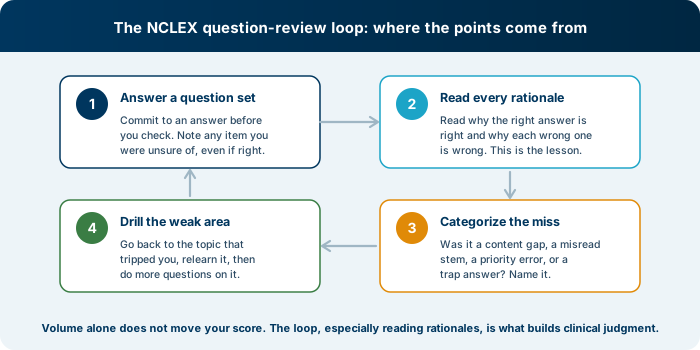
When you finish a set of questions, do not just glance at your score and move on. For each item, work through the loop:
- Answer, then commit. Before you check, settle on your choice and notice whether you were confident or guessing.
- Read every rationale. This is the lesson. Understand why the correct answer is correct and, just as important, why each wrong answer is wrong. The wrong-answer reasoning is often where the real teaching is.
- Categorize the miss. Was it a content gap, a misread question stem, a priority error, or a trap answer that looked right? Naming the failure tells you the fix.
- Drill the weak area. Go back to the topic that tripped you, relearn it, and then do more questions on it specifically.
This is why two students can do the same number of questions and get completely different results. One is practicing. The other is practicing and diagnosing. A question you got right but were unsure about is still worth reviewing, because on test day that uncertainty costs you time and sometimes the item.
If you only change one thing about how you study, make it this: slow down after each set and actually learn from it.
Why rationales beat raw volume
It is tempting to treat NCLEX prep as a counting game, where finishing more questions feels like progress. But the exam is measuring clinical judgment, not how many questions you have seen. Two thousand questions skimmed quickly with shallow review will teach you less than half that many worked carefully.
The rationale is where you learn the reasoning, which is the thing the test actually scores. When you understand why a particular intervention comes first, or why a finding is expected rather than concerning, you are building the judgment that transfers to questions you have never seen. That transfer is the whole point. You cannot memorize your way to it, but you can reason your way to it, one well-reviewed question at a time.
Practice the formats, not just the facts
Since April 2023, the NCLEX has included new item types designed to test clinical judgment more directly. These formats can rattle people who only ever practiced standard multiple choice. Do not let test day be the first time you see a bowtie item or a six-question case study.
A few habits help. With select-all-that-apply and other items that use partial-credit scoring, evaluate each option on its own merits and choose only what you can defend, because over-selecting can cost you. With case studies, read the entire patient chart before answering, since later questions depend on the whole picture. We break the formats down in detail in our guide to the Next Generation NCLEX, show each one worked through in NGN question types with examples, and cover the prioritization logic the case studies hinge on in how to answer NCLEX priority questions.
When to get help
Plenty of people pass with a solid plan, a good question bank, and the discipline to review honestly. Outside help earns its keep mainly in a few situations: you have plateaued, your readiness assessments keep coming back below a comfortable pass, or you have failed once and cannot pinpoint why. In those cases a second set of eyes on your error log often finds the pattern you cannot see from the inside, fast.
Untangling that kind of stall is what our NCLEX instructors are being set up to help with. The method itself, though, is something you can start today: review your weak content, do a high volume of questions, learn from every rationale, and drill the formats until they feel routine. Do that consistently and the pass follows. Because timelines and exam details can change, confirm the current format with the NCSBN as you build your plan. Join the early-access list to get our full study plan and NGN drills when NCLEX prep opens.
Frequently asked questions
Can you study for the NCLEX in 30 days?
Yes, 30 days is a realistic timeline for many first-time candidates who study soon after graduation, when the content is still fresh. The plan that works is four focused weeks: diagnose your gaps, build question volume, drill the NGN formats, then simulate. Give yourself longer if you have large content gaps or finished school a while ago.
How long should I study for the NCLEX?
Many candidates prepare for roughly four to eight weeks of focused study after graduating, though it varies with how recently you finished school and how strong your foundation is. Studying soon after graduation tends to help because the content is still fresh. A focused 30-day plan is a common and workable target.
How many practice questions should I do for the NCLEX?
There is no magic number, but most successful candidates do a high volume, often in the low thousands of questions across their prep. What matters far more than the count is reading the rationale for every question and drilling your weak areas.
Is content review or doing questions more important for the NCLEX?
Both matter, but for most candidates question practice does the heavy lifting because the exam measures clinical judgment, not recall. Use content review to fix gaps the questions expose rather than rereading everything from nursing school.
How do I study for the Next Generation NCLEX item types?
Practice them on purpose. Seek out case studies, bowtie, matrix, and select-all-that-apply items so the formats feel routine on test day. Pay attention to how partial-credit scoring works so you do not over-select.
Should I use a review course or self-study for the NCLEX?
Many people pass with a structured self-study plan and a strong question bank. Outside help earns its keep most when you have plateaued, keep failing readiness assessments, or cannot see your own error patterns.
Prepping for the NCLEX?
Join the early-access list to be first when NCLEX prep opens.