
Section Strategy
How to Answer NCLEX Priority Questions
Priority and select-all-that-apply questions trip up well-prepared nurses. Here are the frameworks (ABCs, Maslow, the nursing process, and safety) and how to read first, most important, and priority stems.
Priority questions are where well-prepared nurses lose points they did not need to lose. You can know every fact in the stem and still pick the wrong answer, because the question is not testing whether you recognize a correct action. It is testing whether you can tell which correct action comes first. That is a different skill, and it is exactly the kind of clinical judgment the Next Generation NCLEX is built to measure.
The good news is that prioritization is not guesswork. Experienced nurses lean on a small set of frameworks, and once you internalize them, priority questions stop feeling like coin flips. This article covers those frameworks, how to read priority stems, and how to handle the dreaded select-all-that-apply item.
Why priority questions are hard
The trap in a priority question is that most or all of the answer choices are things a nurse might genuinely do. None of them is obviously wrong. The question buries the difficulty in the ordering, not the options.
So your job changes. Instead of hunting for the one correct answer and eliminating three wrong ones, you have to recognize that several answers are defensible and then rank them. The correct choice is the action that must happen before the others. Reading every option as “could a nurse do this?” gets you nowhere, because the answer is usually yes for most of them. The right question is “which of these comes first?”
The frameworks that decide order
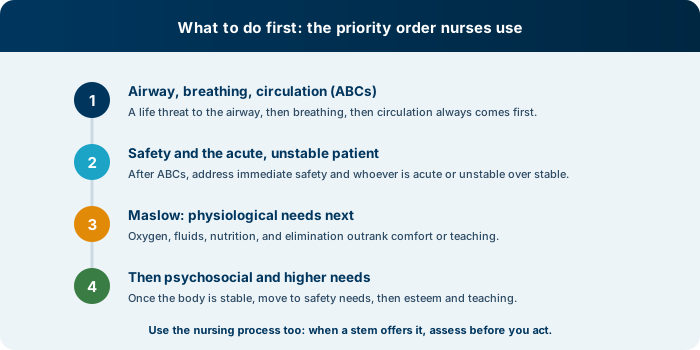
Here is the priority order to run through, from the highest-stakes consideration down. Think of it as a sequence of filters: apply the first one that fits the situation.
1. ABCs: airway, breathing, circulation. When a question involves a possible life threat, this comes before everything else, and in this order. A compromised airway outranks a breathing problem, which outranks a circulation problem. If one answer addresses an airway issue and another addresses something further down, the airway wins. The ABCs reflect what keeps a patient alive, so they sit at the top of the hierarchy.
2. Safety and the acute, unstable patient. Once immediate life threats are handled, turn to safety and to whoever is most acute or unstable. Between two patients, the one who is unstable, changing, or at higher risk generally takes priority over the one who is stable and predictable. Safety risks, like a fall hazard or a medication error in progress, also rise to the top here.
3. Maslow’s hierarchy: physiological needs next. When there is no immediate life threat, Maslow’s hierarchy is your guide. Physiological needs (oxygen, fluids, nutrition, elimination) come before everything above them. A patient’s need to breathe or maintain fluid balance outranks their need for comfort, reassurance, or teaching.
4. Then psychosocial and higher needs. Once the body is stable, you move up Maslow’s ladder to safety needs, then to esteem, belonging, and patient teaching. These matter, but they wait their turn behind physiological stability.
One more framework runs alongside these: the nursing process. When a stem offers it, assess before you act. If one option gathers more information, like assessing or checking a finding, and another jumps straight to an intervention, the assessment often comes first, because you should understand the situation before you act on it. The exception is a clear emergency, where the ABCs override the urge to assess: you do not pause to take a full history on a patient who cannot breathe.
These frameworks do not contradict each other so much as stack. Apply the highest-priority lens that the situation calls for.
A quick way to use them under pressure: scan the answers and ask, in order, “Does any option address a life threat to airway, breathing, or circulation? If not, is anyone unstable or unsafe? If not, which option meets the most basic physiological need?” The first filter that catches an answer is usually your answer. Running that sequence the same way every time keeps you from being swayed by whichever option simply sounds the most clinical.
How to read priority stems
The wording of a priority question is a signal. Train yourself to spot it.
Words like “first,” “initial,” “priority,” “most important,” “best,” and “immediate” are flags that you are ranking actions, not just identifying a correct one. The moment you see them, your mental gear should shift from “which answer is right?” to “which right answer comes before the others?”
A few habits help:
- Read the stem twice and pin down the exact task. “Which action should the nurse take first?” is asking for an order. “Which finding should the nurse report?” is asking you to identify the most concerning result. They feel similar but call for different thinking.
- Notice what the patient situation actually is. Is there a life threat in play, or a stable patient with competing comfort needs? That tells you which framework to lead with.
- Do not let a tempting but lower-priority action distract you. Test writers love to include an answer that is correct and satisfying but simply is not first. Recognizing it as real-but-not-first is the whole game.
We carry the same “read the stem first, then reason” discipline across our prep, including in how to study for the NCLEX, because most avoidable misses come from answering a slightly different question than the one asked.
Handling select-all-that-apply
Select-all-that-apply items, part of the extended multiple response family on the NGN, are their own kind of stress. More than one option is correct, and you have to find all of them without grabbing the ones that are not. (We show SATA and every other format worked through in NGN question types with examples.)
The single best habit is to treat each option as an independent true-or-false question. Do not look at the list and try to sense how many belong. Go option by option and ask, for each one, “Is this true for this patient, given this stem?” Decide yes or no on its own merits, then move to the next. This stops you from the two classic errors: assuming a fixed number are correct, and letting a strong option pull weaker ones in with it.
Two more rules:
- Include only what you can defend. If you cannot point to a reason an option belongs, leave it out. Hedging by selecting everything plausible is exactly what hurts you.
- Mind the scoring. Some NGN items use partial-credit scoring, and on items where incorrect choices can offset correct ones, over-selecting can cost you. Choosing only your defensible options is both the safest and the highest-scoring approach. We cover how that scoring works in our guide to the NGN. Because scoring details can change, confirm the current rules with the NCSBN.
Practice the reasoning, not the answers
Priority questions reward a thinking pattern, which means you build the skill by doing many of them and reviewing the reasoning every time. When you miss one, do not just note the right answer. Ask which framework you should have applied and why your choice was a lower priority. Over a few dozen questions, the ordering starts to feel automatic, and that automaticity is what carries you through the unfamiliar scenarios on test day.
This is also where an outside eye helps most. If you keep missing priority items and cannot see the pattern, a reviewer can often spot that you are, say, jumping to interventions before assessing, or being pulled by tempting-but-not-first options. That is the kind of diagnosis our NCLEX instructors are being set up to help with.
The bottom line: priority questions are not asking whether you know what to do. They are asking what to do first. Run the frameworks in order, read the stem for what it truly wants, take select-all items one option at a time, and review the reasoning relentlessly. Do that, and the questions that used to feel like guesses become some of your most reliable points.
Want targeted practice on priority and select-all-that-apply items with reasoning you can review? Join the early-access list and our NCLEX instructors will help you drill prioritization when prep opens.
Frequently asked questions
How do I answer NCLEX priority questions?
Use a consistent framework. Start with the ABCs (airway, breathing, circulation), then safety and the most acute or unstable patient, then Maslow's hierarchy with physiological needs before psychosocial ones. When a question lets you, assess before you act, following the nursing process.
What are the ABCs on the NCLEX?
ABCs stands for airway, breathing, and circulation. When a priority question involves a possible life threat, address the airway first, then breathing, then circulation. This ordering overrides most other considerations because it reflects what keeps a patient alive.
How does Maslow's hierarchy apply to NCLEX questions?
Maslow's hierarchy reminds you that physiological needs like oxygen, fluids, and nutrition come before safety needs, and that both come before psychosocial needs like esteem and teaching. When no immediate life threat is present, physiological needs usually take priority.
What do first, most important, and priority mean in NCLEX stems?
These words signal that more than one answer is a reasonable nursing action, but only one comes first. The task is not to find the only correct action; it is to rank the correct actions and choose the one that should happen before the others.
How should I approach select-all-that-apply questions?
Treat each option as its own true-or-false question against the patient and the stem. Decide on each one independently, include only the options you can defend, and do not assume a fixed number are correct. On items with partial-credit scoring, avoid over-selecting.
Prepping for the NCLEX?
Join the early-access list to be first when NCLEX prep opens.