
Study Planning
Free MCAT Practice Questions (Passage-Based)
Free MCAT practice questions that test reasoning, not memorization. Why passage-based practice is the fastest way to improve after content review.
There’s a point in MCAT prep where reading another chapter of your Kaplan book does almost nothing for your score. Most students hit that point earlier than they think. I’d say for the average student it happens around week 4 or 5 of content review, sometimes sooner.
After that point, practice questions are the single most effective thing you can do with your study time. Not re-reading notes. Not making more flashcards. Not watching another Khan Academy video. Questions. (If your score has plateaued, the fix is almost always about how you practice, not how much you study.)
I want to explain why that’s true, what makes a good MCAT practice question, and how to actually use questions as a learning tool instead of just a self-assessment tool.
Content review has diminishing returns
When you start studying for the MCAT, content review makes sense. You need to learn (or relearn) amino acid structures, physics equations, the stages of meiosis, sociological theories. That’s real knowledge you need.
But the MCAT isn’t a knowledge test. It’s an application test. The questions give you a novel passage, often describing an experiment or theory you’ve never seen, and ask you to apply your knowledge to figure something out. Memorizing the Michaelis-Menten equation is worth very little if you can’t interpret a Lineweaver-Burk plot from an unfamiliar experiment and figure out what happened when the researcher added an inhibitor.
Here’s what I’ve observed in my own prep and with students I’ve tutored: beyond a certain baseline of knowledge, doing more content review produces diminishing returns. Your tenth hour reviewing the Krebs cycle won’t raise your score. Your tenth hour doing passage-based biochemistry questions probably will.
The reason is simple. The MCAT tests your ability to reason under pressure with unfamiliar information. You only build that ability by practicing it.
Not all practice questions are created equal
This is something I wish someone had told me earlier. The quality of your practice questions matters enormously.
There are two broad categories: AAMC questions (made by the test-makers) and third-party questions (made by prep companies like Kaplan, Princeton Review, Blueprint, or independent question banks like ours). They’re useful for different things.
AAMC questions are the gold standard for two reasons. First, they’re written by the same people who write the real exam, so they test the same reasoning patterns. Second, the answer explanations reflect how the AAMC thinks about the material, which is sometimes different from how a prep company thinks about it. If you’re within 6 weeks of your test date and haven’t done the AAMC question packs and section banks, stop everything else and do those.
The downside of AAMC material is that there’s a limited supply. Once you’ve done it, you’ve done it. Redoing questions you’ve already seen is less useful because you’ll remember the answers.
Third-party questions fill the gap. A good third-party question bank lets you do hundreds of passage-based questions organized by topic so you can target weak areas. The best ones mimic the AAMC’s reasoning style, not just the content. The worst ones ask you to recall obscure facts that would never appear on the real exam.
When I was building the Premier MCAT Prep question bank, that distinction was the thing I cared about most. Every question had to test a reasoning skill, not just a memory skill. I wanted students finishing a question and thinking “I had to actually figure that out,” not “I either knew the fact or I didn’t.”
What good MCAT questions actually look like
Let me give you some concrete examples of what separates a useful practice question from a bad one.
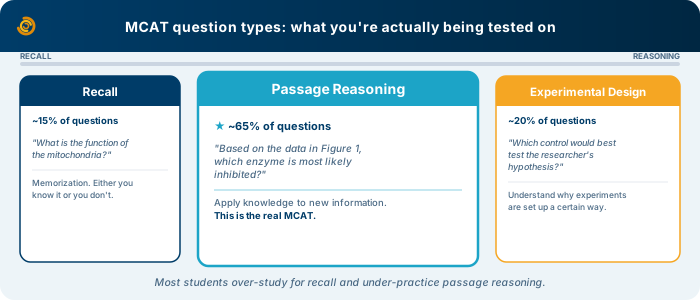
A bad question looks like this: “Which amino acid has a hydroxyl group on its side chain?” That’s a recall question. Either you memorized it or you didn’t. The real MCAT might require you to know that, but it won’t ask you directly. It’ll embed that knowledge in a bigger problem.
A good question looks more like this: you get a passage describing an experiment where researchers mutated a specific residue in an enzyme’s active site. The passage gives you data showing the enzyme lost activity. The question asks you to identify which mutation would explain the result, given what you know about amino acid properties and enzyme mechanisms. Now you need to combine passage comprehension, amino acid knowledge, and biochemical reasoning. That’s what the MCAT actually does.
Another example from psych/soc. A bad question: “Define cognitive dissonance.” A good question: a passage describes a study where participants were paid different amounts to lie about how enjoyable a boring task was, and then asked about their true attitudes afterward. The question asks you to predict which group would report more positive attitudes and explain why. You need to know cognitive dissonance, but you also need to apply it to a specific experimental setup that you haven’t seen before.
Passage-based reasoning is the entire game. If your practice questions don’t have passages, they’re not preparing you for the actual test.
How to use questions as a learning tool
Most students use practice questions like a thermometer. They do a set, check their score, feel good or bad about it, and move on. That’s a waste.
The learning happens in the review, not in the answering. Here’s the process I used, and the one I recommend to every student I work with.
After finishing a set of questions, go through every single one. Not just the ones you got wrong. The ones you got right, too. For each question, ask yourself:
Did I get this right for the right reason, or did I get lucky? If you can’t explain exactly why your answer is correct and why each wrong answer is wrong, you got lucky. That counts as a miss.
For questions you got wrong, write down what went wrong. Was it a content gap? A misread of the passage? A misread of the question? Did you get tricked by a distractor answer that was partially true? Each of these has a different fix.
Track your errors by topic and by error type. After 100 questions, you’ll have clear data on where you’re losing points. Maybe you’re strong on biology passages but fall apart on physics. Maybe you understand the content but consistently misread “LEAST likely” questions. Maybe you keep running out of time and guessing on the last few. The data tells you exactly what to work on next.
This is where our free MCAT resources page can help. We have tracking templates and error logs you can use to organize your review.
When to start doing questions
I get this question constantly. Students want to “finish content review first” before they start questions. I understand the instinct, but I think it’s wrong.
Start doing questions in week one. Yes, you’ll get a lot of them wrong. That’s the point. Getting a question wrong because you don’t know the content is actually more effective than reading about the content, because now you have an emotional memory of getting it wrong. You’ll look up the answer, learn the concept, and remember it better than if you’d just read about it passively.
During the content review phase (roughly the first third of your study plan), I’d say spend about 30% of your study time on questions. During the practice phase (the middle third), flip it to 70% questions. During the final stretch before your exam, you should be doing almost entirely full-length practice tests and targeted question sets.
The transition should feel gradual. If you’re six weeks out and still spending most of your time reading textbooks, something has gone wrong.
The right volume
How many practice questions should you do total? There’s no magic number, but I’ll give you a rough target.
Most students who score 515+ have done somewhere between 2,000 and 4,000 practice questions during their prep. That sounds like a lot, but over a 3-month period it’s about 25 to 45 per day. Totally doable if you’re studying full-time or near full-time.
The distribution matters too. You shouldn’t do 1,000 bio questions and 200 physics questions unless bio is genuinely your weakest section. Weight your practice toward your weak spots.
I did about 3,500 questions during my prep. Some were from AAMC material, some from third-party question banks, some from passage sets I’d find online. The AAMC ones were the most predictive of my actual test performance, but the third-party ones were where I did most of my learning, simply because there were more of them.
What to look for in a question bank
If you’re shopping for a question bank, here’s what I’d prioritize.
Passage-based questions, not standalone. The MCAT is a passage-based test. Your practice should reflect that.
Detailed explanations that explain the reasoning, not just the answer. “The answer is C because mitochondria are the site of oxidative phosphorylation” is not a useful explanation. “The answer is C because the passage states that the researcher inhibited complex III, which would prevent electron transport, reducing the proton gradient and therefore ATP production via oxidative phosphorylation in the mitochondria” is useful, because it connects the passage to the content.
Topic filtering so you can target specific weak areas. Being able to say “give me 20 questions on fluid dynamics” or “give me 15 questions on social stratification” is enormously valuable when you’re trying to patch specific gaps.
Performance tracking so you can see trends over time. Are you improving in your weak areas? Is a new weakness emerging?
We built the Premier MCAT Prep question bank with all of these features because they’re what I wished I’d had when I was studying. But whatever bank you use, make sure it has at least the first two.
The bottom line
Content review gives you the raw material. Practice questions teach you how to use it under test conditions. After your first month of studying, questions should be the center of your prep, not a supplement to it.
The students I’ve seen make the biggest score jumps are almost always the ones who committed to a high-volume, high-quality question practice routine with disciplined review. Not the ones who read the most textbooks. Not the ones with the most color-coded notes. The ones who sat down, did hard questions, got things wrong, figured out why, and did more.
That’s the work. It’s not glamorous. But it’s what moves scores.