
Study Planning
MCAT Score Not Improving? Here's What to Change
Your MCAT score is stuck and more studying isn't helping. A 527 scorer breaks down the 4 real reasons scores plateau and exactly what to do about each one.
You’ve been studying for weeks. You’ve done the practice tests. You’ve reviewed your mistakes. You’ve tried new resources, new flashcard decks, new study schedules. And your score isn’t moving.
I’ve worked with hundreds of MCAT students as the founder of Premier MCAT Prep, and score plateaus are the single most common reason students reach out for help. The frustration is real, and I want to be honest with you about something upfront: the fix is almost never “study more.” The fix is almost always “study differently.”
Here’s what’s actually going on when your MCAT score stops improving, and exactly what to change.
First: figure out why you’re stuck
Most students who plateau treat it as a single problem. “My score isn’t going up.” But a plateau isn’t one problem. It’s a symptom, and it has different causes that require completely different solutions.
Before you change anything about your study plan, you need to diagnose which type of problem is actually holding you back.
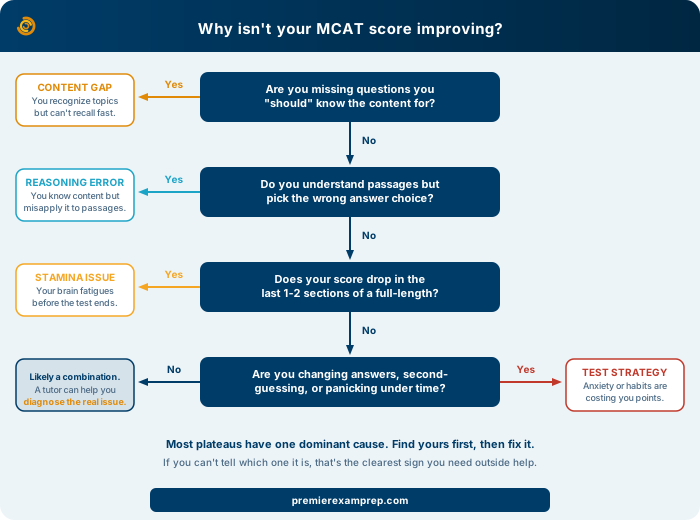
There are four root causes behind nearly every MCAT plateau. You probably have one dominant issue, possibly two. Rarely all four. And the worst thing you can do is apply the wrong fix to the wrong problem — like spending another week on content review when your real issue is passage reasoning.
The 4 types of errors (and the fix for each)
Go through your last two practice tests. For every question you got wrong, categorize it. Don’t skip this step. The pattern will tell you everything.
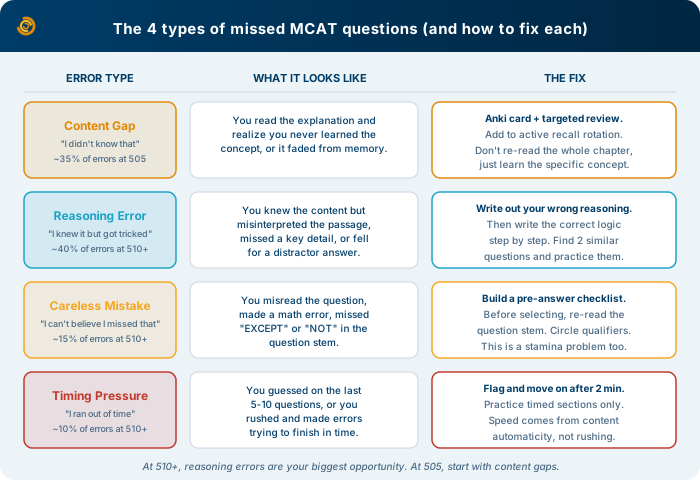
1. Content gaps: “I didn’t know that”
You read the answer explanation and realize you never learned the concept, or you learned it once and it didn’t stick. This is the most straightforward problem and the easiest to fix.
How to identify it: You couldn’t have gotten the question right no matter how carefully you read the passage, because you didn’t have the underlying knowledge.
The fix: Don’t re-read the entire chapter. That’s the mistake most students make. Instead, create a targeted Anki card or note for the specific concept you missed, and add it to your active recall rotation. If you’re missing content questions across many different topics, you may need to revisit your content review approach — our guides on essential MCAT equations and amino acid memorization cover two of the most common gap areas. But if it’s concentrated in 2-3 areas (most students), targeted review is far more efficient than starting over.
The trap to avoid: Spending weeks on content review when you only have gaps in a few specific topics. Your practice tests will tell you exactly which topics are costing you points. Trust the data over your anxiety.
At the 505 level, content gaps are typically about 35% of your missed questions. By 510+, they drop to about 15-20%. If you’re scoring 510+ and still think content is your main problem, it probably isn’t.
2. Reasoning errors: “I knew it but got it wrong”
This is the big one. This is what stops most students from breaking through to 520+, and it’s the hardest to fix on your own because you often can’t see it happening.
You knew the content. You understood the passage. But you picked the wrong answer anyway. Maybe you misinterpreted what the question was asking. Maybe you fell for a distractor that sounded right. Maybe you didn’t connect the passage information to your content knowledge correctly.
How to identify it: When you read the answer explanation, you think “I knew that.” But you still got it wrong. The explanation makes immediate sense to you. The content wasn’t the problem.
The fix: This one takes work. For every reasoning error, write down two things:
- What your actual thought process was when you picked your answer
- What the correct thought process should have been
Then compare them. Where exactly did your reasoning diverge from the correct reasoning? Was it a misread? An assumption? A failure to use passage data?
After doing this for 20-30 questions, you’ll start seeing patterns. Maybe you consistently ignore data tables in passages. Maybe you fall for answer choices that are true statements but don’t answer the question asked. Maybe you’re not eliminating wrong answers before selecting one.
The trap to avoid: Telling yourself “I just need to be more careful.” That’s not actionable. Carelessness isn’t a root cause, it’s a description. You need to know the specific reasoning pattern that’s causing the error.
At the 510+ level, reasoning errors are typically 40% or more of your missed questions. This is where most of your improvement will come from if you’re in the 510-517 range.
3. Careless mistakes: “I can’t believe I missed that”
You misread the question stem. You missed the word “EXCEPT.” You made an arithmetic error. You picked answer B when you meant to pick answer C.
These feel random, but they’re usually not. Careless mistakes cluster in specific situations: late in a section (fatigue), on questions you think are easy (overconfidence), or on passages about topics you’re very familiar with (autopilot mode).
How to identify it: The moment you see the right answer, you know you should have gotten it. There’s no new information in the explanation. You just messed up.
The fix: Build a 3-second pre-answer check. Before you select any answer:
- Re-read the last line of the question stem
- Check for qualifiers: NOT, EXCEPT, LEAST, MOST, BEST
- Confirm your selected answer actually matches what was asked
This sounds obvious. It is obvious. But under time pressure in hour five of a 7-hour test, obvious habits break down. The students who don’t make careless mistakes aren’t more careful by nature. They have a system that forces them to check, even when they’re tired.
The trap to avoid: Dismissing careless mistakes as “not real problems.” If you’re making 3-4 per section, that’s 12+ points you’re leaving on the table. At the 510-515 level, eliminating careless mistakes alone can push you to 515-518.
4. Timing pressure: “I ran out of time”
You guessed on the last 5-10 questions. Or you rushed through the back half of a section and made errors you wouldn’t have made with more time. Or you spent 4 minutes on one hard question and paid for it across the rest of the section.
How to identify it: Look at your accuracy for the first half vs. second half of each section. If there’s a significant drop, timing is a factor. Also count how many questions you flagged and guessed on.
The fix: The 2-minute rule. If you’ve spent 2 minutes on a question and aren’t making progress, flag it and move on. Come back at the end. This one habit recovers 3-5 questions per section for most students.
But the deeper fix is that timing problems are usually content automaticity problems in disguise. If you have to spend 30 seconds recalling a formula or reconstructing a concept like chemical equilibrium, that’s 30 seconds you don’t have for reasoning. The students who finish on time aren’t reading faster. They’re recalling faster because their content knowledge is truly automatic.
The trap to avoid: Practicing at faster speeds. Speed is a side effect of mastery, not a skill you train directly. If you’re running out of time, the answer is almost always “know the content more deeply,” not “read faster.”
The plateau at 505-510
If your score is stuck in the 505-510 range, you likely have a mix of content gaps and reasoning errors. This is actually good news because it means there’s substantial room for improvement on both fronts.
Priority actions:
-
Audit your content knowledge. Go through your last two practice tests and count how many questions you missed purely because you didn’t know the content. Common weak spots include the cell, kinematics, and stoichiometry. If it’s more than 20% of your errors, you need more targeted content review before anything else.
-
Switch from passive to active review. If you’ve been reading prep books or watching lecture videos, that’s your problem. Passive review builds familiarity, not recall. Switch to practice questions, Anki cards, and teaching concepts to yourself out loud. Active recall is how content becomes automatic.
-
Use our free resources strategically. The equation sheets, study guides, and psych/soc document on our resources page aren’t meant to be read cover to cover. Use them as reference tools. Miss a question about Henderson-Hasselbalch? Review our acids and bases chapter, study that specific equation, and make a flashcard. That’s targeted review.
The plateau at 510-515
This is the most common plateau range, and it’s where the problem almost always shifts from content to reasoning. You know the material. Your issue is that you’re not applying it correctly under test conditions.
Priority actions:
-
Do the error analysis described above. For real. Go through 50+ missed questions and categorize every one. This is the single most valuable exercise you can do at this score level. It’s tedious, and it works.
-
Practice passage-based reasoning, not content recall. At 510+, the questions you’re missing are almost never pure content recall. They’re “which of these interpretations of the passage data is supported by what you know about X.” If your daily practice is still content-focused (flashcards, chapter review), you’re optimizing for the wrong thing. For CARS specifically, see our guide to improving your CARS score.
-
Review the questions you got right but were uncertain about. If you guessed correctly, treat it as a miss. Your reasoning was wrong even though the outcome was right. These “lucky gets” hide weaknesses that will cost you on test day.
The plateau at 515-520
You’re close. The margin between where you are and where you want to be is probably 6-10 questions across the entire exam. That’s 1-2 per section.
Priority actions:
-
Find your section anchor. Most students in this range have one section that’s consistently 1-2 points lower than the others. That’s your highest-ROI investment. If it’s CARS, read our CARS strategy guide. A tutor who has scored 520+ can help here because the issues at this level are subtle enough that they’re genuinely hard to self-diagnose.
-
Simulate test day conditions perfectly. Every full-length from here on should be taken at the same time of day you’ll take the real exam, in a quiet room, with proper breaks, wearing what you’ll wear on test day. Performance at this level is partly about managing your physical and mental state across 7+ hours.
-
Stop studying new content. Seriously. At 515+, you know enough content. Any remaining content gaps are so specific that you’ll find them through practice, not review. Your time is better spent on timed practice passages and full-length exams.
When it’s time to get outside help
Some plateaus break with the right adjustments to your study approach. Others don’t. Here are the signs that self-diagnosis isn’t working:
You’ve done the error analysis and can’t find a clear pattern. If your missed questions seem random across different error types, topics, and sections, there may be a subtler issue that you’re too close to see. This is exactly the scenario where an experienced tutor adds the most value, not to teach you content, but to watch your reasoning in real time and identify the pattern you’re missing.
You’ve made changes and your score still hasn’t moved after 2-3 practice tests. At some point, trial and error becomes inefficient. If you’ve genuinely tried a different approach for 2-3 weeks and seen zero improvement, the approach probably isn’t the right one. A tutor who has worked with hundreds of students has seen your pattern before and can shortcut the diagnosis.
Your test is in less than 6 weeks and you need more than 3-5 points. You don’t have time for extended experimentation. This is the situation where targeted help pays for itself by focusing every remaining study hour on the highest-impact changes.
We offer free consultations where we’ll look at your practice test scores and give you an honest assessment of what’s going on. If we think you can fix it yourself, we’ll tell you that. If we think tutoring would help, we’ll explain specifically why. Schedule a free consultation here — no commitment required.
What doesn’t work
Let me save you time on approaches that almost never fix a plateau:
Switching prep companies. If Kaplan materials aren’t working, Blueprint materials probably won’t either. The content is largely the same. The issue is how you’re studying, not what you’re studying from.
Starting over from scratch. You don’t need to re-do content review from the beginning. You need to identify specific gaps and fix them. Starting over feels productive but wastes weeks of time on content you already know.
Taking a long break. A weekend off is fine. A week off might be justified if you’re genuinely burned out. But a month-long break doesn’t fix the underlying problem and often leads to content decay that creates new problems.
Doing more of the same thing, harder. If your study approach produced a 510 after 200 hours, doing the same approach for 400 hours will probably produce a 511 or 512, not a 518. Diminishing returns are real. You need to change the approach, not the volume.
The bottom line
Your MCAT score isn’t improving because something specific in your approach isn’t working. Not because you’re not smart enough, not because the test is unfair, and not because you need to study more hours.
The fix is diagnosis before prescription. Figure out which of the four error types is dominating your missed questions, then apply the specific fix for that type. If you can’t identify the pattern yourself, get someone who can.
A plateau isn’t a ceiling. It’s a signal that you’ve extracted everything you can from your current approach and it’s time for a new one.
Related reading:
- How to Score 520+ on the MCAT: A Complete Guide — the full playbook from a 527 scorer
- MCAT Practice Test Scores vs. Actual: What to Expect — understand what your practice scores really predict
- MCAT Study Plan: 3-Month Schedule — restructure your prep from scratch if needed
- Is MCAT Tutoring Worth It? Honest Take — when 1-on-1 help makes sense and when it doesn’t
- Free MCAT Practice Questions — test yourself section by section
Ready to break through your plateau? Talk to a 520+ scoring tutor for free — we’ll review your practice scores and tell you exactly what’s holding you back.