
Section Strategy
How to Memorize Amino Acids (MCAT)
A practical system for learning all 20 amino acids, from structures and single-letter codes to charge behavior at physiological pH.
I tutored a student last semester who could draw every amino acid structure from memory. All twenty, side chains included, no hesitation. She still missed amino acid questions on her practice exams.
The problem wasn’t memorization. It was that she’d memorized the structures in isolation, without connecting them to the properties the MCAT actually tests. She could sketch tryptophan’s indole ring but couldn’t predict how a Lys-to-Glu mutation would affect a protein’s folding at pH 7.
That disconnect is common. So here’s the approach I use with my students: learn the groups first, then the structures, then the weird edge cases that show up in passages.
What the MCAT actually wants you to know
Let’s get specific. The MCAT will test you on:
- All 20 amino acid names, three-letter abbreviations, and single-letter codes
- Side chain properties (polar, nonpolar, charged, aromatic)
- How charge changes with pH (related to acid-base chemistry)
- How to calculate isoelectric point (pI) given pKa values
- Special structural roles (disulfide bonds, helix breakers, active site residues) — see also bonding and chemical interactions
- How mutations that swap one property for another affect protein behavior
You do not need to memorize every pKa to three decimal places. You do need to know which amino acids are positive at pH 7.4, which are negative, and which are neutral. That distinction drives most of the passage-based questions.
Start with the five groups, not the twenty structures
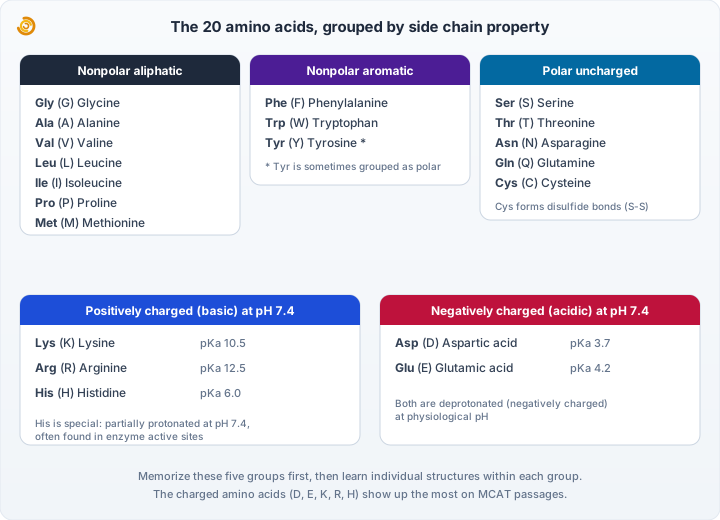
Trying to memorize all twenty amino acids alphabetically is like trying to memorize a phone book. Your brain has nothing to hang the information on. Instead, start with the five property-based groups:
Nonpolar aliphatic (7): Gly, Ala, Val, Leu, Ile, Pro, Met
Nonpolar aromatic (3): Phe, Trp, Tyr
Polar uncharged (5): Ser, Thr, Asn, Gln, Cys
Positively charged at pH 7.4 (3): Lys, Arg, His
Negatively charged at pH 7.4 (2): Asp, Glu
Notice the math works out: 7 + 3 + 5 + 3 + 2 = 20. If you can recall the groups and count, you have a built-in check for whether you’ve forgotten one.
Mnemonics that actually stick
I’ve seen dozens of mnemonic systems. The ones that work are the ones you make yourself, but here are starting points my students tend to keep:
Nonpolar aliphatic — “Great Apes Very Loud In Private, Man”
(Gly, Ala, Val, Leu, Ile, Pro, Met)
Aromatic — WiFeY
(Trp, Phe, Tyr — all have ring structures, Tyr has a hydroxyl that makes it borderline polar)
Polar uncharged — “Santa’s Team Needs Quality Christmas”
(Ser, Thr, Asn, Gln, Cys)
Positively charged (basic) — The positive amino acids are on the “right” side of the alphabet: King Richard’s Horse. Or just remember the letters K, R, H.
Negatively charged (acidic) — Death and Evil. Just two. Asp and Glu. The two acidic amino acids are also the two that have “-ic acid” in their names (aspartic acid, glutamic acid), which makes them easy to spot.
If those mnemonics don’t click, change them. The best mnemonic is the one you actually remember three weeks from now.
The general structure, then the side chains
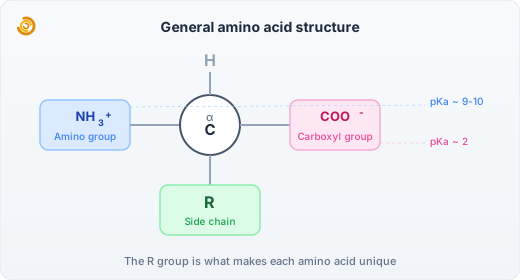
Every amino acid has the same backbone: an alpha carbon bonded to an amino group (NH3+), a carboxyl group (COO-), a hydrogen, and the R group (side chain). Once you’ve internalized this template, learning individual amino acids becomes a matter of swapping out the R group.
Some practical tips for learning the structures:
Draw them, don’t just read them. There’s good research on this. Drawing forces your brain to reconstruct the structure actively, which builds stronger recall than passive review. I tell my students to draw all 20 from memory every other day during their content review phase. It takes about 15 minutes once you get the hang of it.
Look for structural patterns within groups. The aliphatic nonpolars are mostly carbon and hydrogen chains that get progressively longer and more branched (Gly to Ala to Val to Leu to Ile). The polar uncharged amino acids all have either an -OH or an amide group in their side chain. Once you see the pattern, the individual structures feel less random.
Learn the special cases explicitly. A few amino acids have unique structural features the MCAT loves to test:
- Proline has a cyclic side chain that bonds back to the backbone nitrogen. This locks the backbone angle and breaks alpha helices. Expect passage questions about protein structure disruption.
- Cysteine has a thiol (-SH) group that can form disulfide bonds with another cysteine. If a question mentions “crosslinks” or “oxidizing conditions,” think cysteine.
- Glycine is the smallest amino acid (R group is just a hydrogen). It shows up in tight turns and collagen because it can fit where others can’t.
- Histidine has a pKa around 6, which means it’s partially protonated at physiological pH. This is why it appears in so many enzyme active sites, where it acts as a proton shuttle.
Charge behavior: the part most students get wrong
Here’s a question I ask my students early on: “At pH 7.4, what is the net charge of a free lysine molecule?”
Most say +1. The actual answer is +1, but their reasoning is usually wrong. They think only the side chain contributes. In reality, free lysine at pH 7.4 has three ionizable groups: the amino group (protonated, +1), the carboxyl group (deprotonated, -1), and the side chain amino group (protonated, +1). Net charge: +1.
The MCAT cares about this kind of reasoning. What you need to know:
At physiological pH (7.4):
- The backbone amino group is protonated (+1)
- The backbone carboxyl group is deprotonated (-1)
- These cancel out, so the side chain determines the net charge
- Asp and Glu side chains are negative (-1 each)
- Lys, Arg side chains are positive (+1 each)
- His is tricky: about 10% protonated at pH 7.4
When pH changes:
- Lower pH = more protonation = more positive charge
- Higher pH = more deprotonation = more negative charge
- To calculate pI, average the two pKa values that bracket the neutral (zwitterionic) form
You don’t need to memorize exact pKa values for every amino acid. But you should know the approximate ranges: backbone COOH is around 2, backbone NH3+ is around 9-10, and the charged side chains fall where you’d expect (acidic ones low, basic ones high, histidine right near physiological pH).
How to actually test yourself
Flashcards work, but only if you use them in layers. Don’t try to learn everything at once.
Week 1: Learn the five groups and the single-letter codes. Quiz yourself on classification only. Given “Threonine,” you should be able to say: polar uncharged, Thr, T.
Week 2: Add structures. Draw all 20 from memory every other day. Flag the ones you keep getting wrong. For most students, these are Trp (complex ring), His (imidazole ring), and Pro (cyclic structure).
Week 3: Add charge behavior. Given an amino acid and a pH, predict the net charge. Start with pH 7.4, then try extremes (pH 1, pH 13), then try tricky cases (pH 5 for histidine).
Week 4 onward: Shift to passage-based practice. This aligns with the passage-heavy phase in our 3-month study plan. The MCAT won’t ask you to draw leucine. It will give you a passage about a protein with a Leu-to-Asp mutation and ask you to predict the effect on tertiary structure. That’s where this knowledge pays off.
We keep an amino acids video on our free resources page that walks through the memorization process visually. If you’re more of a visual learner, start there and then come back to the drawing practice.
The mutations shortcut
About a third of the amino acid questions I’ve seen on practice exams and real exams involve mutations. The question gives you a wild-type residue and a mutant residue and asks what happens.
You only need to ask one question: did the mutation cross a group boundary?
If a nonpolar residue gets swapped for a charged one, the hydrophobic core of the protein is probably disrupted. Misfolding. If a negatively charged residue becomes positive, a salt bridge flipped. Altered binding, maybe loss of function. But if leucine becomes isoleucine? That’s within the same group. Conservative mutation, probably minimal effect.
If you know the five groups cold, you can answer these questions in under a minute. You’re really just asking: did the mutation cross a group boundary?
This pays off beyond biochemistry
I should mention: amino acids don’t just show up in the biochemistry section. They appear in biology passages (protein function, gene expression), organic chemistry passages (reaction mechanisms involving side chains), and occasionally even in psych/soc passages that touch on neurotransmitter synthesis.
If you’re in content review, spend two focused weeks on this using the schedule above. Pair it with our essential equations guide to cover the other major memorization target. If you’re deep into practice and still getting amino acid questions wrong, pause and fix it now. It’s one of those foundation topics where shakiness bleeds into everything else.
We have an amino acids video on our free resources page that walks through the visual memorization process. There’s also the 86-page P/S document and the equation sheet there. And if you want someone to quiz you and find the specific gaps in your knowledge, that’s basically what our tutors do all day.