
Section Strategy
MCAT Equations You Actually Need to Know
A focused guide to the most tested MCAT equations and formulas, organized by topic with context on how they appear in passages.
There are hundreds of equations in your MCAT prep books. You do not need to memorize all of them.
I’m not saying that to make you feel better. I’m saying it because it’s true, and because I watched too many students, myself included at first, waste hours drilling formulas that almost never get tested. When I started studying, I had a 12-page equation list taped above my desk. By test day, the list that actually mattered fit on two pages. I scored 527.
The MCAT is not a physics exam. It does test physics concepts, but the way those concepts appear in Chem/Phys passages is different from what you see in a university physics final. The test cares more about whether you understand relationships between variables than whether you can plug numbers into a formula and crank out an answer. That said, there are equations you absolutely must know cold, because they show up constantly and you won’t have time to re-derive them under pressure.
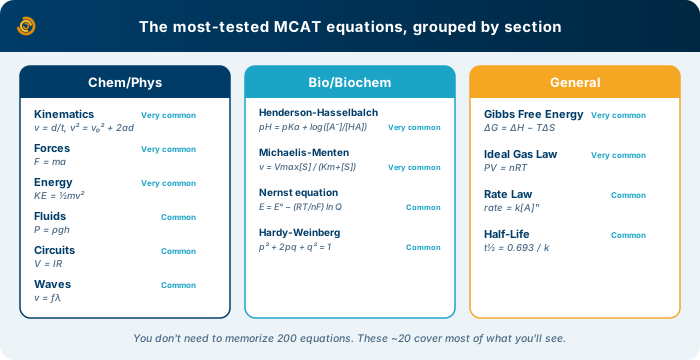
Here’s my breakdown of the equations that come up most, organized by topic area. I’ve included context on how each one tends to appear in passages, because knowing the formula is only half the battle. We also have a downloadable MCAT equation sheet that covers all of these in a printable format.
Kinematics and forces
v = v₀ + at and the other kinematic equations. These show up less than you’d expect on the real test, but when they do, the passage usually gives you a scenario (projectile motion, an object on a ramp) and asks you to reason about what happens when one variable changes. Rarely is it pure calculation. Know the equations, but more importantly, know that acceleration is constant in these problems and that the horizontal and vertical components are independent.
F = ma. Newton’s second law appears everywhere, often in disguise. Any passage about forces, pressure, or motion will assume you can connect force to acceleration. It also shows up in biology-adjacent questions. Think: forces on a blood vessel wall, tension in a muscle, the physics of breathing mechanics.
f = μN for friction. This comes up in passages about inclined planes and sometimes in experimental contexts where something is sliding. Know that static friction can vary up to a maximum value and kinetic friction is constant.
Energy and work
KE = ½mv² and PE = mgh. These two, plus conservation of energy, are probably the single highest-yield physics concept on the MCAT. A huge number of C/P questions boil down to energy conservation in some form. A ball rolling down a hill, a pendulum, a charged particle moving through a potential difference. If you see a passage and aren’t sure where to start, ask yourself: is energy conserved here? That question alone solves a lot of problems.
W = Fd cos θ. Work done by a force. The cos θ matters because the MCAT loves asking about work done by forces at an angle. If the force is perpendicular to displacement, work is zero. This shows up in circular motion questions and in passages about muscles applying force at an angle to a bone.
Fluids
P = ρgh (hydrostatic pressure). This appears in fluid statics problems and in physiology passages about blood pressure at different heights in the body. Know that pressure increases with depth.
A₁v₁ = A₂v₂ (continuity equation) and P + ½ρv² + ρgh = constant (Bernoulli’s equation). These two work together. The MCAT loves asking about what happens to fluid velocity and pressure when a pipe narrows. The key insight: when area decreases, velocity increases and pressure decreases. This shows up in passages about atherosclerosis, aneurysms, and garden-variety pipe problems.
Electricity and circuits
V = IR (Ohm’s law) and P = IV. These are bread-and-butter circuit equations. The MCAT tests circuits fairly often, and the questions are usually about what happens when you add or remove a resistor. Know the difference between series and parallel configurations. In series, current is the same everywhere and voltage divides. In parallel, voltage is the same across each branch and current divides.
F = kq₁q₂/r² (Coulomb’s law). Know that it follows the same inverse-square form as gravity. The MCAT uses this in electrostatics passages but also in biochemistry contexts. The interactions between charged amino acid side chains, for instance, follow Coulomb’s law. The test loves crossing boundaries between disciplines like that.
E = V/d for uniform electric fields between parallel plates. This shows up in passages about capacitors and electrophoresis. If you see a gel electrophoresis passage in C/P, expect to use this relationship.
Waves and optics
v = fλ. The wave equation appears in sound passages, light passages, and sometimes in passages about electromagnetic radiation in a biochemistry context (think spectroscopy). Know it.
n₁sin θ₁ = n₂sin θ₂ (Snell’s law). Optics passages show up on most MCAT administrations. The typical setup is light passing between media with different indices of refraction, and they’ll ask about the angle of refraction or total internal reflection. Know that total internal reflection occurs when going from a higher to lower index of refraction.
Thermodynamics and gases
PV = nRT (ideal gas law). This is tested constantly. Sometimes directly in gas law passages, sometimes in passages about respiratory physiology, sometimes in reaction stoichiometry. Know how to rearrange it. Know what happens to pressure when you decrease volume at constant temperature.
q = mcΔT (specific heat) and q = mL (latent heat during phase changes). Calorimetry passages are common. The key distinction the MCAT tests: during a phase change, temperature doesn’t change even though heat is being added. Students who mix up these two equations lose easy points.
ΔG = ΔH - TΔS. This is the single most important equation for connecting C/P to biochemistry. It tells you whether a reaction is spontaneous. Know the signs: negative ΔG means spontaneous, positive ΔH means endothermic, positive ΔS means increased disorder. The MCAT loves asking about how temperature affects spontaneity for reactions where ΔH and ΔS have the same sign.
Acids, bases, and equilibrium
pH = -log[H⁺] and pH + pOH = 14. Acid-base chemistry is one of the most heavily tested topics on the entire C/P section. You need these relationships to be automatic.
Ka × Kb = Kw = 1 × 10⁻¹⁴. This connects conjugate acid-base pairs and shows up whenever a passage asks about buffer systems or titrations.
Henderson-Hasselbalch: pH = pKa + log([A⁻]/[HA]). Buffer problems are a near-guarantee on test day. The MCAT usually presents a titration curve or a biological buffer system (think bicarbonate buffering in blood) and asks you to determine the pH at various points. At the half-equivalence point, pH equals pKa. That single fact answers probably 40% of the Henderson-Hasselbalch questions I’ve seen.
Radioactive decay and nuclear
N = N₀e^(-λt) or equivalently, using half-life: N = N₀(½)^(t/t½). Radioactive decay shows up in passages about medical imaging, radiometric dating, or tracer experiments. The questions are usually straightforward if you know the formula. The half-life version is easier to use when the problem gives you time in multiples of the half-life.
How to actually study these
Memorizing equations in isolation doesn’t work well for the MCAT. Here’s what I did instead.
First, I made sure I understood what each equation meant conceptually, not just what the variables were. For F = ma, that means understanding that force is what causes mass to accelerate, and that a heavier object requires more force for the same acceleration. That conceptual layer is what the MCAT actually tests.
Second, I practiced using each equation in passage context. If your score is stuck at a plateau, weak equation recall is often the hidden cause — you’re spending time reconstructing formulas instead of reasoning through the passage. The question bank is useful for this because you can filter by topic and see how equations get embedded into experimental scenarios. A standalone problem that says “calculate the force” is very different from a passage that describes an experiment and requires you to figure out which equation is even relevant.
Third, I stopped trying to memorize equations I could derive. If you know the ideal gas law and the definition of kinetic energy, you can figure out the relationship between temperature and molecular speed. You don’t need to memorize a separate formula for that.
The equations on this list are the ones worth memorizing outright. They come up too often and in too many variations for you to waste time deriving them under test-day pressure.
What about biochemistry and biology equations?
The Biological and Biochemical Foundations section is much less equation-heavy than C/P. You’ll want to pair equation study with amino acid memorization, since biochemistry passages often combine both. The main quantitative tools you need are Michaelis-Menten kinetics (Vmax, Km, and how they change with different types of inhibitors), the Nernst equation for membrane potentials, and Hardy-Weinberg equilibrium for genetics passages.
Michaelis-Menten is particularly high-yield. The MCAT consistently tests whether you can look at a Lineweaver-Burk plot and determine what type of inhibition is occurring. Know that competitive inhibitors increase Km (apparent) without changing Vmax, and uncompetitive inhibitors decrease both Km (apparent) and Vmax.
A note on calculator-free math
Since you can’t use a calculator, many equation-based questions are designed to work out cleanly. If you’re getting ugly numbers in the middle of a C/P calculation, you’ve probably made an error or there’s a simpler approach. The test writers pick numbers that simplify. Practice mental math and estimation. Being able to quickly approximate log(3) as roughly 0.48, or knowing that √2 is about 1.4, will save you significant time.
Download our free MCAT equation sheet for a clean, printable reference of everything covered here. Use it during content review, then wean yourself off it as you transition to timed practice. By test day, these equations should be second nature. For a complete study framework that shows when to drill equations vs. when to shift to passage practice, see our 3-month MCAT study plan.
Frequently asked questions
What equations do you need to know for the MCAT?
Key equations include F=ma, PV=nRT, V=IR, pH=-log[H+], Henderson-Hasselbalch, Gibbs free energy, kinematic equations, and Bernoulli's equation.
Do you need to memorize equations for the MCAT?
Yes, you need to memorize the most frequently tested equations. The MCAT tests your ability to apply them in passage context, not just recall them.
Can you use a calculator on the MCAT?
No, calculators are not allowed. Questions are designed to work out cleanly, so practice mental math and estimation.
What is the most important equation for the MCAT?
Conservation of energy (KE = 1/2mv2 and PE = mgh) is arguably the highest-yield physics concept, while Henderson-Hasselbalch is essential for acid-base chemistry.