
Study Planning
Is MCAT Tutoring Worth It? Honest Take
When MCAT tutoring is worth the cost and when self-study works better. Honest advice on MCAT tutor vs self study from a 527 scorer.
I run a company that offers MCAT tutoring, so you should read this post with that bias in mind. I’m going to be as honest as I can, and part of that honesty is telling you upfront that I have a financial interest in you choosing tutoring. With that said, I genuinely believe the advice below is accurate, and I regularly tell prospective students not to sign up if I don’t think tutoring is the right move for them.
Here’s my honest take on when MCAT tutoring is worth the money and when it isn’t.
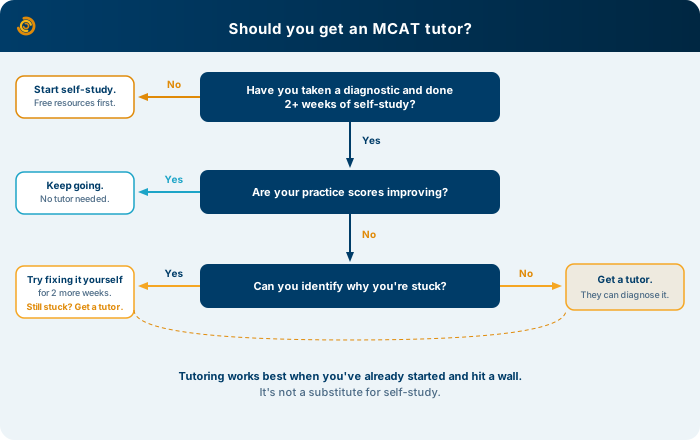
Self-study works for a lot of people
Let me start with something that might seem counterproductive for me to say: most people who score well on the MCAT did it through self-study. They bought prep books, used free resources, did practice questions, took full-length exams, and figured it out on their own. I did this myself. When I prepped for the MCAT and scored 527, I did not have a tutor.
Self-study works when you have the discipline to follow a plan, the ability to diagnose your own weaknesses, and enough time to iterate. If you can take a practice test, look at your results, figure out why you’re missing questions, adjust your approach, and see improvement on the next practice test, you don’t need a tutor. You’re already doing what a tutor would help you do.
There are excellent free and low-cost resources available. Khan Academy’s MCAT content is solid. AAMC’s official materials are indispensable. A solid 3-month study plan is free. Our free resources page has study guides, equation sheets, and other tools that cost nothing. The information is out there. What a tutor provides is not access to secret knowledge.
So what does a tutor actually provide?
If the content is freely available and the test prep books cover everything, what are you paying for when you hire a tutor?
You’re paying for diagnosis. The hardest part of MCAT prep isn’t learning the material. It’s figuring out why you’re not scoring higher when you feel like you know the material. A good tutor can watch you work through a passage, identify the exact point where your reasoning goes wrong, and tell you what to fix. Most students can’t do that for themselves, at least not efficiently.
You’re paying for accountability. This sounds soft, but it’s real. When you’re self-studying, nobody notices if you skip a day or spend your “study time” reorganizing your flashcard deck instead of doing hard practice. A standing weekly session with a tutor creates a structure you have to show up to. For some people, that structure is the difference between consistent progress and weeks of drift.
You’re paying for efficiency. A tutor who has worked with dozens or hundreds of MCAT students has seen your problem before. They know the common sticking points, the typical error patterns, the mistakes that look like content gaps but are actually reading comprehension issues. What might take you weeks to figure out on your own, a tutor can identify in a single session. When you’re on a tight timeline, that efficiency has real value.
You’re paying for someone who has been where you want to go. A tutor who scored well on the MCAT and understands the test at a deep level can offer perspective that prep books can’t. They can tell you which topics are high-yield and which ones you’re over-studying.
When tutoring is worth it
Based on my experience working with students, tutoring tends to be worth the investment in a few specific situations.
You’ve hit a plateau. You’ve been studying for weeks, you’ve done multiple practice tests, and your score isn’t moving. You’ve tried different resources, different strategies, different timing approaches, and you’re stuck at the same number. This is the single best reason to get a tutor. A plateau usually means there’s a systematic issue in your approach that you can’t see because you’re too close to it. A tutor can find it.
You have a specific section weakness that isn’t responding to self-study. Maybe your CARS score is stuck at 125 while your science sections are 129-130. Maybe you keep bombing physics passages even though you’ve reviewed the content multiple times. Section-specific problems often have section-specific causes, and a tutor can pinpoint those faster than trial and error.
You’re on a short timeline. If you have 6-8 weeks until your test and you need to gain 5+ points, you don’t have time to figure everything out by trial and error. A tutor can help you triage, focusing your limited time on the highest-impact changes. I’ve worked with students who gained 8-10 points in 6 weeks, but that kind of jump requires very targeted work. You can see some of those results on our score increase page.
You have accountability issues. If you’re honest with yourself and you know that you’ve been “studying” for the MCAT for months but haven’t actually put in consistent, focused hours, a tutor can provide the external structure you need. This isn’t a character flaw. Some people work better with external deadlines and someone checking their progress. If that’s you, own it, and use a tutor to create the structure you need.
You can afford it without significant financial stress. This matters. If paying for tutoring means you’re skipping meals or taking on high-interest debt, it’s probably not worth it. There are free ways to get many of the same benefits (study groups, Reddit communities, free practice materials).
When tutoring is not worth it
There are situations where I actively discourage students from signing up for tutoring.
You haven’t done any self-study yet. If you come to me having never opened a prep book, never done a practice question, never taken a diagnostic, I’m going to tell you to go do those things first. A tutor can’t teach you all of biochemistry in an hour a week. That’s what textbooks and content review are for. Tutoring works best when you’ve already built a foundation and need help refining your approach. Starting from zero with a tutor is an expensive way to do something a $50 book set does better.
You just want someone to hand you a study plan. A study plan is important, but you don’t need to pay tutor rates for one. There are good free study plans available (including ones on our site). If the only thing you need is a schedule telling you what to do each week, save your money and use a free plan.
You’re scoring at or above your target and just want reassurance. I’ve had students reach out who are already scoring 518-520 on practice tests and want to get to 522. Going from 519 to 522 is a coin flip on test day. The variance in the exam itself might account for those 2-3 points. Spending thousands of dollars chasing a couple of points at the extreme high end is usually not a good investment.
You’re hoping a tutor will do the work for you. A tutor meets with you for maybe 1-2 hours per week. The other 30-40 hours of studying that week are on you. A tutor makes your self-study more effective, but you still have to do the self-study.
The cost question
MCAT tutoring is expensive. Rates typically range from $80 to $250+ per hour depending on the tutor’s credentials, experience, and the company they work through. Big prep companies often charge $150-200/hour. Independent tutors vary widely.
If you’re doing one session per week for 12 weeks, that’s somewhere between $960 and $3,000+. On top of whatever you’re spending on prep books, practice tests, and application fees.
Here’s how I think about the math. If tutoring helps you avoid a retake, it pays for itself. A retake costs $355 in registration fees (2026 AAMC fee), plus months of additional study time, plus the psychological toll, plus potentially delaying your application cycle by a year. A year’s delay to medical school has an opportunity cost that dwarfs the cost of tutoring.
If tutoring helps you score 3-5 points higher, that could change which schools you’re competitive at, which could affect your long-term career trajectory. That’s harder to put a dollar value on, but it’s real.
That said, if you’re choosing between tutoring and being able to pay rent, pay rent. The MCAT is important, but it’s not more important than keeping your life stable during the prep process.
Alternatives to paid tutoring
If tutoring isn’t in your budget, here are options that provide some of the same benefits.
Study groups with students who are scoring at or above your level. Having someone else look at your practice test results and discuss your reasoning can replicate part of what a tutor does. The key is finding study partners who are analytical about their own prep, not just people to commiserate with.
r/MCAT on Reddit has a huge community sharing strategies, score breakdowns, and advice. The quality varies, but there are genuinely helpful people there who have scored well and are willing to talk through specific problems.
Some tutoring companies (including Premier MCAT Prep) offer periodic free workshops or group Q&A sessions. These aren’t the same as one-on-one tutoring, but they can give you access to expert feedback without the per-hour cost.
My bottom line
MCAT tutoring is worth it when you have a specific problem that self-study hasn’t solved, you’re on a timeline that doesn’t allow for extended trial and error, or you need external accountability to stay on track. It’s not worth it when you haven’t started studying yet, when you just need a study plan, or when you’re already hitting your target scores.
Self-study is the foundation of all MCAT prep. Tutoring is a tool that makes self-study more efficient for certain students in certain situations. It’s not a shortcut and it’s not magic. But for the right person at the right time, it can be the thing that unlocks the score improvement they’ve been working toward.
If you’re unsure whether tutoring is right for you, take a diagnostic, do two weeks of focused self-study, take another practice test, and see what happens. If you’re improving and can identify why, keep going on your own. If you’re stuck and can’t figure out what’s wrong, that’s when it’s time to consider bringing someone else in.