
MCAT Logistics
MCAT Percentile Chart 2026: What Every Score Means for Med School
Every MCAT score from 472 to 528 with its 2026 AAMC percentile, and what each one means for DO, MD, mid-tier, and top-20 programs. By a 527 scorer.
A 511 MCAT is the 82nd percentile — the median for US MD matriculants in the 2024–25 cycle. A 503 is the 58th percentile and the median for DO matriculants. The complete percentile chart for every score from 490 to 528 is below.
MCAT Score Percentile Chart (2026 AAMC)
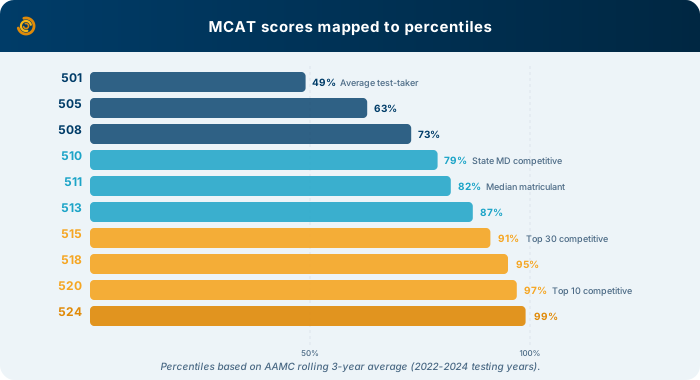
| Score | Percentile | Score | Percentile |
|---|---|---|---|
| 528 | 100 | 508 | 74 |
| 527 | >99 | 507 | 71 |
| 526 | >99 | 506 | 68 |
| 525 | 100 | 505 | 65 |
| 524 | 100 | 504 | 62 |
| 523 | 99 | 503 | 58 ← DO median |
| 522 | 99 | 502 | 55 |
| 521 | 98 | 501 | 52 |
| 520 | 97 ← Top 3% | 500 | 49 |
| 519 | 96 | 499 | 46 |
| 518 | 95 | 498 | 42 |
| 517 | 94 | 497 | 39 |
| 516 | 92 | 496 | 36 |
| 515 | 91 ← Top 10% | 495 | 34 |
| 514 | 89 | 494 | 31 |
| 513 | 87 | 493 | 28 |
| 512 | 84 | 492 | 25 |
| 511 | 82 ← MD median | 491 | 23 |
| 510 | 79 | 490 | 21 |
| 509 | 77 |
Source: AAMC, percentile ranks in effect through April 30, 2026, based on 293,882 test administrations from 2022 to 2024 (mean total score 500.5, SD 11.2). Scores from 472–489 fall below the 21st percentile; the full AAMC table is here.
The four numbers worth memorizing
- 511 = 82nd percentile = MD matriculant median. Half of everyone who got into a US MD school in 2024–25 scored at or below this.
- 503 = 58th percentile = DO matriculant median. The 9-point gap between DO and MD medians is consistent year over year.
- 506.3 = MD applicant mean. The mean for everyone who applied (matriculated or not) is about 506. The 6-point gap between applicant and matriculant means is the score’s actual filtering effect.
- 520 = 97th percentile. The threshold most premeds associate with “top-tier competitive.” It opens every school score-wise but is rarely the binding constraint at programs with medians above 518.
A percentile only matters relative to where you apply. To see the actual median MCAT and GPA for every US MD and DO program (and where your score lands against each), use our Med School Explorer, a free alternative to the AAMC MSAR.
How MCAT percentiles work
Your MCAT score is a number between 472 and 528. But the number by itself doesn’t tell you much. What matters is your percentile, which tells you how your score compares to everyone else who took the test. A 510 means something very different if 50% of test-takers scored higher versus if 80% scored lower.
I want to break down the actual percentile data, explain how these numbers are calculated, and give you practical guidance on what percentile you should be aiming for based on where you want to go to medical school.
The AAMC calculates MCAT percentiles using a rolling three-year average of all test-takers. So the percentile rank for a 510 isn’t based on one test administration. It’s based on every person who took the MCAT in the prior three testing years, which is roughly 250,000 to 300,000 people.
This means percentiles shift slightly from year to year, but they’re remarkably stable. A 510 has been in the 78th to 80th percentile range for years.
One thing that confuses students: your percentile tells you the percentage of test-takers who scored the same as or lower than you. So a 79th percentile means you scored as well as or better than 79% of everyone who took the test. It does not mean that 79% of people got your exact score.
The key numbers you need to know
Here are the percentile benchmarks that matter most. I’m giving you the approximate current values, which may shift by a point or two but are consistent across recent AAMC data releases.
500 is about the 45th percentile. This is slightly below average. A 500 means you answered roughly half the questions correctly after scaling, and nearly half of all test-takers did better than you.
501 is the 50th percentile. This is the true median. Half of test-takers scored 501 or below, half scored above. If you scored 501, you are exactly average.
506 is roughly the 66th percentile. This is about two-thirds of the way up the distribution. Many DO schools have median scores in this range.
510 is the 79th percentile. This is a strong score. You outperformed nearly four out of five test-takers. For many mid-tier MD programs, this puts you in a competitive position, assuming the rest of your application is solid.
511 is the 82nd percentile. This is the approximate median MCAT score for all matriculants to US MD programs. In other words, half of everyone who actually got into medical school scored below this. That’s worth remembering when you’re panicking about whether your 511 is “good enough.”
513 is about the 87th percentile. This is where you start being competitive at the majority of MD programs. Top 15% of all test-takers.
515 is the 91st percentile. This is an excellent score by any standard. You’re in the top 10% of everyone who took the MCAT. Schools in the top 20-30 range often have median scores around here.
518 is roughly the 95th percentile. Top 5%. This opens the door to essentially any medical school, score-wise (though admissions involves much more than your MCAT).
520 is the 97th percentile. Only about 3% of test-takers score 520 or above. Top-tier schools like UCSF, Columbia, NYU, Wash U often have medians in the 519-522 range.
524 is the 99th percentile. Fewer than 1 in 100 test-takers reach this. My score of 527 is above the 99th percentile, which means the AAMC just reports it as “>99.” At the extreme high end, the percentile resolution gets very coarse because so few people score there.
What the distribution actually looks like
The MCAT score distribution is roughly bell-shaped, centered around 500-501. But it’s not a perfect normal distribution. There’s a slight left skew, meaning there are a few more low scores pulling the tail to the left. This makes sense when you consider that some test-takers are underprepared and score well below the mean, while the score ceiling at 528 compresses the high end.
The practical effect of this shape is that each point matters more as you move away from the center. Going from 500 to 505 moves you from the 45th to about the 58th percentile, a jump of 13 percentile points over 5 scaled points. Going from 515 to 520 moves you from the 91st to the 97th percentile, a jump of only 6 percentile points over the same 5 scaled points. The higher you go, the harder each additional point is to earn, and the fewer people you’re passing.
This has real implications for how you set score goals and how you think about retakes.
What percentile do you actually need?
This depends entirely on where you want to go to school. Here’s a rough framework.
If you’re targeting DO programs, scores in the 504-508 range (roughly 60th to 73rd percentile) are competitive for many schools. Some DO programs have medians as low as 502-503. A score in this range, combined with a strong GPA and clinical experience, gives you a realistic shot.
If you’re targeting mid-tier MD programs (state schools, regional programs), the 509-513 range (77th to 87th percentile) is where most successful applicants land. The median for all MD matriculants is 511, so scoring at or above that puts you in the mix.
If you’re targeting top-30 MD programs, you generally want 515+ (91st percentile or above). These schools receive thousands of applications from high-scoring students, and while a 512 won’t automatically disqualify you, it puts you below the median for most of these programs. You’d need the rest of your application to compensate.
If you’re targeting top-10 programs (Harvard, Hopkins, Stanford, Penn, Wash U, Columbia, etc.), realistic competitive scores start around 518-520 (95th to 97th percentile). These schools have medians in the 520-522 range. That said, they also practice holistic admissions, and I’ve seen students get into T10 schools with 514-515 scores when they had compelling research, lived experience, or other distinguishing factors. The score gets you past the initial screen. The rest of the application has to close the deal.
One important note: these are medians, not cutoffs. A median of 515 means half of admitted students scored below 515. Schools don’t have hard score thresholds (with a few exceptions). Your MCAT is one piece of a larger picture.
Section scores matter too
Your total score is what gets cited in percentile tables, but admissions committees also look at your section scores. A 515 total that breaks down as 131/125/130/129 tells a different story than one that breaks down as 128/129/129/129.
That 125 in CARS will raise eyebrows, especially at schools that weight CARS heavily (which many do). Some schools have unofficial section score floors. I’ve heard secondhand from admissions committee members that a section score below 125 can trigger a closer look regardless of your total.
If you have one section dragging down an otherwise strong total, that’s worth addressing. If it’s CARS, our CARS strategy guide covers the specific fixes. It’s often more productive to bring a 125 up to 128 than to bring a 130 up to 132. The lower section has more room for improvement and is more likely to hurt you in admissions.
If you’re stuck on how to improve a specific section, that’s exactly the kind of problem where working with a tutor can help more than self-study, because a tutor can diagnose the specific issue rather than having you throw hours at general review.
When is a retake worth it?
This is one of the most common questions I get. Here’s my honest take.
A retake is worth it if your score is significantly below your target AND you have a clear reason to believe you’ll score higher next time. “Significantly below” usually means 4+ points. “Clear reason” means you can identify what went wrong: you ran out of time, you hadn’t finished content review, you were sick on test day, you hadn’t done enough practice tests.
A retake is probably not worth it if you scored within 1-2 points of your target and had a solid prep. Score changes of 1-2 points on a retake are common and can go in either direction. There’s real variance in the test. You could retake and score the same or even lower.
A retake is risky if you already have two or more attempts on your record. Medical schools can see all your scores, and while most say they consider only the highest, multiple low scores raise questions about your readiness. Two attempts is fine. Four attempts starts to work against you.
If you do decide to retake, change something about your preparation. Don’t just study longer. Study differently. If content gaps were the issue, focus on content — our study guides cover everything from the gas phase to the immune system. If timing was the issue, do more timed practice with our question bank, which lets you simulate real exam conditions. If you plateaued, consider getting outside help to identify what you’re missing on your own. Our score increase page has data on how students have improved between attempts.
Before you commit to a retake, also consider whether your current score is actually disqualifying for your goals. Students with 510 sometimes want to retake for a 515 because they’re anxious, not because 510 is actually a problem for the schools they’re applying to. Check the MSAR data for your target schools. If your score is at or above the 10th percentile of admitted students, you’re in range. The retake energy might be better spent on other parts of your application.
A note on percentile anxiety
I’ve worked with students who check the percentile tables obsessively. They take a practice test, convert their score, do the math on where that places them relative to the median matriculant, and spiral.
Percentiles are a ranking tool, not a destiny tool. They tell you where you stand relative to other test-takers at one point in time. They don’t tell you whether you’ll get into medical school. A student with a 79th percentile MCAT, a 3.8 GPA, genuine clinical experience, and a compelling personal statement is a strong applicant to many programs. For a more detailed breakdown of what score you need by school tier, see our separate guide. A student with a 97th percentile MCAT and a weak application otherwise is not a lock at any school.
Use the data to set realistic goals and to decide whether a retake makes sense. Then move on to the parts of your application you can still improve. The MCAT is one test on one day. It matters, but it’s not the whole story.
Frequently asked questions
What percentile is a 515 MCAT?
A 515 MCAT is the 91st percentile, meaning you scored higher than about 91% of all test-takers.
What is the average MCAT score?
The average MCAT score across all test-takers is about 501, which is the 50th percentile.
Is 510 a good MCAT score?
A 510 is the 79th percentile and is competitive for many mid-tier MD programs and state schools.
What MCAT score do you need for top 10 medical schools?
Top 10 programs like Harvard and Stanford have medians of 519-522, so competitive scores start around 518-520.
What percentile is a 520 MCAT?
A 520 is the 97th percentile. Only about 3% of test-takers score 520 or above.