
Scores
What Is a Good Casper Score?
Casper is scored in quartiles relative to your applicant pool, not as a number. Here is what the four quartiles mean, why there is no single passing score, and how to read your result.
“What is a good Casper score” is a fair question with a confusing answer, because Casper does not work like the tests you are used to. There is no number. You will not get a 512 or a 165 or a percentage correct. Instead, you receive a quartile: a band that tells you roughly where your performance landed relative to everyone else applying to your profession this cycle. That single design choice changes everything about how you should think about a “good” result.
So before you can judge your score, you need to understand what the score actually is. Let’s start there, then turn it into something you can aim for.
How Casper scoring works
Casper is a situational judgment test built by Acuity Insights (formerly Altus), and it is part of the Altus Suite used in admissions for medicine, dentistry, nursing, pharmacy, veterinary medicine, and other health professions. Unlike a knowledge test, it has no right or wrong answers. You respond to scenarios about ethics, communication, and professionalism, and trained human raters evaluate the quality of your reasoning and judgment, not whether you landed on a “correct” choice.
Here is the part that trips people up. Each of your responses is scored by a different rater, and those individual ratings are combined into an overall result. That overall result is then placed on a scale relative to the rest of your applicant pool and reported to schools as one of four quartiles.
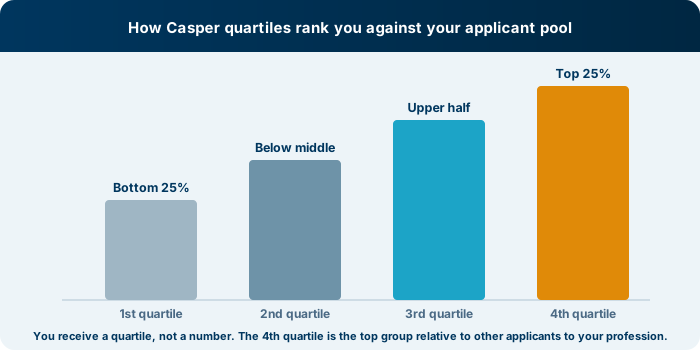
The quartiles run from bottom to top:
- 1st quartile is roughly the bottom 25 percent of applicants in your professional pool.
- 2nd quartile is the next group up, below the middle.
- 3rd quartile sits above the middle, in the upper half.
- 4th quartile is the top group, roughly the top 25 percent of applicants.
The 4th quartile is the best result you can receive. Notice what that means: your score is defined entirely by comparison to other people. You are not measured against a fixed answer key. You are ranked against the field.
How the scoring actually works, step by step
The quartile you see is the end of a longer process, and understanding the steps explains why some common worries (one harsh rater, one bad scenario, “did the grader not like me”) are mostly unfounded.
| Step | What happens | What it means for you |
|---|---|---|
| 1. Independent rating | Each scenario is scored by a different trained rater, so no single person reads your whole test | One off scenario or one strict rater cannot sink your entire result |
| 2. The 1 to 9 scale | Each response is rated on a scale, commonly described as 1 (poor) to 9 (excellent), for the quality of your reasoning | A complete, well-reasoned answer earns more than a thin or undecided one |
| 3. Standardization | Your ratings are combined and standardized against everyone who tested in your same cycle and profession | You are compared to peers, not to an absolute bar |
| 4. Quartile reporting | The standardized result is converted into one of four quartiles and sent to schools | Schools see a band, and in most cases not your underlying number |
A few implications are worth pulling out.
Multiple independent raters protect you. Because a different rater scores each scenario, no one forms a single overall impression of you, and the effect of any one tough rater is diluted across the whole test. This is a deliberate design choice meant to make the result fairer and more reliable. The practical takeaway: do not panic if you feel one scenario went badly. It is one input among many, scored by one rater among many.
The 1-to-9 ratings reward developed reasoning, not a “correct” choice. Raters are evaluating how well you reasoned, so a response that names the dilemma, weighs perspectives, commits, and addresses consequences gives them more to score highly than a vague or rushed one. This is exactly why thin, undecided answers quietly cost you, and why the DECIDE approach and typing speed matter so much.
Standardization is why your “good” is relative. Your raw ratings are not reported directly. They are standardized within your same-cycle, same-profession cohort and then expressed as a quartile. So your result depends partly on how the rest of the field performed, which is the deepest reason there is no fixed passing number.
What schools receive versus what you see
There is a subtle gap between your view of your result and what programs receive, and it is worth understanding so you set expectations correctly.
You typically see a quartile in your account: a band telling you roughly where you landed relative to your pool. What schools receive is generally that same quartile-level information rather than your precise underlying score, distributed to them through Acuity Insights after you test. In other words, neither you nor most schools are working from a granular point total; you are both working from the band. That is by design, because the test is meant to be one holistic signal of professional judgment, not a number to rank applicants to the decimal. Because the exact details of what each program receives can change, confirm specifics with Acuity Insights and with individual schools rather than assuming.
Scores do not transfer between cycles
This trips up applicants every year, so state it plainly: your Casper result is tied to a specific application cycle, and it does not carry over to a future one. Because your quartile is standardized against the people who tested in your cycle for your profession, a result from a past cycle cannot simply be reused; if you apply in a new cycle, you generally take Casper again for that cycle. The same logic applies across professions, since you are compared within your professional pool. Treat each application year as its own sitting, and plan your test date around the cycle you are actually applying in. Policies on validity and reuse are set by Acuity Insights and can change, so confirm the current rules before you assume a prior result counts.
Why there is no single passing score
Because Casper reports a quartile rather than a number, there is no universal cutoff that turns an application from weak to strong. A result that helps you at one program may matter less at another, because schools weight Casper differently within their review.
This is the most important thing to internalize. Some schools treat Casper as one input among many, alongside your GPA, your admissions test, your essays, and your experiences. Others give it real weight, especially programs that care deeply about communication and professionalism. A few use it mainly as a screen. The same quartile can carry different meaning depending on where you send it.
So the honest definition of a good Casper score is this: a higher quartile relative to other applicants, at schools that value the test. In practice, the 3rd and 4th quartiles are the range applicants we work with aim for, because they signal that your reasoning held up well against the field. The 1st and 2nd quartiles suggest there is room to sharpen how you analyze scenarios and communicate under time pressure.
How schools actually use your quartile
It helps to picture where your quartile sits in a real admissions file rather than treating it as a standalone grade.
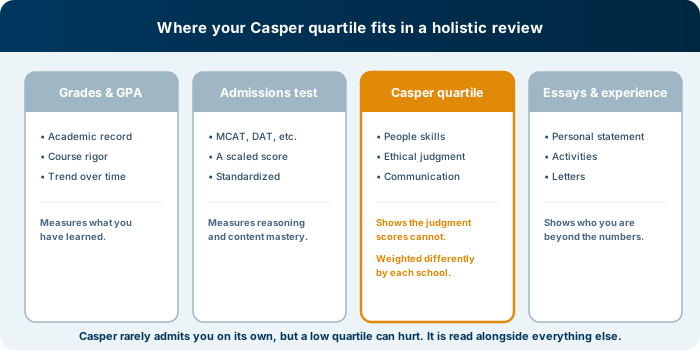
A few realities worth holding onto:
- Casper rarely admits you on its own, but a low quartile can hurt. Think of a strong quartile as removing a potential concern and adding a positive signal, not as a golden ticket. A weak quartile, on the other hand, can become the thing a committee notices.
- It is read alongside everything else. Your scenario responses are meant to surface people skills that grades and admissions-test scores cannot. That is precisely why programs added it.
- Weighting is school-specific and not always published. Do not assume. The applicants who handle this well look up each program’s stated approach rather than guessing from a forum thread.
Because the weighting varies so much, chasing a specific quartile in the abstract is the wrong frame. The right frame is: prepare so your judgment shows up clearly and consistently, then let the quartile reflect that.
Can you actually move your quartile?
Yes, and this is where Casper is more coachable than its reputation suggests. You cannot memorize answers, because there are none. But the quartile reflects skills that respond to deliberate practice: reading a scenario accurately, identifying who is affected, weighing options against clear principles, committing to a defensible action, and writing or speaking it clearly inside a tight time limit.
Applicants we work with most often lose ground for reasons that have nothing to do with their ethics. They run out of time and leave a question half-answered. They write a vague response that never commits to a decision. They consider only one perspective. They miss the actual dilemma in the scenario. Every one of those is a fixable habit, not a character flaw, which is exactly why structured preparation moves results.
The mechanics matter too. Casper is largely typed, so slow typing quietly caps your score by limiting how much reasoning you can get down in the time allowed. That is one of the simplest things to improve, and we cover it along with the rest in how to prepare for Casper.
What a low quartile does and does not mean
If you receive a 1st or 2nd quartile, it is worth understanding what that signals before you panic. It does not mean a committee decided you have bad character. The quartile reflects how your responses, as written or spoken under time, compared to the rest of the field on the specific things raters evaluate: did you identify the real issue, weigh perspectives, commit to a defensible action, and communicate clearly. A lower quartile usually means one or more of those broke down, often for mechanical reasons like running out of time or writing thin, undecided answers, rather than a flaw in who you are.
That distinction matters because it tells you the result is improvable. A common question is whether you can retake Casper to try for a better quartile. Because Casper is tied to a specific application cycle and profession, policies on retaking and on which result schools see are set by Acuity Insights and by individual programs, and they can change, so confirm the current rules directly rather than relying on secondhand advice. The more useful move, regardless of retake policy, is to treat a disappointing quartile as a diagnosis: figure out which part of your response process is failing under pressure and drill that specific weakness before you sit the test again.
What this means for your target
You cannot set a numeric goal, so set a behavioral one instead. Aim to produce, on every scenario, a response that:
- Names the real dilemma and who is affected.
- Weighs more than one perspective.
- Commits to a clear, defensible action.
- Acknowledges the likely consequences and any follow-up.
- Reads clearly and finishes inside the time limit.
Do that consistently and a strong quartile tends to follow, because that is exactly the reasoning raters are trained to reward. The repeatable way to build those responses under time is laid out in how to answer Casper scenarios, and you can rehearse on full examples in our Casper practice questions. It also helps to know which schools require Casper and which value it most, since a “good” quartile only matters at programs that weigh the test.
One last note on accuracy. Quartile boundaries and the way each program uses Casper can change between cycles, so treat any specific percentage as approximate and verify the current details with Acuity Insights. And if you are applying to medical school and also facing AAMC PREview, know that the two are scored very differently. We compare them in Casper vs. PREview, and there is a med-school-specific take in AAMC PREview vs. Casper.
A good Casper score, in the end, is not a magic number. It is a higher quartile earned by clear, consistent judgment under time pressure, at schools that value the skill. Define it that way and it becomes something you can train for.
Want feedback on your scenario responses before test day? Explore Casper prep for timed practice exams, human scoring, and written feedback.
Frequently asked questions
What is a good Casper score?
A good Casper score is a higher quartile relative to the other applicants in your professional pool. The 4th quartile is the top group, the 1st quartile is the bottom, and most schools view the 3rd and 4th quartiles as competitive. There is no single passing number, because Casper reports a quartile rather than a point score.
How is the Casper test scored?
Casper is scored by trained raters who read or watch your responses and rate the quality of your reasoning. Your individual ratings are combined and then converted into a quartile that compares you to other applicants to your profession during the same cycle.
What are Casper quartiles?
Casper results are reported in four quartiles. The 4th quartile is the top 25 percent of applicants in your pool, the 3rd is the next group down, and so on to the 1st quartile, which is the bottom 25 percent. You receive a quartile, not a numeric score.
Is the 4th quartile the best on Casper?
Yes. On Casper the 4th quartile is the highest result, representing roughly the top quarter of applicants in your professional pool. The 1st quartile is the lowest.
Do schools have a minimum Casper score?
Most schools do not publish a hard cutoff, and they weight Casper differently within their overall review. Some treat it as one of many factors, while others give it more emphasis. Check each program's stated policy with Acuity Insights or the school directly.
How many raters score your Casper test?
Each scenario is scored by a different trained rater, so across the test many independent raters contribute to your result and no single person reads your whole test. Each response is rated for the quality of your reasoning, commonly on a scale described as 1 to 9, and the ratings are combined and standardized into your quartile.
Do Casper scores transfer between application cycles?
No. Your Casper result is tied to the specific cycle and profession you tested for, because it is standardized against the other applicants who tested in that cycle. If you apply in a new cycle you generally take Casper again. Confirm the current validity and reuse rules with Acuity Insights, since policies can change.
What do schools actually see, the quartile or a number?
You generally see a quartile in your account, and schools generally receive that same quartile-level information rather than your precise underlying score. Casper is designed to be one holistic signal of professional judgment, not a granular ranking number. Verify the exact details with Acuity Insights and individual programs.
Prepping for the Casper?
Start with the Casper prep options available today, or join the update list for new releases.