
Section Strategy
How to Answer Casper Scenarios
A repeatable five-step framework for Casper scenarios: identify the dilemma, weigh perspectives, decide and justify, and acknowledge consequences, all while managing the clock.
The biggest difference between a strong Casper response and a weak one is rarely the decision itself. It is the reasoning around it. Two applicants can choose opposite actions in the same scenario and both score well, because Casper has no answer key: raters evaluate how you think, not which option you land on. That is good news, because how you think is something you can put on rails.
This article gives you a framework you can run on any scenario, plus the practical habits that keep it from falling apart under the clock. We call it the DECIDE approach, and once you have worked it through a handful of real scenarios it stops feeling like a checklist and starts feeling like instinct.
Why a framework beats improvising
Under time pressure, the worst thing you can do is invent an approach from scratch for every scenario. You burn precious seconds deciding how to think instead of thinking, and your answers come out uneven, thorough on one scenario and scattered on the next. A framework fixes that. When the structure is already in your hands, all of your attention goes to the specifics of the situation in front of you, and your responses become consistent, which is exactly what a stronger quartile reflects.
The framework below is five steps. Internalize it until it runs automatically, and it will carry both the typed and the video sections.
The DECIDE approach: a named, repeatable framework
It is easier to run a framework under pressure when it has a name and a shape you can recall in a second. We teach it as the DECIDE approach, four moves that map onto the five steps below:
| Move | What you do | Why raters reward it |
|---|---|---|
| D — Define the dilemma | Name the actual conflict and identify every stakeholder affected by it | Shows you answered the real question, not a simpler one |
| E — Examine the options | Weigh what you could do against clear ethical principles | Shows deliberation, not a reflex |
| C — Choose and justify | Commit to one concrete action and give the reason behind it | Shows decisiveness, the single biggest differentiator |
| DE — Deal with the consequences | Acknowledge the likely results and any follow-up step | Shows you think past the immediate moment |
Underneath the acronym, the work breaks into the five concrete steps that follow. Internalize the steps; use the name to recall them fast.
The five-step framework
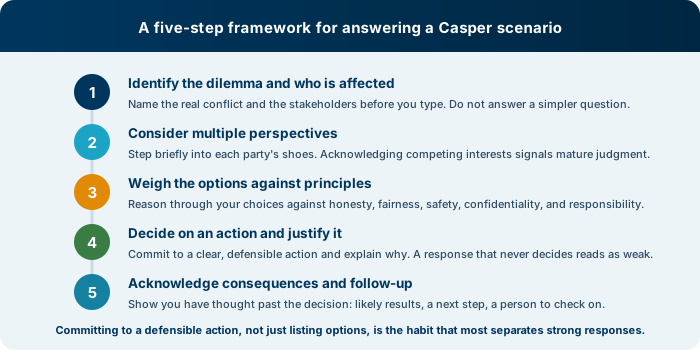
1. Identify the dilemma and who is affected. Before you type a word, name the actual conflict. What is the tension here, and who has a stake in it? Many wrong turns come from answering a simpler question than the one the scenario poses. If a friend asks you to do something that conflicts with a rule, the dilemma is not “should I help my friend.” It is the tension between loyalty and the obligation the rule protects, and the people affected include your friend, yourself, and whoever the rule exists to protect.
2. Consider multiple perspectives. Once you see the stakeholders, briefly step into their shoes. What does each party need or fear? Acknowledging competing interests is one of the clearest signals of mature judgment, and it is something rushed answers skip. You do not need a paragraph per person. A sentence that recognizes the other side’s legitimate concern does real work.
3. Weigh the options against principles. Now reason through what you could do, measured against clear principles like honesty, fairness, safety, confidentiality, and responsibility. This is where you show you are not just reacting but deliberating. Naming the principle in tension, “this protects safety but strains trust,” is far stronger than asserting a choice with no rationale.
4. Decide on an action and justify it. Commit. This is the step weak answers avoid, and it is the most important one. After weighing the options, state clearly what you would do and why. A vague response that lists possibilities without ever choosing reads as indecisive, even if every option mentioned was reasonable. The justification is what turns a decision into evidence of judgment.
5. Acknowledge consequences and follow-up. Show that you have thought past the immediate choice. What are the likely results of your action? Is there a step to take afterward, a conversation to have, a person to check on, a process to follow? This final move signals that you understand decisions have ripples, which is exactly the maturity programs are screening for.
The framework on a sample scenario
To see how this works in practice, imagine a typical prompt: you are working a group project, and you notice a teammate has copied a section of the report from another source without crediting it. The deadline is tomorrow. How would you respond?
Run the five steps. First, name the dilemma: this is a tension between protecting the integrity of the work and your loyalty to a teammate, and it affects the teammate, you and the rest of the group whose names are on the report, and the people who will rely on it. Second, consider perspectives: your teammate may have been rushed or may not have understood the rule, and they have a stake in not being blindsided, while the group has a stake in not submitting compromised work. Third, weigh against principles: honesty and academic integrity point clearly toward not letting the copied section stand, while fairness suggests giving your teammate the chance to fix it rather than going over their head first. Fourth, decide and justify: you would talk to the teammate directly, privately, explain the problem, and ask them to rewrite and properly cite the section before submission, because that protects the integrity of the work while treating your teammate with respect. Fifth, acknowledge consequences and follow-up: if they refuse or there is no time, you would not put your name on work you know is compromised, and you would raise it with the instructor; you would also check that the final version is clean before it goes in.
Notice that the strength of this answer is not the specific decision. Another applicant might escalate sooner and still score well. The strength is that it saw the real conflict, weighed more than one side, committed clearly, and thought past the moment. That is the pattern to reproduce on any scenario.
More worked scenarios with model answers
Reading one worked example is not enough to build the habit. Below are three more original scenarios, the kind you might meet in the typed or video section, each followed by a model answer and a short breakdown of why it works. These are illustrative; for current, official sample material, verify with Acuity Insights, and for a full standalone set see our Casper practice questions.
Worked scenario 1: the manager who asks you to look the other way (typed)
You work part-time at a pharmacy. Your shift manager, who writes your reference letter, tells you to ring up a personal item for a regular customer at the deeply discounted employee price as a favor. The customer is standing right there. What do you do, and why?
Model answer. The conflict here is between staying on good terms with a manager who controls my reference and following the store’s policy, which exists to treat all customers fairly and to protect the business. The people affected are the manager, the customer, me, and the store, plus every other customer who pays full price. I would not ring up the item at the employee discount, because applying a discount the customer is not entitled to is a small dishonesty that I would be the one entering into the system under my own login. I would handle it without embarrassing anyone: I would quietly tell the manager I am not comfortable applying the employee price to a customer’s purchase and offer to check whether any legitimate promotion or loyalty discount applies instead. If the manager insisted, I would still decline and, if it kept happening, raise it privately with a higher manager, because a pattern of unauthorized discounts is a real problem for the store. I would also recognize that my manager may simply be trying to be kind to a loyal customer, so I would keep my tone respectful rather than accusatory.
Why it works. It defines the real dilemma (loyalty and a reference versus honesty and fair treatment) and names every stakeholder, including the easy-to-miss “other customers.” It examines the option of just complying and rejects it on a stated principle. It chooses a concrete action and justifies it, then deals with consequences by describing a graceful way to decline and a follow-up if the pressure continues. Crucially, it extends good faith to the manager rather than moralizing, which signals maturity.
Worked scenario 2: the upset patient and the receptionist (video)
Imagine you are volunteering at a clinic front desk. An elderly patient who has been waiting two hours becomes visibly upset and raises their voice at the receptionist, saying they were forgotten. The receptionist looks overwhelmed. You have about a minute. How would you respond?
Model answer (spoken). The tension here is between the patient, who feels ignored and may be anxious or in discomfort, and the receptionist, who is overwhelmed and being shouted at in front of others. Both deserve to be treated with respect. First, I would step in calmly to take some pressure off the receptionist and turn to the patient, acknowledge that a two-hour wait is genuinely frustrating, and apologize for it without making excuses. I would not dismiss their feelings or tell them to calm down, because that usually escalates things. Then I would do something concrete: I would offer to check on their place in line or find someone who can give them a real update, and make sure they have a place to sit and water if they need it. Afterward, I would quietly check that the receptionist is okay, and if this kind of backlog is a recurring problem, I would mention it to a supervisor so the clinic can look at the wait-time process, because the patient’s anger is really a signal that the system failed them, not just a bad mood.
Why it works. In a single spoken minute it still hits every move: it defines the dilemma and names both stakeholders, it chooses a clear action (de-escalate, acknowledge, then take a concrete step), and it deals with consequences by checking on the receptionist and flagging a systemic fix. It reframes the patient’s anger as a process failure rather than a character problem, which is exactly the kind of perspective-taking raters reward. Notice it is concise: no wasted words, because a minute is short.
Worked scenario 3: the friend, the exam, and the group chat (typed)
A close friend in your program messages you privately to say they have a copy of the questions for tomorrow’s exam that someone leaked in a group chat. They offer to send them to you. Several classmates already have them. What do you do?
Model answer. This is a conflict between loyalty to a friend, the temptation of an unfair advantage, and academic integrity, and it affects me, my friend, the classmates who have the leaked questions, the instructor, and every student who will be graded on the same curve without cheating. I would not accept the leaked questions, because using them would be dishonest and would unfairly disadvantage classmates who studied properly, and because an exam I “passed” that way would not reflect what I actually know, which matters in a health-professions program where competence is the point. I would tell my friend directly that I am not going to look at them and gently encourage them not to use them either, framing it as protecting both of us rather than judging them. The harder question is whether to report the leak. Because it is widespread and undermines the fairness of the exam for everyone, I would inform the instructor or exam coordinator that the questions have circulated, so they can decide whether to swap the exam, even though that is uncomfortable and may strain a friendship. I would focus my report on the leak itself rather than on naming individuals, since the priority is restoring a fair exam, and I would still be there for my friend as a person afterward.
Why it works. It defines a genuinely hard dilemma and refuses to pretend it is easy, naming the cost (a strained friendship) honestly. It chooses a defensible action on a clear principle, fairness to all students and the integrity of a competence-based program, and it justifies the uncomfortable decision to escalate by explaining why this case is different from a one-off. It also deals with consequences with care: report the leak, not the people, and preserve the friendship outside the issue. Another applicant might decide differently about reporting and still score well if they reasoned it through as carefully; what matters is the visible deliberation, not the verdict.
Across all three, the same shape repeats: name the conflict and everyone in it, weigh options against a principle, commit, and handle the fallout. Reproduce that shape and your judgment comes through no matter how unfamiliar the situation.
Run the framework against the clock
The framework only helps if you can execute it inside the time limit. A few habits make that possible.
Spend the first moments reading, not typing. It is tempting to start writing immediately, but ten or fifteen seconds spent actually understanding the scenario prevents the worst error, answering the wrong question. Find the dilemma first.
Give every question its share of the time. In the typed section you get 3.5 minutes for two questions. The classic failure is pouring most of it into a polished first answer and leaving the second half-done. A complete response across both beats a beautiful answer to one and silence on the other.
Write clearly and plainly. This is not an essay contest. Short, direct sentences that move through the framework are easier for a rater to follow and faster for you to produce than ornate prose. Clarity is the goal, not eloquence.
In the video section, take a beat before speaking. With about a minute to talk, a brief pause to organize your answer is worth more than rushing into the first sentence. Hit the dilemma, name a perspective, decide, and note a consequence. The same framework, spoken concisely.
Common traps to avoid
Even with a framework, a few patterns reliably cost applicants we work with:
- Never deciding. Listing options without committing is the single most common weakness. Always land on an action.
- Seeing only one side. Tunnel vision on one stakeholder signals immature judgment. Name at least one competing interest.
- Going generic. A rehearsed, one-size-fits-all answer that ignores the specifics of the scenario reads as hollow. Respond to this situation, not a template.
- Moralizing instead of reasoning. Declaring something “wrong” without explaining the principle behind it is weaker than walking through why.
- Running out of time. A strong incomplete answer still loses points it did not have to. Pace deliberately.
Practice the framework, do not just read it
Knowing the framework and executing it under pressure are different skills. The only way to close that gap is timed practice: run the five steps on realistic scenarios, against the clock, then reread your responses and check whether each one named the dilemma, weighed perspectives, committed to an action, and acknowledged consequences. That review is where the framework becomes automatic. We lay out the full practice plan in how to prepare for Casper, and use realistic, current scenarios, verifying any sample material with Acuity Insights. The complete method, with many worked weak-versus-strong answers, is free to read in our Casper study guide.
If you are also preparing for medical school and facing AAMC PREview, be careful not to let the formats bleed together: PREview asks you to rate responses rather than build your own, which is a different task. The two are compared directly in Casper vs. PREview, with the med-school view in AAMC PREview vs. Casper.
Before test day, it also helps to know the practical context around the exam: which schools require Casper, what a good Casper score actually looks like, and what the test costs to sit and distribute. Getting the logistics settled early frees you to spend your energy on the reasoning.
Run the same five steps on every scenario, commit to a defensible action, and keep an eye on the clock. Do that consistently and your judgment comes through clearly, which is all Casper is really asking for. Explore Casper prep for guided scenario drills and response feedback.
Frequently asked questions
How do you answer Casper questions?
Use a repeatable framework. We call ours the DECIDE approach: Define the dilemma and who is affected, Examine the options against clear ethical principles, Choose a concrete action and justify it, and Deal with the likely consequences and any follow-up. Write clearly and manage the clock so every part of the scenario gets answered.
What is the best framework for Casper scenarios?
A simple four-move framework works on almost any scenario: define the dilemma and the stakeholders, examine your options against principles like honesty, fairness, safety, and confidentiality, choose and justify one defensible action, and deal with the consequences and follow-up. Practicing the same structure on many scenarios is what makes it automatic under time pressure.
What should a good Casper answer include?
A strong Casper answer names the real conflict, recognizes the stakeholders and their competing interests, commits to a clear and defensible course of action with a reason, and shows awareness of consequences. Vague answers that never decide tend to score lower than answers that commit and justify.
Should I always pick the most ethical option on Casper?
There is rarely a single correct option. Raters care less about which choice you make and more about how you reason: whether you saw the real dilemma, weighed perspectives, and justified a defensible action. Two different decisions can both score well if both are well reasoned.
How do I manage time on Casper scenarios?
In the typed section you get 3.5 minutes for two questions, so give each question its share of the time rather than perfecting the first and leaving the second blank. A complete response across both beats a polished answer to one.
Do I need a healthcare background to answer Casper scenarios?
No. Many Casper scenarios are everyday situations rather than clinical ones, and they are designed so that anyone can respond. What is tested is your judgment and communication, not specialized knowledge.
Prepping for the Casper?
Start with the Casper prep options available today, or join the update list for new releases.